To save content items to your account,
please confirm that you agree to abide by our usage policies.
If this is the first time you use this feature, you will be asked to authorise Cambridge Core to connect with your account.
Find out more about saving content to .
To save content items to your Kindle, first ensure no-reply@cambridge.org
is added to your Approved Personal Document E-mail List under your Personal Document Settings
on the Manage Your Content and Devices page of your Amazon account. Then enter the ‘name’ part
of your Kindle email address below.
Find out more about saving to your Kindle.
Note you can select to save to either the @free.kindle.com or @kindle.com variations.
‘@free.kindle.com’ emails are free but can only be saved to your device when it is connected to wi-fi.
‘@kindle.com’ emails can be delivered even when you are not connected to wi-fi, but note that service fees apply.
This paper presents a probability model of an energy-harvesting wireless sensor node, with the objective of linking quality of sensed data to energy consumption and self-sustainability. The model departs from the common energy discretization framework used in the literature, and instead uses a diffusion process modulated by discrete packet arrival and transmission processes for the detailed representation of renewable energy supply, consumption and storage. An analytical–numerical method is developed to compute the average time until the node experiences an outage, due to lack of energy, for a given workload and ambient energy characteristics, battery capacity and initial charge. The results are illustrated with numerical examples.
Direct photoelectrochemical water splitting offers several advantages over PV-powered electrolysis and may become the technology of choice in the future. However, significant R&D efforts and breakthroughs are needed to accomplish this goal.
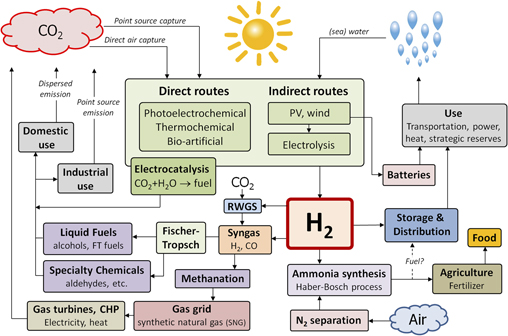
The sustainable production of hydrogen would be an important first step for both powering fuel cells and for enabling large-scale and technologically mature gas phase processes to reduce CO2 and nitrogen to get desired products. Specifically, the central challenge is to produce hydrogen from water using sunlight. Photovoltaics and wind-powered electrolysis are likely to be the technology of choice to produce renewable hydrogen for the next few decades. However, the integration of light absorption and catalysis in ‘direct’ photoelectrolysis routes offers several advantages, such as lower current densities and better heat management, and may become technologically relevant in the second half of this century. This article discusses the research and development efforts and needed breakthroughs to achieve this goal. New chemically stable semiconductors with a band gap between 1.5 and 2.0 eV and long carrier lifetimes are urgently needed to make efficient tandem devices. Scale-up of these research level devices beyond a few cm2 introduces mass transport limitations that require creative electrochemical engineering solutions. Last but not least, standardized methods for measuring efficiencies and stabilities need to be implemented and should lead to official benchmarking and certification laboratories to guide commercial scale up efforts.
The use of in situ formed protective layer on conversion cathodes was introduced as a cheap and simple strategy to shield these materials from undesirable interactions with liquid electrolytes.
Conversion-type cathodes have been viewed as promising candidates to replace Ni- and Co-based intercalation-type cathodes for next-generation lithium (Li) and Li-ion batteries with higher specific energy, lower cost, and potentially longer cycle life. Typically, in conversion reactions two or three Li ions may be stored per just one atom of chalcogen (e.g., S or Se) or transition metal (e.g., Fe or Cu used in halides). Unfortunately, in conversion chemistries the active materials or intermediate charge/discharge products suffer from various unfavorable interactions and dissolution in organic electrolytes. In this mini-review article, we discuss the current interfacial challenges and focus on the protective layers in situ formed on the cathode surface to effectively shield conversion materials from undesirable interactions with liquid electrolytes. We further explore the mechanisms and current progress of forming such protective layers by using various salts, solvents, and additives together with the insight from molecular modeling. Finally, we discuss future opportunities and perspectives of in situ surface protection.
Lessons from the pharmaceutical industry’s commercialization successes can be identified and applied to the U.S. battery industry to potentially improve its discouragingly low startup success rates.
A carbon-neutral and sustainable society of the future necessitates the widespread use of battery technologies that are efficient, effective, and economical. Lower-cost and more energy-dense battery technology can help solve many of our energy challenges, such as balancing the intermittency problems of renewables and making possible electric transportation fleets. New advanced materials are crucial to such battery advances. However, bringing advanced energy materials to market in the United States remains a formidable challenge. Hurdles include high upfront capital requirements, long timelines to success, and few opportunities for technology risk-reduction. Such challenges impede startups from developing financially viable technologies. Consequently, recent advances in battery performance have come from incremental changes implemented by large companies. By contrast, the pharmaceutical industry has many similar technical challenges, yet has an established pipeline of U.S. startup successes. We review and compare the current market structures of battery and pharma innovation. We propose an updated model of U.S. battery commercialization, informed by the pharma model’s successes. The new approach’s benefits and potential pitfalls are discussed. We provide recommendations for entrepreneurs, investors, manufacturers, and policy makers to improve the battery innovation ecosystem. We hope that these ideas spur the battery community to more successfully commercialize and deploy transformative technologies.
It’s hard to beat the energy density and convenience of liquid hydrocarbons. The product of energy used and journey time is another way to compare transportation systems. It is more practical to power electric cars from batteries than photovoltaics. Solar can be used to supply some of the energy needed to recharge the batteries. The primary energy used to make food, the fuel for the human cyclist, can be many times the calorific energy derived from the food.
Transportation is a major source of carbon dioxide emissions. Hermans makes some excellent points in his article “The challenge of energy-efficient transportation.” However primary energy to produce fuel should also be considered. The embodied energy of liquid hydrocarbon fuels is much less than their energy content. For a cyclist the fuel is food, and, depending on diet, the primary energy can be many times the food’s calorific energy. The article is over optimistic on the prospect of cars directly powered by solar photovoltaics. It’s more realistic to use batteries in electric cars and generate the electricity from a number of sources. For anything other than trains that run on fixed tracks it’s hard to beat the energy density and convenience of liquid hydrocarbons.
As materials science is becoming components development and systems technology, hydrogen economy is approaching your porch. Welcome!
Hydrogen mobility can now be purchased from the shelf. Fuel cell electric vehicles from various well-known car manufacturers are now available. The number of hydrogen filling stations in Europe is increasing at a rate that long-distance tours become less and less adventurous. The efforts of fuel cell researchers have paid off. Suppliers of components and systems for hydrogen infrastructure are anticipating business. Meanwhile, basic science in electrochemistry and materials research is continuing, with surprises such as the discovery of a proton polaron which are adding to the progress in fundamental understanding of energy materials in operation. Has the long awaited hydrogen economy finally arrived?
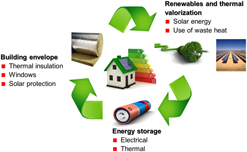
This manuscript provides a bird’s eye view on energy in buildings. We discuss how energy policy leads to building standards that affect innovation in the building sector. We review current and future materials and solutions for the building envelope (insulation and glazing), renewable energy generation and energy storage, and demonstrate how the integration of buildings into district networks mitigates problems arising from a building’s, and its users’, dynamic behavior.
Buildings account for ∼40% of global energy demands, and the increased adoption of innovative solutions for buildings represents an enormous potential to reduce energy demands and greenhouse gas emissions. Here, we critically review the current and future materials and solutions for the construction sector. We describe how policy affects innovative businesses and the adoption of new products and solutions. We investigate how the building envelope and user behavior determine building energy demands. Compared to conventional solutions, superinsulation materials (vacuum insulation panels, silica aerogel) can achieve the same thermal performance with drastically thinner insulation. With low-emissivity coatings and appropriate filler gasses, double and triple glazing reduces thermal losses by an order of magnitude. Vacuum and aerogel glazing reduce these even further. Switchable glazing solutions maximize solar gains during wintertime and minimize illumination demands whilst avoiding overheating in summer. Upon integration of renewable energy systems, buildings become both producers and consumers of energy. Combined with the dynamic user behavior, temporal variations in energy production require thermal and electrical storage and the integration of buildings into smart grids and energy district networks. The combination of these measures can reduce the energy consumption of the building’s stock by a factor of three.
Sustainable, carbon-free methods of large-scale hydrogen production are urgently needed to support industrial processes while decreasing carbon dioxide emissions. The realities of product development timelines dictate that existing commercial technologies such as low-temperature electrolysis will have to serve the majority of this need for at least the next 20 years. At the same time, even a cursory understanding of device design principles and real-world constraints can help to inform basic research. Accelerating the impact from fundamental material discoveries in related technologies therefore requires improved collaboration between academic, government, and industry sectors.
Renewable hydrogen is a key component to global decarbonization and reduction in carbon dioxide emissions. A common misconception is that the need for greener sources of hydrogen is dependent on whether fuel cell vehicles significantly penetrate the automotive market. However, hydrogen is a critical feedstock for many industrial processes, with an annual demand of 65 million metric tons globally. The large majority of this hydrogen is made via steam methane reforming, which represents the major carbon dioxide contribution for industrial processes such as ammonia production. Sustainable manufacturing of hydrocarbons also requires a sustainable source of hydrogen. Deep decarbonization and meeting 80% reduction targets for carbon dioxide emissions thus requires carbon-free sources of hydrogen. Based on the technology readiness levels, the reality is that existing commercial technologies will dominate the market for the next 20 years and beyond. To accelerate the impact of fundamental work in long-term technologies, improved collaboration between researchers across academic, government, and industry sectors is essential, to inform basic research as well as to leverage technology breakthroughs in the near term.
The efficiencies of present-day modes of transportation are reviewed. Future sustainable options are discussed.
Transportation takes about 20% of the energy use worldwide [1], and this figure is likely to increase. The fact that transportation requires some form of mobile energy storage makes this topic especially challenging for the post-fossil-fuel era. When looking at alternatives, we should realize that nothing matches the energy density of liquid fuels like gasoline or diesel, if the system as a whole is considered. It is, therefore, important to consider the efficiency of various modes of transportation. To assess the possibilities of improvements in efficiency, a brief introduction into the physics of transportation is given first. Subsequently, the efficiencies of present-day modes of transportation—cars, buses, trains, air transport, and bicycles—are reviewed. Finally, new technologies relying on biofuel, electricity, solar power, and hydrogen are discussed.
Nuclear power is a crucial source of clean energy for India. In the near-term, India is focusing on thermal reactors using natural and enriched uranium. In the long-term, India is exploring various options to use its large thorium reserves.
India’s present nuclear installed capacity is 5680 MW, which contributes to about 3.4% of the annual electricity generation. However, nuclear power is an important source of energy in India’s aspirations for energy security and also in achieving its Intended Nationally Determined Contributions (INDC), of 40% fossil free electricity, by 2030. India has limited uranium reserves, but abundant thorium reserves. The Nuclear Suppliers Group (NSG) lifted restrictions on trade with India, in 2008, enabling India to import uranium (natural and enriched) and nuclear reactors. In the near–term (2030), the nuclear capacity could increase to about 42,000 MW. This would be from a combination of domestic Pressurized Heavy Water Reactors (PHWR) and imported Pressurized Water Reactors (PWR). For the long–term (2050), India is exploring various options for utilising its vast thorium reserves. This includes Advanced Heavy Water Reactor and Molten Salt Breeder Reactor. However, generating public acceptance will be crucial to the expansion of the nuclear power program.
Current performance of Mg battery cathode is reviewed. Perspective for research in this field is provided and discussed.
Mg battery has recently gathered more and more interest as a high energy density replacement of current Li-ion battery. Significant progress has been made in developing sustainable anode and novel electrolyte. However, the success of Mg battery still high demands the search of cathode material with high energy density, good rate capability, and nice cyclability. This current review focuses on the development of Mg battery cathode in the past 15 years. A detailed review about the performance and limitations of reported cathode material is provided. A perspective for this area is discussed with insights for future research direction. Three important areas that must be explored in this field in near future are suggested: the investigation of high capacity cathode, the study of hybrid ion battery, and deeper understanding about the magnesiation chemistry of the cathode.
This paper reviews existing literature to assess the consensus of the scientific and engineering communities concerning the potential for the United States’ light-duty transportation sector to meet a goal of 80% reduction in vehicle emissions and examine what it will take to meet this target.
Climate change is a problem that must be solved. The primary cause of this problem is burning of fossil fuels to generate energy. A dramatic reduction in carbon emissions must happen soon, and a significant fraction of this reduction must come from the transportation sector. This paper reviews existing literature to assess the consensus of the scientific and engineering communities concerning the potential for the United States' light-duty transportation sector to meet a goal of 80% reduction in vehicle emissions and examine what it will take to meet this target. It is unlikely that reducing energy consumption in just vehicles with gasoline-based internal combustion drivetrains will be sufficient to meet GHG emission-reduction targets. This paper explores what additional benefits are possible through the adoption of alternative energy sources, looking at three possible on-vehicle energy carriers: carbon-based fuels, hydrogen, and batteries.
The desire of the international community to balance global economic growth against concerns of accelerated CO2emissions has brought solar technologies into the forefront for meeting increasing energy demands. This manuscript discusses the historical and potential future roles for small-to-medium scale solar thermal technologies in addressing the challenge of leveling energy access standards across countries with widely variable economic resources and consumer needs.
Access to modern energy services, such as heating for water, pumping for agricultural irrigation or potable water sources, and an on-demand 24/7 electrical grid, is central to provision of high quality social services, economic growth, and improved quality of life; however, over 1 billion people remain unelectrified globally. Enabling the projected growth in energy demands without relying on fossil fuels requires consideration of the viability of renewable energy technologies to serve these markets; this manuscript provides a discussion of the role of solar thermal energy systems in this capacity. A survey of systems under 1 MW capacity reported in the literature (academic and commercial) was conducted, with projects aggregated by service type (heat, cooling, electricity, or multi-) in the database provided as an appendix to this manuscript. In general, many hardware configurations have been explored, with economics driven substantially by supply chain pricing, and no clear winner has emerged. Process heat applications demonstrate economic competitiveness over a wide range of commercial applications; however, early explorations into power generation—or co/tri-generation configurations—provide indications that such technologies, while not expected to reach grid-parity tariffs, may in fact provide the most economical pathway to energy delivery in the currently most underserved communities.
There are lessons from recent history of technology introductions which should not be forgotten when considering alternative energy technologies for carbon dioxide emission reductions.
The growth of the ecological footprint of a human population about to increase from 7B now to 9B in 2050 raises serious concerns about how to live both more efficiently and with less permanent impacts on the finite world. One present focus is the future of our climate, where the level of concern has prompted actions across the world in mitigation of the emissions of CO2. An examination of successful and failed introductions of technology over the last 200 years generates several lessons that should be kept in mind as we proceed to 80% decarbonize the world economy by 2050. I will argue that all the actions taken together until now to reduce our emissions of carbon dioxide will not achieve a serious reduction, and in some cases, they will actually make matters worse. In practice, the scale and the different specific engineering challenges of the decarbonization project are without precedent in human history. This means that any new technology introductions need to be able to meet the huge implied capabilities. An altogether more sophisticated public debate is urgently needed on appropriate actions that (i) considers the full range of threats to humanity, and (ii) weighs more carefully both the upsides and downsides of taking any action, and of not taking that action.
This paper presents, through text and the design project ‘The Silt House’, an alternative architecture for flood landscapes.
The investigation sets out the context for current forms of infrastructure and architecture planned in response to the increased threat of flooding in and around the Thames Estuary. In particular, it looks to certain experimental flood defence systems, suggesting, that instead of building bigger and bigger sea walls, we should look to use the landscape as a hybrid landscape infrastructure where salt marshes can act as a storage point for excess water and the flora can dispel energy from flood tides. Within this context, the text and design work seek to address the questions: what formal and spatial logics might be appropriate for architecture if sited in such a hybridised landscape like the tidal marsh; and, how might these logics mirror the particular conditions of this new model of infrastructure?
To help answer this question, the work looks to the architect and poet Raimund Abraham and, in particular, his 10 Houses projects developed between 1970 and 1973 for an alternative architectural model that uses natural processes to create enclosure and define architectural space. The design project seeks to explore how the direct use of such a historical reference can itself be seen as a means to not only develop an architecture that demonstrates a symbiotic relationship between nature and architecture, but also between the social and the political.
Access to affordable and reliable energy has been a cornerstone of the world’s increasing prosperity and economic growth since the beginning of the Industrial Revolution. Our use of energy in the 21st century must also be sustainable. This article provides a techno-economic snapshot of the current energy landscape and identifies several research and development opportunities and challenges, especially where they relate to materials science and engineering, to create the foundation for this new industrial revolution.
Over the next few decades, the challenge of water scarcity is expected to grow more acute as water demands from the power generation, agriculture, industrial, and municipal sectors all increase. Energy production requires copious amounts of water, with the volume of water used by power generation ranking second only to that used for agriculture. This article reviews options for managing the water requirements associated with power generation. Although the effects of both existing and emerging modes of power generation on water use trends are explored, the primary focus is on thermal systems, which account for the majority of existing capacity.