




No CrossRef data available.
Article contents
Does all teaching rest on evolved traits?
Published online by Cambridge University Press: 08 June 2015
Abstract
Classification schemes are useful when they elucidate common underlying mechanisms, bring together diverse examples, or illustrate gaps in knowledge for empirical investigation. Kline's scheme merges different approaches, but is orthogonal to existing schemes and overemphasizes evolved specializations, potentially at the detriment of clarifying teaching processes. Focus on underlying mechanisms, what is learned, and consequences for information transfer may provide additional utility.
Information
- Type
- Open Peer Commentary
- Information
- Copyright
- Copyright © Cambridge University Press 2015
References
Caro, T. M. & Hauser, M. D. (1992) Is there teaching in nonhuman animals?
The Quarterly Review of Biology
67(2):151–74. Available at: http://www.jstor.org/stable/10.2307/2831436
Google Scholar
Coolen, I., van Bergen, Y., Day, R. L. & Laland, K. N. (2003) Species difference in adaptive use of public information in sticklebacks. Proceedings of the Royal Society of London B
270:2413–19.CrossRefGoogle ScholarPubMed
Csibra, G. & Gergely, G. (2009) Natural pedagogy. Trends in Cognitive Sciences
13(4):148–53.Google Scholar
Danchin, E., Giraldeau, L.-A., Valone, T. J. & Wagner, R. H. (2004) Public information: From nosy neighbors to cultural evolution. Science
305:487–91.CrossRefGoogle ScholarPubMed
Dawson, E. H., Avarguès-Weber, A., Chittka, L. & Leadbeater, E. (2013) Learning by observation emerges from simple associations in an insect model. Current Biology
23:727–30.Google Scholar
de Kort, S. R. & Clayton, N. S. (2006) An evolutionary perspective on caching by corvids. Proceedings of the Royal Society of London B
273:417–23.Google Scholar
Feldon, D. F., Peugh, J., Timmerman, B. E., Maher, M. A., Hurst, M., Strickland, D., Gilmore, J. A. & Stiegelmeyer, C. (2011) Graduate students' teaching experiences improve their methodological research skills. Science
333:1037–39.Google Scholar
Franks, N. & Richardson, T. (2006) Teaching in tandem-running ants. Nature
439(7073):153.Google Scholar
Grüter, C. & Leadbeater, E. (2014) Insights from insects about adaptive social information use. Trends in Ecology and Evolution
29:177–84.Google Scholar
Heyes, C. M. (1994) Social learning in animals: Categories and mechanisms. Biological Reviews of the Cambridge Philosophical Society
69(2):207–231.Google Scholar
Heyes, C. M. (2012a) Grist and mills: On the cultural origins of cultural learning. Philosophical Transactions of the Royal Society B
367:2181–91.CrossRefGoogle ScholarPubMed
Heyes, C. M. (2012b) What's social about social learning?
Journal of Comparative Psychology
126:193–202.CrossRefGoogle ScholarPubMed
Hoppitt, W. J. E., Brown, G. R., Kendal, R., Rendell, L., Thornton, A., Webster, M. M. & Laland, K. N. (2008) Lessons from animal teaching. Trends in Ecology and Evolution
23(9):486–93. doi:10.1016/j.tree.2008.05.008.CrossRefGoogle ScholarPubMed
Kleindorfer, S., Hoi, H., Evans, C., Mahr, K., Robertson, J., Hauber, M. E. & Colombelli-Négrel, D. (2014) The cost of teaching embryos in superb fairy-wrens. Behavioral Ecology
25:1131–35.CrossRefGoogle Scholar
Komdeur, J. (1996) Influence of helping and breeding experience on reproductive performance in the Seychelles warbler: A translocation experiment. Behavioral Ecology
7:326–33.Google Scholar
Lindeyer, C. M., Meaney, M. J. & Reader, S. M. (2013) Early maternal care predicts reliance on social learning about food in adult rats. Developmental Psychobiology
55:168–75.Google Scholar
Reader, S. M. (2014) Experiential effects on mirror systems and social learning: Implications for social intelligence. Behavioral and Brain Sciences
37(2):217–18.Google Scholar
Richardson, T. O., Houston, A. I. & Franks, N. R. (2007) Teaching with evaluation in ants. Current Biology
17:1520–26.Google Scholar
Seppänen, J.-T., Forsman, J. T., Mönkkönen, M. & Thomson, R. L. (2007) Social information use is a process across time, space, and ecology, reaching heterospecifics. Ecology
88:1622–33.Google Scholar
Thornton, A. & Raihani, N. (2008) The evolution of teaching. Animal Behaviour
75(6):1823–36. doi:10.1016/j.anbehav.2007.12.014
CrossRefGoogle Scholar
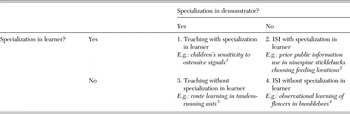
Table 1. Classification of social learning instances according to whether the individual learned from (the “demonstrator”) or the learner (the “observer”) show specializations in behavior.
Kline provides a new and adaptationist taxonomy of different types of teaching that aims to unite fields of research. Kline bases this categorization not on underlying processes or on consequences for cultural transmission, but instead on the adaptive problem that each type of teaching is proposed to solve. There is clear utility in combining knowledge from different approaches to teaching, and the new taxonomy usefully explores how teaching can result from both simple and complex processes. It also clarifies what precise knowledge or opportunities pupils lack. However, over-categorization without appropriate support risks suggesting that we understand more about underlying processes than we do, stifling investigation: a criticism already leveled at social learning taxonomies (Heyes Reference Heyes1994).
Multiple mechanisms may solve the same adaptive problem and multiple adaptive problems may be solved by a single mechanism (de Kort & Clayton Reference de Kort and Clayton2006); therefore, adaptive-problem-based categorizations will not necessarily match underlying mechanisms. However, Kline often links adaptive problems (themselves notoriously awkward to define) to underlying mechanisms, and her categories are not mutually exclusive, meaning that the new and existing schemes overlap uncomfortably. Rather than adding new categories of teaching, we may do better by incorporating classifications into existing schemes (see e.g., Hoppitt et al. Reference Hoppitt, Brown, Kendal, Rendell, Thornton, Webster and Laland2008). For example, bringing together individual learning and social learning classifications suggested the possibility of undiscovered social learning processes (Heyes Reference Heyes1994).
Evolved specializations are core to Kline's definition of teaching (“behavior that evolved to facilitate learning in others”; target article, sect. 3, para. 1). We feel that this definition is overly restrictive, more restrictive than definitions used by scholars of the evolution of teaching (Caro & Hauser Reference Caro and Hauser1992; Thornton & Raihani Reference Thornton and Raihani2008), and potentially unappealing to researchers whose focus is not on evolutionary processes. We prefer simply “specialization” (see our Table 1), which emphasizes that teaching processes, like other social learning processes (Heyes Reference Heyes2012a; Reader Reference Reader2014), could be the result of genetic evolution, cultural evolution, changes within the lifetime of an individual, or interactions between these processes. For example, it is plausible that adult humans may independently develop behavior patterns that fit current functionalist criteria of at least simple modes of teaching. Much teaching may involve a mixture of evolved adaptations for teaching, evolved exaptations that facilitate the development of teaching, and experiential and culturally transmitted effects.
Classification of social learning instances according to whether the individual learned from (the “demonstrator”) or the learner (the “observer”) show specializations in behavior.
Note: Teaching occurs in cases 1 and 3, inadvertent social information use (ISI; (Danchin et al. Reference Danchin, Giraldeau, Valone and Wagner2004) in cases 2 and 4. We use the term “specialization” to underscore that teaching could result from both evolutionary and developmental processes, or from interactions between these processes. In italics we include possible examples, categorizing them according to current evidence. Future work may reveal specialization in learners, for example, bumblebees may preferentially learn about social cues over asocial ones. (1: Csibra & Gergely Reference Csibra and Gergely2009; 2: Coolen et al. Reference Coolen, van Bergen, Day and Laland2003; 3: Franks & Richardson Reference Franks and Richardson2006; 4: Dawson et al. Reference Dawson, Avarguès-Weber, Chittka and Leadbeater2013.)
Table 1 also emphasizes that all social learning, including teaching, could be subdivided according to observer specialization. In tandem-running ants, for example, the learners do not appear to be specialized to promote their own learning, whereas children appear to manifest multiple specializations that promote their learning during teaching (Csibra & Gergely Reference Csibra and Gergely2009; Franks & Richardson Reference Franks and Richardson2006). Similarly, learners may or may not show specializations to take advantage of inadvertent social information. Ninespine but not threespine sticklebacks use public information to learn from others, data consistent with a specialized ability having evolved in ninespine sticklebacks (Coolen et al. Reference Coolen, van Bergen, Day and Laland2003). In contrast, growing disquiet questions the idea that all social information use rests on adaptive specializations (Heyes Reference Heyes2012b). Recent data show that bees can be trained to approach or avoid conspecific-marked flowers through simple associative learning, just as they might learn the value of an asocial cue (Dawson et al. Reference Dawson, Avarguès-Weber, Chittka and Leadbeater2013). Thus, at least prior to training, the bees are not specialized to utilize this social information. These data are consistent with the idea that social learning tendencies may emerge as the result of within-lifetime experience rather than adaptive specializations (Lindeyer et al. Reference Lindeyer, Meaney and Reader2013).
Present classification schemes do not stress distinctions on the basis of observer specializations (i.e., dividing case 1 from 3 or 2 from 4 in our Table 1). Observer specializations are important, not least because specializations may allow inferences to be made on the costs and benefits relevant to a particular learning process. Moreover, some teaching may require observer specializations, that is, demonstrator–observer co-adaptation. However, specialized observers may be more open to exploitation and deceit (Kline's “pupil as skeptic”), potentially prompting the development of countermeasures.
Estimating the costs and benefits of teaching and social learning is complicated by the numerous direct and indirect payoffs potentially involved. For example, learning from others may carry competitive costs (Seppänen et al. Reference Seppänen, Forsman, Mönkkönen and Thomson2007), but provide benefits from joint action, group cohesion, or safety-in-numbers when all perform the same act. As Grüter and Leadbeater (Reference Grüter and Leadbeater2014) note, high relatedness does not necessarily favor the development of high-efficacy social learning, since highly related groups may benefit from sharing the rewards of individual, independent exploration. Direct benefits may be also diverse and unexpected. In humans, for example, graduate students who teach improve their research skills (Feldon et al. Reference Feldon, Peugh, Timmerman, Maher, Hurst, Strickland, Gilmore and Stiegelmeyer2011), thus gaining a delayed benefit rather like the superior parenting skills some cooperative helpers can acquire (Komdeur Reference Komdeur1996). Sensitivity to the costs and benefits of teaching is expected, particularly when payoffs are variable, and evidence from several taxa suggests that teachers are indeed sensitive to costs. For example, ants abandon tandem running more quickly when teaching costs increase (Richardson et al. Reference Richardson, Houston and Franks2007) and superb fairy wrens trade calling at the nest against predation risk (Kleindorfer et al. Reference Kleindorfer, Hoi, Evans, Mahr, Robertson, Hauber and Colombelli-Négrel2014).
Much theory from the study of social learning, cooperation, and communication applies to teaching, although teaching also has distinctive qualities and therefore “teaching” is a useful category (Hoppitt et al. Reference Hoppitt, Brown, Kendal, Rendell, Thornton, Webster and Laland2008). Subdividing teaching is more challenging. Ideally we would determine the correspondence between different categories of teaching, their underlying mechanisms, and their consequences for information transmission. For example, we might demarcate teaching processes based on the neurocognitive mechanisms involved, and determine whether these mechanisms differ in the fidelity of social transmission achieved and the kind and generalizability of the information transmitted. Definitions and distinctions are important, but require concrete grounding to maximize productive debate.
ACKNOWLEDGMENTS
We gratefully acknowledge funding by Utrecht and McGill Universities, the Fonds de recherche du Québec – Nature et technologies (FRQNT) and the Natural Sciences and Engineering Research Council of Canada (NSERC).