




No CrossRef data available.
Article contents
Measuring teaching through hormones and time series analysis: Towards a comparative framework1
Published online by Cambridge University Press: 08 June 2015
Abstract
Arguments about the nature of teaching have depended principally on naturalistic observation and some experimental work. Additional measurement tools, and physiological variations and manipulations can provide insights on the intrinsic structure and state of the participants better than verbal descriptions alone: namely, time-series analysis, and examination of the role of hormones and neuromodulators on the behaviors of teacher and pupil.
Information
- Type
- Open Peer Commentary
- Information
- Copyright
- Copyright © Cambridge University Press 2015
Footnotes
1.
Andrea Ravignani and Ruth Sonnweber contributed equally to this commentary as joint first authors.
References
Alt, H. & Godau, M. (1995) Computing the Fréchet distance between two polygonal curves. International Journal of Computational Geometry and Applications
5(1–2):75–91.Google Scholar
Baccalá, L. A. & Sameshima, K. (2001) Partial directed coherence: A new concept in neural structure determination. Biological Cybernetics
84(6):463–74.Google Scholar
Ball, G. F., Riters, L. V. & Balthazart, J. (2002) Neuroendocrinology of song behavior and avian brain plasticity: Multiple sites of action of sex steroid hormones. Frontiers in Neuroendocrinology
23(2):137–78.CrossRefGoogle ScholarPubMed
Bjorklund, D. F. (2006) Mother knows best: Epigenetic inheritance, maternal effects, and the evolution of human intelligence. Developmental Review
26(2):213–42.CrossRefGoogle Scholar
Bos, P. A., Panksepp, J., Bluthe, R.-M. & van Honk, J. (2012) Acute effects of steroid hormones and neuropeptides on human social-emotional behavior: A review of single administration studies. Frontiers in Neuroendocrinology
33(1):17–35.CrossRefGoogle ScholarPubMed
Crockford, C., Deschner, T., Ziegler, T. E. & Wittig, R. M. (2014) Endogenous peripheral oxytocin measures can give insight into the dynamics of social relationships: A review. Frontiers in Behavioral Neuroscience
8:1–14.Google Scholar
Dore, R., Phan, A., Clipperton-Allen, A. E. & Kavaliers, M. (2013) The involvement of oxytocin and vasopressin in social recognition and social learning. In: Oxytocin, vasopressin and related peptides in the regulation of behavior, ed. Choleris, E., Pfaff, D. W. & Kavaliers, M., pp. 232–255. Cambridge University Press.CrossRefGoogle Scholar
Fries, A. B. W., Ziegler, T. E., Kurian, J. R., Jacoris, S. & Pollak, S. D. (2005) Early experience in humans is associated with changes in neuropeptides critical for regulating social behavior. Proceedings of the National Academy of Sciences USA
102(47):17237–40.CrossRefGoogle Scholar
Fuhrmann, D., Ravignani, A., Marshall-Pescini, S. & Whiten, A. (2014) Synchrony and motor mimicking in chimpanzee observational learning. Scientific Reports
4(5283):1–7.CrossRefGoogle ScholarPubMed
Ghazanfar, A. A., Takahashi, D. Y., Mathur, N. & Fitch, W. T. (2012) Cineradiography of monkey lip-smacking reveals putative precursors of speech dynamics. Current Biology
22(13):1176–82.Google Scholar
Gower, J. C. (1975) Generalized procrustes analysis. Psychometrika
40(1):33–51.CrossRefGoogle Scholar
Granger, C. W. (1969) Investigating causal relations by econometric models and cross-spectral methods. Econometrica: Journal of the Econometric Society
37(3):424–38.Google Scholar
Heinrichs, M., von Dawans, B. & Domes, G. (2009) Oxytocin, vasopressin, and human social behavior. Frontiers in Neuroendocrinology
30(4):548–57.Google Scholar
Insel, T. R. (2010) The challenge of translation in social neuroscience: A review of oxytocin, vasopressin, and affiliative behavior. Neuron
65(6):768–79.CrossRefGoogle ScholarPubMed
Israel, S., Lerer, E., Shalev, I., Uzefovsky, F., Reibold, M., Bachner-Melman, R., Granot, R., Bornstein, G., Knafo, A. & Yirmiya, N. (2008) Molecular genetic studies of the arginine vasopressin 1a receptor (AVPR1a) and the oxytocin receptor (OXTR) in human behaviour: From autism to altruism with some notes in between. Progress in Brain Research
170:435–49.Google Scholar
Knafo, A., Israel, S., Darvasi, A., Bachner-Melman, R., Uzefovsky, F., Cohen, L., Feldman, E., Lerer, E., Laiba, E. & Raz, Y. (2008) Individual differences in allocation of funds in the dictator game associated with length of the arginine vasopressin 1a receptor RS3 promoter region and correlation between RS3 length and hippocampal mRNA. Genes, Brain and Behavior
7(3):266–75.CrossRefGoogle ScholarPubMed
Kozorovitskiy, Y., Hughes, M., Lee, K. & Gould, E. (2006) Fatherhood affects dendritic spines and vasopressin V1a receptors in the primate prefrontal cortex. Nature Neuroscience
9(9):1094–95.Google Scholar
McCall, C. & Singer, T. (2012) The animal and human neuroendocrinology of social cognition, motivation and behavior. Nature Neuroscience
15(5):681–88.CrossRefGoogle ScholarPubMed
Mehta, P. H. & Josephs, R. A. (2012) Social endocrinology: Hormones and social motivation: Psychology Press/Taylor & Francis Group.Google Scholar
Nagasaka, Y., Chao, Z. C., Hasegawa, N., Notoya, T. & Fujii, N. (2013) Spontaneous synchronization of arm motion between Japanese macaques. Scientific Reports
3(1151):1–7.Google Scholar
Porges, S. W. (2001) The polyvagal theory: Phylogenetic substrates of a social nervous system. International Journal of Psychophysiology
42(2):123–46.Google Scholar
Ragen, B. J. & Bales, K. L. (2012) Oxytocin and vasopressin in non-human primates. In: Oxytocin, vasopressin and related peptides in the regulation of behavior, ed. Choleris, E., Pfaff, D. W. & Kavaliers, M., pp. 288–308. Cambridge University Press.Google Scholar
Ravignani, A., Olivera, V. M., Gingras, B., Hofer, R., Hernández, C. R., Sonnweber, R.-S. & Fitch, W. T. (2013) Primate drum kit: A system for studying acoustic pattern production by non-human primates using acceleration and strain sensors. Sensors
13(8):9790–820.Google Scholar
Seth, A. K. (2010) A MATLAB toolbox for Granger causal connectivity analysis. Journal of Neuroscience Methods
186(2):262–73.Google Scholar
Soares, M. C., Bshary, R., Fusani, L., Goymann, W., Hau, M., Hirschenhauser, K. & Oliveira, R. F. (2010) Hormonal mechanisms of cooperative behaviour. Philosophical Transactions of the Royal Society B: Biological Sciences
365(1553):2737–50.Google Scholar
van Anders, S. M., Goldey, K. L. & Kuo, P. X. (2011) The steroid/peptide theory of social bonds: Integrating testosterone and peptide responses for classifying social behavioral contexts. Psychoneuroendocrinology
36(9):1265–75.Google Scholar
Verhoef, T., Kirby, S. & de Boer, B. (2014) Emergence of combinatorial structure and economy through iterated learning with continuous acoustic signals. Journal of Phonetics
43:57–68.CrossRefGoogle Scholar
Winslow, J. T., Noble, P. L., Lyons, C. K., Sterk, S. M. & Insel, T. R. (2003) Rearing effects on cerebrospinal fluid oxytocin concentration and social buffering in rhesus monkeys. Neuropsychopharmacology
28(5):910–18.Google Scholar
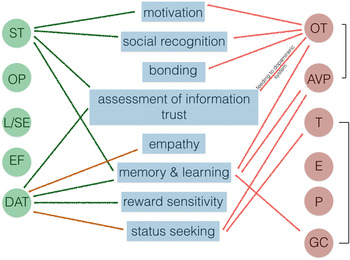
Figure 1. Exemplary mapping of teaching types to hormonal measures via behaviors. The “building blocks” of teaching (in the middle with blue background) are mediated by and fed back to different hormones (right with pink background), such as oxytocin (OT), vasopressin (AVP), testosterone (T), estrogens (E), progesterone (P) or glucocorticoides (GC) (actual although incomplete results on behavior–hormone interactions are indicated with red lines). Hormonal measures allow the investigation of motivational and emotional changes in teaching contexts and can be linked to cognitive processes and behavioral modifications associated with teaching. Kline distinguishes five teaching types based on the adaptive problem they solve: (i) teaching by social tolerance (ST), (ii) opportunity provisioning (OP), (iii) local or stimulus enhancement (L/SE), (iv) evaluative feedback (EF), and (v) direct active teaching (DAT). A precise mapping between building blocks and different teaching types needs to be investigated: Predictions on possible connections are indicated on the left (brown lines for teachers and green lines for pupils). Mapping teaching types to hormones and behaviors may help us understand basic processes and mechanisms of teaching across and within species.
We welcome Kline's emphasis on comparing behavioral measurements between learning episodes, and suggest including novel measures applicable to taught/learnt behaviors across species and tasks.
Hormonal or neuromodulatory states are well known to affect learning, for example, in bird-song acquisition (Ball et al. Reference Ball, Riters and Balthazart2002). So far, little research has been undertaken on the role of hormonal states of teachers and learners in teaching episodes, although such examination offers promise for intraspecies and interspecies comparisons. The few animal studies linking endocrine parameters with social learning show that oxytocin and arginine-vasopressin mediate the social transmission of food preferences and that oxytocin plays an important role in mate-choice copying (Dore et al. Reference Dore, Phan, Clipperton-Allen, Kavaliers, Choleris, Pfaff and Kavaliers2013). Until more direct evidence is available, predictions on the endocrinology of teaching can be established by linking hormonal measures to behaviors that are essential to teaching. For instance, oxytocin and vasopressin mediate social approach and aversion (Porges Reference Porges2001). Arguably, increased approach motivation and decreased social aversion are essential in teaching contexts. Other relevant behaviors, such as social motivation, affiliation, individual recognition, aggression, anxiety, and stress are associated with and regulated by oxytocin, vasopressin, testosterone, estrogens, and progesterone (McCall & Singer Reference McCall and Singer2012; Mehta & Josephs Reference Mehta and Josephs2012). These hormones also regulate and are influenced by trust, prosociality, empathy (empathic concern, perspective taking), reward sensitivity, and status seeking (Bos et al. Reference Bos, Panksepp, Bluthe and van Honk2012; Crockford et al. Reference Crockford, Deschner, Ziegler and Wittig2014; Heinrichs et al. Reference Heinrichs, von Dawans and Domes2009; Insel Reference Insel2010; Mehta & Josephs Reference Mehta and Josephs2012; van Anders et al. Reference van Anders, Goldey and Kuo2011). To what extent these behaviors play a role in teachers or pupils may depend upon the teaching type. Therefore, we propose that Kline's teaching types can be mapped to hormonal variations in teachers and learners via social and cognitive building blocks (Fig. 1). This approach parallels existing frameworks for the study of cooperation (Soares et al. Reference Soares, Bshary, Fusani, Goymann, Hau, Hirschenhauser and Oliveira2010), and according to Kline, teaching is a cooperative behavior.
Exemplary mapping of teaching types to hormonal measures via behaviors. The “building blocks” of teaching (in the middle with blue background) are mediated by and fed back to different hormones (right with pink background), such as oxytocin (OT), vasopressin (AVP), testosterone (T), estrogens (E), progesterone (P) or glucocorticoides (GC) (actual although incomplete results on behavior–hormone interactions are indicated with red lines). Hormonal measures allow the investigation of motivational and emotional changes in teaching contexts and can be linked to cognitive processes and behavioral modifications associated with teaching. Kline distinguishes five teaching types based on the adaptive problem they solve: (i) teaching by social tolerance (ST), (ii) opportunity provisioning (OP), (iii) local or stimulus enhancement (L/SE), (iv) evaluative feedback (EF), and (v) direct active teaching (DAT). A precise mapping between building blocks and different teaching types needs to be investigated: Predictions on possible connections are indicated on the left (brown lines for teachers and green lines for pupils). Mapping teaching types to hormones and behaviors may help us understand basic processes and mechanisms of teaching across and within species.
Kline proposes to conduct comparative research with emphasis on socio-environmental niches in which teaching and specific teaching types evolve. In cooperatively breeding New World monkeys, after the birth of an infant, fathers experience changes in vasopressin, oxytocin, and testosterone (Kozorovitskiy et al. Reference Kozorovitskiy, Hughes, Lee and Gould2006) and siblings show increases in oxytocin (Ragen & Bales Reference Ragen, Bales, Choleris, Pfaff and Kavaliers2012), suggesting physiological adaptations to infants and juveniles (the individuals who are usually taught). Rearing conditions influence later oxytocin balance and social behavior (Fries et al. Reference Fries, Ziegler, Kurian, Jacoris and Pollak2005; Winslow et al. Reference Winslow, Noble, Lyons, Sterk and Insel2003), and altruistic behaviors, sibling relationships, or decision making are genetically associated with different vasopressin-receptor types (Israel et al. Reference Israel, Lerer, Shalev, Uzefovsky, Reibold, Bachner-Melman, Granot, Bornstein, Knafo and Yirmiya2008; Knafo et al. Reference Knafo, Israel, Darvasi, Bachner-Melman, Uzefovsky, Cohen, Feldman, Lerer, Laiba and Raz2008). Parental investment and siblings' infant care predict changes in vasopressin and oxytocin in cooperatively breeding monkeys (Ragen & Bales Reference Ragen, Bales, Choleris, Pfaff and Kavaliers2012). Hence, developmental and epigenetic forces might contribute to the evolution of teaching behavior (Bjorklund Reference Bjorklund2006; Soares et al. Reference Soares, Bshary, Fusani, Goymann, Hau, Hirschenhauser and Oliveira2010). Future comparative data will elucidate the epigenetics of teaching.
While hormones elucidate internal states, Kline's focus is on external, observable behaviors. She claims that the only example of direct active teaching in nonhuman animals comes from anecdotes of chimpanzees learning to crack nuts (Boesch Reference Boesch1991). Building on recent work on synchrony and motor mimicking in chimpanzee dyads (Fuhrmann et al. Reference Fuhrmann, Ravignani, Marshall-Pescini and Whiten2014), we propose additional tools to measure teaching and learning over time across species and behaviors.
A chimpanzee performing quasi-periodic movements to crack nuts can be tracked over time, for example, via video coding (Fuhrmann et al. Reference Fuhrmann, Ravignani, Marshall-Pescini and Whiten2014) or movement sensors (Nagasaka et al. Reference Nagasaka, Chao, Hasegawa, Notoya and Fujii2013; Ravignani et al. Reference Ravignani, Olivera, Gingras, Hofer, Hernández, Sonnweber and Fitch2013). This produces, for each individual, evenly spaced samples (time series) of rhythmic, learnable behaviors. Behaviors can be movements, fundamental frequency of vocalizations, or any other possible recordable semi-repetitive behavior within short time scales (few seconds). Kline stresses the importance of comparing behaviors in teaching and non-teaching contexts, and argues that finding differences in rates of behaviors between baseline and teaching contexts suffices to conclusively demonstrate teaching. Time series of teachers and pupils can be plotted together and statistically related to test hypotheses on teaching types.
Autocorrelation (correlation of a series with itself at different time lags) can be employed to investigate practice and self-consistency in learning movement patterns. Increased learning can be shown via an increase in between-trial autocorrelation (i.e., increased predictability of the pupil's next step once the action is almost completely learned).
Faithfulness of action copying and individual learning performance can be investigated using cross-correlations: the higher the correlation between teacher and pupil, the more accurate the learning. A cross-correlogram provides a measure in the delay of copying: A high cross-correlation (near zero lag) provides evidence for simultaneity of actions (high cross-correlation at a short lag is predicted in stimulus/local enhancement). Alternative methods, originally developed to infer similarity between geometrical curves, can measure resemblance between taught/learnt behaviors, such as Fréchet distance (Alt & Godau Reference Alt and Godau1995), procrustes analysis (Gower Reference Gower1975), and dynamic time warping (Verhoef et al. Reference Verhoef, Kirby and de Boer2014).
Granger-causality (Granger Reference Granger1969; Seth Reference Seth2010) enables investigation of directionality of information transmission in the teaching process; a teacher's time series causes a pupil's time series (sensu Granger-causality) if past teacher's data significantly improve the prediction of future pupil's data (when compared to forecasts based on past pupil's data alone). Granger-causality can be used to show that teacher–pupil synchrony is unilaterally driven by one of the two (Fuhrmann et al. Reference Fuhrmann, Ravignani, Marshall-Pescini and Whiten2014). Alternatively, two time series Granger-causing one another constitute evidence for bilateral information transmission: not only does the pupil's series depend upon the teacher's series, but the teacher's behavior will also be triggered by a pupil's (imperfect) behavior (as needed in evaluative feedback). An alternative for measuring the amount and directionality of information transmission is partial directed coherence (Baccalá & Sameshima Reference Baccalá and Sameshima2001; Ghazanfar et al. Reference Ghazanfar, Takahashi, Mathur and Fitch2012).
The proposed quantitative tools can serve to analyze behaviors in teaching contexts. Hormonal measures allow for conclusions about motivational and emotional states or reward mechanisms. Controlled correlation studies measuring relevant hormones (i.e., via saliva, urine, or feces) or experimental administration studies can help shed light on basal processes involved in teaching and social learning. The tools we suggest here will hopefully contribute to a more empirical and quantitative approach to teaching, transcending verbal descriptions alone.
ACKNOWLEDGEMENTS
This work was supported by Austrian Academy of Sciences grant “Learning from a Friend” to W. Tecumseh Fitch and Ruth Sonnweber, and European Research Council Advanced Grant 230604 SOMACCA to W. Tecumseh Fitch (supporting Andrea Ravignani and Ruth Sonnweber). We thank Gesche Westphal-Fitch for comments and Barbara Finlay for extremely helpful advice.