In this commentary, I argue that we need to move beyond studying only individual or dyadic aspects of teaching to a broader, cultural view of interpersonal and community ways of fostering learning, at least for humans.
Kline seems to have overlooked the depth of the available cultural research on what she defines as teaching: “behavior evolved to facilitate learning in others.” Because of her focus on the definition of teaching as schoolish instruction, she erroneously claims that cultural researchers say that teaching does not exist in non-Western communities. (In addition, her account misrepresents cultural work as claiming that learning occurs through observation and not participation and that the process is automatic, natural, and simple.)
Many people reserve the term teaching for the kind of instruction that is common among schoolteachers. Even Guatemalan Mayan mothers who had not been to school seemed to use the term teaching in this way when I asked them many years ago how they taught their daughters to weave. They often responded that they do not teach them to weave; the daughters learn. Over the past decades, my work and that of a number of other cultural scholars has focused on finding out how adults facilitate children's learning, when they are not doing schoolish teaching.
Kline's misrepresentations may stem in part from her focus on individuals in competition with each other. Her framework does not take into account either the mutually constituting nature of teaching and learning, or the contributions of cultural communities themselves. An example of community contribution is the inclusion of children as contributors to a broad range of activities of the community. This is common in many communities but would be difficult in many middle-class communities, for reasons well beyond the actions of any individual.
Children's inclusion in the range of activities of their family and community subsumes Kline's first type of teaching: social tolerance, in which the teacher does not stop the pupil's close and intrusive observation. (Interestingly, Kline found that in Fiji, an impressive 100% of children's physical intrusions into others' activities were tolerated.) In many communities, children's presence and involvement is not just tolerated, but expected and encouraged by individuals and the community as a whole. For example, in some Mexican communities, children's presence in important events is seen as a contribution to the group, to learn how to maintain the culture (Corona & Pérez Reference Corona, Pérez, Wyller and Nayar2007; Pérez Martínez Reference Pérez Martínez2011). And adults' willingness to allow toddlers to help with chores may be regarded as an important contribution to development of the next generation's character and skill.
Inclusion of children in family and community endeavors also subsumes Kline's second type of teaching: opportunity provisioning, in which a teacher creates opportunities for practice that would otherwise not exist. Kline gives an example of an uncle facilitating the help of a 4-year-old in carrying water, although the uncle could have carried more water without the child's involvement. Oddly, Kline refers to this as “asocial learning,” which may be connected with her focus on individuals.
Cultural research has often discussed Kline's third type of teaching: by stimulus or local enhancement, in which a teacher stimulates the pupil's interest in a stimulus or location, such as pointing or verbally calling the child's attention to observe. Further, if children are included in community activities, their interest can be stimulated by others' interest, and they are often encouraged to be generally observant. In such contexts, Kline's fourth and fifth types of teaching have also been extensively studied – evaluative feedback, such as scolding or teasing, and direct active teaching (verbal or nonverbal or both).
The cultural literature has for decades examined all 5 types of teaching in Kline's framework. In addition, the cultural research goes beyond a focus on teaching by an individual. It calls attention to the mutually constituting, complementary contributions of teachers and learners, who always operate in the context of cultural communities' ways of facilitating learning. These themes are central to the articles that Kline cites as exemplars of cultural research (e.g., Gaskins & Paradise Reference Gaskins, Paradise, Lancy, Bock and Gaskins2010; Lancy & Grove Reference Lancy, Grove, Lancy, Bock and Gaskins2010; Lave & Wenger Reference Lave and Wenger1991; Paradise & Rogoff Reference Paradise and Rogoff2009; Rogoff et al. Reference Rogoff, Paradise, Arauz, ávez and Angelillo2003). Such themes have also been central to the cultural research of many other scholars for more than four decades (e.g., Bolin, Cole, Erickson, Fortes, Goodnow, Greenfield, Gutiérrez, Heath, Jordan, Lee, LeVine, Maynard, Nasir, Ochs, Philips, Saxe, Schieffelin, Scollon, Scribner, Serpell, and the Whitings).
To take a specific example from my own work, ever since those Mayan mothers challenged my way of thinking about teaching and learning decades ago, I have written about the role of community arrangements and practices in facilitating learning, and the mutually constituting nature of teaching and learning (e.g., Rogoff Reference Rogoff1990; Reference Rogoff2003). Over more than a decade, I have published articles articulating a way of learning that appears to be common in Indigenous-heritage communities of the Americas.
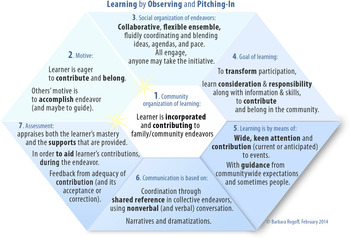
This way of facilitating learning emphasizes the community's role. It is the central feature of the seven features that define this cultural tradition for fostering learning. In addition, all the facets of this learning tradition include complementary teaching/learning roles (Rogoff Reference Rogoff2014). Figure 1 shows a prism defining the facets/features of Learning by Observing and Pitching In (LOPI). The prism's seven facets can be seen as broader versions of Kline's 5 teaching types; in addition, they form part of a cultural tradition for fostering learning that involves individual, interpersonal, and community processes.
Figure 1.
The facets defining Learning by Observing and Pitching In: a cultural tradition for fostering learning that integrates community processes with individual and group processes.
Kline's laudatory aim to integrate developmental, cultural, and ethological studies of teaching would benefit from a more in-depth cultural view of the integrated manner in which individuals, small groups, and communities foster the learning of the next generation.





In this commentary, I argue that we need to move beyond studying only individual or dyadic aspects of teaching to a broader, cultural view of interpersonal and community ways of fostering learning, at least for humans.
Kline seems to have overlooked the depth of the available cultural research on what she defines as teaching: “behavior evolved to facilitate learning in others.” Because of her focus on the definition of teaching as schoolish instruction, she erroneously claims that cultural researchers say that teaching does not exist in non-Western communities. (In addition, her account misrepresents cultural work as claiming that learning occurs through observation and not participation and that the process is automatic, natural, and simple.)
Many people reserve the term teaching for the kind of instruction that is common among schoolteachers. Even Guatemalan Mayan mothers who had not been to school seemed to use the term teaching in this way when I asked them many years ago how they taught their daughters to weave. They often responded that they do not teach them to weave; the daughters learn. Over the past decades, my work and that of a number of other cultural scholars has focused on finding out how adults facilitate children's learning, when they are not doing schoolish teaching.
Kline's misrepresentations may stem in part from her focus on individuals in competition with each other. Her framework does not take into account either the mutually constituting nature of teaching and learning, or the contributions of cultural communities themselves. An example of community contribution is the inclusion of children as contributors to a broad range of activities of the community. This is common in many communities but would be difficult in many middle-class communities, for reasons well beyond the actions of any individual.
Children's inclusion in the range of activities of their family and community subsumes Kline's first type of teaching: social tolerance, in which the teacher does not stop the pupil's close and intrusive observation. (Interestingly, Kline found that in Fiji, an impressive 100% of children's physical intrusions into others' activities were tolerated.) In many communities, children's presence and involvement is not just tolerated, but expected and encouraged by individuals and the community as a whole. For example, in some Mexican communities, children's presence in important events is seen as a contribution to the group, to learn how to maintain the culture (Corona & Pérez Reference Corona, Pérez, Wyller and Nayar2007; Pérez Martínez Reference Pérez Martínez2011). And adults' willingness to allow toddlers to help with chores may be regarded as an important contribution to development of the next generation's character and skill.
Inclusion of children in family and community endeavors also subsumes Kline's second type of teaching: opportunity provisioning, in which a teacher creates opportunities for practice that would otherwise not exist. Kline gives an example of an uncle facilitating the help of a 4-year-old in carrying water, although the uncle could have carried more water without the child's involvement. Oddly, Kline refers to this as “asocial learning,” which may be connected with her focus on individuals.
Cultural research has often discussed Kline's third type of teaching: by stimulus or local enhancement, in which a teacher stimulates the pupil's interest in a stimulus or location, such as pointing or verbally calling the child's attention to observe. Further, if children are included in community activities, their interest can be stimulated by others' interest, and they are often encouraged to be generally observant. In such contexts, Kline's fourth and fifth types of teaching have also been extensively studied – evaluative feedback, such as scolding or teasing, and direct active teaching (verbal or nonverbal or both).
The cultural literature has for decades examined all 5 types of teaching in Kline's framework. In addition, the cultural research goes beyond a focus on teaching by an individual. It calls attention to the mutually constituting, complementary contributions of teachers and learners, who always operate in the context of cultural communities' ways of facilitating learning. These themes are central to the articles that Kline cites as exemplars of cultural research (e.g., Gaskins & Paradise Reference Gaskins, Paradise, Lancy, Bock and Gaskins2010; Lancy & Grove Reference Lancy, Grove, Lancy, Bock and Gaskins2010; Lave & Wenger Reference Lave and Wenger1991; Paradise & Rogoff Reference Paradise and Rogoff2009; Rogoff et al. Reference Rogoff, Paradise, Arauz, ávez and Angelillo2003). Such themes have also been central to the cultural research of many other scholars for more than four decades (e.g., Bolin, Cole, Erickson, Fortes, Goodnow, Greenfield, Gutiérrez, Heath, Jordan, Lee, LeVine, Maynard, Nasir, Ochs, Philips, Saxe, Schieffelin, Scollon, Scribner, Serpell, and the Whitings).
To take a specific example from my own work, ever since those Mayan mothers challenged my way of thinking about teaching and learning decades ago, I have written about the role of community arrangements and practices in facilitating learning, and the mutually constituting nature of teaching and learning (e.g., Rogoff Reference Rogoff1990; Reference Rogoff2003). Over more than a decade, I have published articles articulating a way of learning that appears to be common in Indigenous-heritage communities of the Americas.
This way of facilitating learning emphasizes the community's role. It is the central feature of the seven features that define this cultural tradition for fostering learning. In addition, all the facets of this learning tradition include complementary teaching/learning roles (Rogoff Reference Rogoff2014). Figure 1 shows a prism defining the facets/features of Learning by Observing and Pitching In (LOPI). The prism's seven facets can be seen as broader versions of Kline's 5 teaching types; in addition, they form part of a cultural tradition for fostering learning that involves individual, interpersonal, and community processes.
The facets defining Learning by Observing and Pitching In: a cultural tradition for fostering learning that integrates community processes with individual and group processes.
Kline's laudatory aim to integrate developmental, cultural, and ethological studies of teaching would benefit from a more in-depth cultural view of the integrated manner in which individuals, small groups, and communities foster the learning of the next generation.