


R1. Introduction
I thank the authors of all 38 commentaries for their thoughtful extensions and critiques of the target article on the study of the evolution of teaching, in humans and other animals. The breadth of responses from anthropology, biology, psychology, and beyond attests to the wide-ranging relevance of research on teaching. Due to the large number of commentaries, I am unfortunately not able to address the entirety of points made in each commentary. Instead, I address the major concerns of each, and structure my response according to levels of explanation, in order to further an integrated, interdisciplinary approach to the study of teaching in humans and other animals.
The range of commentaries highlights ontogenetic, phylogenetic, or proximate psychological explanations of teaching behavior as important research areas not covered in the target article. In some cases, the commentators suggest that the lack of such explanations in the target article renders the proposed framework insufficiently broad to motivate comparative work in disparate disciplines. However, the commentary by Thornton & Raihani anticipates how these foci fit with the proposed framework. They argue that working from a functionalist framework allows for the much-needed distinction between ultimate explanations of teaching behavior and proximate ones – and indeed that the study of cooperation more broadly could be improved by a similar frame of analysis.
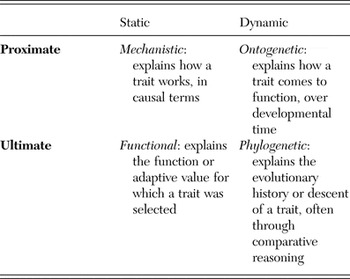
The collection of commentaries would benefit from taking this one step further: The ultimate/proximate levels of analysis can be split into dynamic (explaining processes of change) and static (explaining present form), such that there are four categories of explanations available to us – mechanistic, functional, ontogenetic, and phylogenetic (see Table R1; derived from Tinbergen Reference Tinbergen1963). Whereas the target article discusses existing definitions of teaching based on disciplinary convention, in this response research problems are addressed according to the type of explanation they offer. Note that a key to the enduring usefulness of Tinbergen's levels of analysis is that these levels are consilient: each explanation must be reconcilable with explanations at other levels of analysis. It therefore does not make theoretical or practical sense to argue that one kind of explanation is better or more correct than another – their validity is mutually dependent.
A grid showing Tinbergen's levels of analysis applied to static and dynamic explanations of traits.

Table Note: Most non-evolutionary disciplines focus mainly within one of these categories. One advantage of an integrative evolutionary framework is that it relates proximate/ultimate and static/dynamic explanations to one another in a theoretically meaningful way.
R2. Mechanistic explanations
R2.1. Psychological and neural mechanistic explanations
I first address the commentaries that propose extensions to the target article's framework in ways that would explain how teaching works in terms of proximate, causal mechanisms. These include mental, cognitive, neural, hormonal, and behavioral mechanisms.
Commentaries by Ronfard & Harris, Koenig, Kruger, and Corriveau, each, respectively, argue for greater coverage of a topic not covered in detail in the target article: the behavior of pupils as learners. I agree that this is an important topic underserved in the target article, and I thank these commentators for highlighting it. Ronfard & Harris as well as Corriveau emphasize that among humans, pupils may solicit teaching, may monitor or direct ongoing instruction, and may seek out reliable informants (see sect. 6.2 in the target article for brief coverage of these ideas). Ronfard & Harris even nominate pupil's behavior as another important piece of the puzzle in understanding human cultural capacities, and cite a broad body of work showing that children seek out adult attention. This raises the question of whether such a practice occurs in nonhuman pupils, as well. In some cases, I argue that we know it does: teaching via social tolerance depends by definition upon pupil initiation, and seems to be relatively common among nonhuman animals. The question of pupil behavior extends even beyond the suggestions made by Ronfard & Harris, and could inspire comparative work in the future.
In addition, Corriveau and Kruger argue that teacher and pupil should not be envisioned as independent actors. Both these commentators take issue with the target article's asymmetrical treatment of teacher and pupil behavior. They make an important point in recognizing how humans (and other animals) coordinate, and that this may be observable in teacher–pupil interactions. It may be especially interesting to describe how the behavioral and psychological mechanisms for coordination do or do not differ across human populations, where social hierarchies may restrict the entreaties of young learners (see, e.g., Lancy Reference Lancy2008), or where norms about verbal communication and eye contact mean coordination is more subtly communicated, as is common in Pacific societies (Watson-Gegeo & White Reference Watson-Gegeo and White1990). Explaining the communicative mechanisms by which teachers and pupils jointly interact is not mutually exclusive with tracking the fitness costs and benefits separately. Even for a public good created through cooperation, and even if all parties benefit equally, the reproductive or fitness consequences of behavior must be tallied individually, since it is their fitness relative to each other, rather than absolute reproductive fitness, that predicts the outcomes of natural selection. It is this practical concern that drives the target article's focus on the evolution of teacher behavior over questions regarding pupil behavior. In the context of the target article, this is as a parallel line of inquiry into a mechanistic explanation of teacher and pupil behavior that benefits from the proposed functional framework, even as it requires shifting focus toward pupil behavior.
Pasquinelli, Zalla, Gvodzic, Potier-Watkins, & Piazza (Pasquinelli et al.) discuss how little is known about the neurocognitive mechanisms of teaching, and make a worthwhile appeal for translational, applied research using established methods in cognitive psychology and neuroscience. Similarly, Kim, Torres-Garcia, & Swain (Kim et al.) focus on the neurocognitive and hormonal bases of teaching. These are growing fields, and better integration of their techniques may advance the study of teaching. Both commentaries, however, treat teaching behavior as a unitary phenomenon rather than a set of behaviors. Kim et al. even subsume “parenting” under teaching, which is either a narrow definition of parenting, or a loose definition of teaching that does not coincide with the one proposed in the target article. While Pasquinelli et al.'s focus is a valuable and promising research direction, I urge researchers to step away from the entrenched questions their commentary highlights: whether humans have a “teaching instinct,” and its dependence on theory of mind. A central tenet of the target article is that teaching behaviors are not monolithic in their form and mechanism – and as a result we should not assume that proximate teaching psychologies are uniform, either. This demands that we take a more textured look at the variety of teaching behaviors used by a given study species, by linking the proximate psychological mechanisms to their ultimate functional explanations.
Pasquinelli et al. also suggest that teaching behavior might directly benefit teachers in two ways. First, that “learning in order to teach” creates direct benefits to the teacher, through enhancing the teacher's own learning. The evidence cited in favor of this idea is based on grade-school children and on undergraduates asked to learn in order to teach in a classroom context. This cannot distinguish between the impact of teaching versus the impact of preparing-to-teach, on the teacher's comprehension. Thus, while this research may impact in-classroom teaching techniques, it seems unlikely to affect functional explanations of the cost/benefit structure of teaching behavior. After all, learning for the anticipated purpose of teaching is a special case in human teaching, and almost certainly non-existent other animals. Second, Pasquinelli et al. suggest that teachers might manipulate others for their own direct gain, and that manipulation in a broad sense may be considered teaching. Communicative behaviors used in persuasion and manipulation are superficially similar to those displayed in teaching. Further, it may be that the two share a proximate psychology: The same psychological features that make learners receptive to teaching also make them vulnerable to manipulation, and manipulators may use the same communication techniques that can be useful for teaching. This is a broader problem in human communication, and demands epistemic vigilance among communicators (for deeper discussion, see Sperber et al. Reference Sperber, Clément, Heintz, Mascaro, Mercier, Origgi and Wilson2010). However, integrating mechanistic psychological descriptions with functional explanations makes it clear that manipulative influence should not be categorized as teaching. Teaching, as functionally defined, is a cooperative behavior in which the teacher benefits only indirectly, through the learning benefits the pupil derives. This illustrates why a multi-level approach to the study of teaching is important. For further discussion, see deceptive teachers and skeptical pupils (sect. 6.2) in the target article.
Ravignani & Sonnweber make an ambitious proposal to dissect the proximate mechanisms of the full range of teaching behaviors through hormonal and neuromodulator evidence, as well as time-series analyses. They argue that studying the physiological mechanisms will help scientists to identify the motivations and emotions involved in teaching behavior. While this is one promising tool scientists may use to study teaching, I caution against relying too heavily on proximate mechanisms to diagnose teaching. It poses the same sort of problem discussed above – and repeats the same stumbling blocks for using theory of mind capacities as a measuring stick. In the target article (sect. 5), I argue that there is more than one possible psychological mechanism that could reliably produce a given type of teaching behavior. This suggests that using a single proximate mechanism as a heuristic for identifying teaching runs the risk of excluding behavior that fits the functional definition of teaching.
This same critique applies to the use of teacher–pupil synchrony to diagnose teaching behavior. Marin states that motor movement synchrony (and indeed a wide range of mutual influence between pupil and teacher) can happen during teaching. However, this does not mean it is particularly diagnostic of all types of teaching behavior in all species. For example, for teaching types that promote pupils' independent exploration of novel stimuli (teaching via stimulus enhancement and via opportunity provisioning), behavioral synchrony would not be expected. It also does not establish that synchrony is unique to teaching, as opposed to being common in communication more generally. Similarly, Badets & Osiurak state that perceptual resonance is common across animals, but it is not clear that it is especially relevant to the evolution of teaching, as opposed to perception or social interaction more broadly.
Finally, Palagi, Stanyon, & Demuru (Palagi et al.) highlight play as one of many “forms of teaching and learning.” I think this is a mistake. Although play certainly facilitates learning, and although teaching behavior may happen in the context of play, behaviors commonly accepted as “play” can fall outside of any of the definitions of teaching discussed in the target article. For example, solitary play cannot possibly be categorized as teaching, since it takes (at least) two to teach. While some kinds of teaching may resemble some kinds of play, behaviors sharing proximate mechanisms do not necessarily share an ultimate function. For this reason, a functional explanation of teaching behavior makes an ideal structure upon which to build a framework for comparative research. For example, not all displays of ostensive cues constitute teaching, and not all teaching relies upon ostensive cues. Some behavioral cues, like “motherese,” may be teaching-specific, but this is an empirical question requiring further study. Palagi et al. describe gestural motherese in gorillas as being “direct” and “active,” but this does not categorize it as direct active teaching as defined in the target article. Instead, teaching behaviors should be categorized based on the learning problem they are thought to solve, with consideration of the learner's access and attention. Within the target article, I explicitly classify motherese as a form of teaching via stimulus enhancement (see sect. 3.1).
R2.2. Social, cultural, and other contextual mechanistic explanations
Another group of researchers focuses on a proximate description of the social, cultural, or other contexts of teaching behavior. Rogoff begins by pointing out that cultural anthropologists and others have been richly describing a broad array of teaching and learning behaviors for decades, and that this includes behaviors that fit into my five teaching type categories. This is right – and in the target article I credit such researchers for their achievement (see sect. 2.2), while drawing heavily on their descriptions in the empirical review of teaching in humans (sect. 4.2). To clarify, I do not argue that culture-based approaches are without descriptions of the range of behaviors I discuss in the target article. In fact, there is a richness in that literature that I could not begin to address in the target article. This includes one-to-many and many-to-one teaching, which Rogoff discusses, and questions that draw on social theories of power, knowledge-making, modes of communication, and meaning, to name a few. It also includes aspects of teaching behavior featured in Rogoff's graphic, ranging from community organization, to learning goals, learner and others' behavior, and the mental state or motivation of the learner and others (see Rogoff's Figure 1). These are all valid domains of study, at the level of describing sociocultural contexts. However, descriptions and analyses made without a shared framework do very little to integrate the study of teaching behavior across levels of explanation. Further, much of this qualitative data is exclusive to human teaching and is analyzed without respect to the features we do share with other animals.
This is a problem for an integrative framework for use across human and animal populations. Drawing categories of social learning and teaching in terms of social meaning and cultural context can work as a coherent mechanistic-level analysis. These categories have affordances for discussing the questions that cultural psychologists, for example, are interested in. However, it is incompatible with functional and phylogenetic analyses, and with any comparison with nonhuman animals. This incompatibility limits the usability of data from the culture-based approach by other researchers. In turn, this confines the questions one can ask from a culture-based approach to the mechanistic level. For instance, only a shared framework allows the combination of evidence from cognitive developmental and ethnographic descriptions for a better understanding of how humans, as a single biological species, can demonstrate so much behavioral variation in teaching, across the lifespan. This variation can be described in detail from a culture-based approach, and its subjective meaning can be examined. However, if we want to know how humans came to be this way, or to shift the goals of educational systems towards creativity and away from uniformity, then ontogenetic and functional perspectives are key. Since developing these explanations depends in part upon comparison with other species, a multi-level approach grounded in phylogeny is the best option. This is not a call for cultural psychologists and anthropologists to abandon their questions – it is merely a call to integrate their questions, and their very valuable data, with complementary work on teaching from other approaches.
In many ways, the culture-based approach can be compatible with the functional framework proposed here, so long as we recognize it is a different level of explanation, and seek to reconcile those levels of explanations. Lancy argues that the definition of teaching used in the target article is too broad, and that researchers should persist in the culture-based approach to the study of teaching. However, the breadth of a functional definition is only problematic if one interprets the framework as obligating researchers to use functional definitions exclusively, and to use these definitions without operationalizing criteria for identifying teaching behavior. I am not persuaded, and refer readers to the target article's discussion of the benefits of integration (sect. 2.4). A key consideration is that the functional framework would not prevent researchers from focusing on specific contexts or genres of teaching should they have the intellectual motivation to do so. The teaching typology means research focused on a particular kind of teaching – for example, direct active teaching – can be fitted into the framework with minor adjustments. In fact, the functional framework is perfectly open to the study of when and how learners may solicit teaching – a concern Lancy highlights. Further, distinctions between what Koenig calls “mode” of learning – hearing, watching, seeing – are compatible with a functionalist approach as a mechanistic explanation. Finally, the framework also does not require granting privileged status to teaching as a means of learning, so it can be integrated into the ethnographic and theoretical study of social learning more broadly. Research on social learning has itself benefited from the kind of integrative framework I propose here, and has allowed for cross-species studies. As is clear from my own empirical work (e.g., Kline et al. Reference Kline, Boyd and Henrich2013), teaching is but one of many kinds of social learning.
Lancy also suggests that the illustrative examples I use from my field work in Fiji are irrelevant, because (as I explain in the target article and elsewhere in my published work) the indigenous Fijian people I work with do attend British-style formal schooling. However, I include these details precisely because I think they are important for contextualizing my qualitative observations and quantitative data (see, e.g., Kline et al. Reference Kline, Boyd and Henrich2013). Moreover, the presence of formal schooling does not render these examples useless, nor does it undermine the overarching goal of the target article, which is to propose a synthetic framework. These ethnographic examples are single events, chosen specifically to illustrate teaching types. Examples like this cannot be used to generalize about a population, and disregarding these examples would not topple the proposed framework. The target article includes a range of examples of teaching behavior from the broader ethnographic literature (see sect. 4.2). Further, argument by example cannot tell us whether Western education correlates with (let alone causes) teaching behavior outside of the classroom. To test this kind of relationship would require a large-scale cross-cultural comparative study with quantitative measures of Western schooling and the prevalence of teaching types per population. Alternatively, we might test whether within populations, exposure to Western schooling for the learner or the teacher predicts likelihood of teaching. For the Fijian population in which I work, the answer is that it does not (see Kline Reference Kline2013). Still, Lancy's question highlights the need for a broad, quantitative comparative study of teaching behavior across human populations. The target article has outlined the framework that makes this kind of study possible.
R2.3. Applied uses for mechanistic explanations
Several commentaries have discussed human socio-cultural institutions, such as classrooms, apprenticeships, or styles of parenting, that can affect the performance of teaching. While the target article focuses on kinds of teaching behavior rather than on the human socio-cultural institutions that structure and influence teaching behavior, the study of those institutions is not in conflict with the approach I propose. In fact, this focus on context is one of the most valuable contributions of the culture-based approach can contribute to the study of teaching more broadly. While socio-cultural institutions can be analyzed at other levels, most of the commentaries on these topics focused on how it is that teaching happens, and in what contexts. In this way, they make use of mechanistic accounts of teaching behavior and its contexts in humans.
Shafto & Seifert take an applied approach, asking how we might optimize learning through a combination of teaching and self- and peer-directed learning. In an example regarding peer-directed learning, they contrast peers with teachers as important sources of knowledge. However, in the analysis in the target article, teachers and pupils are not separate, mutually exclusive populations: they are fluid roles that are shorthand ways of describing behavior. A classroom in NASA or at Google may contain only one person employed as a teacher, but within the framework I propose, students can just as easily be performing teaching behavior, and a single individual can be both a learner and teacher. Like a classroom, an apprenticeship is a social arrangement and a context, and not a type of behavior.
Similarly, a syllabus or overarching goals of an educational system are social institutions designed by humans in order to shape teaching behavior to reach a given end – for example, conformity or creativity. Poddiakov likewise describes a number of contexts in which teaching may happen, for example, when a teacher's interests are in conflict with a pupil's. Because teaching evolved as a cooperative behavior, this context poses a cheater-detection problem for pupils, discussed at length in the target article (sect. 6.2). Despite this, what Poddiakov terms “negative work” in teaching, and the kind of false-information that Koenig discusses, are not separate kind of teaching behavior – both are contexts in which teaching behavior happens, and may be examples of teacher-pupil conflict where the pupil's role as skeptic could be studied. For example, Müller suggests a specific domain in which teaching and social learning may proliferate unhealthy behavior: psychiatric disorders.
Researchers whose goal is to define and create strategies for teaching that maximize a given outcome – be it creativity or conformity – would do well to consider teaching from more than one level of analysis. Shafto & Seifert point out that humans are good teachers but not optimal ones. This makes sense from a functional perspective because natural selection produces traits that are best-suited to maximize actors' reproductive success. This is not the same as optimizing teaching for the best possible learning outcome, because there are cost/benefit tradeoffs that affect teachers and pupils. We should not assume that evolved teaching behaviors are optimal teaching behaviors; instead, we can think of them as tendencies or biases that should be taken into consideration in attempts to optimize the teaching process.
R3. Ontogenetic explanations
Another cluster of commentaries focuses on developmental explanations of teaching and learning, particularly in humans. Chouinard-Thuly & Reader put forth developmental specialization as an alternative to evolutionary specialization. As with mechanistic explanations, this only highlights another level of analysis and a shift in focus. I agree that understanding variation and the processes that generate it is important – variation is the engine of change in natural selection. However, development and learning are themselves evolvable, such that ontogenetic explanations are part of an evolutionary explanation rather than a mutually exclusive alternative (see Barrett Reference Barrett, Gangestad and Simpson2006). Examples of flexible social learning behaviors, whether in sticklebacks, bees, or humans, can be indicators of prepared learning (see Barrett & Broesch Reference Barrett and Broesch2012) in that the cognitive features of the learning mechanism are functionally specialized to a set of contexts (Cosmides et al. Reference Cosmides, Barrett and Tooby2010).
In this view, empiricists ought to probe the contexts and conditions under which teaching happens, to understand the flexibility and boundaries of teaching behaviors (Barrett Reference Barrett2014). This is in keeping with Heyes' (Reference Heyes1994; Reference Heyes2012a) critiques of the divisions between social and individual learning, because it treats teaching and other forms of social learning as continuous and complementary strategies. While it is still a useful analytical and practical exercise to categorize learning and teaching types, note that a number of the teaching types I propose effect learning through the combination of teacher intervention and the learner's independent exploration of stimuli. From the learner's perspective, this is a seamlessly integrated process of learning. Likewise, from the perspective of a runner, locomotion and respiration are united – yet it is useful to create abstract categories for the purpose of analysis and quantification. Practically, explaining teaching behavior at any level requires cataloguing and comparing sources of variation in teaching behavior across individuals, societies, and species. To do so, we need a comprehensive framework like the one proposed here; linking developmental accounts to the functional framework, and revising the framework when we find it does not account for the data.
I am encouraged that so many additional commentaries call for a focus on the ontogeny of teaching and learning, including Beck as well as Paulus, Kim, & Sodian (Paulus et al.), and Strauss, Ziv, & Frye (Strauss et al.). However, each of these commentaries emphasizes theory of mind (ToM) or mind-reading as a definitional criterion for identifying teaching. In some cases the commentators mistake the target article's outline of the mentalistic approach (sect. 2.1) as evidence that I endorse this view. In contrast, I argue in the target article (sect. 5) that some combination of metacognitive capabilities along with some degree of mind-reading or ToM capacities might be sufficient but not necessary for direct active teaching, and that other types of teaching might require neither. For example, Strauss et al. argue that because teaching sometimes fails to effect learning, we can only identify teaching by its goal as captured in a mental state rather than by its result. In addition to the theoretical problems with this strategy as discussed in the target article, its practical challenges have been roundly criticized since Caro and Hauser (Reference Caro and Hauser1992) first outlined a functional definition of teaching. I will not recapitulate those critiques here.
As discussed by Strauss et al., the study of teaching behavior is in need of cross-cultural data on the ontogeny of teaching behavior, especially from non-Western samples. However, their argument for how to interpret cross-cultural variation is based on a misunderstanding of evolution and developmental flexibility. They suggest that uniformity in the early psychology and development of teaching behavior would indicate that teaching is “not cultural,” whereas variation early in the trajectory would suggest that the cognitive underpinnings of teaching are “culturally determined.” This link does not hold, because it depends upon a false dichotomy. Universality of a phenotype can result from convergent development in a system evolved to be developmentally plastic and sensitive to cultural and environmental inputs, just as it can result from a system evolved to be insensitive to such inputs (Jablonka & Lamb Reference Jablonka and Lamb2014). Adaptive plasticity – the potential for a developmental system to produce a variety of phenotypes depending on context – can also be selected for, and produce a “norm of reaction” across contexts. In this case, while cultural variation might be linked to variation in phenotype, the resulting variation is nonetheless a product of the evolved developmental system and the environment in which it develops, not necessarily cultural learning. The question we ought to be asking is one of degree of influence. Our empirical efforts, then, should focus on the flexibility of the ontogeny of teaching behavior in a range of environmental contexts.
R4. Phylogenetic and evolutionary historical explanations
Several of the commentaries argue for a focus on the historical nature of the evolutionary process. Smaldino & Newton in particular object to the idea that teaching behaviors are adaptations as opposed to being exaptations. They have a point, in that I take a straightforward adaptationist approach in basing my inquiries on a functional definition of teaching. However, it is not clear how this critique changes the usefulness of the framework as a tool for exploring and understanding the functionality of teaching behavior. An exaptationist program would likely be identical to an adaptationist one in that it would focus on evidence (or lack thereof) of functionally specialized design (see Andrews et al. Reference Andrews, Gangestad and Matthews2002). In either epistemological context, the framework I propose should be viewed as one full of hypotheses; as illustrated by the range of commentaries discussed here, a functionalist explanation is only one of many integrated levels of analysis open for exploration.
If Smaldino & Newton have ideas about how to generate new hypotheses or research questions based on an exaptationist program, they do not share them in their commentary. Instead, they provide a partial alternative explanation for each teaching type, tying features of the teaching behavior described in each type to some underlying feature of human behavior. This critique goes off track in that it mischaracterizes my argument, supposing disagreement where there is none. To clarify: I do not argue that every aspect of teaching behavior evolved de novo because of selection for teaching. On the contrary, I think the best explanation for human-specific forms of teaching is that it evolved alongside a suite of other social and cooperative behaviors. The same reasoning applies to other teaching types. Similarly, I do not argue that social tolerance in general evolved because of selection favoring teaching behavior. My argument applies only to teaching via social tolerance, which might be thought of as a secondary adaptation Footnote 1 derived from those traits Smaldino & Newton discuss (Gould & Vrba Reference Gould and Vrba1982). Future work based on the proposed framework should seek to test whether there is evidence of design specialization for the teaching types I outline. In this sense, testing the adaptationist hypotheses I lay out is the same exercise as testing the exaptationist hypotheses.
Smaldino & Newton's account provides a useful description of the adaptations in humans that likely predate and underlie the emergence of teaching behavior. Such a phylogenetic or comparative approach, combined with evidence for special design, can provide some of the best evidence for adaptation (see Andrews et al. [2002] for kind of evidence for special design, and Gervais & Wilson [Reference Gervais and Wilson2005] for an example of this tool applied to laughter). Rather than ask whether teaching should be called either an adaptation or an exaptation, or a secondary adaptation, we would be better off characterizing the observable functions of teaching behavior and, where possible, quantifying its effects on fitness. Adaptationism generates hypotheses in this context.
In an alternative historical approach, Gärdenfors & Högberg suggest that the emergence of teaching types in humans might be reconstructed from the archaeological record. While this would be data worth having, this endeavor may prove intractable both because of the nature of teaching behavior, and because of the practicalities of the archaeological record. The typology I propose in the target article does link teaching types to adaptive problems to be solved, but this is only in terms of the proposed selection pressures. It does not follow that, once a flexible teaching behavior is within a species' repertoire, that teaching type was subsequently applied to only that learning problem. In fact, much of the ethnographic literature attests to the broad use (some call it over-use) of direct active teaching in white, upper and middle-class American populations, in comparison to societies where children are expected to learn predominantly in more self-directed ways (Lancy Reference Lancy2008). In light of the present-day range of variation it seems tenuous at best to link particular artifacts or technologies in the archaeological record to specific teaching behaviors. The relationship between teaching behaviors, cognitive capacities, and archaeologically observable artifacts is further muddied by the fact that human technologies result from population-level processes. These processes are affected not only by method of transmission, but also by demographics like population size (e.g., Kline & Boyd Reference Kline and Boyd2010) and spatiotemporal population structure (Powell et al. Reference Powell, Shennan and Thomas2009). In light of these complications, specifics about the timing of emergence of types of teaching behaviors may be beyond what archaeological data in general can tell us (Smith Reference Smith, Babits and Van Tilburg1998).
Nielson & Shipton also suggest archaeological data, but with a focus on the emergence of childhood as a necessary precursor to the evolution of teaching. This is an interesting suggestion, but it need not be true: Children are not the only recipients of teaching, though they are overrepresented in the ethnographic literature. In fact, my own fieldwork has focused on children because of doubts from the culture-based school of thought that young children are taught anything at all in non-Western societies (for review, see Hewlett et al. Reference Hewlett, Fouts, Boyette and Hewlett2011). Other examples in the target article are drawn from an ethnographic literature that is specifically focused on how children learn. This should not be misconstrued as a representative sample of teaching and learning across human life history in any sense. However, the proposed framework may lead to the creation of such a sample in the future.
In addition to sampling issues, there is some empirical evidence against Nielson & Shipton's assertion of the relationship between childhood and teaching behavior. First, high-skill tasks for which teaching would be especially useful are learned later in life (Kline et al. Reference Kline, Boyd and Henrich2013). In addition, in at least some domains, children's skill outpaces their physical ability to complete a task, suggesting that teaching would serve little purpose (Bliege-Bird & Bird Reference Bliege-Bird and Bird2002). Childhood and human teaching behavior may both have evolved as part of the human cultural niche (Boyd et al. Reference Boyd, Richerson and Henrich2011), but there is presently little evidence to suggest that teaching requires an extended juvenile period, or vice versa. Further, as reviewed in the target article, teaching has been documented in a range of other species (see sect. 4.3), none of which have the same dramatic extended juvenile period as do humans.
Ridley & Ashton as well as Scheel, Shaw, & Gardner (Scheel et al.) focus on the power of the comparative approach, and express concern that highlighting humans as exceptionally prolific teachers skews the study of teaching behavior by using “humans as a benchmark” by which to measure teaching in other animals. I agree that human exceptionalism is not a theoretically sound approach to comparative studies of teaching. I argue in the target article that although humans are particularly prolific and extensive teachers, any framework we use should account for human as well as nonhuman animal teaching behavior with a single explanatory framework. I do not think humans teach as a result of human-specific mental capacities (see sect. 5), or because of some other inexplicable discontinuity between humans and other animals. Instead, I anticipate human teaching is at the extreme end of the distribution of teaching and that, like other apparent exceptions that in fact prove the rule, explaining teaching in humans will inform our understanding of teaching across species.
This is why an explicit goal of the framework I propose is to enable researchers to collect equivalent data on human and nonhuman animals. Data equivalency is crucial because, while most humans (though not all scientists) will interpret the ethnographic examples provided in the target article as clear evidence of teaching in humans, very few would do the same for Boesch's, or Scheel et al.'s, similarly descriptive accounts of what they argue are cases of teaching in chimpanzees. An integrative framework like the one I propose is needed for this endeavor, because if we are to seek continuity in our explanations we must also have equivalency in our data.
R5. Functional explanations
R5.1. Extensions within a functionalist approach
Commentators have also made suggestions for extensions of the functional analysis offered in the target article. For example, Johnston, McAuliffe, & Santos (Johnston et al.) make a compelling argument for how dogs may serve as a useful study species, because they have evolved to learn from humans, and to attend to ostensive cues. Their proposal is intriguing and novel – though, as with any cross-species comparison, caveats apply. For example, basic differences in dog and human cognitive and communicative capacities mean that the study of human direct active teaching with dogs as pupils is probably not possible.
Scott-Phillips & Sperber contribute richness to the theoretical foundations of the target article, highlighting the importance of psychological, biological, and environmental factors of cultural attraction. Abrams details transmission probability interactions as a system that makes it possible to build abstract mathematical models of teaching and of cultural attractors. No matter their origins, attractors can preserve and construct what is to be learned – and may work in concert with or against what is being taught. A future analysis might delve deeper into the importance of attractors for the range of different teaching types. For example, for teaching that enables individual learning, attractors may play a major role in determining learning outcomes, while teaching affects whether learning is possible. These authors also point out that the study of teaching behavior is especially compatible with cultural attraction theory because teaching (a) functions to influence the frequency of practices or variants other than itself, and (b) the impact of teaching is in part dependent on other sources of cultural attraction. In the context of cross-species comparisons, a major caveat is that not all teaching promotes cultural learning in particular, and only some forms of teaching may be culturally learned. Cultural attractors may be especially relevant for the study of direct active teaching, and for applications of this theory to improving the effectiveness of teaching methods.
Tatone & Csibra argue that despite the synthetic value of the framework, ostension must still be key to understanding human teaching. While I agree that in some contexts, ostension is a key part of human teaching behavior, I think it does not cover the range of teaching behaviors that exists. The goal of the framework above is not to rule out ostension as a feature of a subset of teaching behavior, but it does include a range of teaching behaviors that do not necessarily rely upon ostension. I also do not see ostension as a reliable cue to teaching, as distinct from other kinds of communication.
Hernik & Gergely argue that teaching fills the function of enabling a naïve individual to learn content that is opaque and generic. Their commentary questions the validity of basing the target article's framework in a learner's access and attention, and redirects the focus to four problems of opacity. These indeed do pose problems for learners, but the identification of these problems is relative to the learner and the context (i.e., to the learner's access and attention). The framework in the target article explicitly captures this, by taking the learner's access and attention into account. In this sense, opacity is not treated as an objective feature of the world, because it depends upon the learner's existing store of relevant knowledge. Considering the attention and access of the learner can characterize the learning situation as more or less opaque, rendering particular types of teaching useful or irrelevant. Conceptualizing the pupil's access and attention are not in conflict with identifying kinds of opacity, and in some ways these concepts are addressing the same problem: Why is it the pupil cannot learn, or will learn more slowly, without aid from a teacher?
Finally, while Caro endorses the need for a broadly comparative database, he is not interested in friendly campfire tunes, instead arguing that the mentalistic and culture-based approaches require constraints that make the kind of synthesis I outline impossible. I maintain that a functionalist approach can benefit from integration with the research questions and the empirical observations made across specialized fields (sect. 2.4). Further, I think the application of multiple levels of explanation in this response makes that compatibility explicit rather than hypothetical. In the end, I propose we employ the framework from the target article and evaluate its usefulness empirically.
R5.2. Operational definitions
Another group of commentaries generally approves of the functionalist approach, but expresses doubts about the practical application of the proposed framework, given that operational definitions are only addressed briefly in the target article.
Dean & Kendal argue that the framework focuses too heavily on teacher behaviors as opposed to learner behavior. However, a key component to the framework is to match teacher behaviors to learning problems. These learning problems are defined from the perspective of the learner – whether the learner lacks access or attention to information. From a practical standpoint, this may mean that observational and experimental studies will need to focus on the learner. From a theoretical perspective, it means that the adaptive problem is always with respect to the learner's status. For this reason, learner behavior is indeed an important source of information in arguing for or against alternate explanations of candidate teaching behaviors. In fact, learner behavior can serve both as evidence of an existing learning problem that might be solved by teaching, and as a measure of the fitness-relevant effects of teaching should it be observed. Both kinds of evidence are important in identifying cases of teaching behavior.
Alternatively, Dean & Kendal return to the cost/benefit criteria first proposed by Caro and Hauser (Reference Caro and Hauser1992). Caro and Hauser's criteria are admirably simple and should serve as one of many kinds of evidence for the function of behavior as teaching (see target article, sect. 2.3, para. 1). However, it does not follow that these criteria are an objective rule by which to identify teaching. Take, for example, the criteria that there is a cost, or at least no immediate benefit to the teacher: applied without a researcher's inference or subjective interpretation, this would neatly rule out all instances of (adaptive) teaching as cases of teaching. This is because, for teaching to evolve, there must be some fitness benefit to teachers as opposed to non-teachers. The fact that Caro and Hauser's criteria have been used to identify and confirm cases of teaching is evidence that researchers (quite rightly, I think) apply it in selective ways that make sense within the context of their studies. This is not to say we should do away with Caro and Hauser's criteria. Instead, we should regard it as only one of many lines of evidence for specialized design: that the form of the behavior fits the proposed function of teaching. Further, we should aim to show a behavior fits this proposed function better than it does an alternate function.
In their argument against the adoption of the target article's framework, Dean & Kendal do not consider the discussion of learning problems upon which the framework rests. Specifically, they do not consider that teaching types correspond to a learner's access and/or attention. As a result, they suppose that when otters and sea lions drag their offspring into the water, this fits the framework's definition of either teaching by stimulus/local enhancement or teaching by opportunity provisioning equally well. They take this as an indication of broader problems with the framework. Ironically, given their suggestion for greater focus on learners, the distinction between these two forms of teaching is in the learning problem, from the perspective of the learner. In these examples, the pups are not prevented by circumstances or by conspecifics from entering the water. This means there is no access problem for the pups. However, they only seem to learn to swim as a result of being forced into the water by their mothers. This suggests that they lack attention to the water, and only engage in swimming when their attention is forced. We can imagine that pups who are never pulled into the water by their mothers might never learn to swim, or might learn much later without interference. In either outcome, opportunity provisioning does not fit the scenario, since it corresponds to cases where learners lack access to a stimulus, and do not lack attention. Opportunity provisioning would apply if, for example, otter pups consistently attempted to enter the water but were not able to do so because they were physically prevented from accessing it by their small size, and could only reach the water through assistance in gaining access by their larger-bodied mothers.
Similarly, commentators Moore & Tennie and Eschar & Fragaszy favor an evolutionary approach focused on adaptive problems, but take issue with the framework's categories. First, Moore & Tennie suggest my definition of teaching by stimulus enhancement is meant to be a new definition of stimulus enhancement more generally. As discussed above, I am not arguing for a new definition of stimulus enhancement and would not categorize all learning by stimulus enhancement as teaching. They go on to argue that lumping teaching behavior by function rather than by cognitive difficulty is “not intuitively a useful tool for understanding evolution.” This is demonstrably untrue, since evolutionary reasoning is regularly and fruitfully applied according to functional definitions. For example, the reproductive habits of soapbox bugs and of humans rely upon wildly different cognitive mechanisms, yet we can understand frequency-dependent mating strategies in both species with the same kind of cost/benefit rationale. On the other hand, a functional framework is just one level of analysis. This shared functional analysis does not prevent us from studying the cognitive complexity of each teaching type, or of teaching behaviors that cut across functional categories. On the contrary, it facilitates phylogenetic comparisons, which help researchers to understand the details of how and when individuals in each species do or do not adjust their behavioral strategies. This gives us insight into the behavior's proper domain and the constraints on its flexibility, including cognitive constraints.
Moore & Tennie go on to argue that the flossing behavior of Japanese macaques, as discussed in the target article, could fit the definition of “direct active teaching.” In contrast, they make the suggestion that Warao fathers' repositioning of their sons' hands during canoe carving should fall under evaluative feedback rather than direct active teaching. This is only possible because they substitute their own intuitive definition of what constitutes “direct teaching,” for the one I propose, stating “we often engage in direct teaching by drawing others' attention to important features of objects.” In asserting this, Moore & Tennie step away from the definition of direct active teaching proposed in the framework above, such that these specific critiques cannot apply in a meaningful way. The source of confusion here seems to be similar to Dean & Kendal's, in that the focus is on apparent behavioral similarity (i.e., something can be described as “direct” and “active” in lay terms) rather than how researchers might tease apart behaviors based on their function in facilitating learning. This problem is not unique to the evolution of teaching behavior. For example, researchers have had to create ways to discriminate mounting behaviors that function to establish dominance from those that function as reproductive sex. As in the framework I propose above, distinctions are made by contextual indicators, including others' behaviors, rather than by a distinguishing feature of the actor's behavior alone.
Eshchar & Fragaszy state that “[f]raming teaching in terms of its evolutionary sources does not help the empirical researcher to recognize it.” I strongly disagree. Observed teaching behaviors should, all else equal, represent a specialized functional match to the context of the adaptive problem, and, if functioning in its proper domain, should have fitness-enhancing consequences for the teacher and pupil. This form–function fit can generate insights into the ways cognition can operate to reliably produce teaching behavior in teachers and pupils.
Mapping conditions under which the behavior's functionality breaks down can serve as evidence of the adaptation's proper domain, and experimental methods may help us to probe that landscape to better understand the flexibility of an adaptation (Barrett Reference Barrett2014). Similarly, ontogenetic evidence can be used to infer a trait's function and further detail its flexibility or lack thereof. Phylogenetic analyses can temper adaptationist reasoning with an understanding of the evolutionary origins of underlying traits, as suggested by Smaldino & Newton. Further, comparative studies based on phylogenetic analyses may help us to identify recurring social learning problems that can be solved by teaching, for a set of socio-ecological niches. All of this comes with a better understanding of the evolutionary sources of teaching behavior, and these multiple lines of evidence can be used to design better operational criteria for distinguishing among alternative explanations for potential teaching behavior.
As Rapaport discusses, there are a range of criteria that can and should be used to identify and characterize teaching behaviors. This is directly addressed in the target article (sect. 3). This section of the paper makes clear that, contrary to Eshchar & Fragaszy's assertions, the framework in the target article is not designed to include any and all learning that happens in any social context as teaching. Eschar & Fragaszy's critique is that the framework does not come with a generalizable operational rule to distinguish teaching behavior from all alternative explanations of behavior, so it must be impossible to differentiate between teaching and other kinds of learning under this framework. This argument is flawed. Our operational definitions are necessarily going to be variable and piecemeal, because we are studying a selection of behaviors spread across a range of species and contexts. Creating operational criteria will not be simple or easy, and I do not provide a universal operational criterion because I believe there is none that will apply across all study contexts. Again, this does not mean that researchers should subjectively judge what seems to be teaching and what is not. Instead, it means they should design tools of measurement and experimental and field methodologies to distinguish teaching from other forms of social learning and from other forms of communication. These methodologies should enable researchers to provide evidence that a behavior likely functions as teaching, and to collect evidence of functional specialization for teaching, as opposed to some alternate function.
As Fogarty highlights, this is a challenging problem for researchers, especially those conducting observational work without the option for experimental manipulation of their subjects. In mathematical modeling, Caro and Hauser's (Reference Caro and Hauser1992) criteria may be the easiest and therefore most fruitful to apply. However, this represents a tradeoff, since those models will only be able to tell us about a subset of socio-ecological contexts that the underlying assumptions accurately describe. To explore the evolutionary dynamics that could have given rise to the full range of teaching behaviors, a more differentiated set of models is needed. Nonetheless, this kind of model can be a powerful tool for generating theoretical insight beyond what verbal reasoning can tell us.
Rapaport meets the difficult question of what operational criteria we might use head on. She proposes we use Hoppitt et al.'s (Reference Hoppitt, Brown, Kendal, Rendell, Thornton, Webster and Laland2008) standard of only including “active” demonstration as teaching. However, this approach struggles with precisely the same questions as the framework proposed in the target article. Hoppitt et al.'s “active” or “advertent/inadvertent” distinction is simply another way of weighing alternative explanations of behavior against one another. Rapaport rightly notes that distinguishing social tolerance that evolved as teaching from social tolerance more generally is a difficult challenge in primate species that have reached ceiling-high levels of social tolerance. I agree with Rapaport's assertion that it is not scientifically sound to categorize all types of social tolerance as instances of teaching by social tolerance; I also agree with similar assertions made by Moore & Tennie with respect to teaching by stimulus enhancement, and by Eshchar & Fragaszy about the teaching types in general. However, these objections are somewhat surprising since they echo the argument made in the target article, in the very introduction to the framework itself (see sect. 3). In each of these cases, the commentators misinterpret some of the examples of teaching and as a result infer that the framework equates social learning with teaching. Here I discuss these misinterpretations in turn.
First, Rapaport notes that, in the example of the Balinese music teacher who plays for his pupils without adjusting his style of play, there is no behavioral adjustment whatsoever by the teacher. In fact, in this example, the music teacher puts on a performance exclusively for the pupils to observe – were the pupils not present, he would not play. The modification is that he is playing, not how he plays. Aside from the specifics of interpreting ethnographic examples, there is a broader point. The practical difficulty of identifying teaching by social tolerance does not necessarily lessen its theoretical validity. Because of the minimalist nature of teaching by social tolerance, it may predate the evolution of other, more derived forms of teaching. The conceptual role of teaching by social tolerance in this framework may be important in considering the socio-ecologies in which we would expect teaching to evolve, even if we are unable to reach a consensus on how to quantify and observe cases of teaching by social tolerance.
Eshchar & Fragaszy provide their own examples, presenting them as problematic for the framework. These examples are worth discussing in that they highlight some important misunderstandings. First, they propose that in a case of chimpanzee termite fishing, when a juvenile physically intrudes upon a foraging adult, it will be impossible to tell the “purpose” of the adult's social tolerance. They argue that teaching by social tolerance will be indistinguishable from the social tolerance that evolved because intolerant adults would incur direct costs. This is a testable hypothesis, provided the researchers can come up with a proxy measure of the cost or threat of costs (e.g., presence and rank of the juvenile's kin). This question can be settled by testing the competing hypotheses against each other, using measures developed for the study species and context. In fact, it is difficult to see why Eshchar & Fragaszy think this problem is specific to the framework described in the target article, as the same kind of challenge exists for all studies of teaching behavior, and more broadly for the measurement of behavior in general.
Eshchar & Fragaszy also suggest that under the proposed framework, teaching would include any behavior done in proximity to juveniles, even if there is no behavioral modification contingent on the learner's presence. This directly contradicts the target article's discussion of distinguishing teaching behavior from baseline behavior (sect. 3). These commentators also highlight the need to know whether a behavior is “for the purpose” or with the “intention” of teaching. This is not a reliable standard, for reasons discussed throughout the target article, and has been discarded by functionalists since Caro and Hauser's (Reference Caro and Hauser1992) critique. On the other hand, some of the ethnographic examples I draw upon in the empirical review section (sect. 4.2) do give accounts of the mental states of human teachers. As discussed in that same section, I include these examples because ethnographic data are necessarily impoverished of quantitative data on behavioral details, and the ethnographer's qualitative interpretation of the actor's intention can lend valuable insight when applying quantitative criteria is not possible. Using these examples as an act of necessity is not the same as endorsing intentionality as a criterion for identifying teaching.
Jacquet raises punishment as an example, asking how punishment can be distinguished from teaching by evaluative feedback and suggesting that this may necessarily be a grey area. Jacquet notes that others have distinguished punishment from teaching according to the timing of the fitness payoffs, reasoning that behavior that results in an immediate benefit to the actor should be considered to function as punishment, rather than as teaching (see, e.g., Thornton & Raihani Reference Thornton and Raihani2008). Evident in Jacquet's commentary are a range of definitions of what actually constitutes punishment, and I suspect this topic could inspire a review piece of its own. For the sake of clarity, I conceptualize punishment here as “negative feedback” in which the actor creates and imposes a cost on its recipient. The specific definition of teaching by evaluative feedback (sect. 3.1) is not as relevant here as the definition of teaching more generally as a cooperative behavior between teacher and learner (sect. 6). With these definitions, teaching via evaluative feedback is neither equivalent with punishment nor mutually exclusive with it. That is, some punishment may function as teaching by evaluative feedback, and some may not. Differentiating between these cases will require considering the costs and benefits to the candidate teacher and pupil in a particular context.
A defining feature of teaching as discussed in the target article is that the benefit to the teacher is indirect, derived from benefits to the pupil. In this sense, teaching is a cooperative behavior. This means punitive behavior that benefits the actor/punisher at the expense of the recipient/punished – for example, parking tickets or reputational damage – does not function as teaching. This is more precise than timing of costs and benefits since, in reality, teachers must benefit at some point regardless of timing, and punishers can accrue delayed benefits. Likewise, punishment that is not teaching can still create direct benefits for the punisher, as a result of the punished individual modifying her behavior. To continue the example, if those who receive parking tickets learn not to park in permit-only zones, the punisher gains parking availability. In this case, punishment is not equivalent to teaching because it is not cooperative: the punisher (the permitted parker) benefits at a cost to the punished individual (the ticketed, unpermitted parker). Where punishers derive indirect benefits from the modified behavior of the punished individual, and the punished individual also benefits, punishment is a form of teaching by evaluative feedback, albeit a relatively costly form. Of course, these questions become more complex when we consider that teaching, like other cooperative behaviors, is open to manipulation for selfish means by teachers. The waters are further muddied by considerations of how to measure the scale and flow of benefits and costs – but these are matters of methodological rather than theoretical distinctions and are beyond the reach of this response.
Sharkey provides an outside-the-box commentary, asking whether robots are teachers. Since robots are not living, reproducing creatures, they do not evolve or behave in the way that organisms do. Thus, in an evolutionary approach, robots are best characterized not as being teachers themselves, but as culturally evolved tools that humans use for teaching. This is because robot actions are not shaped by natural selection on robot behavior and reproduction, but instead are the result of natural and cultural selection on human behavior and culture. So, for example, where robots are deployed to provide an English-speaking companion for students studying English as a second language, this is an example of humans teaching via opportunity provisioning. Humans may even undertake direct active teaching via a robot, by equipping a robot with a pre-planned lecture or demonstration. Likewise, some book-based teaching may fall into this category since, like robots, books are cultural artifacts created by humans. Similarly, the online quizzes with feedback that are common in large university courses at the present can be considered teaching via evaluative feedback. From an applied perspective, the important difference between teaching that uses robots as tools and teaching that happens between two humans face-to-face, is the relatively poor ability of a robot to tailor its actions to the context and the learner's status. As noted in other commentaries, this reactivity between teacher and pupil (or more broadly, in acts of human communication) is important for the effectiveness of communication. This has implications for the use of robots as teachers-by-proxy: Teaching types that are more dependent on adjustment and tailoring may be less effective through the use of robots. This poses a problem for the use of robots in the classroom, because direct active teaching can be tailored, intensive, and quite common in a typical Western-model classroom.
R6. Conclusion
The commentaries expand an already extensive field of research on teaching, and contribute new questions, techniques, and strengths to the evolutionary approach proposed in the target article. The various commentaries have touched on a wide range of subjects, from the neurobiology of teaching, to the receptivity of domestic dogs to human teaching and the roles of robots as teachers, as well as the finer points of how to operationally define teaching in the laboratory and in the wild. As several commentators have suggested, the proposed framework would benefit from additional emphases on mechanistic, ontogenetic, and phylogenetic research problems. I have used the response here to demonstrate how these research questions are not in conflict with the functionalist approach I outline, but should be regarded instead as multiple lines of evidence that may improve and modify the framework in the future. Students of the evolution of teaching have thus far lacked a comprehensive framework that is open to this kind of input, and this has been a source of miscommunications across disciplinary divisions.
The breadth of commentaries in response to this framework is in itself evidence that this approach is accessible to researchers pursuing questions across levels of explanation. Further, it provides a platform on which to integrate research questions and data at the core of the mentalistic, culture-based, and functionalist approaches to the study of teaching. The proposed framework defines teaching from a functionalist perspective, as behavior that evolved to facilitate learning in others. The categories of teaching are based on learning problems derived from a learner's lack of access or attention to relevant stimulus. Because these represent general adaptive problems for learners, these categories capture the full range of teaching behaviors that have been described so far in the qualitative and quantitative literature on teaching behavior in humans and in other animals. The application of this framework will allow for a more integrated, interdisciplinary treatment of questions and data across populations of humans and other animals.



Target article
How to learn about teaching: An evolutionary framework for the study of teaching behavior in humans and other animals
Related commentaries (38)
Another way to learn about teaching: What dogs can tell us about the evolution of pedagogy
Childhood and the evolution of higher-effort teaching
Clarifying the range of social-cognitive processes subserving human teaching
Cognitive mechanisms matter – but they do not explain the absence of teaching in chimpanzees1
Cognitive universals and cultural variation in teaching
Cooperation in human teaching
Cultural variant interaction in teaching and transmission
Does all teaching rest on evolved traits?
Evolutionary mechanisms of teaching
Eyes on the price: Human culture and its teaching
Human teaching and learning involve cultural communities, not just individuals
Is tolerance really teaching?
Learning about teaching requires thinking about the learner
Learning in and about opaque worlds
Measuring teaching through hormones and time series analysis: Towards a comparative framework1
Mind, brain, and teaching: Some directions for future research
More examples of chimpanzees teaching
Multiple dilemmas of help and counteraction to teaching in complex social worlds
On the persistent gray area between teaching and punishment
Play to learn, teach by play
Robot teachers: The very idea!
Subjectivity may hinder the application of Kline's teaching framework in comparative contexts
Systematic data are the best way forward in studies of teaching
Teacher and learner: Supervised and unsupervised learning in communities
Teaching as an exaptation
Teaching interactions are based on motor behavior embodiment
The active role played by human learners is key to understanding the efficacy of teaching in humans
The benefits of an evolutionary framework for the investigation of teaching behaviour: Emphasis should be taken off humans as a benchmark
The lowest common denominator between species for teaching behaviors
The mutual relevance of teaching and cultural attraction
The parental brain: A neural framework for study of teaching in humans and other animals
The proximate-ultimate confusion in teaching and cooperation
The study of teaching needs an inclusive functional definition
To what adaptive problems is human teaching a solution?
Understanding teaching needs development
Variations in teaching bring variations in learning
What is teaching? A clear, integrative, operational definition for teaching is still needed
“Teaching is so WEIRD”
Author response
Much to learn about teaching: Reconciling form, function, phylogeny, and development