




Crossref Citations

This article has been cited by the following publications. This list is generated based on data provided by Crossref.
Mucke, Hermann A.M.
2018.
Drug Repurposing Patent Applications April–June 2018.
ASSAY and Drug Development Technologies,
Vol. 16,
Issue. 7,
p.
420.
Langille, Jesse J.
2019.
Remembering to Forget: A Dual Role for Sleep Oscillations in Memory Consolidation and Forgetting.
Frontiers in Cellular Neuroscience,
Vol. 13,
Issue. ,
Murillo-Rodríguez, Eric
Arankowsky-Sandoval, Gloria
Pertwee, Roger G.
Parker, Linda
and
Mechoulam, Raphael
2020.
Sleep and neurochemical modulation by cannabidiolic acid methyl ester in rats.
Brain Research Bulletin,
Vol. 155,
Issue. ,
p.
166.
Su, Chun-Kuei
2020.
State-dependent modulation of sympathetic firing by α1-adrenoceptors requires constitutive PKC activity in the neonatal rat spinal cord.
Autonomic Neuroscience,
Vol. 227,
Issue. ,
p.
102688.
Liu, Binwen
Chu, Shuaishuai
Liu, Tiantian
Song, Jia
Ma, Zhengliang
Gu, Xiaoping
and
Xia, Tianjiao
2021.
Effects of 5-HT7 receptors on circadian rhythm of mice anesthetized with isoflurane.
Chronobiology International,
Vol. 38,
Issue. 1,
p.
38.
Sun, Yu-Ying
Wang, Zhun
Zhou, He-Yan
and
Huang, Han-Chang
2022.
Sleep–Wake Disorders in Alzheimer’s Disease: A Review.
ACS Chemical Neuroscience,
Vol. 13,
Issue. 10,
p.
1467.
Song, Yubin
Park, Yoon-A
Lee, Da Hoon
Yee, Jeong
and
Gwak, Hye Sun
2024.
Sleep-related adverse events of smoking cessation drugs: A network meta-analysis of randomized controlled trials.
Psychiatry Research,
Vol. 335,
Issue. ,
p.
115874.
Crespin, Ludwig
2025.
Dreaming is a conscious experience in its own right: proponents of non-cognitive and non-executive theories of dreaming suffer from a retrospective illusion of their waking extended self.
Consciousness and Cognition,
Vol. 133,
Issue. ,
p.
103890.
Komasi, Saeid
Nazari, Amin
Faridmarandi, Behrooz
Saeidi, Mozhgan
Bahremand, Mostafa
Shadman, Taherh
Mirani, Atefeh
Nazarpour, Parisa
Kiani, Zhaleh
and
Zakiei, Ali
2025.
Associations Between Both Adaptive and Maladaptive Personality Constructs and Emotional Load and Content of Adult Dreams.
Indian Journal of Psychological Medicine,
Vol. 47,
Issue. 1,
p.
39.
Juginović, Alen
2025.
Sleep Science Made Simple.
p.
3.
Lehue, Fernando
Coronel-Oliveros, Carlos
Medel, Vicente
Liebe, Thomas
Kaufmann, Jörn
Orellana, Sebastián
Becerra, Diego
Tagliazucchi, Enzo
Orio, Patricio
and
Berry, Hugues
2025.
Noradrenaline and acetylcholine shape functional connectivity organization of NREM substages: An empirical and simulation study.
PLOS Computational Biology,
Vol. 21,
Issue. 10,
p.
e1012852.
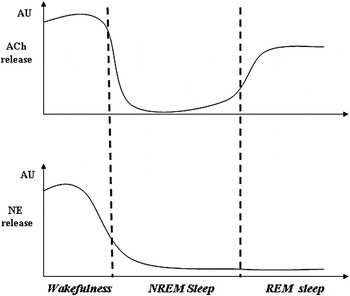
Regulation of neocortical circuits by ascending regulatory systems involves all of the classic neurotransmitters. Most of the nuclei located in the brainstem, hypothalamus, and basal forebrain not only are reciprocally connected, but also send direct projections to the neocortex (Jones Reference Jones2011; Saper et al. Reference Saper, Fuller, Pedersen, Lu and Scammel2010; Steriade & McCarley Reference Steriade and McCarley2005). The same applies to release by the hypothalamic nuclei of neuropeptides such as orexin/hypocretin in wakefulness and melanin-concentrating hormone (MCH) in rapid-eye-movement (REM) sleep (Aracri et al. Reference Aracri, Banfi, Pasini, Amadeo and Becchetti2015; Jones & Hassani Reference Jones and Hassani2008; Monti et al. Reference Monti, Torterolo and Lagos2013; and references therein). As a first approximation, these bewildering intricacies can be simplified by focusing on the balance in activity between noradrenergic and cholinergic nuclei, which are crucial regulators of arousal and cognition (e.g., Constantinople & Bruno Reference Constantinople and Bruno2011; Schmidt et al. Reference Schmidt, Chew, Bennett, Hammad and Frölich2013). Both project varicose fibers that widely innervate the neocortex, and their global effects are excitatory. During wakefulness, high levels of norepinephrine (NE) and acetylcholine (ACh) cooperate in regulating arousal and cognitive processes. However, although cholinergic transmission is certainly implicated in synaptic plasticity (e.g., Berg Reference Berg2011), the physiological action of NE is thought to be more persistent and more closely related to memory retention and consolidation (e.g., Constantinople & Bruno Reference Constantinople and Bruno2011; McGaugh Reference McGaugh2013; Schmidt et al. Reference Schmidt, Chew, Bennett, Hammad and Frölich2013). The activity of noradrenergic and cholinergic neurons decreases during non-REM (NREM) sleep, whereas in REM sleep, ACh release increases again, whereas NE activity remains low (Datta Reference Datta2010; Lee et al. Reference Lee, Hassani, Alonso and Jones2005; Saper et al. Reference Saper, Fuller, Pedersen, Lu and Scammel2010; Takahashi et al. Reference Takahashi, Kayama, Lin and Sakai2010) (Fig. 1). The fact that neocortex activation in REM sleep is sustained mainly by ACh is a further indication that the cholinergic tone is more directly related to consciousness and executive functions. In fact, the role of REM sleep in memory consolidation remains controversial (Ackermann & Rasch Reference Ackermann and Rasch2014; Rasch & Born Reference Rasch and Born2013).
Cholinergic and noradrenergic activity through the sleep–wake cycle. The scheme provides a qualitative comparison of the activity of the ascending cholinergic and noradrenergic projections, with no pretension of quantitative precision. AU=arbitrary units.
Does the GANE model help suggest possible explanations of the different functional consequences of activating these regulatory systems during brain states? A first central assumption is that, under strong neuronal activation, spillover glutamate stimulates nearby NE varicosities in an N-methyl-D-aspartate (NMDA) receptor-mediated manner. By activating low-affinity β-adrenoreceptors, high NE release would stimulate neuronal excitability, as well as glutamatergic terminals, thus constituting activity “hotspots” that effectively amplify inputs with high priority under phasic arousal. Are such hotspots possible in the cholinergic system? Not much is known about the glutamatergic regulation of ACh release, but evidence does exist of ionotropic glutamate receptors regulating cholinergic terminals in the neocortex (Ghersi et al. Reference Ghersi, Bonfanti, Manzari, Feligioni, Raiteri and Pittaluga2003; Parikh et al. Reference Parikh, Man, Decker and Sarter2008). Hence, it is conceivable that spillover glutamate also stimulates cholinergic fibers. Because it is well known that ACh increases glutamate release (Marchi & Grilli Reference Marchi and Grilli2010), a positive feedback loop could generate local ACh hotspots, analogous to those hypothesized by Mather and colleagues.
A second tenet of the GANE model is that the low-threshold α2-adrenoreceptors, by responding to low NE concentrations, would inhibit glutamate release in pathways implicated in low priority signaling, under aroused conditions. In this respect, the cholinergic system presents several differences compared with the noradrenergic. In particular: (1) cholinergic fibers form both well-differentiated point-to-point synapses and axon varicosities that sustain diffuse ACh release (Dani & Bertrand Reference Dani and Bertrand2007); and (2) ACh activates both metabotropic (muscarinic, mAChRs) and ionotropic (nicotinic, nAChR) receptors. In prefrontal regions, M1 mAChRs are widespread and produce excitatory effects related to working memory through different cellular mechanisms (e.g., McCormick & Prince Reference McCormick and Prince1986; Gulledge et al. Reference Gulledge, Bucci, Zhang, Matsui and Yeh2009; Proulx et al. Reference Proulx, Suri, Heximer, Vaidya and Lambe2014). Their EC50 for ACh is in the low μM range. On the other hand, nAChRs can be divided into two functional classes (Dani & Bertrand Reference Dani and Bertrand2007). Heteromeric nAChRs have high affinity for ACh (with EC50 in the μM range), relatively low permeability to Ca2+ (PCa), and slow desensitization in the presence of agonist. Homomeric nAChRs have high PCa (in the order of the one displayed by NMDA receptors), but low affinity for ACh (EC50 ≈ 200 µM), and quick desensitization kinetics. A striking difference with NE transmission is immediately apparent. The long-term effects on synaptic consolidation are thought to depend on Ca2+ signals. However, within the putative ACh hotspots, the efficacy of high-PCa homomeric receptors would be blunted by quick desensitization. High ACh concentrations would also tend to desensitize heteromeric nAChRs. This would prevent sustained Ca2+ entry through nAChRs as well as by nAChR-dependent activation of glutamate release, and thus of NMDA receptors. Therefore, it seems unlikely that ACh hotspots can produce long-term cellular effects considerably different from those produced by lower ACh concentrations.
In summary, by following up the GANE model reasoning, one is led to conclude that low and high concentrations of NE and ACh produce distinct functional effects on neocortical networks. Low to moderate ACh release sustains global neocortex arousal in both wakefulness and REM sleep. However, in the absence of NE activity (as in REM sleep), cholinergic activity is unable to yield long-term synaptic changes, such as those implicated in memory retention, which would partly explain the well-known difficulty of recalling oneiric activity. Instead, high levels of ACh seem more able to shape the rapid synaptic responses implicated in executive functions, as the quick kinetics of the low-affinity nicotinic ACh receptors would suggest. We believe that deeper functional studies of the interplay between the ascending regulatory systems, led by heuristic models such as GANE, will greatly lead to progress in understanding the physiological basis of cognition.