




No CrossRef data available.
Article contents
Does arousal enhance apical amplification and disamplification?
Published online by Cambridge University Press: 05 January 2017
Abstract
We summarize evidence that input to the apical tufts of neocortical pyramidal cells modulates their response to basal input. Because this apical amplification and disamplification provide intracortical mechanisms for prioritization, Mather and colleagues' arguments suggest that their effects are enhanced by noradrenergic arousal. Though that is likely, it has not yet been adequately studied. Their article shows that it should be.
Information
- Type
- Open Peer Commentary
- Information
- Copyright
- Copyright © Cambridge University Press 2016
References
Arnsten, A. F., Wang, M. J. & Paspalas, C. D. (2012) Neuromodulation of thought: Flexibilities and vulnerabilities in prefrontal cortical network synapses. Neuron
76(1):223–39.Google Scholar
Bachmann, T. & Hudetz, A. G. (2014) It is time to combine the two main traditions in the research on the neural correlates of consciousness: C=L× D. Frontiers in Psychology
5:Article 940. doi: 10.3389/fpsyg.2014.00940.Google Scholar
Chalifoux, J. R. & Carter, A. G. (2011) Glutamate spillover promotes the generation of NMDA spikes. The Journal of Neuroscience
31(45):16435–46.Google Scholar
Cichon, J. & Gan, W. B. (2015) Branch-specific dendritic Ca2+ spikes cause persistent synaptic plasticity. Nature
520(7546):180–85.CrossRefGoogle ScholarPubMed
Gambino, F., Pagès, S., Kehayas, V., Baptista, D., Tatti, R., Carleton, A. & Holtmaat, A. (2014) Sensory-evoked LTP driven by dendritic plateau potentials in vivo. Nature
515(7525):116–19.CrossRefGoogle ScholarPubMed
Grienberger, C., Chen, X. & Konnerth, A. (2014) NMDA receptor-dependent multidendrite Ca2+ spikes required for hippocampal burst firing in vivo. Neuron
81(6):1274–81.Google Scholar
Larkum, M. (2013) A cellular mechanism for cortical associations: An organizing principle for the cerebral cortex. Trends in Neuroscience
36:141–51.CrossRefGoogle ScholarPubMed
Larkum, M. E. Nevian, T., Sandler, M., Polsky, A. & Schiller, J. (2009) Synaptic integration in tuft dendrites of layer 5 pyramidal neurons: A new unifying principle. Science
325:756–60.Google Scholar
Larkum, M. E., Waters, J., Sakmann, B. & Helmchen, F. (2007) Dendritic spikes in apical dendrites of neocortical layer 2/3 pyramidal neurons. The Journal of Neuroscience
27:8999–9008.Google Scholar
Larkum, M. E., Zhu, J. J. & Sakmann, B. (1999) A new cellular mechanism for coupling inputs arriving at different cortical layers. Nature
98 (6725):338–41.Google Scholar
Lavzin, M., Rapoport, S., Polsky, A., Garion, L. & Schiller, J. (2012) Nonlinear dendritic processing determines angular tuning of barrel cortex neurons in vivo. Nature
490:397–401.CrossRefGoogle ScholarPubMed
Meyer, K. (2015) The role of dendritic signaling in the anesthetic suppression of consciousness. Anesthesiology
122:1415–31.Google Scholar
Palmer, L. M., Shai, A. S., Reeve, J. E., Andersen, H. L., Paulsen, O. & Larkum, M. E. (2014) NMDA spikes enhance action potential generation during sensory input. Nature Neuroscience
17:383–90.CrossRefGoogle ScholarPubMed
Phillips, W. A. (2015) Cognitive functions of intracellular mechanisms for contextual amplification. Brain and Cognition. Available at: http://dx.doi.org/10.1016/j.bandc.2015.09.005.Google Scholar
Phillips, W. A., Clark, A. & Silverstein, S. M. (2015) On the functions, mechanisms, and malfunctions of intracortical contextual modulation. Neuroscience and Biobehavioral Reviews
52:1–20. doi: 10.1016/j.neubiorev.2015.02.010.Google Scholar
Smith, S. L., Smith, I. T., Branco, T. & Häusser, M. (2013) Dendritic spikes enhance stimulus selectivity in cortical neurons in vivo. Nature
503(7474):115–20.CrossRefGoogle ScholarPubMed
Wang, Z. & McCormick, D. A. (1993) Control of firing mode of corticotectal and corticopontine layer V burst-generating neurons by norepinephrine, acetylcholine, and 1S, 3R-ACPD. The Journal of Neuroscience
13(5):2199–216.Google Scholar
Xu, N. L., Harnett, M. T., Williams, S. R., Huber, D., O'Connor, D. H., Svoboda, K. & Magee, J. C. (2012) Nonlinear dendritic integration of sensory and motor input during an active sensing task. Nature
492(7428):247–51.Google Scholar
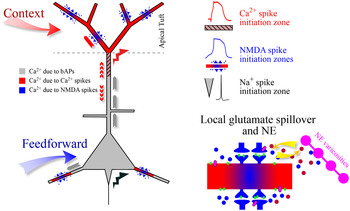
Figure 1. Dendritic spikes in neocortical pyramidal neurons. Apical tufts of pyramidal neurons receive inputs from diverse sources. Calcium currents, and thus synaptic plasticity, depend on backpropagating action potentials (bAPs, gray), apical dendritic calcium spikes (red) and NMDA spikes (blue). NMDA spikes require both local depolarization and glutamate (blue dots) and are enhanced by glutamate spillover to extrasynaptic NMDA receptors (green squares). Norepinephrine (maroon dots) interacts with glutamate in a feedback process hypothesized to enhance post-synaptic excitability.
Mather et al. argue that as arousal increases, things of high priority are perceived and remembered even better, whereas things of low priority are suppressed even more. Intracortical mechanisms for prioritization of selected signals are a prerequisite for this because the noradrenergic system provides only diffuse low-bandwidth innervation of neocortex, whereas the particular signals to be amplified or suppressed must be specified by locally specific interactions of high bandwidth. We therefore outline recent evidence for intracellular and microcircuit mechanisms by which signals are either amplified or suppressed within neocortex, prior to their further modulation by the noradrenergic system. We refer to those mechanisms as apical amplification (AA) and disamplification.
Evidence for AA is provided by patch-clamping studies showing that inputs to the apical tufts of pyramidal cells are integrated separately from inputs to their basal dendrites before being used to modulate the cell's response. Current models of neocortex, including noradrenergic effects, typically assume that pyramidal cells can be adequately thought of as point processors that simply sum all of their excitatory and inhibitory inputs and fire when that sum exceeds a threshold. The evidence for AA indicates that some pyramidal cells have not one, but two main sites of integration such that when apical and basal inputs coincide, intracellular calcium spikes initiated by a site of integration near the top of the apical dendrite amplify the cell's response to its basal inputs (Larkum Reference Larkum2013; Larkum et al. Reference Larkum, Zhu and Sakmann1999; Reference Larkum, Waters, Sakmann and Helmchen2007; Reference Larkum, Sandler, Polsky and Schiller2009).
The most studied mechanism by which AA is implemented in layer 5 cells is referred to as backpropagation-activated calcium spike firing (BAC firing). In addition to these two main integration sites, local integration takes place within both basal and tuft dendrites by the regenerative activation of N-methyl-D-aspartate receptors (NMDA spikes). AA may be fully implemented by NMDA spikes alone in supragranular neurons (Palmer et al. Reference Palmer, Shai, Reeve, Andersen, Paulsen and Larkum2014), but even in subgranular neurons, NMDA spikes have an important influence (Larkum et al. Reference Larkum, Sandler, Polsky and Schiller2009). Essential properties of these mechanisms are illustrated in Figure 1. Inhibitory interneurons that specifically target apical dendrites in layer 1, such as Martinotti cells, produce disamplification, which suppresses amplification without inhibiting action potential output.
Dendritic spikes in neocortical pyramidal neurons. Apical tufts of pyramidal neurons receive inputs from diverse sources. Calcium currents, and thus synaptic plasticity, depend on backpropagating action potentials (bAPs, gray), apical dendritic calcium spikes (red) and NMDA spikes (blue). NMDA spikes require both local depolarization and glutamate (blue dots) and are enhanced by glutamate spillover to extrasynaptic NMDA receptors (green squares). Norepinephrine (maroon dots) interacts with glutamate in a feedback process hypothesized to enhance post-synaptic excitability.
Though much of this work has been carried out in vitro, there are strong grounds for supposing that AA and disamplification apply to awake behaving humans (Phillips et al. Reference Phillips, Clark and Silverstein2015). Imaging studies of local dendritic NMDA spikes in awake behaving animals indicate the importance of such integrative intracellular processes in vivo (Cichon & Gan Reference Cichon and Gan2015; Gambino et al. Reference Gambino, Pagès, Kehayas, Baptista, Tatti, Carleton and Holtmaat2014; Grienberger et al. Reference Grienberger, Chen and Konnerth2014; Lavzin et al. Reference Lavzin, Rapoport, Polsky, Garion and Schiller2012; Palmer et al. Reference Palmer, Shai, Reeve, Andersen, Paulsen and Larkum2014; Smith et al. Reference Smith, Smith, Branco and Häusser2013; Xu et al. Reference Xu, Harnett, Williams, Huber, O'Connor, Svoboda and Magee2012). These discoveries are well known to cellular neurophysiologists, but not yet to psychologists or cognitive neuroscientists. For a clear introduction to AA and disamplification and their relevance to cognitive function and theoretical neuroscience, see Phillips (Reference Phillips2015).
Arousal releases norepinephrine (NE), that is, noradrenalin, which regulates the firing mode of layer 5 neurons (Wang & McCormick Reference Wang and McCormick1993). Many new questions are raised by the possibility of interactions between AA and NE release in these and other neocortical neurons. First, are the effects of NE and AA synergistic, or do they simply sum in some quasi-linear way? Synergistic interactions between AA and mechanisms proposed in the GANE model seem likely because glutamate spillover will not spread from apical to basal dendrites. Spillover is intrinsic to the GANE model because of the non-synaptic component of NE release, and that implicates NMDA more than AMPA receptors. Local dendritic NMDA-spikes are also enhanced by glutamate spillover (Chalifoux & Carter Reference Chalifoux and Carter2011). To see the possibility of synergistic interactions consider the case to which AA is most applicable, that is, where apical input is strong and basal input is present but weak. There would then be NE-dependent enhancement of depolarization in the apical tuft but not in the basal dendrites. That would increase the effect of AA on cellular output while maintaining the need for basal input to initiate axonal spiking. Second, how are NE-receptor subtypes distributed across regions, layers and subcellular compartments, and is that compatible with the modulatory role proposed for tuft inputs? An explicit focus on intracellular and microcircuit mechanisms in theories of arousal requires answers to these questions. Third, will studies of interactions between AA and NE cast light on the putative role of AA in regulating states or levels of consciousness (Bachmann & Hudetz Reference Bachmann and Hudetz2014; Meyer Reference Meyer2015; Phillips Reference Phillips2015)? It seems likely that they will. Fourth, do previous studies under-estimate the extent of AA because they do not ensure appropriate levels of noradrenergic input? This is clearly relevant to in vitro studies or under anesthesia, but, Mather and colleagues's hypotheses imply that local phasic arousal needs to be considered as well as tonic arousal when studying awake behaving animals. Finally, are working memory capabilities dependent upon specialized interactions between NE and AA in dorsolateral prefrontal cortex (Arnsten et al. Reference Arnsten, Wang and Paspalas2012)?
Much intracellular, electrophysiological, cognitive, and computational research is required to answer such questions. If that shows noradrenergic enhancement of AA and disamplification, then that will strengthen and broaden both the GANE model and our understanding of the role of intracellular computations in mental life. If not, then we will need to discover why not. Thus, the target article opens the door to a wide array of issues concerning interactions between noradrenergic arousal and prioritization within the neocortex by AA and disamplification. These issues may well be crucial to our understanding of relations between brain and behavior.