


We proposed the glutamate amplifies noradrenergic effects (GANE) model to answer the following question: What are the brain mechanisms that allow arousal to simultaneously enhance processing of salient or high-priority stimuli and impair processing of inconspicuous or low-priority stimuli? In our model, the local level of glutamatergic neurotransmission signifies the priority of an activated representation. In the cortex, when glutamate spillover from activated synapses activates N-methyl-D-aspartate (NMDA) receptors on nearby varicosities of locus coeruleus (LC) neurons that are being depolarized by LC action potentials, this leads to more local release of norepinephrine (NE), which further amplifies glutamate release and enhancement of the information the highly excited neurons are representing. Elsewhere, lower glutamate levels fail to ignite hotspots and undergo greater suppression via NE-induced inhibition. We proposed that, in addition to enhancing activation of prioritized representations, the NE–glutamate hotspot effects selectively recruit metabolic resources, enhance neuronal oscillations, and trigger synaptic plasticity processes that enhance long-term memory of prioritized information.
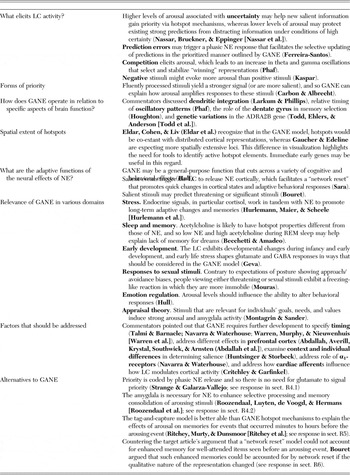
Across the commentaries discussing GANE's relevance to cognitive and neural processes, several important themes emerged (see Table R1). Generally, the responses can be grouped as having one of two foci (with some exceptions): behavioral and cognitive aspects of the arousal by priority interaction relevant to GANE or the NE hotspot mechanism itself.
General topics raised in commentaries.

To predict which information will be selectively enhanced or impaired by arousal, it is important to focus on the two key factors necessary to ignite a hotspot: (1) an arousing–inducing stimulus that can stimulate LC activity (NE), and (2) a stimulus that has high priority (glutamate). As outlined in Table R1, several of the commentaries elaborated on these two factors, as well as on other issues and themes. We discuss the issues raised in the commentaries here in our response, starting with the topic of arousal.
R1. Arousal
A number of the commentaries raise questions regarding arousal.
R1.1. Nature of arousal
In our view, the LC–NE system is not the only brain system involved in a generalized arousal response (see Pfaff Reference Pfaff2006 for a review of arousal pathways in the brain), but its activation is a common theme that runs through all different modes of arousal. For instance, NE inputs to cells in the ventromedial hypothalamus are critical in initiating sexual arousal (Pfaff Reference Pfaff2006; of relevance for Mouras' commentary), whereas noradrenergic input to the amygdala is critical in enhancing memory for emotionally arousing stimuli (see Roosendaal et al.'s commentary and sect. R4.2 on the role of the amygdala).
What is arousal? At the most basic level, we have the contrast between sleep and wakefulness. NE is low during most sleep states (see Becchetti & Amadeo). Then, during wakefulness, physical activity increases NE (Carter et al. Reference Carter, Yizhar, Chikahisa, Nguyen, Adamantidis, Nishino, Deisseroth and de Lecea2010). But in addition to these broad-scale changes, the arousal system is also exquisitely sensitive and can adapt rapidly to small changes in the environment or internal goals.
These arousal responses can be detected by measuring pupil dilation. NE system activity increases pupil dilation, as NE released by the LC inhibits pupil constriction (Koss et al. Reference Koss, Gherezghiher and Nomura1984; Wilhelm Reference Wilhelm2008). Pupils are constricted during sleep, compared with wakefulness (Yoss et al. Reference Yoss, Moyer and Hollenhorst1970). During wakefulness, aerobic exercise (Ishigaki et al. Reference Ishigaki, Miyao and Ishihara1991) or muscular exertion (Nielsen & Mather Reference Nielsen and Mather2015; Nielsen et al. Reference Nielsen, Barber, Chai, Clewett and Mather2015) increases pupil dilation. Arousal induced by stimuli or tasks also increases pupil dilation. For example, emotionally arousing scenes (Bradley et al. Reference Bradley, Costa and Lang2015), sexually arousing stimuli (Bradley et al. Reference Bradley, Costa and Lang2015), surprise, uncertainty, loud noises, and cognitive effort all increase pupil dilation. Subjective arousal ratings given for emotional images correlate with pupil diameter during viewing (Bradley et al. Reference Bradley, Miccoli, Escrig and Lang2008). These consistencies across different elicitors of arousal suggest they share some underlying mechanisms to modulate cognitive and brain processing. Eldar et al. review a recent line of work in which they used pupil dilation as a marker of NE activity and found that indices of high NE function are associated with increased selectivity in learning, perception, and memory, consistent with their neural network models in which NE was modeled as global increase in gain. GANE complements and extends this approach by providing hypotheses about how NE implements neural gain.
We agree with Mouras and Kaspar regarding the relevance of sexual arousal and internal sources of arousal (such as from one's thoughts). Our point of view is that these different types and sources of arousal can be accommodated by the GANE model, as evidence suggests that LC activation is a common theme for all of them.
R1.2. How the heartbeat influences LC activity
The LC is influenced not only by external stimuli and an individual's own thoughts, but also by interoceptive signals. For example, distension of the bladder or colon increases LC activity (Elam et al. Reference Elam, Thorén and Svensson1986), whereas an increase in blood pressure decreases LC activity (Elam et al. Reference Elam, Yoa, Svensson and Thoren1984). LC neurons also exhibit cardiac periodicity. For example, in cats, LC neurons are most likely to fire 80–180 ms after the peak of the cardiac R-wave (during diastole) and least likely to fire 40 ms before to 60 ms after the R-wave (during systole) (Morilak et al. Reference Morilak, Fornal and Jacobs1986).
Critchley & Garfinkel have shown that stimuli detection and memory encoding differ during the systole (contraction) and diastole phases of the heartbeat. During systole, participants are better able to detect fear (but not neutral) faces in an attentional blink paradigm and rate them as more intense (Garfinkel et al. Reference Garfinkel, Minati, Gray, Seth, Dolan and Critchley2014). When words are the T2 stimuli in an attentional blink paradigm, later memory for the words depends on both the confidence with which the words were originally detected and at what heartbeat phase the words were detected (Garfinkel et al. Reference Garfinkel, Barrett, Minati, Dolan, Seth and Critchley2013). Words detected with high confidence during systole have a memory advantage, whereas words detected with low confidence during systole have a memory disadvantage. Therefore, during systole, highly salient stimuli such as fear faces and clearly detected target words get a boost in processing or later consolidation. But why would this GANE-like pattern occur during systole when the LC neurons are less likely to fire? This surprising aspect of the findings suggests the possibility that LC activity and salient glutamatergic representations may interact best when they are offset slightly in time.
Critchley & Garfinkel argue that the GANE notion that LC–NE activity amplifies salience is not sufficient to account for their findings because their cardiac cycle effects sometimes appear to be driven by fear rather than arousal more generally. However, as illustrated in their figure, there was not a significant difference between fear and disgust or happy faces, and the disgust and happy faces showed trends toward enhancement where neutral faces showed a trend toward impairment at diastole. Fear faces are often more salient than happy or disgust faces (Anderson et al. Reference Anderson, Christoff, Panitz, De Rosa and Gabrieli2003; Mather & Knight Reference Mather and Knight2006); therefore, we think more work is needed before a specific-emotion account must be invoked in place of a salience mechanism such as that provided by GANE.
R1.3. How arousal may amplify the salience of negative stimuli
Kaspar makes the case that negative stimuli may be more likely than positive stimuli to ignite neuronal hotspots because of the evolutionary pressure not to miss potential threats. One challenge is how to test this hypothesis, as negative stimuli, on average, induce more arousal than positive stimuli (Grühn & Scheibe Reference Grühn and Scheibe2008), and so any differences in processing or memory between negative and positive stimuli could be due to different levels of arousal when processing them, rather than to different levels of priority. To try to address this question, we recently ran a study in which we induced arousal independently by having participants squeeze a ball in their hand as hard as they could before they viewed emotional pictures and examined how the resulting increases in arousal influenced memory for the pictures (Nielsen et al. Reference Nielsen, Barber, Chai, Clewett and Mather2015). We were interested in hormonal effects, and all participants were younger female women. Consistent with Kaspar's predictions, we found that handgrip-induced arousal enhanced memory for the negative, but not the positive pictures. This effect was most pronounced for women with low estrogen and progesterone levels at the time of testing.
Kaspar also suggested that because of declines in the LC–NE system, negative stimuli lose their arousing potential as people age. However, the evidence suggests that the older adults' positivity effect is not due to a lack of bottom-up salience for negative stimuli. Like younger adults, older adults look first at arousing stimuli regardless of their valence (Knight et al. Reference Knight, Seymour, Gaunt, Baker, Nesmith and Mather2007) and notice arousing or threatening stimuli more quickly than other types of stimuli (Leclerc & Kensinger Reference Leclerc and Kensinger2008; Mather & Knight Reference Mather and Knight2006). Bottom-up affective salience should play less of a role in influencing processing for low-arousal pictures, and indeed, the positivity effect appears to be stronger among valenced stimuli low rather than high in arousal (Kensinger Reference Kensinger2008). In addition, we found that arousal induced by handgrip selectively benefited memory encoding of negative pictures (compared with positive or neutral pictures) in older women not taking hormone supplements, as well as in younger women with low estrogen and progesterone levels (Nielsen et al., Reference Nielsen, Chai and Matherin preparation). The evidence thus suggests that arousing negative pictures have similar bottom-up salience for older and younger adults.
R1.4. Relation between arousal and appraisal theory
On the basis of appraisal theory, Montagrin & Sander raise a question about how arousal and priority interact. They argue that arousal and goal relevance are not independent and stimuli that are relevant for individuals' goals, needs, and values induce strong arousal and amygdala activity. We agree with them: Given that the LC exhibits phasic activity in response to goal-relevant stimuli (Aston-Jones & Cohen Reference Aston-Jones and Cohen2005; Aston-Jones et al. Reference Aston-Jones, Rajkowski and Cohen1999), it seems possible that goal-relevant stimuli become arousing. However, the appraisal theory approach they discuss does not detail the neural mechanisms by which arousal induced by goal-relevant stimuli helps people memorize (Montagrin et al. Reference Montagrin, Brosch and Sander2013) and prioritize attention to those stimuli (Pool et al. Reference Pool, Brosch, Delplanque and Sander2015). In contrast, our GANE model can explain their findings of enhanced processing of goal-relevant stimuli: once the amygdala and/or prefrontal regions detect goal-relevant stimuli and recruit the LC (see Sara & Bouret Reference Sara and Bouret2012 for discussion of amygdala and prefrontal inputs to LC), NE hotspots will be generated in circuits transmitting goal-relevant information and, in turn, hotspots will enhance memory and perception for those stimuli. Therefore, GANE does not contradict the appraisal model, but instead extends it.
R1.5. Arousal and emotion regulation
Hull argues that the role of arousal in GANE is relevant for understanding impairments in emotion regulation. In particular, when stuck on a particular representation associated with negative emotions, decreases in arousal may be necessary to allow for less emotionally disturbing representations to be prioritized. Although not addressed in Hull's commentary, a related point is the relevance of GANE for disorders such as post-traumatic stress disorder (PTSD), in which intrusive thoughts are a problem. A particular disturbing thought or memory may induce arousal, which, in turn, enhances attention to and memory reconsolidation of that particular representation. On the basis of GANE, beta blockers during initial encoding or retrieval of the memory should attenuate the immediate strength of its activation and its long-term synaptic strength. Consistent with this are some observational findings suggesting that beta blockers may help prevent intrusive thoughts or PTSD (Krauseneck et al. Reference Krauseneck, Padberg, Roozendaal, Grathwohl, Weis, Hauer, Kaufmann, Schmoeckel and Schelling2010; Lindgren et al. Reference Lindgren, Fagundes, Alfano, Povoski, Agnese, Arnold, Farrar, Yee, Carson and Schmidt2013), although random assignment has yielded some null effects (Stein et al. Reference Stein, Kerridge, Dimsdale and Hoyt2007).
R2. Priority
Other commentaries focused on physiological and psychological aspects of priority, a key factor in GANE.
R2.1. Perspectives on physiological mechanisms of priority
Larkum & Phillips describe a novel physiological mechanism by which contextual information modulates pyramidal cell activity. Neocortical pyramidal cell bodies have an apical trunk that ascends to a dendritic branching pattern called an apical tuft, which resides in a different cortical layer than the cell body and the basal dendrites around it. The long distance of the apical tuft from the cell body sets it up to serve a modulatory role in driving cell activity (Phillips Reference Phillips2015). Apical amplification could, for example, provide top-down priority selection of a quiet bottom-up auditory input to cortical output circuits. In their figure, Larkum & Phillips illustrate the interaction between GANE and apical amplification priority, providing an experimentally testable physiological model. Houghton argues that, computationally, the mossy cell hilar circuit in hippocampus would set priority for hippocampal processing and suggests heavy hilar NE innervation is consistent with GANE amplification of that mechanism. Becchetti & Amadeo make the interesting point that conscious (and, thus, prioritized) oneiric processing occurs during rapid eye movement (REM) sleep, likely supported by high acetylcholine modulation. But with active suppression of LC–NE during REM, there is little or no memory of those priority events, also consistent with GANE.
R2.2. Possible relation between fluency and priority
Carbon & Albrecht point out that fluency (i.e., processing information more easily) is an important factor determining stimulus priority. Greater fluency can arise because of perceptual salience (e.g., reading a word printed in a clear, high-contrast font more quickly than a blurry word) or because of prior knowledge or experience (e.g., reading a familiar word more easily than an unfamiliar word). Previous findings had suggested that people feel more positively about stimuli that they process more fluently (e.g., Winkielman & Cacioppo Reference Winkielman and Cacioppo2001). In a recent study, Albrecht and Carbon (Reference Albrecht and Carbon2014) presented affective pictures that were either preceded (507 ms earlier) by that same image or by a different image shown for only 7 ms and asked participants to rate the valence of the pictures. There was no main effect of valence, but, instead, an amplification effect, with highly positive pictures rated more positively when they had been primed and highly negative pictures rated more negatively when they had been primed. Insofar as fluently processed stimuli yield higher glutamatergic activity than less fluently processed stimuli (something that seems plausible but remains to be tested) and that the emotional stimuli elicited arousal, their findings that valence judgments of emotional stimuli are amplified by fluency fit with GANE.
R3. Predictive utility of GANE
Huntsinger & Storbeck and Talmi & Barnacle argued that GANE does not provide clear predictions concerning whether the presentation of emotionally arousing stimuli would enhance or impair cognitive processing of stimuli that appear nearby in time or space. Huntsinger & Storbeck state that GANE can provide post hoc explanations about the effects of emotional stimuli in a range of situations, but they question GANE's predictive utility. Talmi & Barnacle also argue that because we don't know exactly how long emotional stimuli dominate competition for representation, we can explain either the enhanced or impaired effects of emotional stimuli on nearby neutral stimuli by GANE.
We agree with them that it is hard to determine priority when comparing emotional with neutral stimuli. As discussed in our target article, emotional stimuli tend to have higher priority than neutral stimuli because of their goal relevance, bottom-up salience, and emotional salience. Thus, in the hypothetical experiment Huntsinger & Storbeck mention, where emotional stimuli are presented as distractors with task-relevant neutral stimuli, emotional distractors can have higher priority than neutral goal-relevant stimuli. This could especially be the case when the top-down control mechanisms are not strong enough to establish the goal relevance of neutral stimuli (see Warren et al.).
Talmi & Barnacle suggest that one can get around the issue of the different salience between emotional and neutral stimuli by having a long interval between emotional and subsequent neutral stimuli. But it is not clear that having a long interval would increase the priority of neutral stimuli as high as that of emotional stimuli. In addition, because high arousal can impair top-down prioritization (Arnsten Reference Arnsten2011; Kuhbandner & Zehetleitner Reference Kuhbandner and Zehetleitner2011), top-down control mechanisms might fail to increase the priority of neutral stimuli presented after emotional stimuli. These considerations suggest that in their EEG study (Barnacle et al., Reference Barnacle, Schaefer, Tsvilis and Talmiin preparation), neutral stimuli intermixed with emotional stimuli still had lower priority than neutral stimuli presented in a neutral list, which led to the impaired processing of neutral stimuli in the intermixed condition as predicted by GANE. Furthermore, having a long interval has the disadvantage that the effects of phasic arousal and NE release might not last long enough to yield modulatory effects (see Section 9 in our target article).
In summary, it is difficult to test GANE in experimental settings where researchers simply include emotionally arousing stimuli and neutral stimuli without a clear manipulation of priority. In our view, to test GANE, it is important to manipulate the priority of neutral stimuli, independently from arousal (Lee et al. Reference Lee, Sakaki, Cheng, Velasco and Mather2014b; Sakaki et al. Reference Sakaki, Fryer and Mather2014a; Sutherland & Mather Reference Sutherland and Mather2012). One way to achieve this in the context of Barnacle et al. (Reference Barnacle, Schaefer, Tsvilis and Talmiin preparation) would be to have high-priority neutral images and low-priority neutral images in the mixed list condition. Similar changes can be made in the bridge study mentioned by Huntsinger & Storbeck (Dutton & Aron Reference Dutton and Aron1974); GANE predicts that arousal induced by the scary bridge will enhance memory for nearby high-priority stimuli (e.g., a woman seen on the bridge if the participant were asked to approach a woman and ask her something) while impairing memory for nearby low-priority stimuli (e.g., a man on the bridge who has no task relevance or particular interest). In summary, GANE can provide clear predictions as long as priority levels can be manipulated or assessed in the experiment.
R4. Alternatives to GANE proposed in commentaries
Several of the commentaries propose alternatives to GANE to explain the mechanisms by which arousing stimuli affect cognitive processing.
R4.1. NE-only model
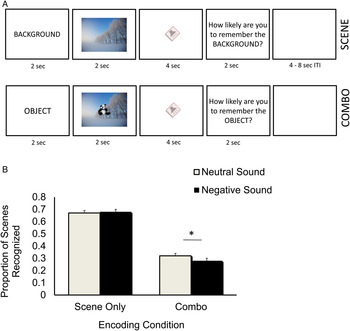
Strange & Galarza-Vallejo propose that the glutamate aspect of the model is not necessary; they describe a simpler model in which priority is coded by phasic NE release in the brain. They work through an example from research on the emotional oddball – 1 (E-1) effect, in which emotional oddballs (words or pictures) impair memory for the immediately preceding item on the list if that item was low priority for the participant, but enhance it if that item was high priority (e.g., Sakaki et al. Reference Sakaki, Fryer and Mather2014a). A problem with their NE-only model is that it is not clear how phasic NE release can selectively “tag” the E-1 item and not other items. Perhaps in the simple setup they describe, in which one word or object appears at a time in the list, phasic NE release could mark activated neural networks via a temporal tagging process. However, they do not consider findings that when multiple items are shown simultaneously, whether and how much memory for them is enhanced or impaired by a subsequent emotional item depends on their priority. For example, in an experiment in which a scene was shown either alone or with an object superimposed (Fig. R1A), if the image was followed by an emotional sound, there was impaired memory for the scene later, but only if it had been made lower priority by being in the background (Fig. R1B) (Ponzio & Mather Reference Ponzio and Mather2014). Likewise, in another study in which participants saw four items at the same time that were then followed by a tone that was conditioned to predict either a shock (CS+) or no shock (CS−), having a subsequent arousing tone affected later memory for the simultaneously shown items differently depending on the relative priority of the items (Lee et al. Reference Lee, Greening and Mather2015). The model Strange and Galarza-Vallejo propose does not explain how phasic LC activation could have different effects on items shown at the same time. In our view, this is the main contribution of GANE: by positing a mechanism for local cortical modulation of NE, it provides the only explanation to date of how arousal can have simultaneous differential effects on items based on their priority.
(A) Arousing negative sounds were heard after seeing a background scene either alone or superimposed with a foreground object. (B) The arousing sounds impaired memory for the scene only when it was seen behind the object and, therefore, was somewhat suppressed by that competitor (Ponzio & Mather Reference Ponzio and Mather2014).

R4.2. Amygdala-based model
Roozendaal et al. argue that the amygdala is necessary for NE to enhance selective processing and memory consolidation of arousing stimuli. We agree that the amygdala plays a critical role, but argue below that its role in mediating the effects of NE is necessary only when the amygdala is the primary site of the neural representation in question.
Data from individuals with amygdala lesions help reveal which types of representations depend on the amygdala and which types can be supported by other brain regions. Compared with controls, unilateral amygdala patients exhibited as much enhanced visual cortex activity when viewing emotionally salient images (Edmiston et al. Reference Edmiston, McHugo, Dukic, Smith, Abou-Khalil, Eggers and Zald2013), as much of an advantage for detecting emotional targets (Piech et al. Reference Piech, McHugo, Smith, Dukic, Van Der Meer, Abou-Khalil and Zald2010), and as much emotional capture by emotional stimuli during an attentional blink task (Piech et al. Reference Piech, McHugo, Smith, Dukic, Van Der Meer, Abou-Khalil, Most and Zald2011). Two individuals with selective bilateral amygdala lesions exhibited a significant advantage in recalling aversive (compared with neutral) words during an attentional blink task, and this advantage was as large as that seen for matched control participants (Bach et al. Reference Bach, Talmi, Hurlemann, Patin and Dolan2011). Someone with complete bilateral amygdala lesions who could not recognize fear from faces still showed normal rapid detection of those faces (Tsuchiya et al. Reference Tsuchiya, Moradi, Felsen, Yamazaki and Adolphs2009). Thus, the amygdala is not necessary for the initial selective attention and encoding advantages seen for emotionally arousing stimuli, suggesting that NE–glutamate hotspots in sensory brain regions can occur even in the absence of the amygdala.
In addition, highly salient sensory stimuli yield normal physiological responses in people missing amygdalae (e.g., Tranel & Damasio Reference Tranel and Damasio1989). For example, in studies of fear conditioning, individuals with amygdala lesions have normal skin conductance responses to aversive stimuli such as loud noises (Bechara et al. Reference Bechara, Tranel, Damasio, Adolphs, Rockland and Damasio1995; Klumpers et al. Reference Klumpers, Morgan, Terburg, Stein and van Honk2014). Likewise, three patients with bilateral amygdala lesions each had a panic attack when inhaling 35% CO2 (Feinstein et al. Reference Feinstein, Buzza, Hurlemann, Follmer, Dahdaleh, Coryell, Welsh, Tranel and Wemmie2013), indicating that amygdala lesion patients still experience fear in response to interoceptive alarming cues. These intact responses to interoceptive or external sensory stimuli contrast with the lack of fear shown by amygdala patients in response to experiences or visual stimuli (e.g., a haunted house or a live snake) that typically elicit fear because of their association with danger (Feinstein et al. Reference Feinstein, Adolphs, Damasio and Tranel2011).
This pattern of findings suggests that the amygdala is essential for anticipatory physiological responses to stimuli that predict something aversive. This possibility is supported by fear conditioning studies with individuals with amygdala lesions (Bechara et al. Reference Bechara, Tranel, Damasio, Adolphs, Rockland and Damasio1995; Klumpers et al. Reference Klumpers, Morgan, Terburg, Stein and van Honk2014). These individuals lacked skin conductance responses to CS+ cues that predicted loud noises, even though they acquired explicit knowledge about the CS+ contingency. In contrast, an individual with bilateral hippocampal lesions failed to acquire explicit knowledge about the contingency, but had skin conductance responses to the CS+ (Bechara et al. Reference Bechara, Tranel, Damasio, Adolphs, Rockland and Damasio1995). Therefore, amygdala lesions impair physiological responding to cues that predict threat, but do not impair explicit learning about these cues. Amygdala lesions also impair physiological responding to simulated monetary rewards and losses in the context of a gambling game (Bechara et al. Reference Bechara, Damasio, Damasio and Lee1999), indicating that the amygdala is necessary for an abstract stimulus predicting something positive or negative to yield a physiological affective response.
The findings that patients with amygdala lesions no longer have physiological responses to predictive cues despite having as much explicit knowledge of the contingencies as normal controls suggests that: (1) there are amygdala-based neural representations of associations between neutral cues and potential affectively relevant outcomes; and (2) these amygdala-based representations are necessary to trigger signals to sympathetic pathways to mount a physiological response, possibly in part via amygdala projections to the LC (Cedarbaum & Aghajanian Reference Cedarbaum and Aghajanian1978).
Likewise, the finding that an individual with a hippocampal lesion lacked explicit knowledge of fear conditioning contingencies despite exhibiting a skin conductance response to the CS+ suggests that there also are amygdala-independent, hippocampus-based neural representations of associations between CSs and USs. However, in people with intact amygdalae and hippocampi, these separate representations in the two regions are likely to have close interactions, in part supported by a direct glutamatergic pathway from the basolateral amygdala to the CA1 region of the hippocampus (Rei et al. Reference Rei, Mason, Seo, Gräff, Rudenko, Wang, Rueda, Siegert, Cho, Canter, Mungenast, Deisseroth and Tsai2015).
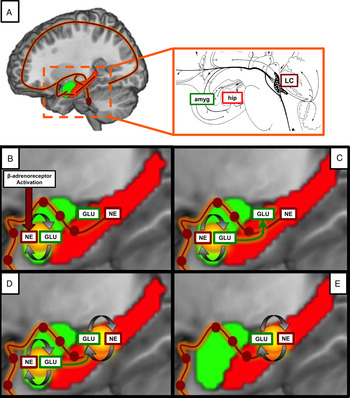
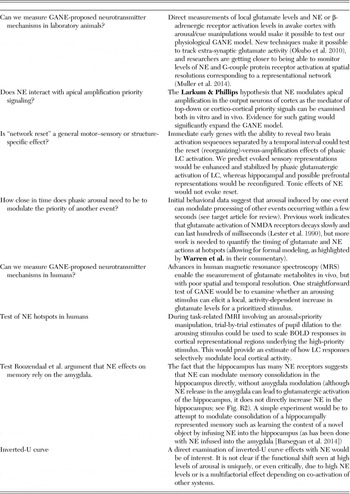
Noradrenergic contributions to interactions between amygdala and hippocampus have been examined using one-trial learning to avoid a shock (McIntyre et al. Reference McIntyre, Miyashita, Setlow, Marjon, Steward, Guzowski and McGaugh2005). In this paradigm, the β-adrenergic receptor agonist clenbuterol is infused into the basolateral complex of the amygdala shortly after a rat learns that moving from a brightly lit compartment of an alley through a door to a dark compartment is associated with a shock. The β-adrenergic stimulation of the amygdala increases Arc expression (indicating more synaptic changes occurred) in the hippocampus in the 45 min after the shock. Of particular relevance in this context, however, are findings that the increased Arc expression depends not only on greater NE activity in the amygdala itself, but also on arousal levels more generally (McReynolds et al. Reference McReynolds, Anderson, Donowho and McIntyre2014). Specifically, whereas basolateral amygdala infusions of a β-agonist increased Arc protein levels for the inhibitory avoidance shock task, as seen in previous studies and also for a “high-arousal” version of an object recognition task, NE activity in the amygdala was not sufficient to increase Arc in the hippocampus when the object recognition task was not arousing. These findings suggest that glutamate–NE feedback loops in the amygdala can be intensified by within-amygdala local β-adrenergic activation (Fig. R2A). This hotspot activity increases glutamatergic signaling to the hippocampus (Fig. R2B) but does not directly increase NE levels in the hippocampus. However, the increased glutamatergic activity in the hippocampus can stimulate local release of NE via NMDA receptor activity at LC neuron varicosities if the LC is depolarized (Fig. R2C; see target article for more details on hotspot mechanisms). In summary, McReynolds and colleagues' data suggest that NE can influence hippocampal activity either indirectly via glutamatergic pathways from the amygdala or directly via local release from LC varicosities. More generally, we posit that NE action within the amygdala has important glutamatergic modulatory effects elsewhere in the brain (in particular in the hippocampus), but that the LC also modulates excitation and inhibition directly in these other brain regions via local release of NE. The critical experiments necessary to test this hypothesis have not been performed yet (see relevant proposed study in Table R2).
Previous findings suggest that NE can influence hippocampal activity both directly from NE release from LC neurons and also via amygdala glutamatergic pathways. (A) LC neurons innervate both amygdala and hippocampus. (B) NE released during LC activation (or, in the case of McReynolds et al., Reference McReynolds, Anderson, Donowho and McIntyre2014 discussed in the text, a β-agonist) interacts with activated local glutamatergic representations within the amygdala to create a hotspot of higher glutamatergic activity. (C) These glutamate-NE hotspots originating in the amygdala amplify hippocampal glutamatergic activity via glutamatergic pathways. Neurons originating in the amygdala connecting to the hippocampus do not release NE, and so amygdala activity will not directly affect NE levels in the hippocampus. (D) However, amygdala modulation of hippocampal glutamatergic activity can increase the probability of local hotspots developing in the hippocampus, because if the LC is depolarized, the amygdala-induced glutamatergic activation in the hippocampus stimulates local NE release and further amplifies glutamatergic activation via glutamate-NE hotspot mechanisms. (E) Even in the absence of amygdala modulatory activity, NE hotspots can develop in the hippocampus from excited glutamatergic activity interacting with NMDA receptors on local LC neuron varicosities to increase local release of NE, as demonstrated in hippocampal slice preparations (e.g., Lalies et al., Reference Lalies, Middlemiss and Ransom1988; Nelson et al., Reference Nelson, Zaczek and Coyle1980; Pittaluga & Raiteri, Reference Pittaluga and Raiteri1990; Vezzani et al., 1987; Wang et al., 1992). Note: Inset in (A) is reprinted with permission from Marien et al. (Reference Marien, Colpaert and Rosenquist2004), p. 41, part of Figure 2.

Data needed to test hypotheses and better understand arousal–priority or NE–glutamate interactions.

Roozendaal et al. also argue that “the impairing effects of amygdala–NE interactions on memory of non-salient/non-arousing information involve an active process that is dependent on the amygdala.” They make this case based on Lovitz and Thompson (Reference Lovitz and Thompson2015), whom they interpret as showing that intra-basolateral amygdala infusion of a β-adrenergic agonist (clenbuterol) decreases hippocampal excitability in non-inhibitory avoidance-trained control animals. However, their interpretation appears to be incorrect, as in that study, there was no significant difference between vehicle and clenbutorol conditions in the untrained rats.
R5. Role of NE hotspots in long-term memory formation
Some commentaries raise questions concerning the role of NE hotspots in memory. First, Hurlemann et al. point out the importance of cortisol, in addition to NE and glutamate, in explaining the effects of arousal on memory. Combining neuroimaging with a psychopharmacological approach, Hurlemann et al. demonstrated that NE and glucocorticoids interact during processing of emotional stimuli (Hurlemann Reference Hurlemann2008; Kukolja et al. Reference Kukolja, Schlapfer, Keysers, Klingmuller, Maier, Fink and Hurlemann2008; Reference Kukolja, Klingmuller, Maier, Fink and Hurlemann2011). In particular, their work suggests that NE interacts with cortisol to enhance learning of emotional information within the amygdala–hippocampus network.
Acute stress and administration of glucocorticoids lead to enhanced glutamate release both in the amygdala (Reznikov et al. Reference Reznikov, Grillo, Piroli, Pasumarthi, Reagan and Fadel2007) and in the hippocampus (Moghaddam et al. Reference Moghaddam, Bolinao, Stein-Behrens and Sapolsky1994) via mechanisms mediated by glucocorticoid receptors (GRs) and mineralocorticoid receptors (MRs) (for reviews, see Popoli et al. Reference Popoli, Yan, McEwen and Sanacora2012; Sandi Reference Sandi2011). In the amygdala and hippocampus, interactions between glucocorticoids and NE have been observed, as well (for reviews Joëls et al. Reference Joëls, Fernandez and Roozendaal2011; Krugers et al. Reference Krugers, Karst and Joels2012). These results suggest the interesting possibility that glucocorticoids help NE create hotspots in the amygdala–hippocampus circuit by enhancing glutamatergic activity. One question is whether the NE–cortisol interaction goes beyond the amygdala–hippocampus circuit. Although most previous research focuses on the effects of glucocorticoids either in the amygdala-hippocampus pathway or in the prefrontal cortex (PFC), glucocorticoids might also amplify NE hotspots in other cortical regions, given that GRs are widely expressed in brain (Morimoto et al. Reference Morimoto, Morita, Ozawa, Yokoyama and Kawata1996). Furthermore, elevated cortisol and NE levels tend to impair goal-directed attentional processes in the PFC (Schwabe et al. Reference Schwabe, Tegenthoff, Höffken and Wolf2012), which should enhance the impact of the bottom-up, salience-driven hotspots predominant in sensory brain regions.
Second, Ritchey et al. state that the tag-and-capture model is better able than GANE hotspot mechanisms to explain the effects of arousal on memories for events that occurred minutes to hours before the arousing event. For example, initially weak memories can be strengthened by a subsequent salient signal, such as a novelty or aversive event (Dunsmoor et al. Reference Dunsmoor, Murty, Davachi and Phelps2015; Redondo & Morris Reference Redondo and Morris2011). The tag-and-capture model explains these results by asserting that memory traces are tagged during initial learning, which allows for subsequent plasticity-related protein-mediated mechanisms to capture those tagged traces to create long-term memories. Ritchey et al. also argue that the effects of arousal on protein synthesis processes are mediated by dopaminergic neuromodulation.
Although in our target article we focused mainly on the immediate effects of NE hotspots, we believe that evidence indicates a role for these hotspots in tag-and-capture scenarios. β-Adrenergic receptor activity stimulates protein synthesis and gene expression alterations associated with long-term potentiation maintenance (Maity et al. 2016; O'Dell et al. Reference O'Dell, Connor, Gelinas and Nguyen2010). NE hotspots should play a role in tag-and-capture by elevating local NE levels to activate β-adrenergic receptors, as well as by increasing glutamatergic activation of NMDA receptors. Both β-adrenergic activity and NMDA activity (in addition to dopamine D1/D5 receptor activity) are essential to “set the learning tag” for an initial weak memory, and β-adrenergic receptor activation is required during exposure to the modulating novel event occurring an hour later (Moncada et al. Reference Moncada, Ballarini, Martinez, Frey and Viola2011). A particularly intriguing finding is that the behavioral tagging phenomenon requires the initial weak event and the subsequent novel event to occur in the same sensory modality, thereby activating the same general population of neurons (Ballarini et al. Reference Ballarini, Moncada, Martinez, Alen and Viola2009). Likewise, Dunsmoor et al. (Reference Dunsmoor, Murty, Davachi and Phelps2015) found that fear conditioning enhanced memory for previously learned images only when those images were semantically related to a fear-conditioned category; when images of animals were fear-conditioned, memories for previously learned animals were enhanced, whereas when images of tools were fear-conditioned, memories for previously learned tools were enhanced. This is consistent with the local nature of NE hotspots and raises the interesting question of just how widely the plasticity-related proteins stimulated via β-adrenergic receptor activation at NE hotspots modulate interconnected memory circuitries. The behavioral findings (Ballarini et al. Reference Ballarini, Moncada, Martinez, Alen and Viola2009; Dunsmoor et al. Reference Dunsmoor, Murty, Davachi and Phelps2015) suggest that they do not have an influence much beyond a local region that represents the same category or sensory modality of item. Although much still needs to be worked out about the potentially complementary roles of dopamine and norepinephrine on tag-and-capture phenomena, we believe that thinking about the local nature of the β-adrenergic activity induced by arousing modulatory events will be fruitful.
R6. GANE amplification of prioritized representations during a “network reset”
According to a prominent theory, NE release orchestrates a “network reset” that reorients attention and, consequently, reorganizes underlying representational networks during a sudden and unexpected change in environmental imperatives (Bouret & Sara Reference Bouret and Sara2005; Sara & Bouret Reference Sara and Bouret2012). We agree with Sara's perspective that GANE is complementary to the “reset” hypothesis. From the perspective of GANE, whether this type of reorienting occurs will depend on whether there are currently representations with high glutamatergic activity or not. If there are no current strongly active representations, both GANE and the network reset theory predict that the predominant effect of an increase in LC activity would be to enhance reorientation to new salient stimuli. However, when there is already a highly active representation, GANE predicts that an increase in LC activity will further enhance processing of that representation (e.g., Anderson et al. Reference Anderson, Wais and Gabrieli2006; Knight & Mather Reference Knight and Mather2009; Sakaki et al. Reference Sakaki, Fryer and Mather2014a), rather than having a network reset effect. On the basis of these findings, in our target article we argued that the network reset perspective fails to account for the ability of arousal to enhance memory of preceding high-priority information. Bouret responded by suggesting that enhanced memory for a preceding event could be consistent with a network reset if, when an arousing event occurred, the preceding salient event was now represented in a qualitatively different way that was integrated with the arousing event.
Consistent with Bouret's argument that arousal enhances memory for preceding information when the preceding information is integrated with the arousing events, in fear/evaluative conditioning paradigms events repeatedly followed by emotional outcomes acquire emotional properties (for a review, see Baeyens et al. Reference Baeyens, Field and Houwer2005). Our previous research also demonstrated that when individuals are presented with neutral cues followed by emotional or neutral outcomes, emotional outcomes facilitate memory for neutral cues only when they are aware of the cue–outcome contingency (Mather & Knight Reference Mather and Knight2008; Sakaki et al. Reference Sakaki, Ycaza-Herrera and Mather2014b).
To address the important question raised by Bouret about whether arousal changes the nature of representations, future research should probe the effects of arousal on the specificity of mental and neuronal representations. At least one recent study suggests active sensory representations are strengthened, rather than altered, by noradrenergic system activation (Shakhawat et al. Reference Shakhawat, Gheidi, MacIntyre, Walsh, Harley and Yuan2015). In addition, our findings suggest that emotional arousal enhances the veracity of the original representation, or detail memory, rather than gist alone (Sakaki et al. Reference Sakaki, Fryer and Mather2014a).
R7. Alternative ways to trigger LC activity
Although most of the target article focused on how emotionally arousing stimuli shape cognitive processing, non-emotional stimuli can also activate the LC and thereby influence cognition. In this section, we discuss how prediction errors, uncertainty, and competition each influence LC activity.
R7.1. Prediction errors
Prediction is a central feature of efficient cognitive processing. As described by Ferreira-Santos, GANE fits well with “predictive coding” frameworks of cognition: Sudden mismatches between predicted and actual sensory and affective inputs represent an important form of conflict and competition that can elicit arousal and LC activity. Supporting this view, pupil dilation has been linked to the occurrence of prediction errors (Braem et al. Reference Braem, Coenen, Bombeke, van Bochove and Notebaert2015; Preuschoff et al. Reference Preuschoff, Marius't Hart and Einhäuser2011). Furthermore, in monkeys, phasic LC activity ceases to signal the occurrence of reward once the reward follows a specific action predictably (Sara & Segal Reference Sara and Segal1991). Other research also indicates that affect enhances prediction error responses (Vogel et al. Reference Vogel, Shen and Neuhaus2015a) and that prediction errors are a fundamental component of generating interceptive feelings (Barrett & Simmons Reference Barrett and Simmons2015).
R7.2. Uncertainty
As pointed out by Nassar et al., as well as by Bouret, it is important to consider the purpose of having one level of arousal modulate cognitive processing differently than another level. When is it useful for cognitive processing to remain focused on previously salient information? And when will it be advantageous to be open to new prioritized information? Nassar and colleagues argue that during times of uncertainty, it is especially important not simply to focus on current prioritized cues, but to amplify incoming prioritized sensory information (Yu & Dayan Reference Yu and Dayan2005). They review findings that pupil diameter is larger during periods of uncertainty than when expectations are reliable. Thus, tonically higher levels of NE should decrease the threshold for new salient stimuli to ignite hotspots. They suggest that older adults' deficits in learning under conditions of uncertainty may be linked to age-related declines in LC function.
R7.3. Competition and conflict
As highlighted by Phaf, there is much evidence that competition and conflict between representations induce arousal. These stimuli/events are also likely to produce hotspots, based on evidence that conflict, along with novelty, target detection, uncertainty, and performance errors, elicit LC activity (for reviews, see Berridge & Waterhouse Reference Berridge and Waterhouse2003; Nieuwenhuis et al. Reference Nieuwenhuis, Aston-Jones and Cohen2005a; Ullsperger et al. Reference Ullsperger, Harsay, Wessel and Ridderinkhof2010; Yu & Dayan Reference Yu and Dayan2005). Fundamentally, GANE predicts that any stimulus that activates the LC–NE system will produce hotspots in an activity-dependent manner, regardless of whether NE release is triggered by something emotional or not. If competition elicits arousal, it could very well be an effect driven by prediction errors (i.e., significant discrepancies between feedforward and feedback inputs; see sect. R7.1), initiating a network reset via the LC.
Phaf also discusses the distinct but complementary roles of theta and gamma oscillations in signaling and resolving stimulus conflict, respectively. According to Phaf, theta arises from conflict, is a substrate of arousal, and helps select dominant representations via intercortical communication. Subsequently, gamma oscillations facilitate a resetting and stabilization of “winning” representations. His description is consistent with Sara's empirical data. In her commentary, Sara describes evidence that stimulating the LC briefly suppresses gamma oscillations for 200 ms, which is followed by a near doubling of the gamma power immediately afterward, as well as an increase in theta power (Sara Reference Sara2015). Interestingly, in an early report of conflict activating LC, the absence of expected reward elicited a specific theta band increase (~7.7 Hz) in hippocampus (Gray & Ball Reference Gray and Ball1970). This effect was later demonstrated to require forebrain norepinephrine (Gray et al. Reference Gray, McNaughton, James and Kelly1975). It could be useful to reexamine this theta signature of LC activation (for more recent support, see Walling et al. Reference Walling, Brown, Milway, Earle and Harley2011) and its role in synchronizing activity for prioritized representations. Another interesting question is whether (as suggested in the target article) NE hotspots enhance local gamma power via a β-adrenergic pathway, thereby increasing selective attention.
R8. Additional mechanistic considerations/complications for GANE
As noted by several commentators, GANE is necessarily a simplification of a complex reality. It does not, for example, incorporate the function of postsynaptic α2-receptors, the subthreshold input promoting role of α1-receptors, the synergistic role of α1- with β-adrenergic receptors or recently described astrocytic functions of α1-receptors. The co-release of peptides from LC varicosities is not considered; neither is the probable role of other neuromodulators known to be elevated in various forms of arousal discussed. This is a beginning that will, ideally, lead to a more veridical model of cortical self-regulation that addresses how neurotransmitters released during arousal interact with local cortical conditions to modulate activity in flexible yet highly targeted ways.
R8.1. Varied effects of adrenoreceptors
As highlighted in several commentaries, the GANE model does not incorporate all known adrenoreceptor functions. These omissions include the role of postsynaptic α2-receptors that play important roles in the PFC (see commentaries by Abdallah et al. and Todd et al. and that also occur in other areas of neocortex (Venkatesan et al. Reference Venkatesan, Song, Go, Kurose and Aoki1996). Navarra & Waterhouse and Gaucher & Edeline point out that α1-adrenoreceptors have more varied actions, including synergism with β-adrenoreceptor effects, potentiation of effects on their own, and astrocytic action. In particular, they highlight that the role of α1-adrenoreceptor in sensory cortex may be facilitatory: When activated, these receptors appear to potentiate postsynaptic excitatory responses and can boost subthreshold inputs (for a review, see Berridge & Waterhouse Reference Berridge and Waterhouse2003). Furthermore, global astrocytic calcium waves are initiated via LC–NE activation of astrocytic α1-adrenoreceptors (Ding et al. Reference Ding, O'Donnell, Thrane, Zeppenfeld, Kang, Xie, Wang and Nedergaard2013), consistent with a model in which LC–NE global effects recruit both α1- and α2-adrenoreceptors.
R8.2. Suppressive effects of NE in sensory regions
Gaucher & Edeline emphasize the suppressive actions of exogenous NE on processing in auditory cortex as being inconsistent with GANE. But their finding that a small population of auditory neurons encoding natural stimuli are enhanced by NE (Gaucher & Edeline Reference Gaucher and Edeline2015) and contribute to discrimination is similar to newer findings in olfactory cortex that LC–NE modulation is essential for difficult natural odor discrimination and increases the stability of small distributed odor representations (Shakhawat et al. Reference Shakhawat, Gheidi, MacIntyre, Walsh, Harley and Yuan2015), as predicted by GANE.
R8.3. Differential effects of adrenergic receptors in prefrontal and posterior cortex
Abdallah et al. highlight the differences between the actions of NE on classic sensory synapses in subcortical and posterior sensory regions and newly evolved circuits in layer 3 of the dorsolateral PFC (DLPFC). On the basis of animal and human research, they suggest hotspot effects are most likely to occur in sensory and limbic (e.g., amygdala, hippocampus) synapses where β-adrenoreceptors promote glutamate responses and long-term potentiation. In the PFC, in contrast to “classic” sensory areas, β-adrenoreceptor activation has been found to impair rather than enhance postsynaptic function via increased cAMP signaling (Arnsten et al. Reference Arnsten, Raskind, Taylor and Connor2015a; Ramos & Arnsten Reference Ramos and Arnsten2007). Like β-adrenoreceptors, α1- and α2-adrenoreceptors also appear to have contrasting influence on neuronal activity in the PFC versus sensory cortices. Although α1-receptors enhance sensory neuron firing, they tend to impair PFC function and working memory (Ramos & Arnsten Reference Ramos and Arnsten2007). On the other hand, whereas α2-receptors enhance inhibitory signals and suppress noisy activity in the posterior cortex, their activation strengthens dorsolateral PFC functional network connectivity and promotes working memory (Arnsten et al. Reference Arnsten, Wang and Paspalas2012).
These inverted rules of adrenoreceptor function in the PFC have important implications for how GANE influences cognitive processing during sudden arousal. Although an arousal-induced surge of NE may disrupt working memory representations in the DLPFC (e.g., current event models), it should also transiently enhance the throughput of strong glutamatergic signals in the hippocampus (Brown et al. Reference Brown, Walling, Milway and Harley2005). Therefore, DLPFC impairments may facilitate reorientation during arousal to information that has bottom-up salience and is associated with hotspots of high activity in sensory regions but not in PFC.
R8.4. Relative timing of arousal and prioritization process
The key distinction outlined in the previous section between the effects of NE in sensory cortices and limbic regions versus the PFC agrees well with the timing hypotheses proposed by Warren et al. In their commentary, Warren and colleagues present evidence that the relative strength of bottom-up and top-down (cognitive control) priority inputs changes rapidly within a single trial. Whereas bottom-up salience dominates the competition for mental resources early on, cognitive control processes take longer to develop and overcome the initial dominance of perceptual salience. Warren et al. suggest that this time-variant model of salience determines whether phasic arousal enhances or impairs task-relevant (but not perceptually salient) information.
Indeed, the GANE model predicts that arousal-induced NE release will bias competition in favor of whatever information has the highest priority at that moment. Experiencing arousal while a representation is highly active should strengthen that representation regardless of whether top-down goals or bottom-up salience prioritized the representation, because the representation was activated before moderate to high levels of NE could disrupt goal-directed processing in the PFC (Ramos & Arnsten Reference Ramos and Arnsten2007). In contrast, the source of priority may matter more when experiencing arousal before a stimulus is perceived. Although prestimulus arousal should amplify the effects of bottom-up salience, it may diminish the effects of top-down priority if, as outlined in the previous section, working memory processes that help maintain and implement processing goals are impaired by the arousal (Ramos & Arnsten Reference Ramos and Arnsten2007).
Data from our lab provide clear evidence that prestimulus arousal enhances the impact of bottom-up salience (Lee et al. Reference Lee, Sakaki, Cheng, Velasco and Mather2014b; Sutherland & Mather Reference Sutherland and Mather2012), whereas poststimulus arousal enhances the impact of top-down prioritization (Lee et al. Reference Lee, Greening and Mather2015; Sakaki et al. Reference Sakaki, Fryer and Mather2014a). Whether arousal enhances priority for the other two combinations remains to be seen. We have not yet tested scenarios in which something perceptually salient is followed by something arousing, but GANE would predict that as long as the representation associated with that perceptually salient item were still strongly active when arousal increased, it would benefit further from the arousal. In contrast, as outlined above, the situation in which arousal occurs before top-down prioritization occurs could show the reverse effect; insofar as arousal disrupts the ability of the PFC to prioritize an otherwise nonsalient stimulus, arousal should diminish the impact of top-down priority because the goal-relevant representation is not highly activated. Consistent with this, we have found that playing an emotional sound before a brief display of letters makes it harder for participants to selectively report the letters in the high point value color (Sutherland et al., under review). Given the impairing effects of high NE on DLPFC, for a prestimulus arousal to enhance processing of a goal-relevant item, the goal prioritization process would need to be relatively independent of the PFC, perhaps because it is automatic or habitual.
R8.5. Inverted-U relationship between LC firing and cognitive selectivity
Aston-Jones and Cohen (Reference Aston-Jones and Cohen2005) proposed an inverted-U model of tonic NE function, in which low tonic LC activity promotes being inattentive and nonalert, moderate LC activity promotes being focused, and high tonic LC activity promotes distractibility. In their commentary, Navarra & Waterhouse ask where along the inverted-U function the glutamate–NE interactions proposed in GANE would operate. Their question is in part inspired by data from Devilbiss and Waterhouse (Reference Devilbiss and Waterhouse2000), who simultaneously administered glutamate and NE into in vitro rat barrel field cortex slices. They found that some cells showed a monotonic suppression of the excitatory postsynaptic response to glutamate, as NE increased. Other cells showed an inverse U shape, in which there were increasing glutamate-evoked discharges as NE increased to 5 nA, but then decreasing glutamate-evoked discharges as NE tonic levels were further increased (10–30 nA). These findings suggest that tonic levels of NE modulate postsynaptic responses to glutamatergic input, which is quite interesting. In particular, it seems that high tonic levels of NE would quiet activity in neurons exhibiting this postsynaptic NE suppression, which could contribute to the general decrease in neural noise seen under arousal (one interesting side note is that they found that, unlike in layers II/III, NE-induced facilitation of glutamate-evoked responses was the predominant response in layer V, which may be connected to the apical amplification ideas of Larkum & Phillips). However, the in vitro preparation of the study eliminated the LC from the equation and so did not provide the opportunity to observe the glutamate-evoked local release of NE proposed in GANE. As outlined in Table R2, more research is needed measuring in vivo interactions of glutamate and NE, as the GANE hotspot mechanism involves interactions between the LC and distant cortical representations.
R8.6. Individual differences
Geva points out that tonic levels of arousal predict whether infants orient toward novel or familiar stimuli, and suggests that infancy is an interesting test case for GANE, as, unlike in later stages of development, infants lack an “established neural network set with implicit know-hows” that provide the glutamatergic priority signal necessary to ignite hotspots under arousal. Differences at the other end of life are also relevant, as Nassar et al. point out. Genetic variation in adrenergic receptors also may matter; Todd et al. make the case that ADRA2b deletion carriers have reduced inhibitory autoreceptor function.
R9. Conclusions
As evinced by the diverse range of commentary, the NE hotspot mechanism goes beyond just the emotion–cognition literature to explain how arousal influences different forms of cognitive selectivity. One of GANE's most vital contributions is that it showcases the ability of the cortex to regulate its own processing efficiency. Such local control of cognition represents a fundamental mechanism of adaptive brain function that has the potential to explain a variety of cognitive phenomena. As GANE exemplifies, synaptic activity is not just passively modified by neuromodulators. Instead, under situations of arousal that demand our attention, such as threat or excitement, salient brain signals recruit the ingredients necessary to form lasting memories.



Target article
Norepinephrine ignites local hotspots of neuronal excitation: How arousal amplifies selectivity in perception and memory
Related commentaries (27)
Adaptive memory systems for remembering the salient and the seemingly mundane
Amplified selectivity in cognitive processing implements the neural gain model of norepinephrine function
Are there “local hotspots?” When concepts of cognitive psychology do not fit with physiological results
Arousal-biased preferences for sensory input: An agent-centered and multisource perspective
Bidirectional synaptic plasticity can explain bidirectional retrograde effects of emotion on memory
Bodily arousal differentially impacts stimulus processing and memory: Norepinephrine in interoception
Cognitive control, dynamic salience, and the imperative toward computational accounts of neuromodulatory function
Competition elicits arousal and affect
Contemplating the GANE model using an extreme case paradigm
Dentate gyrus and hilar region revisited
Does arousal enhance apical amplification and disamplification?
Effect of arousal on perception as studied through the lens of the motor correlates of sexual arousal
Emotional memory: From affective relevance to arousal
Emotionally arousing context modulates the ERP correlates of neutral picture processing: An ERP test of the GANE model
For better or worse, or for a change?
GANEing on emotion and emotion regulation
Glutamate and norepinephrine interaction: Relevance to higher cognitive operations and psychopathology
Importance of amygdala noradrenergic activity and large-scale neural networks in regulating emotional arousal effects on perception and memory1
Interactions of noradrenaline and cortisol and the induction of indelible memories
Locus coeruleus reports changes in environmental contingencies
Once more with feeling: On the explanatory limits of the GANE model and the missing role of subjective experience
The Fluency Amplification Model supports the GANE principle of arousal enhancement
The role of arousal in predictive coding
What BANE can offer GANE: Individual differences in function of hotspot mechanisms
What do we GANE with age?
Why we forget our dreams: Acetylcholine and norepinephrine in wakefulness and REM sleep
“What have we GANEd?” A theoretical construct to explain experimental evidence for noradrenergic regulation of sensory signal processing
Author response
GANEing traction: The broad applicability of NE hotspots to diverse cognitive and arousal phenomena