




No CrossRef data available.
Article contents
Bidirectional synaptic plasticity can explain bidirectional retrograde effects of emotion on memory
Published online by Cambridge University Press: 05 January 2017
Abstract
Emotional events can either impair or enhance memory for immediately preceding items. The GANE model explains this bidirectional effect as a glutamate “priority” signal that modulates noradrenaline release depending on arousal state. We argue for an alternative explanation: that priority itself evokes phasic noradrenaline release. Thus, contrasting E-1 memory effects are explained by a mechanism based on the Bienenstock–Cooper–Munro theory.
Information
- Type
- Open Peer Commentary
- Information
- Copyright
- Copyright © Cambridge University Press 2016
References
Abraham, W. C. & Tate, W. P. (1997) Metaplasticity: A new vista across the field of synaptic plasticity. Progress in Neurobiology
52(4):303–23.Google Scholar
Anderson, A. K., Wais, P. E. & Gabrieli, J. D. E. (2006) Emotion enhances remembrance of neutral events past. Proceedings of the National Academy of Sciences of the United States of America
103(5):1599–604. doi: 10.1073/pnas.0506308103.Google Scholar
Aston-Jones, G., Rajkowski, J., Kubiak, P. & Alexinsky, T. (1994) Locus coeruleus neurons in monkey are selectively activated by attended cues in a vigilance task. The Journal of Neuroscience
14(7):4467–80.Google Scholar
Bienenstock, E. L., Cooper, L. N. & Munro, P. W. (1982) Theory for the development of neuron selectivity: Orientation specificity and binocular interaction in visual cortex. The Journal of Neuroscience
2(1):32–48.Google Scholar
Diamond, D. M., Park, C. R. & Woodson, J. C. (2004) Stress generates emotional memories and retrograde amnesia by inducing an endogenous form of hippocampal LTP. Hippocampus
14(3):281–91.Google Scholar
Dudek, S. M. & Bear, M. F. (1992) Homosynaptic long-term depression in area CA1 of hippocampus and effects of N-methyl-D-aspartate receptor blockade. Proceedings of the National Academy of Sciences of the United States of America
89(10):4363–67.Google Scholar
Hu, H., Real, E., Takamiya, K., Kang, M.-G., Ledoux, J., Huganir, R. L. & Malinow, R. (2007) Emotion enhances learning via norepinephrine regulation of AMPA-receptor trafficking. Cell
131(1):160–73.CrossRefGoogle ScholarPubMed
Kemp, A. & Manahan-Vaughan, D. (2008) β-adrenoreceptors comprise a critical element in learning-facilitated long-term plasticity. Cerebral Cortex
18(6):1326–34.Google Scholar
Kim, J. J. & Yoon, K. S. (1998) Stress: Metaplastic effects in the hippocampus. Trends in Neurosciences
21(12):505–509.Google Scholar
Knight, M. & Mather, M. (2009) Reconciling findings of emotion-induced memory enhancement and impairment of preceding items. Emotion
9(6):763–81. doi: 10.1037/a0017281.Google Scholar
Strange, B. A. & Dolan, R. J. (2004) Beta-adrenergic modulation of emotional memory-evoked human amygdala and hippocampal responses. Proceedings of the National Academy of Sciences of the United States of America
101(31):11454–58.Google Scholar
Strange, B. A., Hurlemann, R. & Dolan, R. J. (2003) An emotion-induced retrograde amnesia in humans is amygdala- and beta-adrenergic-dependent. Proceedings of the National Academy of Sciences of the United States of America
100(23):13626–31. Available at: http://www.ncbi.nlm.nih.gov/pubmed/14595032.Google Scholar
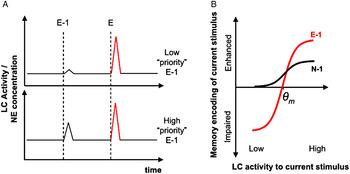
Figure 1. Alternative model for bidirectional retrograde effects of emotion on memory. (A) LC responses are illustrated schematically to the presentation of two pairs of E-1 and E items (stimulus onset is indicated by vertical dashed lines). If the E-1 item is of high priority (i.e., the encoding task requires attention to this item), the LC response is higher than that to a low-priority E-1 item. Subsequent presentation of the E item triggers greater LC activity. (B) Hypothesized likelihood of encoding the current neutral stimulus, as a function of LC activity to that stimulus, depending on whether the subsequent stimulus is emotional (red curve) or neutral (black). If the subsequent stimulus is emotional (i.e., triggers large NE release), low E-1 LC activity is more likely to lead to subsequent forgetting of the E-1 stimulus. θm=modification threshold.
An emotional stimulus is typically well remembered but also influences memory for temporally adjacent events. In humans, we reported an emotion-induced retrograde impairment of memory in the context of shallow encoding of word lists containing an occasional emotional (E) noun (Strange et al. Reference Strange, Hurlemann and Dolan2003). This retrograde disruption for “E-1” nouns appears to be mediated by the amygdala via a noradrenergic (NE) mechanism, as it is blocked by the β-adrenergic antagonist propranolol (Strange et al. Reference Strange, Hurlemann and Dolan2003). However, subsequent studies have indicated that, if the encoding task requires that attentional weight be given to each E-1 stimulus, these stimuli show memory enhancement (Anderson et al. Reference Anderson, Wais and Gabrieli2006; Knight & Mather Reference Knight and Mather2009). Mather et al. propose that for tasks involving attention to E-1 items, this “priority” signal is mediated by glutamate. According to their model, in a state of arousal, this elevated glutamate level associated with highly active neural representations stimulates greater NE release, leading to enhanced encoding of E-1 stimuli.
We propose that the opposing retrograde effects of emotion on memory can be explained by an alternative, simpler model. We propose that “priority” itself is coded by phasic NE release in the brain. Attending to task-relevant cues has been found to increase activity in the locus coeruleus (LC) in non-human primates (Aston-Jones et al. Reference Aston-Jones, Rajkowski, Kubiak and Alexinsky1994). Thus, high-“priority” E-1 encoding is likely to be associated with moderate levels of LC activity (Figure 1A, bottom). Given that enhanced memory for emotional items is blocked by propranolol, we assume that these emotional items provoke LC activity (Figure 1A, bottom). Because of the aversive nature of the E stimuli, this LC activity is likely to be greater than that evoked by task-relevant E-1 items. By contrast, in the case of low-“priority” E-1 encoding, E-1 items trigger minimal LC activity (Figure 1A, top).
Alternative model for bidirectional retrograde effects of emotion on memory. (A) LC responses are illustrated schematically to the presentation of two pairs of E-1 and E items (stimulus onset is indicated by vertical dashed lines). If the E-1 item is of high priority (i.e., the encoding task requires attention to this item), the LC response is higher than that to a low-priority E-1 item. Subsequent presentation of the E item triggers greater LC activity. (B) Hypothesized likelihood of encoding the current neutral stimulus, as a function of LC activity to that stimulus, depending on whether the subsequent stimulus is emotional (red curve) or neutral (black). If the subsequent stimulus is emotional (i.e., triggers large NE release), low E-1 LC activity is more likely to lead to subsequent forgetting of the E-1 stimulus. θ m=modification threshold.
The bidirectional effects of emotion on memory for E-1 items can then be explained by a non-linear relationship between LC activity to E-1 items and memory encoding. According to the Bienenstock–Cooper–Munro model (Bienenstock et al. Reference Bienenstock, Cooper and Munro1982), when the postsynaptic cell is weakly depolarized by other inputs, active synapses undergo long-term depression (LTD) as opposed to long-term potentiation (LTP) (Dudek & Bear Reference Dudek and Bear1992; Abraham & Tate Reference Abraham and Tate1997). The modification threshold, θ m, is the measure of postsynaptic activity that determines the direction of synaptic-efficacy change. In this scheme, if postsynaptic activity is below θ m, but above baseline, synaptic efficacies are weakened. Conversely, if postsynaptic activity exceeds θ m, synapses are strengthened. In Figure 1B, we apply this model to E-1 memory encoding (red curve). For low-priority E-1 items, postsynaptic activity is below θ m at the time of LC responses to the E noun, leading to a weakening of the efficacy of synapses that were engaged during the immediately preceding E-1 encoding (Diamond et al. Reference Diamond, Park and Woodson2004). For high-priority E-1 items, postsynaptic activity is already relatively high (above θ m) when the E stimulus is presented, yielding memory enhancement (red curve in Figure 1B). Note that the bidirectionality of this proposed effect is dependent on the presentation of E items. The black curve in Figure 1B represents memory for a stimulus that precedes a neutral (N) item (i.e., an N-1 stimulus) plotted as a function of the LC activity to this stimulus. Obviously, if, for any reason, this “N-1” stimulus evokes LC activity, its memory will be enhanced, but not to the level of enhanced E-1 memory. Importantly, N-1 memory will not be impaired even if it is low priority.
Thus, applying a model of the bidirectional nature of synaptic plasticity (Bienenstock et al. Reference Bienenstock, Cooper and Munro1982) that has been validated in the context of NE stimulation (Hu et al. Reference Hu, Real, Takamiya, Kang, Ledoux, Huganir and Malinow2007; Kemp & Manahan-Vaughan Reference Kemp and Manahan-Vaughan2008) can fully explain retrograde memory effects of emotion in a parsimonious way. The change in synaptic efficacy most likely occurs within a limited brain circuit involving amygdala and hippocampus (Strange & Dolan Reference Strange and Dolan2004), with NE input from the LC. It will be interesting to test whether contexts proposed to modulate θ m, such as stress (Kim & Yoon Reference Kim and Yoon1998), will alter the direction of memory modulation for E-1 items for a given encoding task. Interestingly, blocking β-adrenergic receptors with propranolol does not abolish the emotion-induced retrograde amnesia for low-priority E-1 stimuli, but actually enhances memory for these E-1 items (Strange et al. Reference Strange, Hurlemann and Dolan2003). It is tempting to speculate that propranolol decreases θ m (i.e., shifts the red curve in Figure 1b to the left), such that low levels of LC activity to low-priority E-1 nouns become associated with better memory.