We partner with a secure submission system to handle manuscript submissions.
Please note:
You will need an account for the submission system, which is separate to your Cambridge Core account. For login and submission support, please visit the
submission and support pages.
Please review this journal's author instructions, particularly the
preparing your materials
page, before submitting your manuscript.
Click Proceed to submission system to continue to our partner's website.
To save this undefined to your undefined account, please select one or more formats and confirm that you agree to abide by our usage policies. If this is the first time you used this feature, you will be asked to authorise Cambridge Core to connect with your undefined account.
Find out more about saving content to .
To send this article to your Kindle, first ensure no-reply@cambridge.org is added to your Approved Personal Document E-mail List under your Personal Document Settings on the Manage Your Content and Devices page of your Amazon account. Then enter the ‘name’ part of your Kindle email address below. Find out more about sending to your Kindle.
Find out more about saving to your Kindle.
Note you can select to save to either the @free.kindle.com or @kindle.com variations. ‘@free.kindle.com’ emails are free but can only be saved to your device when it is connected to wi-fi. ‘@kindle.com’ emails can be delivered even when you are not connected to wi-fi, but note that service fees apply.
Stressful life events (SLE) may influence the illness course and outcome.
Objectives
The present study aimed to characterize socio-demographic and clinical characteristics of euthymic major depressive disorder (MDD) outpatients with SLE relative to those without.
Methods
This sample included 628 (mean age=55.1 ± 16.1) currently euthymic MDD outpatients, among them 250 (39.8%) reported SLE and 378 (60.2%) did not.
Results
After univariate analyses, outpatients with SLE were most frequently widowed and lived predominantly with friends/others. Furthermore, compared to outpatients without SLE, those with SLE were more likely to have a family history of suicidal behavior, manifested melancholic characteristics and higher Coping Orientation to the Problems Experienced (COPE) positive reinterpretation/growth and less likely to manifest a comorbid panic disorder, residual interepisodic symptoms, have used psychiatric medications, and use current antidepressant medications. After regression analyses, having a family history of suicide (OR=9.697; p=≤.05), history of psychotropic medications use (OR=2.888; p=≤.05), and reduced use of antidepressants (OR=.321; p=.001) were significantly associated with SLE. Mediation analyses demonstrated that the association between current use of antidepressants and SLE was mediated by previous psychiatric medications.
Conclusions
Having a family history of suicide, history of psychotropic medications use, and reduced use of antidepressants may confer a specific “at risk” profile related to the enhanced vulnerability to experience SLE.
In many countries, depressed individuals often first visit primary care settings for consultation, but a considerable number of clinically depressed patients remains unidentified. Introducing additional screening tools may facilitate the diagnostic process.
Objectives
This study aims to examine whether Experience Sampling Method (ESM)-based measures of depressive affect and behaviors can discriminate depressed from non-depressed individuals. In addition, the added value of actigraphy-based measures was examined.
Methods
We used data from two samples to develop and validate prediction models. The development dataset included 14 days of ESM and continuous actigraphy of currently depressed (n=43) and non-depressed individuals (n=82). The validation dataset included 30 days of ESM and continuous actigraphy of currently depressed (n=27) and non-depressed individuals (n=27). Backward stepwise logistic regression analyses were applied to build the prediction models. The performance of the models was assessed with the goodness of fit indices, calibration curves, and discriminative ability (AUC, the area under the receiver operating characteristic curve).
Results
In the development dataset, the discriminative ability was good for the actigraphy model (AUC=0.790) and excellent for the ESM (AUC=0.991) and combined-domains model (AUC=0.993). In the validation dataset, the discriminative ability was reasonable for the actigraphy model (AUC=0.648) and excellent for the ESM (AUC=0.891) and combined-domains model (AUC=0.892).
Conclusions
ESM is a good diagnostic predictor and is easy to calculate, and, therefore, holds promise for implementation in clinical practice. Actigraphy shows no added value to ESM as a diagnostic predictor, but might still be useful when active monitoring with ESM is not feasible.
Social medias are seen as a risk factor for mental health because they increase body dissatisfaction and decrease self-esteem. This program is based on alimentation and physical well-being by relying on integrated intuitive eating and physical self-esteem. This program, implemented in a community setting use social media (i.e. Instagram-Loricorps), is composed of 12 monthly 180-second video capsule that address themes related to the promotion of body sensations and intuitive movement.
Objectives
The main objective of this study is to evaluate the effects of the program into the physical environment targeting the physical self-perceptions (PSP). Specifically, this study evaluates whether the eSILENCE 1.0 Program improves the level of PSP related to nutrition and explores the changes in the level and variability of the PSP.
Methods
This project is a mixed sequential explanatory study. 300 participants (Experimental Group [EG; N=200], Control Group [CG; N=100]) are targeted. Online nomothetic questionnaires evaluate occupational changes and PSP in relation to alimentation and are completed by the EG and the CG at pre-test, mid-test and post-test. Online idiographic questionnaires assess PSP and are completed by the EG before and after each video capsule and by the CG once a month without viewing the capsules. Following a preliminary analysis, a focus group will be formed to explain and deepen these results. Participants (N=5) will be recruited voluntarily into the EG.
Results
to come.
Conclusions
Analysis of quantitative data will be used to assess the effectiveness of the program and analysis of qualitative data will provide an in-depth understanding of the linkages between the variables.
In France about 10,000 suicides/year are recorded. General practitioners (GPs) have an important role in prevention, with consultation rates between 20% and 76% the day preceding suicide. StopBlues is an application/website for primary prevention of suicide in the general population. Its promotion was supported by municipalities and involved GPs.
Objectives
To evaluate how the involvement of GPs in the promotion of StopBlues had an impact on its utilization.
Methods
StopBlues was promoted in 25 French municipalities randomly assigned to a ‘basic’ promotion group organized by municipalities only or an ‘intensified’ promotion group that also includes promotion in GPs’ waiting rooms. StopBlues users were asked how they found out about StopBlues. After two years, an ad hoc questionnaire was sent to all GPs (N=2,111).
Results
StopBlues users from those municipalities (N=885) were 16% to learn about StopBlues from GPs, 93% of them living in municipalities with ‘intensified’ promotion. In the ‘basic’ group, where no GPs have heard about StopBlues, 15% would like to know more about it/will have a look at it and 8% will use it and recommend it to colleagues. Half of GPs from the ‘intensified’ group had heard about the program, with 24% who recommended StopBlues to some patients. 21% of GPs agreed that they will use it and recommend it to colleagues.
Conclusions
Involving GPs in the use of e-health tools is of major interest to improve their utilization. Our results show that GPs are in need of those in dealing with patients with psychological pain/distress.
The virtual environment with realistically rendered fear-inducing stimuli is enough to conduct VR exposure therapy (VRE), although the total control over the virtual environment also enables presentation of stimuli, contexts, and tasks not possible in in vivo exposure therapy (i.e. flight etc.)30 randomized controlled trials revealing high efficacy and effect sizes comparable of VRE-CBT to in vivo exposure therapy. Aerophobia is a very frequent limitation and affect 25% of the population and 30% of the subjects who fly make habitual use of anxiolytics.
Objectives
The aims of this study is to show that conducting VR exposure in CBT for simple phobia (flight phobia) is effective and is an efficacious treatment for fear and anxiety,Vs other treatments.
Methods
Participants (n = 39; age between 19 and 60 years) in the active arms received individual CBT VR exposure for six sessions and outcome was assessed with questionnaires: MSPS;Rathus Assertiveness Scale (RAS); HAM-A; QMAV; QSAV – (Flying fear); QoL INDEX and a behaviour avoidance test (really take the plane). Wilcoxon tests was using for the statistical analysis.
Results
36 subjects managed to take the plane at the end of treatment and the results obtained showed a significant difference between “before treatment (T0) and after (T1)” with the exception of the Rathus test. All the SF-36 scales show a significant difference between “before-after”. 3 subjects was dropped out
Conclusions
Using VR can be advantageous over standard CBT as a potential solution for treatment avoidance and as an efficient, cost-effective and practical medium of exposure.
For more than a decade, digital health has held promise for enabling a much broader population to have access to health information, education and services. However, the increasing number of studies on the subject show mixed results and currently, there is a certain disillusionment regarding its benefits. And yet, the Covid-19 crisis has revealed the importance of developing digital-based complementary support to existing resources.
Objectives
Factors associated with higher utilization rates among the target audience need to be investigated.
Methods
In 2018, 41 French cities enrolled in an intervention program aimed at promoting StopBlues®, a digital health tool that helps prevent mental distress and suicide among the general population. After two years of experimentation, a Multiple Correspondence Analysis (MCA) was performed using quantitative and qualitative data collection methods from institutional sources, questionnaires and web analytics tools.
Results
Finding trends show that higher utilization rates were associated with the involvement of general practitioners (GPs) in the promotion of StopBlues and the use of digital marketing channels. Context-specific characteristics also played an important role in the adoption of the tool.
Conclusions
The local context has a strong influence on how digital tools are locally promoted and accepted. Further research is needed to understand how local actors and specifically GPs can be involved in suicide prevention. More broadly, the challenge today is to ensure acceptance of digital health technology among targeted populations by adapting the digital offer to their needs and promoting the available tools.
The Eye Movement Desensitization and Reprocessing (EMDR) therapy has shown to be useful in the treatment of PTSD, general anxiety, stress and burnout. Nonetheless, assessing therapy progress has been limited to subjective appreciations of the patient and therapist, which compromise therapy efficacy, and the continuum of care (clinic and at home) and scalability that digitized approaches can offer.
Objectives
The aim of the present study was to validate the potential of a smartphone-based biofeedback digitized approach for EMDR usage in burnout therapy, as a means to provide quantitative progress assessment and personalized therapy optimization.
Methods
A digitized burnout status assessment app based on Maslach Burnout Inventory was first implemented and tested. Then, an EMDR app was developed by making use of adjustable audiovisual stimuli (e.g. different velocity and horizontal/vertical visual stimuli; and different pitch and left-right surround sound effects) and also of the smartphone’s camera photoplethysmography finger recordings from which heart rate, heart rate variability and breathing rate are derived and used for modulating stimuli (biofeedback). Finally, interviews with several EMDR experts were conducted to assess the potential of the app as a therapeutic adjuvant.
Results
The preliminary interview results showed that the app can be useful for online therapy, to optimize the stimuli presentation, and to quantify the therapy experience and outcomes. The interviews also validated the technical specifications and usability of the tool.
Conclusions
Results so far have shown a promising receptivity and interest from EMDR experts. As such, patient testing is currently on-going.
Disclosure
The work of the present abstract is the basis of the research conducted at the Faculty of Sciences of the University of Lisbon, co-lead with NEVARO, a spin-off company of the same Faculty.
Under the umbrella of e-Mental Health (eMH), Telepsychiatry (TP) keeps its place as the oldest and best-documented application. Legislative issues, and the concerns related to the quality of care and patient safety, have kept TP from broader adoption. COVID19 pandemic seems to be a turning point for TP as well as for the eMH in general. The use of TP has exploded as many regulatory barriers to its use have been temporarily lowered during the COVID-19 pandemic. What has to be done to sustain this momentum?
Objectives
-outline temporary changes in TP regulations made due to COVID19; -discuss which of these should be maintained, modified, or reversed; -suggest additional initiatives needed to facilitate patient and professional use of digital technology.
Methods
Examination of the use of digital technology in the light of regulatory, legislative, and other changes and initiatives made due to COVID 19.
Results
Among several policy changes, the most important is e.g. removal of the “originating site” rule so professionals can be paid for a remote appointment wherever the patient is, including in the patient’s home. Further, professionals were allowed to serve patients through everyday communication technologies such as FaceTime, WhatsApp, Viber, or Skype, all compromising patient/data safety.
Conclusions
EPA is perfectly positioned to be the frontrunner for the required initiatives i.e. mandatory lectures related to eMH at medical educational institutions, launching of TP-competency training of mental health professionals, regulatory and statutory changes e.g. unified licensure regulations, etc that are crucial for modernizing mental health care delivery and preparation for future unprecedented events.
There is a growing interest in the relationship between Autism Spectrum Disorders (ASD) and Eating Disorders (ED), two relatively common conditions lying on a spectrum from mild to severe clinical features. However, only limited data are available about pathological eating behaviours throughout adults on the autistic spectrum.
Objectives
The aim of the present study is to assess dysfunctional eating behaviours, including ED manifestations and ASD-related eating disturbances, in a population of adults with ASD with no intellectual disabilities.
Methods
We recruited 115 adults on the autistic spectrum, with no intellectual disability and 114 neurotypical adults (NA). Participants completed the “Eating Attitude Test” (EAT-26), to measure symptoms and concerns characteristic of ED, and the “Swedish Eating Assessment for Autism Spectrum Disorders” (SWEAA), to assess eating behaviours frequently seen within the autistic spectrum.
Results
Subjects with ASD scored significantly higher than NA at the EAT-26 and at the SWEAA. Women reported higher scores than men. Moreover, an interaction effect Group*Gender emerged at the EAT-26 only, with women with ASD scoring higher than men with and than NA overall. ASD subjects scored higher than NA at the EAT-26 subscales Dieting and Bulimia. Furthermore, the higher the SWEAA total score was, the more likely it was that a subject on the autistic spectrum would score above the cut-off of 20 at the EAT-26.
Conclusions
These results indicate that adults with ASD without intellectual disability presented not only a higher prevalence of eating disturbances typical of autistic spectrum, but also other ED symptoms in comparison to NA.
Sexual dysfunction is common in eating disorders (EDs), but its relevance is often overlooked.
Objectives
To describe different ED clinical subgroups in terms of psychopathology, putative biological correlates, and consequences of dysregulated sexuality, focusing on the role of childhood trauma.
Methods
Healthy controls (n=60), binge-purging (n=38), and restricting patients (n=24) were compared (age- and BMI-adjusted ANOVA; Bonferroni post-hoc tests), using total scores of Eating Disorder Examination Questionnaire (EDE-Q), Emotional Eating Scale (EES), SCL-90-R Global Severity Index (GSI), Barratt Impulsiveness Scale (BIS-11), Difficulties in Emotion Regulation Scale (DERS), Childhood Trauma Questionnaire (CTQ), Female Sexual Functioning Index (FSFI), Hypersexual Behaviour Inventory (HBI), and patients’ hormonal profiles (gonadal and pituitary hormones, ghrelin). Self-reported voluntary termination of pregnancy (VTP) and promiscuous sexual activity were recorded. For ED patients (N=62), regression analyses between significant variables and HBI were carried, applying moderation models for different CTQ scores.
Results
Table 1 outlines significant between-group comparisons (°: different from controls; *: different from restricting patients; p<0.05). Binge-purging patients had higher FSH, LH, and ghrelin levels, more VTPs and promiscuity. HBI showed significant correlations with EES, SCL-90-R-GSI, DERS, CTQ, and ghrelin levels. CTQ moderated interactions for DERS and EES (Figure 1).
Binge-purging
Restricting
Controls
F
EDE-Q
3.86±1.20°
3.41±1.64°
0.85±0.83
67.32
EES
40.85±22.74°*
16.01±15.88
19.87±15.21
7.01
SCL-90-R GSI
1.73±0.65°
1.27±0.69°
0.68±0.44
20.32
BIS-11
62.47±9.91°
60.81±8.56
57.04±10.04
4.99
DERS
106.97±29.15°*
83.97±33.12
78.14±14.12
10.21
CTQ
55.32±21.06°
49.31±10.81°
38.02±8.32
15.24
FSFI
17.32±11.89°*
11.70±10.98°
29.32±7.45
24.02
HBI
28.75±13.89*
20.56±3.12
26.11±4.90
4.92
Conclusions
Dysregulated sexuality is linked to emotion dysregulation and childhood trauma. Binge-purging patients experience adverse behavioural consequences.
Food addiction (FA) has been found to correlate with personality traits and psychosocial factors (Zhao et al., 2018). However, the vast majority of studies on this subject use the variable-oriented approach, which assumes that relationships between specific variables are identical in a given population (Collins & Lanza, 2010).
Objectives
The main aim of this study was to assess the heterogeneity of young adults with respect to food addiction, personality traits (extraversion, conscientiousness and emotional stability) and loneliness. The secondary aim was to examine the relationships between profile membership and well-being.
Methods
The sample consisted of 1,157 young adults (58.1% women). The Yale Food Addiction Scale, the Ten-Item Personality Inventory and the Short Loneliness Scale were used in the present study. Various aspects of well-being were included (e.g. quality of life). Latent Profile Analysis was performed twice: in the full sample, and in the subsample of individuals with increased FA (defined as z-score ≥ 1; n = 213).
Results
Four profiles were identified both in the full sample and in the subsample. The best functioning was observed in individuals who scored high on extraversion and low on loneliness, despite their relatively high levels of FA. Young adults who scored high on FA and loneliness, and low on extraversion, conscientiousness and emotional stability, were more likely to have the worst functioning.
Conclusions
Our findings suggest that using the person-oriented approach may expand our knowledge on the role of personality traits and psychosocial factors in determining the effects of FA on well-being.
Few studies have examined the course of eating disorders and the respective treatments based on insurance data, even though they provide representative information.
Objectives
To assess the epidemiology, treatments, duration of illness, costs of treatment in a data set of a public health insurance.
Methods
Data provided by a German health insurance (data from 4.2 million members from 2005-2010). A matched control group based on age and gender without an eating disorder diagnosis was used for comparisons.
Results
2.734 cases with the diagnoses of an eating disorder (anorexia nervosa AN, bulimia nervosa BN or combination ANBN) were identified. More than 92% of the patients were female. The relative risk for personality disorders, depressive disorders, alcohol abuse and obsessive-compulsive disorders was highly increased. Most of the patients with BN (53.04%) or AN (41.57%) were treated in out-patient care, and many were only treated for three months, whereas most of the patients with ANBN were treated for a longer time. 3-19% with BN, AN or ANBN were treated only in in-patient care. The in-patient costs of treatment for the year of the diagnosis were 5471.15€ for BN, 9080.26€ for AN, 10809.16€ for ANBN and 339.37€ for the control group.
Conclusions
Our findings suggest that patients with ANBN diagnosis have a severe and longer course of treatment. Furthermore, contrary to national guidelines for eating disorders, there is a considerable proportion of patients with BN or AN that are treated only in in-patient care.
Research has shown that negative affect leads to unhealthy eating, the top cause of death in the United States.
Objectives
This project examined whether AR (Affect Regulation) can be applied to incidental negative affect to improve eating behavior.
Methods
We conducted four studies.
Results
In Studies 1 and 2 (n=80), we developed a autobiographical negative affect induction, showed that it induces negative affect, and demonstrated that participants can learn to downregulate this negative affect. In Study 3 (n=40), participants completed a three-phase dietary food choice task. In phase 1, participants made food choices under neutral conditions. In phase 2, participants made food choices after receiving the negative affect induction from Studies 1 and 2. In phase 3, participants made food choices while downregulating the negative affect caused by the induction. In phase 2, participants placed less importance on health (b=-0.15, z=-5.99, p<.001) when making food choices than under neutral conditions (phase 1). In phase 3, participants successfully downregulated their negative affect (b=-1.2, t=-22.01, p<.001) and placed the same level of importance on health when making food choices as in phase 1, indicating that AR applied to incidental affect is an effective method for improving eating behavior. In Study 4 (n=120), we pre-registered and replicated our findings from Study 3. In addition, we fit drift-diffusion models to participants reaction time data and show that these results extent to the by-participant weights participants place on health when making food choices.
Conclusions
These results are a step towards scalable AR interventions to improve eating behavior.
Alexithymia, that is the inability to recognize and describe one’s own emotions, is a transdiagnostic feature across eating disorders (EDs) and it has been associated to a prolonged stress exposure.
Objectives
Therefore, we evaluated whether alexithymia affects the hypothalamus-pituitary-adrenal (HPA) axis functioning in patients with anorexia nervosa (AN) or bulimia nervosa (BN).
Methods
Twenty-six women with AN and 26 with BN participated in the study. Alexithymia was evaluated by the Toronto Alexithymia Scale–20 and eating-related psychopathology was measured by the Eating Disorder Inventory-2. The activity of the HPA axis was assessed by the salivary cortisol awakening response (CAR). Group differences in saliva CAR were tested by repeated measures 3-way ANOVA with diagnosis and alexithymia as between-subject factors.
Results
The prevalence of alexithymia did not differ significantly between the two diagnostic groups (c2=1.24, p=0.26). Alexithymia was associated with more severe eating-related psychopathology in AN women but not in BN women. A significant reduction in the magnitude of CAR occurred in alexithymic patients with BN compared to non-alexithymic patients with BN (t = 3.39, p = 0.008), but not in alexithymic women with AN (t = 0.67, p = 0.54).
Conclusions
These results confirm the presence of a more severe eating-related psychopathology in alexithymic individuals with AN and show, for the first time, an association between alexithymia and a dampened basal activity of the HPA axis in BN.
Social dysfunction is a putative risk and maintaining factor for Eating Disorders (EDs).
Objectives
We aimed to assess biological, emotional, and cognitive responses to a psychosocial stressor, in order to provide a multilevel investigation of the RDoC social process system in EDs.
Methods
Cortisol response to Trier Social Stress Test (TSST) was measured in 105 subjects: 35 women with anorexia nervosa (AN), 32 with bulimia nervosa (BN) and 38 healthy women. In a subgroup of them (23 AN, 21 BN, and 25 control women) anxiety, hunger, and desire to eat throughout the TSST were also rated.
Results
Compared to healthy women, AN and BN women showed reduced cortisol reactivity that disappeared after controlling for trait anxiety and ineffectiveness. They also displayed increased anxiety response, while only people with AN reported greater decrease in hunger and desire to eat. Baseline ineffectiveness predicted post-stress body dissatisfaction through the mediation of post-stress anxiety while no significant correlations were found between cortisol and anxiety, hunger, or desire to eat responses
Conclusions
People with EDs are characterized by blunted cortisol reactivity and greater anxiety, hunger, and desire to eat responses to a psychosocial stressor. We show a relationship between socio-emotional distress and ED-related attitudes without an association between biological and emotional or cognitive changes. This study provides the first empirical and multilevel support to a deranged functioning of the RDoC “system for social process” in EDs.
The coronavirus disease 2019 (COVID-19) pandemic and the resulting containment measures, such as “lockdown” and “social distancing”, have had important consequences on people’s mental and physical health.
Objectives
We aimed to study the effect of social isolation and subsequent re- exposure and eventual changes in general and ED-specific psychopathology in people with Eating Disorders (EDs).
Methods
Three-hundred twelve Italian people with EDs (179 Anorexia Nervosa, 83 Bulimia Nervosa, 48 Binge Eating Disorder and 22 Other Specific Feeding Eating Disorder) were asked to fill-in an online survey to explore several dimensions such as: anxiety, depression, panic, insomnia, suicide ideation, stress, post-traumatic stress and obsessive-compulsive symptoms. Differences in ED specific and general symptoms among the 3 investigated time periods (before, during and after the end of lockdown) were assessed with a one-way ANOVA with repeated measures. Subsequently, ED diagnosis was introduced as covariate in the analysis in order to investigate the possible contribution on psychopathological changes.
Results
ED core symptoms increased during the lockdown but most of them returned to pre-COVID19 levels at re-opening. The severity of general psychopathology also increased during the lockdown and persisted high in the following phase, except for depression and suicide ideation. None of this symptoms was affected by ED diagnosis, participants’age and illness duration.
Conclusions
People with EDs showed worsening of both general and specific psychopathology; moreover, changes in general psychopathology persisted in the re-opening period suggesting a higher stress vulnerability in this kind of patients.
Anandamide (AEA) and 2-Arachidonoylglycerol (2-AG) play a pivotal role in food intake and reward aspects of feeding. Aberrant functioning in the endocannabinoid system has been observed in patients with eating disorders (EDs). This dysfunction may influence the incentive processes stimulating behaviors towards food acquisition or the hedonic evaluation of ingested food.
Objectives
The aims of this study are to compare fasting peripheral levels of AEA and 2-AG in ED patients, obese subjects (OB) and healthy controls (HCs), and to explore their association with clinical and anthropometric variables.
Methods
The sample included a total of 63 adult women. Peripheral blood samples were collected to investigate fasting levels of AEA and 2-AG in 31 ED patients: 22 Anorexia Nervosa (AN) and 9 Binge Eating Disorder (BED), compared to 21 OB and 11 HCs. Several clinical and anthropometric variables were also assessed.
Results
Comparing groups, significant differences in AEA levels were found (p=0.001). Specifically, individuals with AN exhibited lower AEA than OB (p<0.001) and BED (p=0.007), while OB showed higher AEA than HCs (p=0.015). 2-AG was positively correlated with hostility dimension in EDs and negatively associated with impulsive traits in OB. AEA showed a direct association with body dissatisfaction in AN, contrary to OB. Finally, in AN, AEA negatively correlated with the body mass index, while 2-AG was positively associated with the fat mass.
Conclusions
These results suggest an interaction between biological and clinical factors defining a vulnerability pathway that could help fitting personalized therapeutic approaches in each condition.
Amenorrhea is one of the most frequent and serious consequences of Anorexia Nervosa (AN). Resumption of menses (ROM) is considered an important goal and is associated with a better outcome.
Objectives
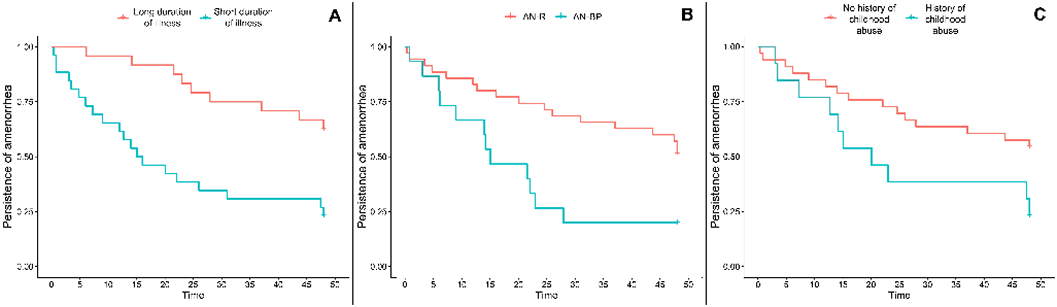
To investigate the role of age, Body Mass Index (BMI), diagnostic subtype (restrictive vs binge-purging), history of childhood abuse, duration of illness, psychopathology and sex hormones on ROM in AN.
Methods
52 patients with AN and amenorrhea were enrolled at the start of treatment. Clinical parameters of interest were collected, and questionnaires were administered for the assessment of general (SCL-90-R) and specific (EDE-Q) psychopathology. Blood samples were taken to assess FSH, LH and estradiol levels. All patients were monitored regularly through psychiatric checkups until ROM, for up to four years.
Results
A total of 30 (57.7%) subjects recovered their menstrual cycle in the follow-up period (mean time: 18.7 ± 14.8 months). Recovery was more frequent in the binge-purging subtype than in the restrictive subtype (82.4% vs 48.6%, p=0.019), and was significantly associated with diagnostic crossover (odds ratio=10.0, p=0.032). Multivariate Cox regression showed an increased likelihood of menstrual recovery for binge-purging subtype (p=0.005) and for those reporting a history of childhood abuse (p=0.025). Early ROM was also associated with baseline SCL-90-R scores (p=0.002) and FSH (p=0.011), while a longer duration of illness (p=0.003) and EDE-Q scores (p=0.009) predicted a later recovery.
Conclusions
This study highlights the role of duration of illness, childhood abuse history and psychopathological characteristics in subjects with AN at the start of treatment in predicting ROM.
Family-based therapy (FBT) has been proven effective in treating eating disorders among children and adolescents. However, many families have difficulties implementing the measures recommended in outpatient therapy.
Objectives
This study examines the effectiveness of add-on home treatment (HT) to family based therapy (FBT) in adolescents with anorexia nervosa (AN). The HT intervention is delivered by specialized nurses and aims at supporting patients and parents to re-establish family meals in the home environment.
Methods
We performed an case-control study in AN patients comparing 44 (42 female, 2 male) adolescents receiving FBT augmented with HT compared to 22 (22 female, 1 male) participants receiving FBT alone. Eating disorder diagnosis, psychopathology and severity of clinical symptoms were assessed using (EDE, EDI-2) and clinical parameters (BMI, menstrual status, level of over-exercising) at baseline and after 3-months.
Results
After 3 months both treatment groups showed a significant early weight gain, a reduction in the rate of AN diagnoses assessed with the EDE interview and a reduction in EDI-2 total scores. The combined HT/FBT group showed a significantly greater increase in BMI than the FBT-only group. In the combined HT/FBT group none of the patients had to be admitted to hospital while 13.6% of the FBT-only group had to be referred to inpatient treatment. Treatment satisfaction in the combined HT/FBT group was high in both patients and parents.
Conclusions
Our results suggest that HT augmented FBT is superior compared to FBT alone in terms of early weight gain and might reduce the risk of hospital admission in adolescent AN.
Perfectionism is a consistent risk factor for various psychopathological conditions, including psychological distress and eating disorders. Recently, we have shown, for the first time, that there is a relationship between perfectionism and generalized problematic internet use/GPIU (Sobral et al. 2020). Specifically, we found that the role of perfectionism in psychological disorder is partially mediated by GPIU. On the other hand, it has been suggested that the widespread use of digital media can lead to negative body image perception and abnormal eating attitudes and behaviors.
Objectives
To explore, for the first time, the relationship between perfectionism, GPIU and disordered eating behavior.
Methods
475 university students (78.9% girls; mean age 20.22±1.695) answered the Portuguese validated versions of: Composite Multidimensional Perfectionism Scale, GPIU Scale and Eating Attitudes Test-25. SPSS and Hayes’ Process Macro (2020) were used.
Results
Bulimic Behaviours/BB significantly and moderately correlated with Perfectionist efforts (r=.263), Perfectionist concerns (r=.284) and GPIU (r=.25) (all p<.001). The mediation analyses revealed that GPIU is a partial mediator of the relationship between both perfectionism dimensions and BB.
Conclusions
The evidence that both negative and “positive” perfectionism dimensions are associated to eating pathology is in line with our previous research. The present study adds, for the first time, that one of the perfectionism pathways of influence on BB operates through UGPI. Assessment and intervention to diminish eating psychopathology should focus on perfectionism and compulsive traits which could be involved in both ED and GPIU and in their comorbidity.