We partner with a secure submission system to handle manuscript submissions.
Please note:
You will need an account for the submission system, which is separate to your Cambridge Core account. For login and submission support, please visit the
submission and support pages.
Please review this journal's author instructions, particularly the
preparing your materials
page, before submitting your manuscript.
Click Proceed to submission system to continue to our partner's website.
To save this undefined to your undefined account, please select one or more formats and confirm that you agree to abide by our usage policies. If this is the first time you used this feature, you will be asked to authorise Cambridge Core to connect with your undefined account.
Find out more about saving content to .
To send this article to your Kindle, first ensure no-reply@cambridge.org is added to your Approved Personal Document E-mail List under your Personal Document Settings on the Manage Your Content and Devices page of your Amazon account. Then enter the ‘name’ part of your Kindle email address below. Find out more about sending to your Kindle.
Find out more about saving to your Kindle.
Note you can select to save to either the @free.kindle.com or @kindle.com variations. ‘@free.kindle.com’ emails are free but can only be saved to your device when it is connected to wi-fi. ‘@kindle.com’ emails can be delivered even when you are not connected to wi-fi, but note that service fees apply.
Literature showed that patients suffering from disorders belonging to the schizophrenic (SZ) and bipolar (DB) spectrum have a qualitatively similar but quantitatively different neurocognitive impairment that correlates with the outcomes. However, the majority of former studies are conducted on patients in remission phase.
Objectives
This study aims to compare cognitive functions between SZ and DB in the acute phase and their possible correlations with treatment outcomes.
Methods
In a prospective longitudinal study conducted at the SPDC Ausl unit of Romagna - Cesena, 57 SZ and 82 DB took part in the study. The diagnosis was based on the SCID5 CV and SCID5 DP. Symptom severity was assessed with BPRS and HONOS both at the beginning and at the end of hospitalization. Executive functions were measured with Tower of London (ToL) and Modified Wisconsin Card Sorting Test (MCST), attention with Attentive Matrices (MA) and Stroop Test (ST), non-verbal logic skills with Colored Matrices by Raven (PM47). The statistical analyzes applied are ANOVA and logistic regression.
Results
The cognitive tests did not reveal significant differences between SZ and DB. The logistic regression analysis showed that the scores obtained at the MCST and MA positively correlate with the efficacy of the treatment for both groups.
Conclusions
Cognition in DB and SZ patients was similarly impaired, supporting recent theories that placed diagnoses on a continuum of severity. Moreover, the results indicated that also in the acute phase the best predictors of the outcome were flexibility in problem solving strategies and visuospatial attention.
Although OCD is believed to have a chronic course, little research has been conducted on this, and there are discrepant findings. Studies over the last years have found that a significant proportion of patients with OCD shows symptomatic remission over long term, however there are significant variations in sampling, clinical characteristics, follow-up, and outcome assessments.
Objectives
The present prospective study aims to examine rates of OCD remission after 20 years of follow up and to explore demographic and clinical predictors of remission.
Methods
The study sample consists of adult patients with a principal OCD diagnosis and Y-BOCS total score ≥16, who have been referred to the Department of Neuroscience, University of Turin (Italy). OCD symptoms were assessed every 5 years over the 20-year follow-up period. Course data were examined using standard survival analysis methods; Cox proportional hazards regression was used to estimate relative hazards for predictors of remission.
Results
There were 360 participants in the study. At year 20, the 28.7 % of the total sample showed OCD remission. Predictor of remission were female gender, lower Y-BOCS mean scores at study entry, longer duration of illness and comorbidity with major depressive disorder. No specific predictors of full remission were found. Lower Y-BOCS mean scores and comorbid bipolar disorder predicted partial remission.
Conclusions
This study suggests that a significant proportion of patients with OCD shows remission. Future studies are needed to clearly identify predictors of remission.
Obsessive compulsive disorder (OCD) affects 2-3% of the general population. The neurobiology of OCD has been linked to dysfunction of cortico-striatal circuits connecting the orbitofrontal (OFC) to the striatum. Recently, this loop has become an approved target for non-invasive neuromodulatory treatment of OCD.
Objectives
To explore structural and functional connectivity of the OFC in OCD subjects and healthy controls.
Methods
14 OCD patients and 12 age/sex-matched controls underwent magnetic resonance imaging (MRI) (3T-Philips scanner) for diffusion tensor imaging (DTI) and resting state functional connectivity (rsFC). DTI images were brain extracted and corrected for movement and eddy currents. A diffusion tensor model was fitted to each voxel and used to generate Fractional Anisotropy (FA) maps. Voxel-wise statistical analysis of FA was performed using Tract-Based Spatial Statistics. RsFC images were preprocessed and seed-based correlation (SBC) analysis was performed using Data Processing Assistant for Resting-State fMRI.
Results
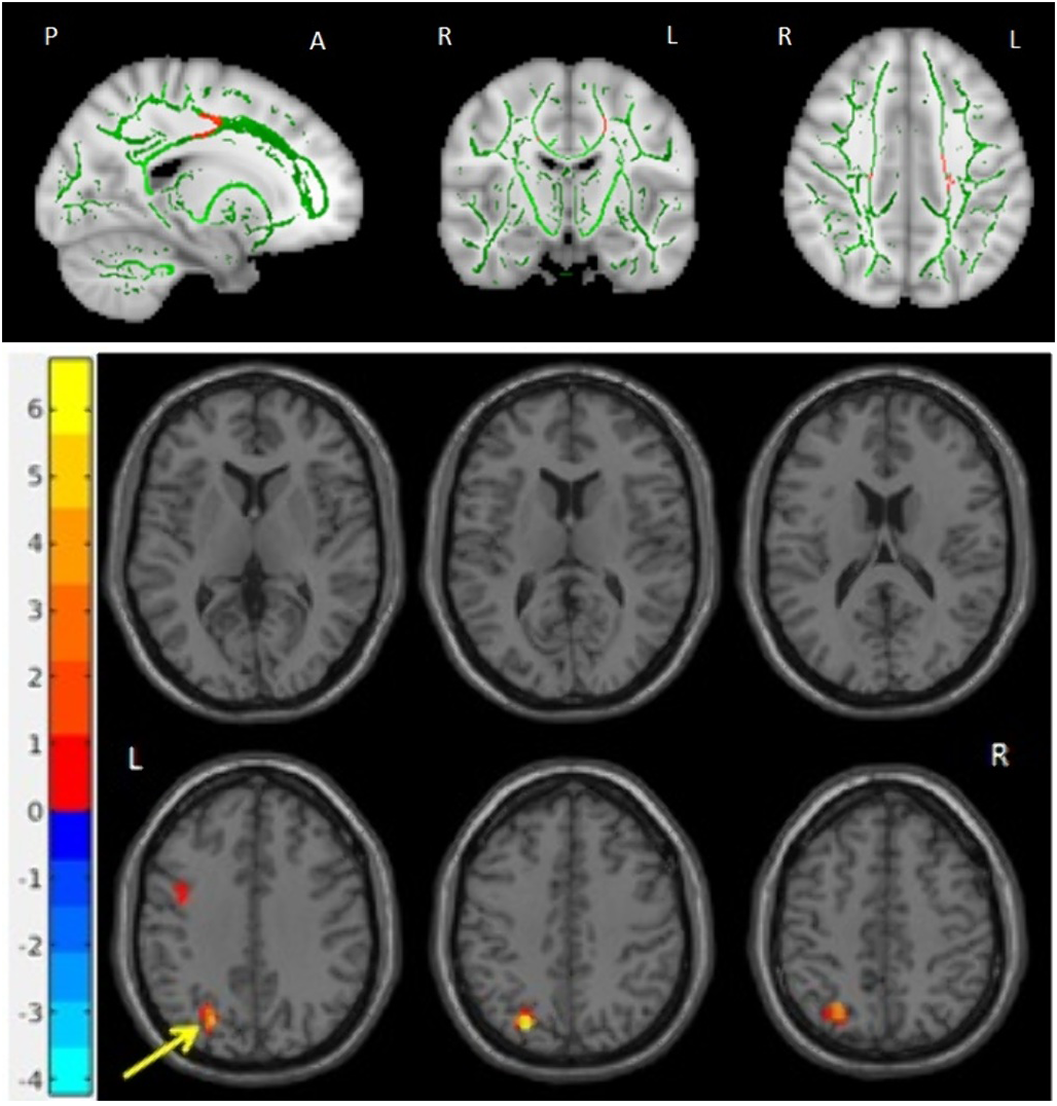
We found decreased values of FA in the body of the Corpus Callosum bilaterally (MNI_coordinates: x= 16, y= -16, z= 33 and x= -19, y= -16, z= 42) and left superior longitudinal fasciculus in OCD patients (fig 1, left), as well as decreased rsFC of the right superior orbitofrontal seed with the left inferior frontal gyrus and left middle occipital gyrus (fig 2, right).
Conclusions
Using an exploratory multimodal approach we found evidence of abnormal structural and functional long-range connectivity of the OFC in OCD. If confirmed in a larger sample these connectivity abnormalities could be explored as potential predictors of response to OFC-targeted non-invasive neuromodulatory interventions.
Altered fear learning processes could be mechanistically linked to the development and/or maintenance of obsessive-compulsive disorder (OCD). From a clinical perspective, the first-line psychological treatment for OCD is cognitive-behavioral therapy (CBT), which is based on the principles of fear learning. However, no previous functional magnetic resonance imaging (fMRI) studies have evaluated the predictive capacity of regional brain activations during fear learning on CBT response in patients with OCD.
Objectives
We aimed at exploring whether brain activation during fear learning in patients with OCD are associated with CBT outcome.
Methods
We assessed 18 patients with OCD and 18 healthy participants during a 2-day experimental protocol where brain activation and skin conductance responses (SCR) where assessed during fear conditioning, extinction learning, and extinction recall within the fMRI scanner. Following the protocol, patients with OCD received CBT.
Results
We found non-significant between-group differences in SCR during fear learning. Patients with OCD showed significantly diminished activation of the dorsal anterior cingulate cortex and the right insula during fear conditioning. Importantly, our analyses revealed a significant negative association between clinical improvement after CBT and activity at the right insula during fear conditioning (x = 39, y = 12, z = -11; t = 5.64; p<0.001; k = 928). This finding is displayed in Figure 1 below.
Conclusions
Patients with OCD may require less fear-conditioned brain responses to achieve the same level of psychophysiological fear conditioning as healthy participants. Interestingly, insula activations during fear-conditioned responses may represent a potential predictor biomarker of response to CBT for OCD.
Obsessive-compulsive disorder (OCD) is associated to a wide range of symptomatic expression and treatment response variability [1]. Sensory perception has been identified as an emerging factor in this process [2]. Sensory vulnerability and atypical sensory experience were identified as risk factors for the development of OCD [3] and a sensory subtype of the disease was proposed in which there is a positive correlation with early onset sensory symptoms, male gender and family background [4]. Adding to the atypical sensory profile, obsessions are frequently experienced as partially perceptual.
Objectives
Our main goals are to characterize the sensory perception in OCD patients; assess the prevalence and intensity of the sensory properties of the obsessive thoughts and explore the how sensory perception, obsessive thoughts and obsessive dimensions/clusters are interrelated.
Methods
Patients with OCD diagnosis, aged 18 to 65 years and no comorbid mental disorder (except depression) will be recruited. The study battery will include participant form with demographical and clinical features, assessment of depressive and anxiety symptoms (HAM-A and HAM-D) evaluation of clinical outcome measures and obsessive dimensions/clusters (Yale-Brown Obsessive-Compulsive Scale (Y-BOQS) and Obsessive Beliefs Questionnaire-44 (OBQ-44)), assessment of sensory perception and sensory properties of obsessive thoughts (Sensory Perception Quotient (SPQ 21) and Sensory Properties of Obsessive Thoughts Questionnaire (SPOQ)).
Results
The results will help us understand the interaction between perceptual and cognitive processes in OCD.
Conclusions
Better definition of OCD psychopathology and the establishment of a sensory subtype may indicate the need of specific therapeutic indications or a different escalation of treatment measures.
People living with dementia or mild cognitive impairment (MCI) experience stigmatisation and there are not many specific psychosocial interventions dedicated to help them coping with this issue, reducing its impact on their lives.
Objectives
This study aimed to a) investigate the stigmatisation level among people with dementia and MCI in Poland, Italy and the United Kingdom and b) assess the role of the Meeting Centre Support Programme (MCSP) in decreasing stigmatisation.
Methods
We investigated outcomes for 114 people with dementia and MCI living in Italy, Poland and the UK who participated 6 months in MCSP or usual care (UC) using a pre/post-test control group study design. Level of stigmatisation was assessed with the Stigma Impact Scale: neurological impairment (SIS).
Results
Stigmatisation level (SIS) among participants varied from 2 to 65 (median=33.5; Q1=27; Q3=41) with people from the UK experiencing a statistically significantly higher level of stigmatisation than people in Italy and Poland. In Italy, stigmatisation was lower (p=0.02) in the MCSP group following the intervention. In Poland, the social isolation level did not significantly change in MCSP, but increased (p=0.05) in UC. In the UK, the social rejection level raised (p=0.03) in MCSP. Overall, the combined data of the three countries did not show statistically significant differences in SIS between MCSP and UC.
Conclusions
Stigmatisation among people with dementia and MCI is complex and seems culturally dependent. There is a great opportunity in psychosocial interventions to reduce the burden of stigma among people with dementia which requires further investigation.
Delirium affects a significant proportion of hospitalized older patients with acute infections. There is growing evidence that delirium accelerates the cognitive decline at long term.
Objectives
We aimed to determine if delirium during hospitalization was independently associated with cognitive deterioration at one-year.
Methods
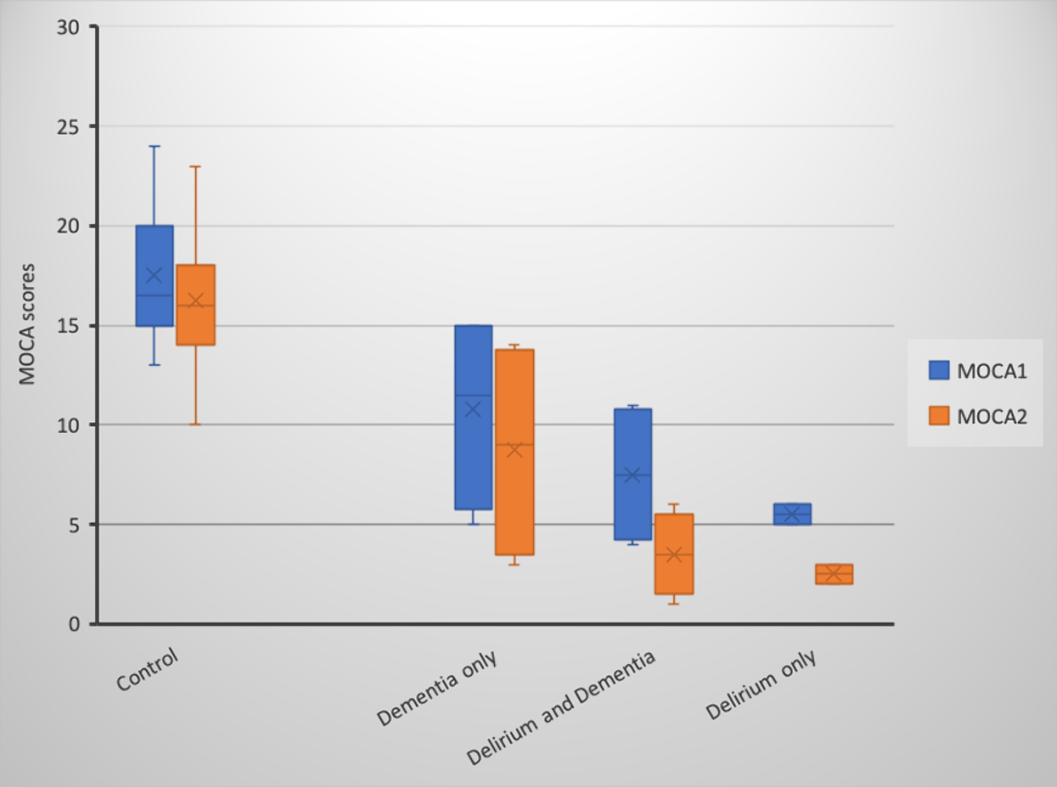
From a total of 22 patients (12 C, 4 Dem, 2 D, and 4 DD) delirium (D and DD groups) was associated with a worse score in MOCA of 3-points (p<.02) and 2.5-points (p<.03), respectively, at one year, follow up. Dementia patients without delirium had a decrease of 2-point (p=.04) while cognitively healthy patients had a decrease in 1.08 points (p=.05) (Graph1). MOCA and NPI scores during hospitalization correlated significantly with cognitive decline in the four groups (r=.658, p<.01 and r=.439, p=.02, respectively.)
Results
From a total of 22 patients (12 C, 4 Dem, 2 D and 4 DD) delirium (D and DD groups) was associated with a worse score in MOCA of 3-points (p<.02) and 2.5-points (p<.03), respectively, at one year follow up. Dementia patients without delirium had a of 2-point (p=.04) while cognitively healthy patients had a decrease in 1.08 points (p=.05) (Graph1). MOCA and NPI scores during hospitalization correlated significantly with cognitive decline in the four groups (r=.658, p<.01 and r=.439, p=.02, respectively.)
Conclusions
Individuals developing delirium while recovering from infection have higher rates of cognitive decline after one year, but the cognitive decline is also present to a lower extent for individuals with infections that did not develop delirium.
Sexual violence (SV) is an important public health concern which may induce important and long lasting mental health problems. However, studies on SV and its mental health impact on older adults and more specifically gerontopsychiatric patients are currently lacking.
Objectives
This study aims to contribute to a better understanding of the prevalence, risk factors and mental health impact of SV in a gerontopsychiatric patient population.
Methods
Between July 2019 and March 2020 100 patients (66%F, 34%M) participated in a face to face interview on health, sexuality and wellbeing during their admission at an old age psychiatry ward in one general hospital and two psychiatric hospitals across Flanders, Belgium. Participation rate was 58%. Interviews were performed by a psychiatric trainee and especially trained master students in medicine.
Results
58% (65%F; 42%M) of the participants were sexually victimised during their life, 45% (51%F, 33%F) experienced hands-off SV, 43% (48%F, 33%M) sexual abuse with physical contact and 16% (6%M, 21%F) was raped. 7% were sexually victimised in the past year. Compared with non-victimized respondents, hands-on SV victims (incl. rape) described more symptoms of depression (p=0.007) and anxiety (p=0.003) and reported lower resilience (p=0.022).
Conclusions
SV appears to be common in the gerontopsychiatric population and is linked to even worse mental health outcomes. These findings confirm the long-lasting mental health impact of SV and highlight the importance of attention to (sexual) trauma in mental health care in old age.
It remains difficult to predict which individuals will develop cognitive impairment and progress to major neurocognitive disorders. Prevention studies suffer from the long time frames and the manner in which this topic does not lend itself to randomized, double-blinded controlled trials.
Objectives
We aimed to construct a computer simulation model that would accurate portray the time course for a series of individuals to develop cognitive impairment and to progress to major neurocognitive disorder.
Methods
We built a computer simulation model that incorporated the role of exercise, genetic load, age, quality of diet, presence of diabetes and level of hemoglobin A1C, ongoing levels of cognitive stimulation, presence or absence of micronutrients, presence or absence of other co-morbidities, an overall general health index, levels of smoking and other substance use, and family history. We modeled the life course of 10 individuals, adjusting parameters to make correct predictions for all 10 people. Then we entered the data from another 10 people to determine how accurate the model would be with ten new individuals for whom it had not been developed.
Results
We defined success as a prediction of onset within 10% of the actual date and a prediction of the slope of the trend within 20%. We had 7 successes. We were able to engage 6 of the 10 in interacting with the model to change health behaviors.
Conclusions
Computer simulation modeling may provide an opportunity to study the long-term effects of health behaviors and to engage people in interacting with the program to change behavior.
Pain, fatigue and anxiety are common features of fibromyalgia and ME/CFS and significantly impact quality of life. Aetiology is poorly defined but dysfunctional inflammatory, autonomic and interoceptive (sensing of internal bodily signals) processes are implicated.
Objectives
To investigate how altered interoception relates to baseline expression of pain, fatigue and anxiety symptoms in fibromyalgia and ME/CFS and in response to an inflammatory challenge.
Methods
Sixty-five patients with fibromyalgia and/or ME/CFS diagnosis and 26 matched controls underwent baseline assessment: pressure-pain thresholds and self-report questionnaires assessing pain, fatigue and anxiety severity. Participants received injections of typhoid (inflammatory challenge) or saline (placebo) in a randomised, double-blind, crossover design, before completing heartbeat tracking tasks. Three interoception dimensions were examined: subjective sensibility, objective accuracy and metacognitive awareness. Interoceptive trait prediction error was calculated as discrepancy between accuracy and sensibility.
Results
Patients with fibromyalgia and ME/CFS had significantly higher interoceptive sensibility and trait prediction error, despite no differences in interoceptive accuracy. Interoceptive sensibility and trait prediction error correlated with all self-report pain, fatigue and anxiety measures, and with lower pain thresholds. Anxiety mediated the positive-predictive relationships between pain (Visual Analogue Scale and Widespread Pain Index), fatigue impact and interoceptive sensibility. After inflammatory challenge, metacognitive awareness correlated with baseline self-reported symptom measures and lower pain thresholds.
Conclusions
This is the first study investigating interoceptive dimensions in patients with fibromyalgia and ME/CFS, which were found to be dysregulated and differentially influenced by inflammatory mechanisms. Interoceptive processes may represent a new potential target for diagnostic and therapeutic investigation in these poorly understood conditions.
People from the general population often tend to believe that psychiatric patients may be incurable, dangerous, and unpredictable. Stigma represents a critical issue which should be defeated. In spite of the interest of research, little is known about the relationship between personality traits and level of stigma toward people with mental illness.
Objectives
To evaluate whether certain personality traits can influence the level of stigma towards mental illness in a population of university students.
Methods
A web-survey was spread on social networks between March and June 2020 through Google Forms. Eligibility criteria for inclusion were:1) Being 18 years of age or older; 2) Attending a degree course in an Italian University; 3) Provide informed consent. Socio-demographic characteristics of the participants were collected. Stigma was measured using the Attribution Questionnaire (AQ-27), personality traits were evaluated through the Big Five Inventory (BFI) and the Mental Health Knowledge Schedule (MAKS-i) investigated the knowledge about mental illness. Statistical analyses were performed using SPSS 24.0.
Results
We computed a multiple linear regression to calculate potential predictors of stigma, adjusted on the basis of the knowledge of mental illness. Results showed that age and faculty class were not related to stigma. Agreeableness (A) and Openness to experience (O) were associated with less stigmatizing attitudes. Conversely, Neuroticism (N) and Conscientiousness (C) seemed to predict higher levels of stigma.
Conclusions
Our results suggest an interesting relationship between personality traits and stigmatizing attitudes, which deserves to be further studied. They also confirm the importance of implementing appropriate strategies against the stigma of mental illness.
Triple Network Model (TNM), which considers the dynamic interaction between Default Mode (DMN), Salience (SN), and Central Executive (CEN) networks, explains clinical features in mental disorders from a neurophysiological perspective. Some studies highlight the increased connectivity in TNM in adults with Borderline Personality Disorder (BPD), but little is known about adolescents.
Objectives
The aim of our preliminary study was to investigate TN functional connectivity (FC) in BPD adolescents with a history of traumatic experiences, and its correlation with dissociative symptoms.
Methods
15 BPD adolescents (DSM-5 criteria) with early traumatic experiences were compared to 15 healthy controls, matched for sex and age. Dissociation Questionnaire (DIS-Q) was administered. Eyes-closed resting-state (RS) EEG recordings were performed (19 electrodes; 10- 20 system) and analyzed using Exact Low-Resolution Electromagnetic Tomography software (eLORETA). FC was computed for all frequency bands and 9 Regions of Interest for TNM.
Results
BPD adolescents showed a hyper-connection between CEN and DMN [dorso-lateral prefrontal cortex (dlPFC) and posterior cingulate cortex (PCC); PCC and left posterior parietal cortex (PPC)] and within the CEN (left and right PPC). The strength of PCC-dlPFC and left-right PPC connections was correlated with dissociative symptoms severity.
Conclusions
FC alterations can already be identified in BPD adolescents, supporting the need for early diagnosis. Normally DMN and CEN show opposite functioning. In our BPD adolescents, the absence of this “anti-correlation” reflects the typical confusion between internal and external mental states, which clarify their difficulties in metacognition or mentalization. Moreover, in dissociative symptoms, two CEN nodes are also involved, not only DMN as previously described.
Openness, conscientiousness, extroversion, agreeableness and neuroticism are dimensional personality traits known as the Big Five. Study attrition is a common but often hard to anticipate problem. Artificial intelligence (AI) could examine both fronts to mitigate the unpredictability of the latter.
Objectives
To investigate whether AI could predict study attrition employing personality traits scores.
Methods
Data from 2,697 questionnaires were analysed using an AI. The short form of the International Personality Item Pool was used to assess the Big Five personality traits on the first of three planned waves. The personality traits scores were employed to predict the missing of at least one wave. Overall attrition was 17.6%. The AI was conservatively tuned to minimize the negative likelihood ratio when confronting predicted and real attrition. The free and open source programming language R was used for all the analyses. Dataset source: Hansson, Isabelle; Berg, Anne Ingeborg; Thorvaldsson, Valgeir (2018), “Can personality predict longitudinal study attrition? Evidence from a population-based sample of older adults”, Mendeley Data, V1, doi: 10.17632/g3jx8zt2t9.1
Results
Predictions obtained a negative likelihood ratio of 0.333 and a negative predictive value of 0.933. The results were indicative of fair performance.
Conclusions
AI might be useful to predict study retention. Furthermore, the results of this study might indicate a moderate effect of the Big Five on the probability of study retention. Finally, the AI used in this study is freely available, allowing anyone to experiment.
The dark triad is composed by the personality traits Machiavellianism, narcissism and psychopathy (MNP). Their complexity can make them difficult to interrelate. Artificial intelligence (AI) could help in this endeavour.
Objectives
To investigate whether AI could predict MNP from themselves.
Methods
Data from 210 questionnaires were analysed using an AI. The short Dark Triad questionnaire (SD3) was used to assess MNP. Two of the MNP scores were employed to predict the third one and the procedure was repeated for all of them alternatively. The AI was conservatively tuned to maximize the one-way random intraclass correlation coefficient (ICC) between predicted and real values. Pearson’s r was calculated too. The free and open source programming language R was used for all the analyses. Dataset source: Borráz-León, Javier I. (2020), “Dark triad, attractiveness, mate value, and sexual partners”, Mendeley Data, V1, doi: 10.17632/87vx6jfnrp.1
Results
Machiavellianism, narcissism and psychopathy predictions obtained ICC of 0.593, 0.335, 0.505 and Pearson’s r of 0.608, 0.346, 0.548 respectively. The results were indicative of fair performance, mainly for Machiavellianism and psychopathy.
Conclusions
AI might be useful to predict MNP. This could be utile in many situations, such as dealing with missing data or deciding whether to formally test someone. Finally, the AI used in this study is freely available, allowing anyone to experiment.
On August 4th 2020, a massive port explosion shook Beirut, killing at least 200, injuring more than 6,000 people and leaving more than a quarter of a million living in unfit homes. Various factors can participate in the severity of mental health outcomes of a disaster including the number of injuries, the degree of property destruction, unexpectedness of the occurrence of the event, and the type of the disaster.
Objectives
The main aim of this study is to assess the prevalence of post-traumatic stress disorder (acute stress disorder) and major depression at 1 and 6 months following the Beirut explosion. The secondary aim is to determine predictors of PTSD incidence among civilians and relief workers affected by the disaster.
Methods
This is a cross-sectional study with data collected via an online survey through convenience sampling. People will be recruited via social media platforms. To achieve a power of 80% and a two-sided significance of 5% and because gender differences will be explored, assuming a design effect (deff) of 2.5, a minimum sample of 960 participants would be needed. The survey will include sociodemographic data, questions about exposure levels to trauma and a psychiatric symptom inventory. Pearson’s Chi Square test will be used to examine the association between categorical variables and regression models will be run to examine the associations while controlling for confounders, including age, gender and others.
Results
The results from both rounds of data collection (months 1 and 6) will be available in late March 2021.
Post-traumatic stress disorder (PTSD) following intensive care is a relatively new entity. It is triggered due to traumatic experiences in a setting of threat to life due to illness. Prolonged stay in intensive care predisposes to delusional memories related to the stay experience and may increase likelihood of post-traumatic stress.It may also present as anxiety or depression.
Objectives
This study explored the prevalence of post-traumatic symptoms in intensive care, find its correlates and its impact on health-related quality of life (HRQoL).
Methods
225 adult patients admitted for at least 1 day in the intensive care unit (ICU) of a general hospital in Bangalore,India were recruited and assessed at 1 week,1 month and 3 months after ICU discharge. Subjects were assessed for ICU related memories, PTSD, anxiety and depression scores and quality of life at and post discharge.
Results
59.6% of the study population had significant post-traumatic stress, including anxiety in 62.35%, depression in 10.58% and mixed anxiety-depression in 27.06%. Delusional memories were found in 31.6%. Presence of delusional memories was found to have significant correlation with post-traumatic stress and had a negative impact on HRQoL.
Conclusions
This study was the first of its kind from Asia. More systematic studies on PTSD following ICU stay and its correlates are required as available evidence lacks homogeneity. Suitable preventive measures should be taken to reduce prevalence of post-traumatic stress in intensive care due to its lasting impact on HRQoL.
Novel, evidence-based treatments are required for treatment-resistant post-traumatic stress disorder (PTSD). 3,4-Methylenedioxymethamphetamine (MDMA) has beneficially augmented psychotherapy in several small clinical trials.
Objectives
To review the use of MDMA-assisted psychotherapy in treatment-resistant PTSD.
Methods
Systematic searches of four databases were conducted from inception to February 2020. A meta-analysis was performed on trials which were double-blinded, randomised, and compared MDMA-assisted psychotherapy to psychotherapy and placebo. The primary outcomes were the differences in Clinician Administered PTSD Scale (CAPS-IV) score and Beck’s Depression Inventory (BDI). Secondary outcome measures included neurocognitive and physical adverse effects, at the time, and within seven days of intervention.
Results
Four randomised controlled trials (RCTs) met inclusion criteria. When compared to active placebo, intervention groups taking 75mg (MD -46.90; 95% CI -58.78, -35.02), 125mg (MD -20.98; 95% CI -34.35, -7.61) but not 100mg (MD -12.90; 95% CI -36.09, 10.29) of MDMA with psychotherapy, had significant decreases in CAPS-IV scores, as did the inactive placebo arm (MD -33.20; 95% CI -40.53, -25.87). A significant decrease in BDI when compared to active placebo (MD -10.80; 95% CI -20.39, -1.21) was only observed at 75mg. Compared to placebo, participants reported significantly more episodes of low mood, nausea and jaw-clenching during sessions and lack of appetite after seven days.
Conclusions
These results demonstrate potential therapeutic benefit with minimal physical and neurocognitive risk for the use of MDMA-assisted psychotherapy in TR-PTSD, despite little effect on Beck’s Depression Inventory. Better powered RCTs are required to investigate further.
Disclosure
James Rucker has attended trial related meetings paid for by Compass Pathways Ltd.
International Classification of Diseases 11th Revision (ICD-11) has inserted complex post-traumatic stress disorder (cPTSD) as a clinically distinct disorder, different from PTSD. The diagnosis of cPTSD has the same requirements for the one of PTSD, in addition to disturbances of self-organization (DSO – e.g., disturbances in relationships, affect dysregulation, and negative self-concept).
Objectives
This study aimed to explore suicidality in PTSD and cPTSD. We examined also the association between clinical dimensions of hopelessness (feelings, loss of motivation, future expectations) and other symptomatologic variables.
Methods
The sample, recruited at the Fondazione Policlinico Tor Vergata, Rome, Italy, consisted of 189 subjects, 132 diagnosed with PTSD, and 57 with cPTSD, according to the ICD-11 criteria. Participants underwent the following clinical assessments: Clinician-Administered PTSD Scale (CAPS), Impact of Event Scale-Revised (IES), Beck Depression Inventory (BDI), Symptom Checklist-90-Revised (SCL-90), Dissociative Experience Scale (DES), Beck Hopelessness Scale (BHS).
Results
cPTSD showed significantly higher BHS-total (p = 0.01) and BHS-loss of motivation subscale (p <0.001) scores than PTSD. Besides, cPTSD showed significantly higher scores in all clinical variables except for the IES-intrusive subscale. By controlling for the confounding factor “depression”, suicidality in cPTSD (and in particular the BHS-total) appears to be correlated with IES-total score (p = 0.042) and with DES-Absorption (p = 0.02). Differently, no such correlations are found in PTSD.
Conclusions
Our study shows significant symptomatologic differences between PTSD and cPTSD, including suicidality. Indeed, suicidality in cPTSD appears to be correlated with the “loss of motivation” dimension, which fits well within the ICD-11 criteria of DSO.
Posttraumatic stress disorder is a prevalent mental health condition with substantial impact on daily functioning that lacks sufficient treatment options. Previous research has led to the designation of 3,4-methylenedioxymethamphetamine (MDMA) as a Breakthrough Therapy for treatment of post-traumatic stress disorder (PTSD) when administered as an adjunct to psychotherapy.
Objectives
Here we report the findings of the first randomized, double-blind, Phase 3 trial assessing the efficacy and safety of 3 sessions with a flexible dose of MDMA or placebo administered under direct observation to participants with severe PTSD (n = 100) as an adjunct to inner-directed psychotherapy.
Methods
Change in PTSD symptoms (CAPS-5) and functional impairment (SDS) were assessed by a central, blinded Independent Rater Pool at baseline and following each treatment session. Adverse events (AEs), concomitant medications, suicidal ideation and behavior were tracked throughout the study. Vital signs were measured during experimental sessions. The primary endpoint was 18 weeks post-randomization.
Results
Change in CAPS-5 and SDS, placebo-subtracted Cohen’s d effect size, and a responder analysis will be presented. There were three serious AEs of suicidal ideation or behavior reported. MDMA was well tolerated, with some treatment emergent AEs occurring at greater frequency for the MDMA group during and after experimental sessions.
Conclusions
If MDMA-assisted psychotherapy significantly attenuates PTSD symptomatology and associated functional impairment, these results will form the basis for marketing authorization applications worldwide, including among participants with dissociative subtype of PTSD, depression, history of alcohol and substance use disorders, and adverse childhood experiences.
Major depressive disorder is highly prevalent worldwide and has been affecting an increasing number of people each year. Current first line antidepressants show merely 37% remission, and physicians are forced to use a trial-and-error approach when choosing a single antidepressant out of dozens of available medications.
Objectives
We sought to identify a method of testing that would provide patient-specific information on whether a patient will respond to a medication using in vitro modeling.
Methods
Patient-derived lymphoblastoid cell lines from the STAR*D study were used to rapidly generate cortical neurons and screen them for bupropion effects, for which the donor patients showed remission or non-remission.
Results
We provide evidence for biomarkers specific for bupropion response, including synaptic connectivity and morphology changes as well as specific gene expression alterations.
Conclusions
These biomarkers support the concept of personalized antidepressant treatment based on in vitro platforms and could be utilized as predictors to patient response in the clinic.
Disclosure
This work was funded by Genetika+ Ltd, Jerusalem, Israel. YA, DK, EN, DL and TCS are employees of Genetika+ Ltd and received salary and/or stock options for the submitted work.