We partner with a secure submission system to handle manuscript submissions.
Please note:
You will need an account for the submission system, which is separate to your Cambridge Core account. For login and submission support, please visit the
submission and support pages.
Please review this journal's author instructions, particularly the
preparing your materials
page, before submitting your manuscript.
Click Proceed to submission system to continue to our partner's website.
To save this undefined to your undefined account, please select one or more formats and confirm that you agree to abide by our usage policies. If this is the first time you used this feature, you will be asked to authorise Cambridge Core to connect with your undefined account.
Find out more about saving content to .
To send this article to your Kindle, first ensure no-reply@cambridge.org is added to your Approved Personal Document E-mail List under your Personal Document Settings on the Manage Your Content and Devices page of your Amazon account. Then enter the ‘name’ part of your Kindle email address below. Find out more about sending to your Kindle.
Find out more about saving to your Kindle.
Note you can select to save to either the @free.kindle.com or @kindle.com variations. ‘@free.kindle.com’ emails are free but can only be saved to your device when it is connected to wi-fi. ‘@kindle.com’ emails can be delivered even when you are not connected to wi-fi, but note that service fees apply.
Stress is a risk factor for developing psychopathology. Emerging evidence suggests that daily experiences of stress may also predict symptoms during the day. It is unclear to what extent the influence of stress on psychopathology during the day is the same across individuals (including across diagnostic boundaries), and which effects are individual-specific
Objectives
This study aims to reveal how stress and symptoms are interrelated in a cross-diagnostic context by modeling individual level temporal networks, and examining subgroups with similar dynamics.
Methods
Hundred twenty two young adults (43.4% women) with a wide range of psychopathology in terms of severity and type of problems completed a six-month daily diary study. We used a temporal network approach (i.e., group iterative multiple model estimation) to model how stress and ten specific symptoms (e.g., feeling down, paranoia, restlessness) were related across time at the individual-specific, subgroup, and group level.
Results
After controlling for the lagged influence of stress on itself, stress level predicted the level of restlessness, worrying, nervousness, and feeling down during the same day for >70% of individuals. We observed three larger subgroups with each over 20 individuals, whose temporal networks showed different dynamic patterns involving specific symptoms. Effects of stress on other specific symptoms differed across individuals, and these were not subgroup-specific.
Conclusions
This study showed important overlap between individuals in terms of impact of stress on psychopathology in daily life. Subtle differences between individuals were also observed. Possibly, such differences are relevant for examining individual-specific vulnerability for future psychopathology. This requires further investigation.
Pharmacogenetics (PGx) studies genetic variance and related differences in drug outcomes. PGx guidelines for psychotropic drugs are available (PGx drugs), but PGx testing is used only limitedly in psychiatric clinical practice.
Objectives
The aim of this study is to pinpoint different aspects of PGx drug use in the population, to support clinical uptake of PGx.
Methods
This drug utilization study investigated prescription PGx drug use in 56,065 young individuals with different severe mental disorders (SMD) in the Danish iPSYCH sample (born 1981-2005). We investigated the number of PGx drug users (incidence, prevalence), age (at first PGx drug use), sex, multiple PGx drugs per user (in light of panel-based PGx testing) and concomitant use of PGx drugs (in light of combinatorial PGx testing).
Results
We identified substantial PGx drug use in terms of incidence rates (e.g. 333 per 10,000 person years for the anticonvulsant lamotrigine) and prevalence (e.g. 15,260 users for the antidepressant citalopram) in patients with SMD. The age of first time PGx drug use ranged from 11.6-20 years, depending on SMD and sex. On average, more than one PGx drug was used by a single person (range 1.6-5.6 drugs, depending on SMD) or even used concomitantly (41-69%) affecting mostly two different PGx genes (84-92% of concomitant PGx drug users).
Conclusions
PGx drugs were frequently used in young individuals with SMD, often subsequently and concomitantly, arguing for panel-based/combinatorial PGx testing over single-gene testing. PGx testing could be applied already at a very young age.
Disclosure
We thank the iPSYCH consortium, in specific the iPSYCH PI’s (Merete Nordentoft, Anders Børglum, Preben B. Mortensen, Ole Mors, Thomas Werge and David M. Hougaard). The iPSYCH project is funded by the Lundbeck Foundation Denmark and the universities and un
Pharmacogenetics (PGx) studies genetic variance and related differences in drug outcomes. The aim of PGx testing is to increase therapy efficacy and safety, by applying e.g. dose adjustments in patients with a specific geno- or phenotype. PGx guidelines for psychotropic drugs are available (PGx drugs), including atomoxetine used in the treatment of attention deficit hyperactivity disorder (ADHD). In Denmark, broad implementation of PGx is currently still low, possibly due to the lack of population-based studies investigating the real-world impact of PGx variability.
Objectives
The aim of this study is to investigate the association of PGx variability (patients’ genotype/phenotype) in users of atomoxetine and different treatment outcomes in a large population-based sample of individuals with ADHD.
Methods
This study will use data of the large Danish population-based iPSYCH case-cohort study sample including information on genetic variants, prescription drug use and outcome data, e.g. psychiatric and somatic hospitalizations and death. The study population comprises all individuals diagnosed with ADHD born 1981-2005 with at least one prescription for atomoxetine between 1995 and 2016. All individuals will be categorized according to their CYP2D6 phenotypes. We will perform Cox regression analysis to estimate the hazard ratios comparing the rates of the different outcomes in people with different phenotypes adjusted for a number of confounding factors.
Results
We have identified approximately 20,000 individuals with ADHD, of whom an estimated 10-20% have filled at least one prescription of atomoxetine.
Conclusions
We expect results in the beginning of 2021.
Disclosure
We thank the iPSYCH consortium, in specific the iPSYCH PI’s (Merete Nordentoft, Anders Børglum, Preben B. Mortensen, Ole Mors, Thomas Werge and David M. Hougaard). The iPSYCH project is funded by the Lundbeck Foundation Denmark and the universities and un
Pharmacogenetics (PGx) studies genetic variance and related differences in drug outcomes. PGx guidelines for psychotropic drugs are available (PGx drugs). By executing PGx testing in a prospective or pre-emptive setting, dose adjustments or even change of treatment type can be applied prior to start of therapy to patients who carry a specific geno- or phenotype (i.e. actionable geno- or phenotypes). By doing so, increased efficacy of therapy or reduced risk of adverse events of treatment can be accomplished. In Denmark, broad implementation of PGx is currently still low.
Objectives
The aim of this study is to classify the PGx profiles of Danish individuals with and without severe mental disorders (SMD), to be used in follow-up studies investigating PGx and drug outcomes.
Methods
This study made use of imputed genotyping data of the Danish iPSYCH sample, which includes 77,639 young individuals born between 1981-2005, with or without a diagnosis of one or more of five selected SMD (i.e. depression, attention-deficit/hyperactivity disorder, autism, bipolar disorder and schizophrenia). We investigated a panel of 48 genetic variants with known PGx applications (part of the U-PGx consortium, a Horizon2020 funded project on clinical relevant PGx in the EU).
Results
Imputed data contains over 11 million SNPs of 77,639 individuals.
Conclusions
We expect results in the end of 2020.
Disclosure
We thank the iPSYCH consortium, in specific the iPSYCH PI’s (Merete Nordentoft, Anders Børglum, Preben B. Mortensen, Ole Mors, Thomas Werge and David M. Hougaard). The iPSYCH project is funded by the Lundbeck Foundation Denmark and the universities and un
Autism spectrum disorder (ASD) is among the most common and pervasive neurodevelopmental disorders. Yet, despite decades of research, the neurobiology of ASD is still poorly understood, as inconsistent findings preclude the identification of robust and interpretable neurobiological markers and predictors of clinical symptoms.
Objectives
Identify robust and interpretable dynamic brain markers that distinguish children with ASD from typically-developing (TD) children and predict clinical symptom severity.
Methods
We leverage multiple functional brain imaging cohorts (ABIDE, Stanford; N = 1004) and exciting recent advances in explainable artificial intelligence (xAI), to develop a novel multivariate time series deep neural network model that extracts informative brain dynamics features that accurately distinguish between ASD and TD children, and predict clinical symptom severity.
Results
Our model achieved consistently high classification accuracies in cross-validation analysis of data from the ABIDE cohort. Crucially, despite the differences in symptom profiles, age, and data acquisition protocols, our model also accurately classified data from an independent Stanford cohort without additional training. xAI analyses revealed that brain features associated with the default mode network, and the human voice/face processing and communication systems, most clearly distinguished ASD from TD children in both cohorts. Furthermore, the posterior cingulate cortex emerged as robust predictor of the severity of social and communication deficits in ASD in both cohorts.
Conclusions
Our findings, replicated across two independent cohorts, reveal robust and neurobiologically interpretable brain features that detect ASD and predict core phenotypic features of ASD, and have the potential to transform our understanding of the etiology and treatment of the disorder.
It has been well established that depressive disorders including perinatal depression are very heterogeneous, which partly explain the ineffectiveness of available treatments for many patients. Recent innovations in data science can help elucidate the nature of perinatal depression especially the heterogeneity in its presentation.
Objectives
The present study aime to elucidate heterogeneous subtypes of PND and assess the effectiveness of a multicomponent cognitive behavioral therapy (CBT) across heterogenous subtypes of PND.
Methods
This study was conducted in 2005 in two rural areas of Rawalpindi, Pakistan. Out of a total of 3,898 women, 903 pregnant women were identifed with PND (using DSM-IV) and randomly assigned to intervention and control group. Baseline assessments included interviewer admininstered Hamilton Depression Scale (HDS) and social risk factors. Follow-up assessments were conducted at 6 months and 12 months post-intervention. Principle component analysis was run to reduce dimensionality of the HDS. Two step cluster analysis was then run to elucidate subtypes of PND using the dimensional scores. Thereafter, effectiveness of CBT was compared across these subtypes of PND using multilevel modelling.
Results
Principle component analysis revealed a four component solution for the Hamilton depression rating scale. Using these dimensional scores, cluster analysis (average silhouette= 0.5) revealed a parsimonius four cluster soultion of participants with mild PND symptoms (n=326); predominant sleep problems (n=311) c) predominant atypical symptoms (n=80) and d) comorbid depressive and anxiety symptoms (n=186). CBT yielded moderate effect sizes across all these subtypes of PND (cohen’s d > 0.8).
Conclusions
Multicomponent CBT is effective across hetergeneous presentations of PND.
The relevance of studying the characteristics of the home environment of a person with mental health problems is determined by the need to identify the resources of the individual and the family to form multilevel adaptive competencies aimed at maintaining mental health.
Objectives
The present study was conducted to obtain standardized assessments of attitudes towards the home environment, towards the home as a place of functioning of the family with mental patients.
Methods
The study involved 12 patients aged 21-60 years diagnosed according to ICD-10 F2 with the disease duration of more than 1 year and readmission. Methods used were experimental psychological questionnaire “My home” (Reznichenko, Nartova-Bochaver, Kuznetsova, 2016), mathematical statistics
Results
The test results showed that the average score for the “strength of significance of the home for its inhabitants” across the data set was 4.14, which differed from the average value of 3.73.
Conclusions
The psychological foundations of attachment can be associated with a variety of facts, including the frequent absence of patients outside the home environment during readmission periods. The home environment can be a complex of positive feelings and experiences in relation to the home as a personally significant place. The study revealed some of the psychological traits of the subjective attitude to home, which can become indicators of psychological adaptation in persons with mental disorders in the future. Reznichenko S.I., Nartova-Bochaver S.K., Kuznetsova V.B. (2016) Home Attachment Assessment Method. Psychology. Journal of the Higher School of Economics. 13(3): 498-518.
Maternal age and related factors, such as social vulnerability, are associated with neurodevelopmental and behavioral disorders in offspring.
Objectives
To examine the influence of maternal age and its related factors on the appearance of autism spectrum disorder (ASD), attention deficit hyperactivity disorder (ADHD), alterations in executive functions and behavioral syndromes of the offspring.
Methods
A prospective study was conducted, consisting of 131 healthy pregnant women aged 20 to 41 years, recruited at 38 weeks’ gestation. Their offspring were followed up to 2 years after birth, when psychopatology was assessed. Maternal age and possible related factors were considered predictors. Bayesian ordinal regression models were performed for each outcome variable.
Results
Symptoms of ASD in children were associated with an older maternal age (OR = 0.188; 95% CI[1.062, 1.401]) and a lower educational level of the parents (OR = -0.879; 95% CI[0.202, 0.832]), meanwhile poor social support predicted most ADHD symptoms OR = -0.086; 95% CI[0.838, 1]) and executive dysfunctions OR = -0.661; 95% CI[0.313, 0.845]. Lower parental education predicted both externalizing and internalizing behavior.
Conclusions
Maternal age-related factors were the main predictors of neurodevelopmental disorders in offspring, rather than maternal age. The performance of prenatal interventions in pregnant women with advanced age and anxious depressive symptoms or adverse social situation, is crucial to reduce the risk of neurodevelopmental disorders in the offspring. Likewise, being able to carry out an early detection of childhood psychopathology would allow the implementation of resources that improve their long-term prognosis.
It is clear from the literature that depressive disorder is closely related to lifestyle, however the relationship between burnout and lifestyle remains unclear.
Objectives
The aim of this study was to present a comprehensive overview of depressive symptoms, burnout and lifestyle over the years. Furthermore, this study looks at the relationship between burnout, depressive symptomatology and lifestyle and seeks to clarify the extent to which burnout can be explained by these variables.
Methods
Data collection took place in three waves. The first data collection was in 2014 (October/November), the second in 2017 (March) and the third in 2020 (March). The STEM/MARK agency conducted the data collection and collected answers from a representative sample of respondents using the CAWI method - computer-assisted questioning. These respondents were selected from the European National Panel. Because the target group was adults (18-65 years), an online survey was chosen. Internet penetration in this target population is sufficient and it was not necessary to use a combination of methodologies.
Results
All 3 data collections identically show that for the model explaining burnout statistically significant variables are: age, depression and fatigue during the day. Other variables related to healthy lifestyles did not reach statistical significance.
Conclusions
Even though the variables regarding healthy lifestyles have not reached statistical significance, their importance should not be underestimated. Mental well-being is closely linked to physical health and therefore a holistic approach to health should be emphasized and the rate of burnout should be regularly monitored.
Severe mental disorders (SMD) are associated with higher morbidity rates and poorer health outcomes compared to the general population. They are more likely to be overweight, to be affected by cardiovascular diseases, and to have higher risk factors for chronic diseases.
Objectives
To assess physical health in a sample of patients with SMD and to investigate which mental health-related factors and other psychosocial outcomes could be considered predictors of poor physical health.
Methods
Patients referring to the psychiatric outpatients unit of the University of Campania “L. Vanvitelli” were recruited, and were assessed through validated assessment instruments exploring psychopathological status, global functioning and stigma. Physical health was assessed with an ad-hoc anthropometric schedule. A blood sample has been collected to assess levels of cholesterol, blood glucose, triglycerides, and blood insulin.
Results
75 patients have been recruited, with a mean age of 45.63±11.84 years. 30% of the sample had a diagnosis of psychosis, 27% of depression and 43% of bipolar disorder. A higher BMI is predicted by higher number of hospitalizations, a reduced score at MANSA (p<.000), and PSP (p<.05), and higher score at ISMI and BPRS (p<.05). A higher cardiovascular risk is predicted by a reduced MANSA score (p<.000), a higher ISMI score and a poorer adherence to pharmacological treatments (p<.05). Higher ISMI score (p<.0001) and number of hospitalizations (p<.05) are predictors of insulin-resistance.
Conclusions
Our study shows that psychosocial domains negatively influence physical health outcome. It is necessary to disseminate an integrated psychosocial intervention in order to improve patients’ physical health.
A growing body of evidence in both chronic and first-episode schizophrenia report increased expression of pro-inflammatory substances in the blood and cerebrospinal fluid of patients. However, there is not much data in the literature on immune alterations in unaffected first-degree relatives (FDRs) of the patients.
Objectives
We aimed to evaluate inflammatory aberrancies in patients with schizophrenia, their unaffected first-degree relatives (FDRs) and healthy controls.
Methods
50 chronic, stable schizophrenia patients, 42 FDRs and 40 healthy subjects with no family history (HCSs) were recruited to the study. IL-1β, IL-6, TNF-a and CRP levels were measured. Complete blood counts, fasting glucose and lipid levels were analyzed and neutrofil-lymohocyte ratio (NLR) were calculated.
Results
There was a significant group difference in all cytokine levels after controlling for age, gender, smoking status, comorbid medical diseases, BMI and blood glucose and tyrigliseride levels (p<.001). FDRs showed significantly higher serum levels of cytokines than HCs, in the same way as the corresponding schizophrenia patients but a lower level. Pairwaise comparisions revealed that the differences were significant between each group after controlling for confounders (p<.001 for all comparisons). However, NLR and CRP levels were not different between groups.
Conclusions
Our results support the role of inflammatory aberrancies in the pathophysiology of schizophrenia. The finding of abnormal cytokine levels both in schizophrenic patients and FDRs indicates that such immunological alterations are not exclusive to the patients and can be possible endophenotypes for the disorder.
Study of conversion disorders is urgent problem in psychiatry due to high prevalence of hysterical manifestations, both in structure of various mental diseases and in general somatic network: among population it is from 0.5 to 2%.
Objectives
Our aim was to study the effect of complex therapy, combining traditional psychopharmacological drugs and hyperbaric oxygenation, on indicators of acid-base balance of blood, neurotransmitter metabolism, immune and hormonal status in experimental modeling of stress, as well as reduction of psychopathological symptoms in various forms of hysterical disorders.
Methods
Studies were conducted with the participation of 160 patients (145 women and 15 men), average age 33.5 ± 6.1 years, Сontent of adrenaline, norepinephrine, dopamine, serotonin was determined by concentration of prolactin, thyroid-stimulating hormone (TSH), free thyroxine (T4 light), cortisol using ELISA. Immune status was assessed according to following indicators: determination of level of immunoglobulins of classes A, M and G by the method of radial immunodiffusion in a gel; study of total complementary activity of blood serum by hemolytic method.
Results
It is necessary to highlight a significant increase in the concentration of Ig G and Ig A, a higher level of large, medium and small circulating immune complexes, which does not exclude the development of autoimmune reactions as a result of a long course of the mental process, which occurs with damage to the own cells of the nervous tissue.
Conclusions
Кevealed changes in the immune and endocrine reactions upon admission, under the influence of HBO treatment indicate involvement of these structures in the pathogenetic mechanisms.
Anti-N-methyl-D-aspartate receptor (NMDAR) encephalitis is an autoimmune disorder characterized by neuropsychiatric symptoms before progressing to seizures, complex movement disorder, autonomic dysfunction and hypoventilation.
Objectives
Presenting a review of the psychiatric manifestations of anti-NMDAR encephalitis.
Methods
Search on Pubmed® and Medscape® databases with the following keywords: “psychiatric”, “anti-NMDA receptor encephalitis” and “anti-NMDAR encephalitis”. We focused on data from systematic reviews and meta-analyzes. The articles were selected by the authors according to their relevance.
Results
Studies show that 77% to 95% of patients with anti-NMDAR encephalitis initially present psychiatric manifestations. Age and sex distribution are young women, and the frequency of cases is lower after 40 years of age. The most common psychiatric symptoms are agitation (59%) and psychotic symptoms (54%). The psychotic symptoms more common are visual (64%), auditory (59%) hallucinations and persecutory delusions (73%). Catatonia is described in 42% of patients. Antipsychotic treatment induces an adverse drug reaction (33%), the neuroleptic malignant syndrome represents 22% of the cases. Delays in distinguishing this disease from a psychiatric disorder can have serious complications, with a mortality of up to 25% in patients receiving limited or delayed immunotherapy.
Conclusions
It’s important to consider anti-NMDAR encephalitis in the differential diagnosis of patients with an acute onset psychosis or unusual psychiatric symptoms. Antipsychotic treatment should be use with caution when suspected or confirmed anti-NMDAR encephalitis. Without appropriate treatment, patients may suffer a protracted course with significant long-term disability or death. A clinical index of suspicion is required to identify patients who would benefit from cerebrospinal fluid testing and immunotherapies.
Our 15-years follow-up ReMIND project aims to re-assess an epidemiological and a clinical sample of adults (Wave 3), who were assessed in preadolescence (Wave 1) and adolescence (Wave 2), to evaluate symptoms trajectories and their relationship with genetic/epigenetic data, environmental risk factors and neuroimaging measures.
Objectives
Here, we depict preliminary results regarding the epidemiological sample.
Methods
We assessed internalizing and externalizing symptoms in 40 italian subjects (25 F) from general population at three waves (W1 mean age: 12±0,82; W2 mean age: 17±0,88, W3 mean age: 28±1), through the Child Behavior Checklist (W1 and W2) or the Adult Self Report (W3), and perinatal risk factors through a socio-anamnestic questionnaire, by a new online platform (MedicalBit). We analyzed symptoms trajectories and their relation with perinatal risk factors through a repeated measures multivariate analysis of variance (rm-MANOVA).
Results
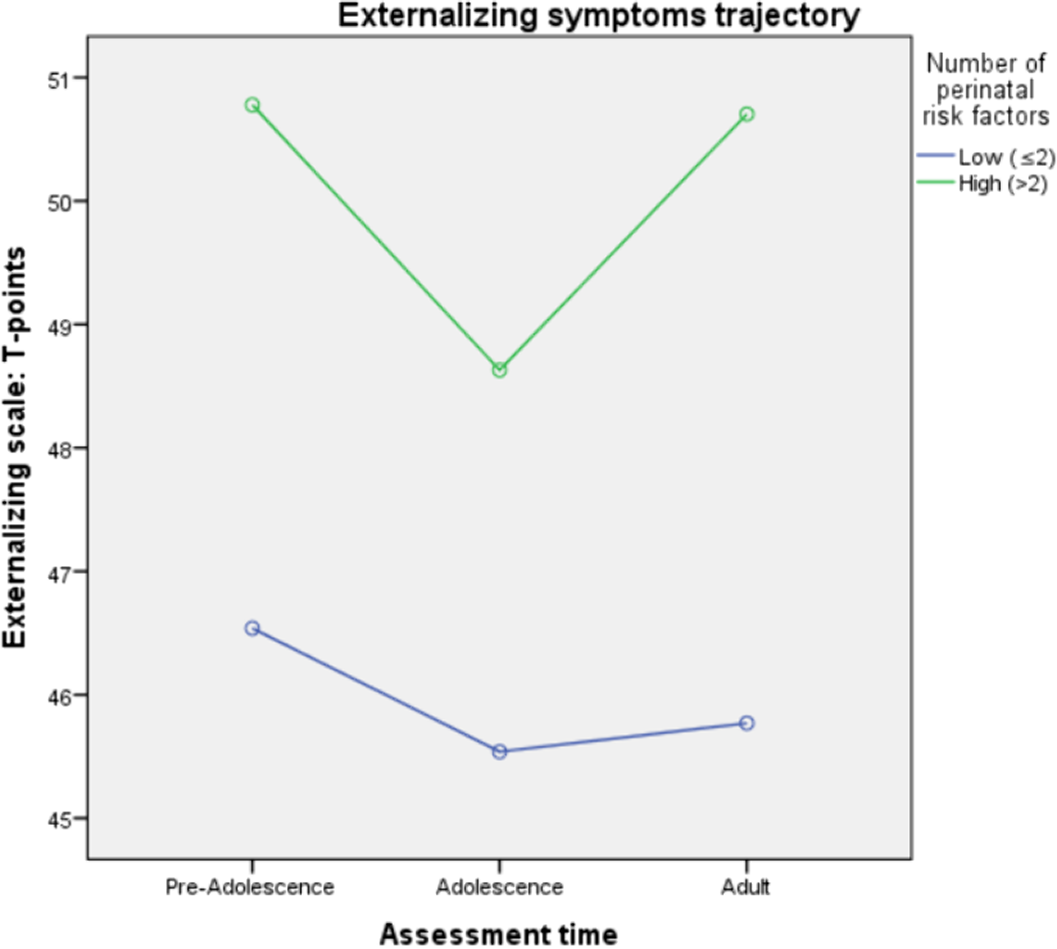
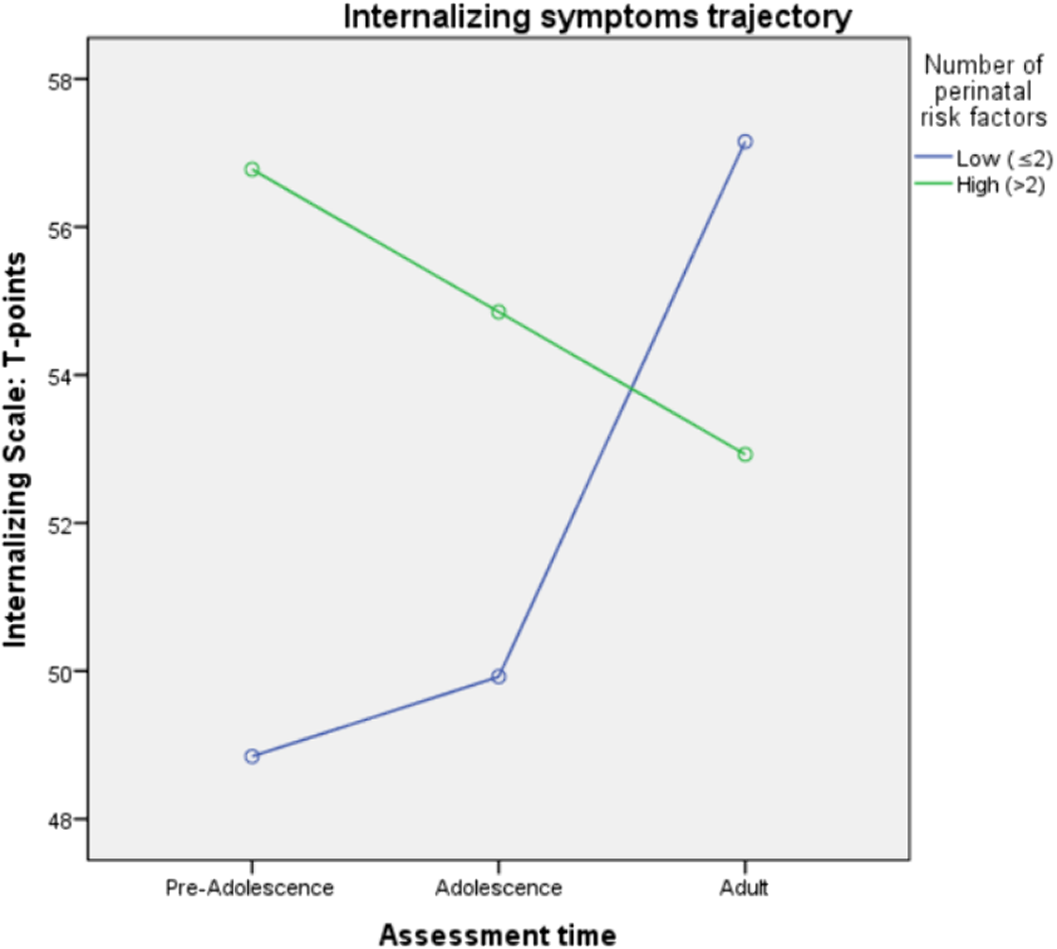
rm-MANOVA results show that high number of perinatal risks was significantly associated with higher internalizing symptomatology in preadolescence but not in adolescence and adult life. The mean difference was 8 T-points. The same trend is evident in adolescence but not in adult age (Graph 1). Perinatal risk factors did not have a significant effect on externalizing symptoms at any time point, despite a non-significant trend is evident (Graph 2).
Conclusions
Our preliminary results suggest a trend of increased internalizing symptoms from childhood to adulthood and a significant role of perinatal risk factors in pre-adolescence. Further investigations are necessary to better understand symptoms trajectories and the role of biological and environmental factors.
Since ancient philosophy extraordinary creativity is associated with mental disorders, emotional and cognitive destabilization, and melancholia. We here summarize the results of empirical and narrative studies and analyze most prominent cases of highly creative persons who suffered from depression, bipolar and schizotypic disorders, drug- and alcohol addiction. Hereby, we focus on the interaction of creative processes with “bipolar” personality traits. Finally, we offer an interdisciplinary interpretation of the creative dialectics between order and chaos.
Objectives
An interdisciplinary concept of the relationship between creativity and psychopathology is shown to be essential for reasonable psychopharmacological and psychotherapeutic treatment of creative individuals.
Methods
On the basis of empirical-statistical and biographical studies we offer a comprehensive concept of the interaction between creativity and psychopathology.
Results
The exemplary cases of J. W. v. Goethe and Robert Schumann show a complex interaction of mood swings with creative achievements. Dysthymic and mild depressive phases were associated with creative efforts whereas severe depressive episodes inhibited their creativity. Mild mood swings and “bipolar personality traits” interacted constructively with their creative striving. With respect to the relationship of alcohol- and drug-abuse, we show on behalf of a detailed analysis of the life and work of prominent Pop-Icons that addiction mostly leads to psycho-social disintegration and destruction of creativity.
Conclusions
An interplay between cognitive coherence and incoherence, emotional stability and instability, order and chaos accompanies many creative processes. The interdisciplinary approach shows that psychopathology can motivate creative efforts. However, if expressed severely, mental disorders inhibit or even destroy creativity.
Olanzapine (OL) represents one of the main chooses for the treatment of psychosis. However, OL increase the risk of metabolic syndrome (MS). Previous literature proposes the “Leptin resistance” as a possible hypothalamic pathogenesis of OL induced MS because of the occurrence of weight gain with increased Leptin blood level.
Objectives
The aim of our study is to investigate in a murine model of full-MS phenotype induced by Olanzapine the hypothalamic gene expression of the pathways involved in Leptin receptor signalling to clarify if a Leptin resistance occurs.
Methods
For the experiment C57BL/6Jfemale mice are used.The OL group (n=15) received pure Olanzapine compounded into chow (54 mg/kg of diet). The vehicle group (n=15)is fed with the same chow without OL. Weight gain is measured every 5 days. After 4 weeks of treatment, mice are sacrificed by rapid cervical dislocation. Blood is collected for Glucose, Insulin and Leptin evaluation. Hypothalamus is dissected and RNA-seq is performed.
Results
The OL group shows a significantweight gain compared to Control (p= 0.02). Likewise blood glucose, Insulin and Leptin levels appear increased (p= 0,0089, p= 0,01, p= 0,0012). From the analysis of RNA-seq hypothalamic differentially expressed genes the anorexigenic POMC pathway downstream to the Leptin Receptor shows a 4-fold increased compared to control.
Conclusions
In our study the “Leptin resistance” involvement in OL induced MS is not confirmed. In fact, although there is an increase in blood Leptin, the expression of Leptin receptor downstream pathways shows a significant increase. This could suggest a possible “POMC resistance” mechanism for OL induced MS.
The most common medical decision is the prescription of medicines. More than 130 different drugs with proven efficacy are currently available for the treatment of patients with mental disorders.
Objectives
The aim was to use routine data available at a patient’s admission to the hospital to predict polypharmacy and drug-drug interactions (DDI).
Methods
The study used data obtained from a large clinical pharmacovigilance study sponsored by the Innovations Funds of the German Federal Joint Committee. It included all inpatient episodes admitted to eight psychiatric hospitals in Hesse, Germany, over two years. We used gradient boosting to predict respective outcomes. We tested the performance of our final models in unseen patients from another calendar year and separated the study sites used for training from the study sites used for performance testing.
Results
A total of 53,909 episodes were included in the study. The models’ performance, as measured by the area under the ROC, was “excellent” (0.83) and “acceptable” (0.72) compared to common benchmarks for the prediction of polypharmacy and DDI, respectively. Both models were substantially better than a naive prediction based solely on basic diagnostic grouping.
Conclusions
This study has shown that polypharmacy and DDI at a psychiatric hospital can be predicted from routine data at patient admission. These predictions could support an efficient management of benefits and risks of hospital prescriptions, for instance by including pharmaceutical supervision early after admission for patients at risk before pharmacological treatment is established
Disclosure
This work was supported by the Innovations Funds of the German Federal Joint Committee (grant number: 01VSF16009). The funding body played no role in the design of the study and collection, analysis, and interpretation of data and in writing the manuscrip
The approval of the esketamine nasal spray for treatment-resistant depression in March 2019 by the Food and Drug Administration (FDA), and few months later by the European Medicine Agency, triggered a vivid debate and many concerns, mainly because of the lack of convincing evidence on its efficacy and safety, based on the development programs, approval trials and few post-marketing trials.
Objectives
We aimed to detect and characterize safety signals for esketamine, by analyzing relevant adverse events (AEs) reports in the FDA Adverse Event Reporting System (FAERS) database (March 2019-March 2020).
Methods
We performed disproportionality analysis through the case/non-case approach: reporting odds ratios (ROR) and information components (IC) with 95% confidence intervals (95%CI) were estimated for esketamine-related AEs with at least four counts. We compared serious and non-serious AEs using non-parametrical tests.
Results
The FAERS database registered 962 reports of esketamine-related AEs in one year. Signals (i.e., statistically significant disproportionality) were detected for several AEs, such as dissociation, sedation, feeling drunk, suicidal ideation and completed suicide. Signals for suicidal ideation, but not suicide attempt and completed suicide, remained significant when comparing esketamine to venlafaxine. The comparison of patients with serious vs. non-serious esketamine AEs revealed that females, patients receiving antidepressant polypharmacy, co-medication with antipsychotics, mood stabilizers, benzodiazepines or somatic medications were more likely to suffer from serious AEs.
Conclusions
This real-world pharmacovigilance analysis detected signals of serious unexpected esketamine-related AEs, thus reinforcing current worries regarding esketamine safety/acceptability. Further real-world studies are urgently needed to unravel the safety profile of esketamine.
Neuropsychiatric drugs account for 16% of drugs that can lead to hepatotoxicity and psychiatric patients can have multiple comorbidities that can increase the incidence of liver disorders such as alcoholism, drug abuse and polymedication. The continuous use of atypical antipsychotic drugs (AAD) has raised questions over their tolerability over endocrine, metabolic and cardiovascular systems. They are also associated with mild elevation of aminotransferases and occasionally cause idiosyncratic liver injury with varying phenotypes. Hepatotoxicity is defined based on biological parameters such as elevation of alkaline phosphatase enzyme, SGPT, SGOT and GGT or clinical abnormalities (jaundice and hepatitis).
Objectives
This work reviewed the current available evidence on the hepatic damage produced by AAD.
Methods
Non-systematic review of the literature with selection of scientific articles published in the past 10 years; by searching Pubmed and Medscape databases using the combination of MeSH descriptors. The following MeSH terms were used: atypical antipsychotic drugs; hepatotoxicity; hepatic; Olanzapine; Clozapine; Risperidone; Aripiprazol; Paliperidone.
Results
Atypical Antipsychotic Drugs are generally well tolerated and hepatic alterations are in general very low or rare. The cases published were observed with Clozapine, Olanzapine and Risperidone. Atypical Antipsychotic drugs have a better profile than Chlorpromazine.
Conclusions
In conclusion, the hepatic injury generally occurs within the first weeks of treatment and is usually reversible with drug withdrawal. Hepatic check-ups may be relevant, especially in the beginning of treatment.
Patients with dissociative identity disorder (DID) present two or more identities. Although it is a widely questioned diagnosis, it is currently found in the main DSM-5 and ICD-10 diagnostic manuals. So far there is no standard psychopharmacological treatment for people with this pathology.
Objectives
Describe the pharmacological treatment associated with the clinical evolution of a patient with DID.
Methods
Follow-up was carried out in a mental health center for a year, undergoing psychopharmacological and psychotherapeutic treatment. The information is taken from the medical history.
Results
The patient presents with anxious and depressive symptoms. She was referred from primary care with 50mg sertraline without response. Dose was increased to 100mg without response. New management started with desvenlafaxine 100mg, associated with lorazepam, partially reducing the symptoms. Later, the patient presented self-referentiality, sounding of thought, began to describe frequent memory losses and a rebound in anxiety-depression symptoms, increasing the dose of desvenlafaxine to 200mg and introducing haloperidol to 1.5mg. Three months later, she presented showing another identity, active, aggressive, pythiatic, without evident anxious symptoms that she previously presented in a marked way. Desvenlafaxine was adjusted to 100mg and haloperidol to 0.5mg every 12 hours. The patient evolved favorably, decreasing anxiety, depressive symptoms and memory loss, in addition to disappearing psychotic symptoms. This treatment was sustained, keeping the patient psychopathological and functional stability and allowing a psychotherapeutic approach.
Conclusions
Treatment with desvenlafaxine and haloperidol was favorable to maintain clinical stability and allow other therapeutic approaches.High dose of antidepressant could favor the expression of another identity of the patient.