We partner with a secure submission system to handle manuscript submissions.
Please note:
You will need an account for the submission system, which is separate to your Cambridge Core account. For login and submission support, please visit the
submission and support pages.
Please review this journal's author instructions, particularly the
preparing your materials
page, before submitting your manuscript.
Click Proceed to submission system to continue to our partner's website.
To save this undefined to your undefined account, please select one or more formats and confirm that you agree to abide by our usage policies. If this is the first time you used this feature, you will be asked to authorise Cambridge Core to connect with your undefined account.
Find out more about saving content to .
To send this article to your Kindle, first ensure no-reply@cambridge.org is added to your Approved Personal Document E-mail List under your Personal Document Settings on the Manage Your Content and Devices page of your Amazon account. Then enter the ‘name’ part of your Kindle email address below. Find out more about sending to your Kindle.
Find out more about saving to your Kindle.
Note you can select to save to either the @free.kindle.com or @kindle.com variations. ‘@free.kindle.com’ emails are free but can only be saved to your device when it is connected to wi-fi. ‘@kindle.com’ emails can be delivered even when you are not connected to wi-fi, but note that service fees apply.
Long-acting injectable antipsychotics (LAIs) are currently the most effective alternative for patients with schizophrenia who exhibit poor adherence. Although a recent meta-analysis reported similar efficacy between first and second-generation LAIs, these results were only based on 3 studies due to the limited number of head-to-head comparisons.
Objectives
Present the preliminary results of a network meta-analysis on the comparative efficacy of LAIs in schizophrenia.
Methods
Studies were obtained from a previous study, where we carried out a systematic search from until May 2019 in various databases. Included trials of adults with schizophrenia compared the efficacy of LAI vs LAI or placebo through the Positive and Negative Syndrome Scale (PANSS). Efficacy was evaluated through the mean differences (MD) from baseline to endpoint in the PANSS total scores. Network meta-analysis was performed in MetaInsight through direct and indirect comparisons using a Bayesian approach.
Results
from 12 studies are presented in Figures 1 and 2. All LAIs except zuclopenthixol were more effective than placebo. There were no significant differences between LAIs except for aripiprazole and risperidone, which were more efficacious than zuclopenthixol. The largest change occurred with aripiprazole LAI, but was not significantly higher than haloperidol.
Figure 1. Comparison of treatment pairs. Effect sizes are presented as MD and 95% confidence intervals (*p<0.05).
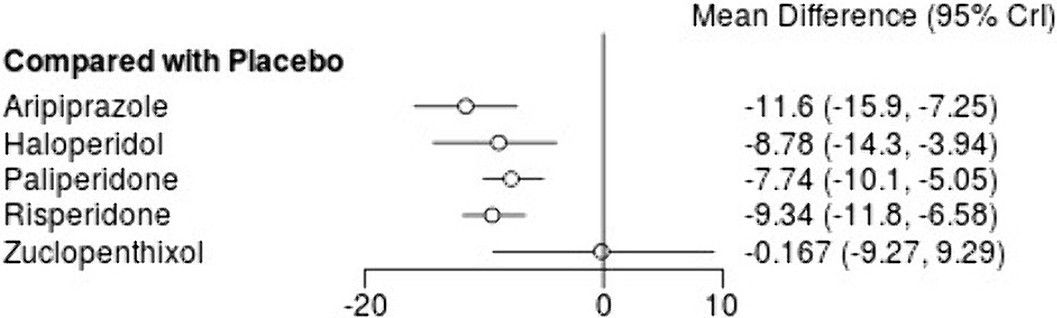
Figure 1. Overall change in symptoms
Conclusions
Preliminary results from a network meta-analysis also suggest that in the long-term haloperidol decanoate is equally effective in overall symptom changes compared to other LAIs. Further analyses are needed to obtain a better perspective on these drugs.
In schizophrenia, there are disorders in all sensory modalities, but the regularities of their occurrence, their pathogenesis and attitude towards cognitive functions are not sufficiently studied.
Objectives
Examine the interrelation between the dysfunctions in different analysers (olfactory and visual) and their dependence on the duration of the disease and the severity of psychotic symptoms and cognitive deficit in schizophrenic patients (F20 according to ICD 10 criteria).
Methods
All subjects were determined the threshold of olfactory sensitivity to n-butanol, the ability to discriminate against odors and the amount of error in comparing the same sections. Cognitive functions were evaluated using the BACS scale.
Results
The inverse correlation between the value of the visual assessment error and the reduction of the threshold of olfactory sensitivity (r=- 0.56; p < 0.05) and the inverse correlation between the value of the visual assessment error and the ability to discriminate smells (0.64; p < 0.05) were revealed. There are no significant correlations between the duration of the disease and sensory disturbances. Olfactory and visual disturbances in schizophrenic patients were connected with cognitive functions ((r=-0,62; p< 0,05 and r=-0,84, p< 0,001 accordingly).
Conclusions
The data confirm that sensory impairments have a common pathogenesis and are closely related to cognitive deficits. Sensory and cognitive deficits in schizophrenia may be the result of top-down regulation failure.
Metabolic syndrome (MS) is an often co-occurring condition that occurs during antipsychotic therapy and impairs social functioning
Objectives
We tried to conduct a self - evaluation of social adaptation in patients with schizophrenia and MS
Methods
We examined 150 patients with schizophrenia receiving antipsychotic therapy at the clinics of Mental Health Research Institute. The study was supported by a grant from the Russian Science Foundation 18-15-00011. The IDF criteria were used to diagnose metabolic syndrome. We used «The social adaptation self - evaluation scale» (SASS).
Results
63 patients (42%) had MS and 87 patients (58%) did not. In the subgroup of patients with MS, 59 people (93.65%) had disabilities or were unemployed, in the group without MS - 82 (94.26%) patients. There were no statistically significant differences between the groups (p ≥ 0.05). In the patients with schizophrenia and concomitant MS, the median SSAS scores was 35 [29; 39], which corresponds mainly to a high level of self - evaluation of social adaptation. At the same time, in patients with schizophrenia and without MS, on the contrary, the self - evaluation of social adaptation was 30 [23; 38] points (p = 0.03914). Perhaps this is due to the great attention from relatives and doctors of general somatic practice and the primary medical network in connection with the risk of developing severe somatic pathology.
Conclusions
Patients with MS can give a higher assessment of social adaptation, despite a objectively low social status.
Social cognition has been associated with functional outcome in patients with first episode psychosis (FEP). Social cognition has also been associated with neurocognition and cognitive reserve. Although cognitive reserve, neurocognitive functioning, social cognition, and functional outcome are related, the direction of their associations is not clear.
Objectives
The aim of the study was to analyze the influence of social cognition as a mediator between cognitive reserve and cognitive domains on functioning in FEP both at baseline and at 2 years.
Methods
The sample of the study was composed of 282 FEP patients followed up for 2 years. To analyze whether social cognition mediates the influence of cognitive reserve and cognitive domains on functioning, a path analysis was performed. The statistical significance of any mediation effects was evaluated by bootstrap analysis.
Results
At baseline, as neither cognitive reserve nor the cognitive domains studied were related to functioning, the conditions for mediation were not satisfied. Nevertheless, at 2 years of follow-up, social cognition acted as a mediator between cognitive reserve and functioning. Likewise, social cognition was a mediator between verbal memory and functional outcome. The results of the bootstrap analysis confirmed these significant mediations (95% bootstrapped CI (−10.215 to −0.337) and (−4.731 to −0.605) respectively).
Conclusions
Cognitive reserve and neurocognition are related to functioning, and social cognition mediates in this relationship.
Disclosure
This work was supported by the Carlos III Institute of Health and European Fund for Regional Development (PI08/1213, PI11/ 01977, PI14/01900, PI08/01026, PI11/02831, PI14/01621, PI08/1161, PI16/ 00359, PI16/01164, PI18/00805), the Basque Foundation for He
Long-acting antipsychotics (e.g. 1-monthly (PP1M) / 3-monthly (PP3M) injection forms of paliperidone palmitate) have been developed to improve treatment continuation in schizophrenia patients.
Objectives
To assess risk factors of treatment discontinuation in patients on paliperidone palmitate and risperidone microsphere. Additionally, treatment continuation between patients with PP1M and PP3M was compared.
Methods
The IQVIA Longitudinal Prescription databases were used. Risk factors of treatment discontinuation were identified by a multilevel survival regression using Cox proportional hazards model. Kaplan Meier analyses were performed by identified significant risk factors.
Results
25,361 patients (France: 9,720; Germany: 14,461; Belgium: 1,180) were included. Over a one-year follow-up period, a significant higher treatment continuation was observed for patients newly initiated on paliperidone palmitate (46.2%) than those initiated on risperidone microspheres (14.6%). Additionally, a significantly higher treatment continuation was found for ‘stable’ PP3M patients (81.8%) than ‘stable’ PP1M patients (62.9%). Patients were more likely to discontinue when drugs prescribed by GP only (HR = 1.68, p < 0.001 vs. psychiatrist only) or being females (HR = 1.07, p < 0.001), whereas discontinuation rate decreased with age (31-50 years: HR = 0.95, p = 0.006 and > 50 years: HR = 0.91, p < 0.001 vs. 18-30 years).
Conclusions
Paliperidone palmitate was associated with a significantly higher treatment continuation than risperidone microspheres. Treatment continuation is likely to be improved by targeting young patients (18-30 years), empowering GPs with mental health knowledge and managing patients by a collaborative primary care-mental health model. Further research is needed to understand why females have more treatment discontinuation.
Disclosure
Rui Cai, Flore Decuypere and Pierre Chevalier are IQVIA employees and served as paid consultants to Janssen during the conduct of this study. Antonie Wimmer, Pascal Guillon, Stefan Pype, Annabelle Godet, Valeria Timtschenko are Janssen employees.
Schizophrenia is associated with lower life expectancy due to cardiovascular disease. Metabolic syndrome (MetS) occupies an important place among the main problems. Indicators of hormones regulating metabolism may be appealing candidates as biomarkers of metabolic side-effects. Certain role belongs to genetic factors that might be the basis of sensitivity to development of MetS.
Objectives
The aim is to study polymorphisms of leptin gene (LEP) and serum leptin concentration in schizophrenia patients with metabolic syndrome.
Methods
After obtaining informed consent, patients with schizophrenia (ICD-10: F20) were included: 91 patients for biochemical research and 463 patients for genotyping. Patients were divided into two groups: 46 (119) with MetS; 45 (344) without it. Concentration of leptin was measured on an analyzer MAGPIX (Luminex, USA). Determination of 4 polymorphisms (rs2167270, rs3828942, rs10954173, rs4731426) of LEP was performed by PCR. Differences were considered significant at p<0.05.
Results
The leptin concentration is significantly (p<0.001) higher in MetS (13511.5 [7392.5; 28278.75] pg/ml) compared to patients without MetS (6662 [2131.5; 11380] pg/ml). Significant differences were found in the distribution of rs3828942 (GG:GA:AA): 25.9%:44%:30.2% in MetS and 31.2%:52.6%:16.2% without MetS (χ2=10.545, p=0.005). The genotype AA and the allele A have a predisposing effect on the development of MetS (OR1=2.247, C.I:1.248-4.046; OR2=1.475, C.I:1.093-1.991, χ2=6.49, p=0.01).
Conclusions
A number of features are observed in patients with MetS, which impair the functioning of patients. These investigations should aim to optimize the approach to assess the risk of MetS. The study was supported by grants from the RSF 19-75-10012 (genetic research) and 18-15-00011 (determination of leptin concentration)
Disclosure
The study was supported by grants from the Russian Science Foundation №19-75-10012 (genetic research) and №18-15-00011 (determination of leptin concentration)
Patients with schizophrenia show severe difficulties in interpersonal communication, including impairments in conversation skills, like the turn-taking. To our knowledge, very few studies to date have taken into account conversation analysis in order to investigate turn-taking in schizophrenia patients.
Objectives
To investigate the conversational patterns in schizophrenia patients; to assess possible associations between dialogic features, abnormal subjective experiences and symptom dimensions.
Methods
Thirty-six patients with Schizophrenia underwent an interview, subsequently analyzed with an innovative semi-automatic analysis. Positive and Negative Syndrome Scale (PANSS) was adopted for the investigation of psychopathology and Examination of Anomalous Self Experience (EASE) for Self-Disorders.
Results
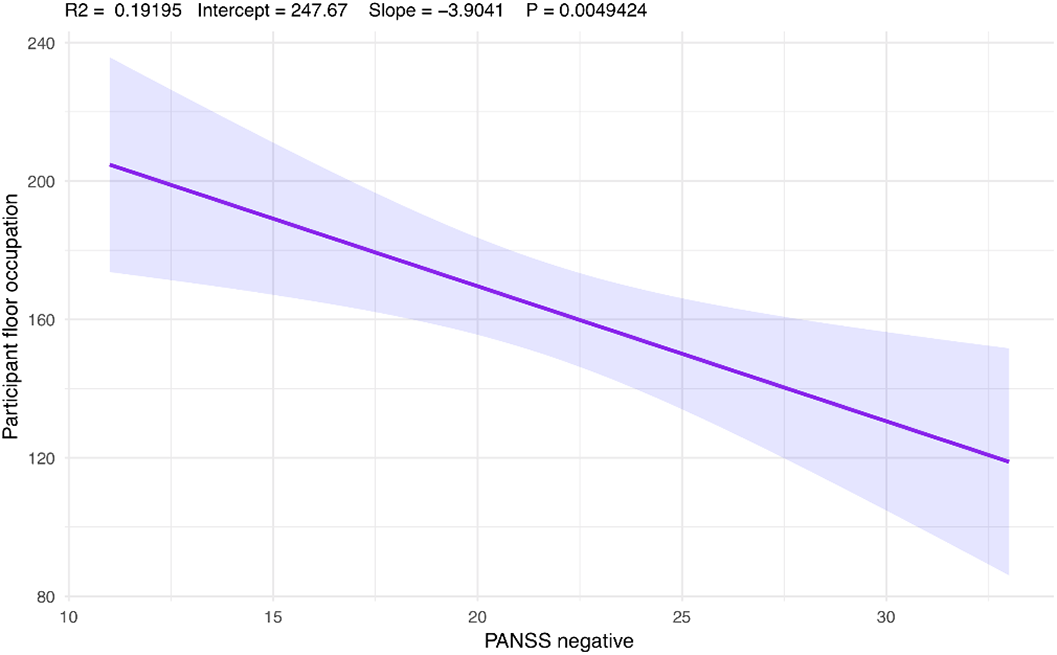
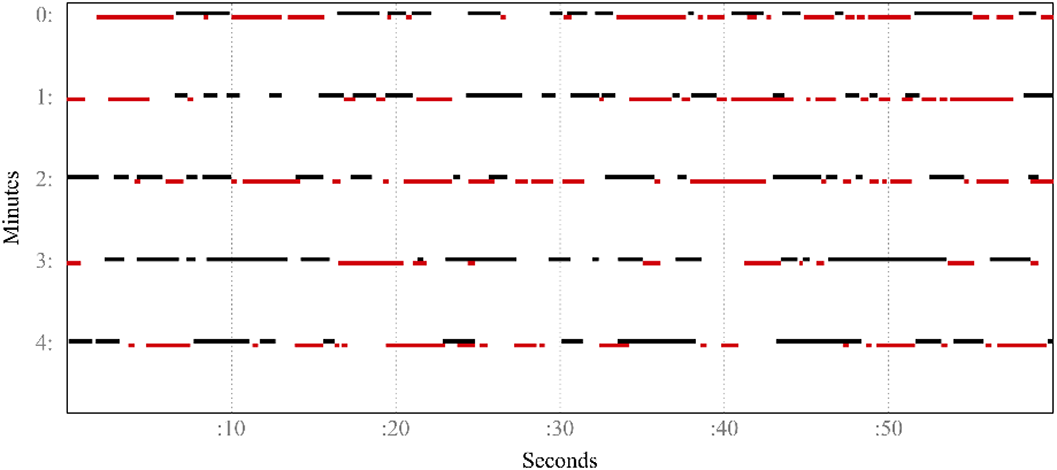
Dialogic exchanges are graphically represented in Figure 1. An inverse correlation was found between participant speaking time and PANSS negative symptoms score (r = -0.44, p value < 0.05; Figure 2), whereas no associations were found between conversational variables and PANSS positive or disorganization dimensions. Finally, a positive correlation was found between the EASE item “spazialization of thought” and average pause duration (r = 0.42, p value < 0.05).
Conclusions
The finding of a relationship between negative symptoms and conversational patterns suggest that conversational features in schizophrenia are expression of the “core” negative dimension of the disorder. The association with the phenomenon of thought spatialization seems to suggest that the disturbances of the stream of consciousness impact on natural dialogic interactions. Ultimately, conversation analysis seems a promising tool to study dialogic exchanges of patients with schizophrenia.
Frontotemporal Demential (FTD) is a neurodegenerative disorder evolving the frontal or temporal brain lobes. They have been described six variants. Behaviour variant (BvFTD) is the most common, and is characterized by changes in social behaviour and conduct, with loss of social awareness and poor impulse control. Hebephrenic schizophrenia (HSz), or disorganized schizophrenia, was recognized as a schizophrenia subtype, characterized by desorganized behaviour and a cognitive deteriorization. Subtypes of schizophrenia are no longer recognized as separate conditions neither in the Diagnostic and Statistical Manual of Mental Disorders, nor in the new International Statistical Classification of Diseases.
Objectives
To review the literature about the concepts of hebephrenic schizophrenia and their similarities with the concept of frontotemporal dementia
Methods
Narrative review of the literature on PubMed/MEDLINE, using the keywords “hebephrenic szchizophrenia” AND “frontotemporal dementia”. Only articles in English were included.
Results
Some authors described dificulty in establish a diferential diagnosis between HSz and BvFTD. HSz has an earlier onset. However, BvFTD is an early age dementia. The fenomenology of both diseases is similar, and schizophrenia was historical conceptualized as praecox dementia. Frontotemporal abnormalities are common neuroimagiological findings in schizophrenia. Clinically, FTD shows a profound alteration in personality and social conduct, emotional blunting and loss of insight. Memory, intellectual functions, executive and attentional abilities may be disturbed in both.
Conclusions
A diferential diagnosis between HSz and BvFTD is dificult to establish (clinically and imagiologically). The response to treatment is weak in both. It should be investigated the possibility they could be the same syndrome, onseting in diferent ages.
Compared with adult onset, early onset schizophrenia is typically characterized by greater illness severity and less favorable prognosis.
Objectives
To evaluate the proportion of adolescent patients with schizophrenia who achieved sustained remission and recovery during 2 years of treatment with lurasidone.
Methods
Patients aged 13-17 years with a DSM-IV-TR diagnosis of schizophrenia, and a Positive and Negative Symptom Scale (PANSS) total score ≥70 and <120, were randomized to 6 weeks of double-blind (DB), fixed-dose treatment with lurasidone (37 or 74 mg/d) or placebo. Patients who completed 6 weeks of DB treatment were eligible to enroll in a 2-year, open-label (OL), flexible dose extension study of lurasidone (18.5-74 mg/d). Criteria for sustained remission, were the 6-month consensus criteria summarized by Andreasen (Am J Psych 2005;162:441-9). Criteria for sustained recovery consisted of meeting sustained remission criteria with a Children’s Global Assessment Scale (CGAS) score ≥70 for at least 6-months indicating no clinically significant functional impairment.
Results
A total of 271 patients completed the 6-week DB study and entered the extension study, and 186 (68.6%) and 156 (57.6%) completed 52 weeks and 104 weeks of treatment, respectively. During OL treatment with lurasidone, 52.8% met sustained remission criteria, with a Kaplan-Meier (KM) estimate of 64.1 weeks for median time to sustained remission; and 28.8% met sustained recovery criteria, KM estimate of 104.6 weeks for median time to sustained recovery.
Conclusions
For adolescents with schizophrenia, treatment with lurasidone was associated with high rates of sustained remission and sustained recovery over a two-year period.
Disclosure
Employee of Sunovion Pharmaceuticals Inc. The study summarized in this Abstract was supported by funding from Sunovion Pharmaceuticals Inc
Onset of schizophrenia commonly occurs during late adolescence or early adulthood and is often characterized by greater symptom severity and impairment.
Objectives
To evaluate the efficacy and safety of lurasidone in the treatment of acute schizophrenia in adolescents and young adults.
Methods
The 4 studies in this pooled analysis used similar study designs. Patients (ages 13-25 years) were randomized to 6 weeks of double-blind, placebo-controlled treatment with once-daily lurasidone (37 mg, 74 mg, 111 mg, 148 mg). The primary outcome was endpoint change in the Positive and Negative Syndrome Scale (PANSS) total score; secondary measures included the Clinical Global Impression, Severity scale (CGI-S).
Results
The safety population consisted of 537 patients; 79.1% completed the studies. Treatment with lurasidone was significant (P<0.001) at Week 6 endpoint for change in the PANSS total score, with higher effect sizes (ES) at higher doses (37 mg, 0.53; 74 mg, 0.57; 111 mg, 0.67; 148 mg, 1.35); significance was also observed for change in the CGI-S (37 mg, 0.51; 74 mg, 0.49; 111 mg, 0.57; 148 mg, 1.75). For lurasidone (combined doses), 3 adverse events occurred with a frequency ≥5% (nausea, 13.5%; somnolence, 12.1%; akathisia, 10.1%); 4.8% of patients discontinued due to an adverse event. At LOCF-endpoint, 3.6% of patients had weight gain ≥7%, and 1.5% had weight loss ≥7%. Minimal median changes were observed at endpoint in metabolic lab values.
Conclusions
In adolescents and young adults with schizophrenia, treatment with lurasidone in doses of 37-148 mg/d was a safe, well-tolerated, and effective treatment.
Disclosure
Presenter is an employee of Sunovion Pharmaceuticals Inc. The study summarized in this Abstract was supported by Funding from Sunovion Pharmaceuticals Inc.
Childhood trauma increases social functioning deficits, which in turn negatively impact social inclusion in those experiencing first-episode psychosis (FEP). Associations between aberrant higher-order social cognitive processes such as emotion recognition (ER) and trauma severity may be one pathway by which trauma negatively impacts social functioning.
Objectives
Given sex differences identified in the experience of childhood trauma, it is pertinent to evaluate how trauma severity may differentially impact ER in males and females.
Methods
Eighty-three FEP participants (52 males, 31 females) and 69 nonclinical controls (49 males, 20 females) completed the CogState Research Battery. FEP participants completed the Childhood Trauma Questionnaire. A sex × group (FEP, controls) ANOVA examined ER differences and was followed by two-way ANCOVAs investigating the effects of sex and childhood trauma severity (none, low, moderate, severe) on ER and global cognition in FEP.
Results
FEP participants had significantly lower ER scores than controls (p = .035). In FEP, a significant interaction emerged between sex and childhood trauma severity (F(3, 72) = 6.382, p = .001), selective to ER, while controlling for age at onset. Simple effects analyses revealed that females in the severe trauma category exhibited superior ER capacity relative to males.
Conclusions
The differential impact of trauma severity on ER in males and females with FEP may be theoretically interpreted as the distinct way that hypervigilance affects the sexes. Early intervention services should refine social cognitive interventions in male and female trauma survivors to facilitate social functioning improvements.
Disclosure
Funding: This study was supported by the Canadian Institutes of Health Research (#68961) to M.L. and A.M. Salary awards include: The Fonds de recherche du Québec - Santé to M.L. and R.J., the James McGill Professorship to M.L., and the Canada Research Cha
Aggression and violent incidents are a major concern in psychiatric inpatient care, potentially leading to physical and psychological consequences for both patients and staff. Nutritional supplementation was found to reduce aggressive incidents and rule violations in forensic populations and children with behavioural problems.
Objectives
To assess whether multivitamin, mineral and n-3 PUFA supplementation is effective in reducing the number of aggressive incidents among psychiatric patients who are chronically admitted.
Methods
In a pragmatic, multicentre, randomized, double-blind, placebo-controlled study, psychiatric inpatients were randomized to receive either three supplements containing multivitamins, minerals, and n-3 PUFA or placebo. During the intervention period of six months, aggressive incidents were assessed using the Staff Observation Aggression Scale – Revised (SOAS-R). Secondary outcome parameters were the patients’ quality of life and affective symptoms. The trial was registered in the Clinical Trials Register (NCT02498106).
Results
A total of 176 patients were enrolled and randomly assigned to receive supplements (n=87) or placebo (n=89). They were on average 49.3 years old (SD=14.5), and 64.2% were male. Most patients had a psychotic disorder (60.8%). Supplementation versus placebo significantly increased circulating micronutrient levels. The primary outcome of SOAS-R incidents was similar in those assigned to supplements (1.03 incidents per month; 95% confidence interval [CI]: 0.74-1.37) and placebo (0.90; 95%CI: 0.65-1.19), with a rate ratio of 1.08 (95%CI: 0.67-1.74; p=0.75). Differential effects were neither found in sensitivity analyses on the SOAS-R, nor on secondary outcomes.
Conclusions
Six months of nutritional supplementation did not reduce aggressive incidents among chronically admitted psychiatric inpatients.
The relationship between history of childhood trauma (CT) and current schizophrenic symptoms is complex and controversial. Most of the studies report more positive psychotic symptoms (PPS) in psychotic patients who had suffered CT. Findings for negative psychotic symptoms (NPS) are mixed: most authors do not find differences or even find less.
Objectives
The purpose of this study is to evaluate and describe the types of CT suffered by patients diagnosed with schizophrenia spectrum disorders (SSD), and to analyse the relationship between history of CT and the present-time intensity of PPS and NPS.
Methods
We conducted a cross-sectional study of 45 adult patients with a SSD. Instruments: Childhood Trauma Questionnaire, short form (CTQ-SF) for measuring CT and Positive and Negative Syndrome Scale (PANSS) to assess the PPS and NPS of psychosis.
Results
77.8% of the patients reported having suffered any kind of CT. By types of trauma: 48.9% reported emotional abuse, 28.9% physical abuse, 40.0% sexual abuse, 55.6% emotional neglect and 46.7% physical neglect. A lineal correlation between CTQ-SF and PANSS+/- scores was performed. Neither total PANSS+ nor any particular PANSS+ items correlate with CTQ scores. A significant inverse lineal association of moderate intensity exists between total PANSS− score and CT intensity (ρ = −0.300, p = 0.045)
Conclusions
In line with previous research, our study has found inverse correlation between NPS and CT. In contrast, no association was found between PPS and CT. Our sample was mostly composed by chronic patients, which might explain the differences with the previous literature.
Treatment-resistant schizophrenia (TRS) represents a major clinical issue, characterized by worse psychopathological outcome, a more disrupted neurobiological substrate and higher healthcare costs. Cognitive impairment is a core feature of schizophrenia, strongly associated with patients’ functional outcome. Different studies showed that TRS patients exhibit poorer neurocognitive performance, particularly on verbal domains. To date Cognitive Remediation Therapy (CRT) represents the best available tool for treating cognitive deficits in schizophrenia. However, CRT outcomes are highly heterogeneous and significant treatment predictors are still lacking.
Objectives
To investigate possible differences of CRT outcome among patients with schizophrenia, stratified according to antipsychotic response (TRSs vs. first-line responders - FLRs).
Methods
150 patients with schizophrenia, (95 FLRs, 55 TRSs) were assessed for neurocognition with BACS and WCST at baseline and after CRT. General Linear Models (GLMs) were performed to investigate possible differences between groups on basal cognition and CRT outcome (Cohen’s d Effect Size).
Results
At baseline, GLMs showed significant differences in Verbal Memory (F=4,66; p=0,03) and WCST–executive functions (F=5,59; p=0,02), both worse in TRS group. Effecr Sizes of CRT outcome resulted significantly different in domains of Verbal Memory (F=4,68; p=0,03) and WCST–executive functions (F=4,62; p=0,03), with greater improvements among TRS patients.
Conclusions
This is the first study to indicate treatment-resistance as a possible predictor of CRT outcome in schizophrenia. Moreover, we observed that CRT resulted able to fill the cognitive gap between treatment groups. Thus, these results further highlight the importance of early cognitive interventions in order to reduce the neuropsychological and functional burden associated with the disease, especially for TRS patients.
COVID-19 raises serious concerns regarding its unknown consequences for health, including psychiatric long term outcomes. Historically, influenza virus has been responsible for pandemics associated with schizophrenia. Epidemiological studies showed increased risk for schizophrenia in children of mothers exposed to the 1957 influenza A2 pandemic. Controversy remains concerning the mechanisms of pathogenesis underlying this risk.
Objectives
We aim to review the evidence for the association between influenza infection and schizophrenia risk, the possible pathogenic mechanisms underlying and correlate these findings with the schizophrenia hypothesis of neurodevelopment.
Methods
We reviewed literature regarding evidence from epidemiological, translational animal models and serological studies using medline database.
Results
The biological mechanisms likely to be relevant account to the effects of infection-induced maternal immune activation, microglial activation, infection-induced neuronal autoimmunity, molecular mimicry of the influenza virus, neuronal surface autoantibodies and psychosis with potential infectious antecedents. Influenza infection may fit into the theory of the neurodevelopment of schizophrenia as a factor that alters the normal maturation processes of the brain (possible second or third hit).
Conclusions
Influenza infection has multiple pathogenic pathways in both pre and post natal processes that might increase the risk of schizophrenia or psychosis. The existing evidence regarding the relationship between influenza virus and psychosis might help us draw similar long-term concerns of COVID-19.
Identifying distinct dimensions of negative symptoms in First Episode Schizophrenia (FES) might result in a better understanding and treatment of this invalidating symptomatology.
Objectives
Aim of this study was to examine negative symptom structure in FES patients using the Positive and Negative Syndrome Scale (PANSS).
Methods
All 147 participants, aged 12–35 years, completed the PANSS and the Global Assessment of Functioning (GAF) scale. A principal component analysis with varimax rotation was performed to investigate PANSS negative symptom structure in the FES total sample.
Results
A 2-factor model (i.e. “Expressive Deficits” and “Asociality” dimensions) was identified. Only “Expressive Deficits” domain had a significant negative correlation with baseline GAF score.
Conclusions
This bipartite solution seems to be adequate to describe the phenomenological variety of negative symptoms experienced by FES individuals at the point of entry in early intervention services.
The prevalence rates of mental health issues, particularly anxiety and depression, is high among transgender people. However, the incidence of anxiety and depression in transgender people living in Russia is unclear until now.
Objectives
To examine the frequency of anxiety and depression in transgender people living in Russia.
Methods
The Hospital Anxiety and Depression Scale (HADS) was used for online screening for symptoms of anxiety and depression in transgender people living in Russia throughout November 2019. 588 transgender adults living in all Federal Districts of Russia (mean age 24.0±6.7) were included in the final analysis. 69.6% (n=409) of the survey participants indicated the direction of transition as transmasculine (TM), 23.1% (n=136) – as transfeminine (TW), and 7.3% (n=43) – as other (TO).
Results
It was found that 45.1% (n=265) and 24.0% (n=141) of transgender people had clinically significant levels of anxiety and depression, respectively (HADS score of 11 or higher). The rates of anxiety (TM=10.21±4.68; TW=8.72±3.91; TO=10.72±4.43) and depression (TM=7.53±4.09; TW=7.40±4.19; TO=7.74±4.33) did not have statistically significant differences within the direction of transition. The anxiety and depression mean scores in all subgroups were statistically significantly higher than in the general Russian population (p<0.001; one sample t-test).
Conclusions
Our findings suggest a high prevalence of depression and anxiety disorders in the transgender population as compared to the cisgender population in Russia. The identified frequency of anxiety and depression in transgender people in Russia is worrying and requires immediate action to improve the availability and quality of medical and psychological care for this group of people.
Exploring the ways in which sexual fantasies may affect sexual experience and satisfaction is of relavence in the clinical setting involving sexual dysfuntion.
Objectives
To observe how the sexual fantasy scores differ in their relationship with sexual satisfaction, experience and quality between sexual dysfunction cases and normal controls.
Methods
Scales included: Wilson’s sex fantasy questionnaire (WSFQ), Arizona Sexual Experience Scale (ASEX), Sexual Quality of life Questionnaire (SQoL), and a subjective sexual satisfaction meter. Differences in resposes of both groups on WSFQ (item-wise and domain-wise) were analysed using T-tests. Two-way ANOVA was applied to see how other scales affected sexual fantasy.
Results
Cases scored significantly higher on ASEX scale, and low on satisfaction, SQoL and WSFQ
Cases N=1OO
Controls N=100
t-test
Satisfaction Mean(sd)
4.27(1.85)
7.82(1.31)
t=3.052;df=198,p=0.0026
Asex
17.52(4.73)
8.28(1.34)
t=15.24;df=198,p<0.0001
SQoL
29.41(12.12)
49.5(6.67)
t=14.52;df=198,p<0.0001
WSFQ
26.80(17.61)
30.59(15.32)
t=1.62,df=98,p=0.106
Majority of WSFQ responses, both in cases and controls, fell in the intimate and impersonal domains. Sexual fantasy scores and sexual satisfaction had a strong positive and significant correlation in controls but no linear correlation in the case-subjects. sexual fantasy scores contributed to 5.7% of difference in the scores of SQoL between groups. Major variance in scores of satisfaction in our subjects depended on presence or absence of sexual dysfunction(46.5%)but sexual fantasies also contributed to 8.8% of the variance.
Conclusions
The study showed that fantasies contribute to positive sexual outcomes only in absence of sexual dysfunction. ANOVAanalysis revealed that in case-subjects sexual satisfaction briefly increases initially with increase in fantasy scores but starts to decline as fantasies increase.
Abnormalities of sleep patterns are common in people with psychiatric disorders and often represent a source of distress, worsening the outcome. However, little is knwon about the relationship between psychotic-like symptoms and sleep disorders in the general population.
Objectives
1. Whether there is a relationship between sleep disorders and psychotic-like experiences in a sample of individuals belonging to the general population. 2. Which sleep disorders are more commonly associated with psychotic-like experiences.
Methods
A web survey was spread thorugh social networks. We administered the SLEEP-50 to investigate the presence of sleep disorders and the Community Assessment of Psychic Experience (CAPE) for psychotic-like symptoms. Moreover, socio-demographic characteristics of participants were collected.
Results
The web-survey was completed by 824 participants. Six people refused to give consent and 95 were excluded because they declared to suffer from psychiatric disorder sor other medical conditions potentially infleuncing on sleep. Therefore, 729 subjects were included in the analysis. Pearson correlation coefficients showed strong correlations between the scale regarding SLEEP-50 “All sleep disorders” scale and CAPE Total and Depressive scales (r = 0.52, p < 0.001). A moderate correlation was found between “All sleep disorders” and CAPE Negative (r = 0.49) and Positive (r = 0.32) scales. Correlations with specific SLEEP-50 subscales were also found.
Conclusions
There seems to be a strong relationship between psychotic-like symptoms and sleep problems in the general population. Our findings might indicate that some sleep abnormalities may represent earlier symptoms of a psychiatric condition and need to be always monitored even in the non-psychiatric population.
Emotion self-regulation relies both on cognitive and behavioral strategies implemented to modulate the subjective experience and/or the behavioral expression of a given emotion.
Objectives
While it is known that a network encompassing fronto-cingulate and parietal brain areas is engaged during successful emotion regulation, the functional mechanisms underlying failures in emotion suppression are still unclear.
Methods
We analyzed facial-view video and high-density EEG recordings of nineteen healthy adult subjects (26±3yrs, 10F) during an emotion suppression (ES) and a free expression (FE) task performed on two consecutive days. An actigraph was worn for 7-days and used to determine sleep-time before each experiment. Changes in facial expression were identified and manually marked on the video recordings. Continuous hd-EEG recordings were preprocessed using standard approaches to reduce artifactual activity and source-modeled using sLORETA.
Results
Changes in facial expression during ES, but not FE, were preceded by local increases in sleep-like activity (1-4Hz) in in brain areas responsible for emotional suppression, including bilateral anterior insula and anterior cingulate cortex, and in right middle/inferior frontal gyrus (p<0.05, corrected; Figures 1 and 2). Moreover, shorter sleep duration the night prior to the ES experiment correlated with the number of behavioral errors (p=0.01; Figure 3) and tended to be associated with higher frontal sleep-like activity during emotion suppression failures (p=0.05).
Conclusions
These results indicate that local sleep-like activity may represent the cause of emotion suppression failures in humans, and may offer a functional explanation for previous observations linking lack of sleep, changes in frontal activity and emotional dysregulation.