We partner with a secure submission system to handle manuscript submissions.
Please note:
You will need an account for the submission system, which is separate to your Cambridge Core account. For login and submission support, please visit the
submission and support pages.
Please review this journal's author instructions, particularly the
preparing your materials
page, before submitting your manuscript.
Click Proceed to submission system to continue to our partner's website.
To save this undefined to your undefined account, please select one or more formats and confirm that you agree to abide by our usage policies. If this is the first time you used this feature, you will be asked to authorise Cambridge Core to connect with your undefined account.
Find out more about saving content to .
To send this article to your Kindle, first ensure no-reply@cambridge.org is added to your Approved Personal Document E-mail List under your Personal Document Settings on the Manage Your Content and Devices page of your Amazon account. Then enter the ‘name’ part of your Kindle email address below. Find out more about sending to your Kindle.
Find out more about saving to your Kindle.
Note you can select to save to either the @free.kindle.com or @kindle.com variations. ‘@free.kindle.com’ emails are free but can only be saved to your device when it is connected to wi-fi. ‘@kindle.com’ emails can be delivered even when you are not connected to wi-fi, but note that service fees apply.
It currently remains unclear in how far supratherapeutic lithium serum concentrations can affect the cardiac conduction system. Prolonged QT interval, arrhythmias and cardiac death have all been anecdotally reported, but the systematic studies are few.
Objectives
To examine ECG changes occurring with supratherapeutic lithium concentrations that have given rise to lithium toxicity.
Methods
We examined all episodes of lithium intoxication defined as serum lithium level (≥ 1.5 mmol/L). We analyzed ECG before, during and after intoxication and recorded ECG changes. These, we then assessed according to type of intoxications, clinical and other pharmacological characteristics. The study is based on 20-year data (1997-2020) from the retrospective cohort study (LiSIE) in the Swedish region of Norrbotten.
Results
Of 1101 patients treated with lithium, 77 patients had experienced lithium intoxications. 12 patients had more than one episode of intoxication, yielding 91 episodes. 39 had ECG available both as reference and during lithium intoxication. We found no statistically significant prolongation of the QTc interval during lithium intoxication, compared to respective reference ECG (p = 0.364). Heart rate during lithium intoxication was significantly lower, mean 73 beats/min (SD 16,8, range 43 - 112), compared to the reference ECG, mean 79 beats/min (SD 15,3, range 48-112; p = 0.006). No patient died. All findings were independent of whether an intoxication was acute or chronic.
Conclusions
In our study, heart rate was significantly lower during episodes of intoxication. However, this decrease was of no clinical relevance in most cases. Lithium intoxication was not associated with prolonged QT time.
Disclosure
M. Ott: scientific advisory board member of Astra Zeneca, Sweden. U. Werneke: received funding for educational activities on behalf of Norrbotten Region; Astra Zeneca, Eli Lilly, Janssen, Novartis, Otsuka/Lundbeck, Servier, Shire, Sunovion. Others: None
The implementation of Intensive Home Treatment (IHT) aims to decrease the pressure on acute inpatient services that could lead to prevent hospitalization and reduce the number of hospitalization days and, ultimately, reduce cost in the mental health services. Although there are studies assessing the effectiveness of IHT, there is a shortage of research studying the cost-effectiveness.
Objectives
The aim of this study is to present an cost-utility analysis of IHT compared to care as usual (CAU)
Methods
Patients between 18 and 65 years of age whose mental health professionals considered hospitalization were included. These patients were pre-randomized in either IHT or CAU and followed up for 12-months. For this study, the base case analysis was performed from the societal and healthcare perspective. For the cost-utility analyses the Euroqol 5D was used to calculate quality adjusted life years (QALYs) as a generic measure of health gains.
Results
Data of 198 patients were used. From a sociatal perspective, the cost-utility analysis resulted in an incremental cost-effectiveness ratios (ICERs) of €58 730, and a 37% likelihood that IHT leads to higher QALYs at lower costs. The probability of IHT being cost-effective was >50% if there was no willingness to pay more for extra QALY than in the current situation under CAU.
Conclusions
Professionals working in crisis care are able to offer IHT with the same effect as other crisis care interventions at lower costs. IHT seem to be cost-effective compared with CAU over 52 weeks follow-up for patients who experience psychiatric crises.
Catatonia, a complex psychomotor syndrome and psychiatric emergency, is encountered across various psychiatric disorders. Most findings have been derived in the context of schizohrenia, warranting more comprehensive understanding in affective disorders.
Objectives
To evaluate the longitudinal course of affective disorders presenting with catatonia and factors influencing the same.
Methods
Medical records of 439 patients presenting with catatonia to the psychiatry emergency from 2014 to 2017 were reviewed till June 2020. 135 patients with a final diagnosis of affective disorder (67 bipolar and 68 unipolar) were identified. Poisson regression and survival analysis were used for longitudinal data.
Results
77.6% of bipolar patients were initially diagnosed under psychotic spectrum disorders compared to 3% in unipolar. Bipolar patients had a significantly younger age of first catatonic episode, earlier illness onset, and longer duration of illness. Survival analysis showed no significant difference between groups in time to recurrence of mood episode, readmission or catatonia relapse, with both groups demonstrating a greater likelihood of catatonia relapse in first 20 months. Poisson regression showed that bipolar patients had fewer catatonic relapses longitudinally over 2.5-6.5 years (RR: 0.64, CI: 0.43-0.96), but warranted more electroconvulsive therapy sessions for catatonic relapses (RR: 2.33, CI: 1.49-3.50), with fewer episodes resolving with lorazepam (RR: 0.62, CI: 0.40-0.95) compared to unipolar patients over same time period.
Conclusions
Bipolar disorders appear to have an earlier onset but fewer episodes of catatonia over illness course. Poorer lorazepam response and higher number of ECT sessions for catatonia resolution longitudinally suggest a differential treatment response of catatonia in bipolar disorder.
Panic disorder is among the most prevalent anxiety diseases. Although psychotherapy is recommended as first-line treatment for panic disorder, little is known about the relative efficacy of different types of psychotherapies.
Objectives
To evaluate the effectiveness and acceptability of different types of psychotherapies for adults suffering from panic disorder, with or without agoraphobia.
Methods
We are conducting a systematic network meta-analysis of randomized controlled trials examining panic disorder. A comprehensive search was performed to identify relevant studies. The primary efficacy outcome is anxiety symptoms at study endpoint. The primary acceptability outcome is all-cause trial discontinuation at endpoint. Pairwise and network meta-analysis will be conducted. We are considering any kind of psychotherapy delivered by any therapist, as long as they were trained to deliver the therapy, or as self-help.
Results
To date we have identified 126 panic disorder and agoraphobia trials. The publication time span ranges from 1968 to 2020. We are now extracting data to provide an overview of the included study characteristics. The statistical analysis will be conducted between December 2020 and January 2021, and its results presented for the first time at the forthcoming 2021 EPA congress.
Conclusions
126 trials on psychotherapy for panic disorders in adults are available. Because of this huge body of knowledge, it is important that the results of these studies are summarized using network meta-analytic techniques. The findings of this study will guide future research as knowledge gaps will be easily identified. Moreover, policymakers will have the opportunity to use this summarized knowledge to inform evidence-based decision making.
Socioeconomic status (SES) are well known to be associated with mental health. Previous studies are often restricted by the use of individual SES indicators, while contextual measures aggregating multiple dimensions would present a better picture of SES in multivariate context.
Objectives
The present study aims to construct the socioeconomic index (SEI) by integrating significant socioeconomic factors in predicting mental health of young adults in Hong Kong.
Methods
Data were drawn from the Hong Kong Youth Epidemiological Study of Mental Health (HKYES), a population-based psychiatric study of young people in Hong Kong. The present study exacted data of 1,164 participants who had completed baseline interviews between April 2019 to August 2020. Socioeconomic characteristics including age, gender, education years, income, expenditure, home ownership, housing type, household crowdedness and parental occupation were collected. Data were checked for the assumptions for normality, linearity and homoscedasticity before the standardized SEI were derived using Principal Component Analysis (PCA). Logistic regression analyses were performed to further examine the association between SEI and mental health outcomes.
Results
Our results identified five significant socioeconomic factors (education years, personal income, home ownership, housing type and household crowdedness) which together explained 67.7% of the total variation. SEI was associated with depression (OR=0.671, p=.003) and anxiety (OR=0.667, p=.015) after adjusting for potential confounders.
Conclusions
The PCA-generated SEI took account of the multiple dimensions of SES in younger adults including education, income, expenditure and housing. The indices would provide meaningful contextual information of SES across geographical areas or different groups of interest.
Stigma is omnipresent in human societies, both globally and historically; while it is also discerned in other primates. On these grounds, it has been suggested to be the product of natural selection and therefore to protect against threats to effective group functioning. Nonetheless, in contemporary society, stigma raises fundamental ethical concerns, while it actually impinges on public health
Objectives
To explore prejudicial attitudes and desired social distance from recovered COVID-19 patients, people with mental illness and refugees in Athens region.
Methods
A convenience sample of 360 residents of Athens region participated in the study, after being recruited from social media. The questionnaire was distributed online and encompassed: i) the Prejudicial Attitudes Survey, (ii) the Social Distance scale, (iii) the Interpersonal Reactivity Index and information about respondents’ socio-demographic characteristics and personal experience with the three population subgroups. The stigma measures were included three times, one for each out-group.
Results
Repeated ANOVA revealed that negative attitudes were predominantly expressed for refugees. On the contrary, positive attitudes were predominantly expressed for people with mental illness. Interestingly, desired social distance was greater from people with mental illness (mean = 32.37) compared to refugees (mean = 25.47) and recovered COVID-19 patients (mean = 24.17).
Conclusions
Stigma towards people with mental illness and refugees is still prevalent in Greece. Anti-stigma efforts should target prejudices in the case of refugees and social distance in the case of mental illness. To date, no stigma attached to COVID-19 has been discerned in the country
Individuals with severe mental disorder (SMD) have a higher risk of somatic comorbidity and mortality than the rest of the population.
Objectives
To assess whether individuals with SMD had a higher risk of death associated with a COVID-19 infection (COVID-19 associated death) than individuals without SMD.
Methods
Exploratory analysis with a cross-sectional design in the framework of a population-based register study covering the entire Swedish population. The Swedish Board for Health and Welfare (Socialstyrelsen) provided anonymised tabulated summary data for further analysis. We compared numbers of COVID-19 associated death in individuals with SMD (cases) and without SMD (controls). We calculated the odds ratio (OR) for the whole sample and by age group and four potential risk factors, namely diabetes, cardiovascular disease, hypertension, chronic lung disease.
Results
The sample comprised of 7,923,859 individuals, 103,999 with SMD and 7,819,860 controls. There were 130 (0.1%) COVID-19 associated deaths in the SMD group and 4945 (0.06%) in the control group, corresponding to an OR of 1.98 (CI 1.66-2.35; p < 0.001). The odds were fourfold in the age group between 60 and 79 years. Cardiovascular diseases increased the odds by 50%. Individuals with SMD without any of the risk factors under study had three-folds odds of COVID-19 associated death.
Conclusions
Our preliminary results suggest that individuals with SMD are a further group at increased risk of COVID-19 associated death. The factors contributing to this increased mortality risk require clarification.
Disclosure
Ursula Werneke has received funding for educational activities on behalf of Norrbotten Region (Masterclass Psychiatry Programme 2014-2018 and EAPM 2016, Luleå, Sweden): Astra Zeneca, Eli Lilly, Janssen, Novartis, Otsuka/Lundbeck, Servier, Shire and Sunovi
Many people think that people with mental disorders might be dangerous or unpredictable. These patients face various sources of disadvantages and experience discrimination in job interviews, in education, and housing. Mental health-related stigma occurs not only within the public community, it is a growing issue among professionals as well. Our study is the first that investigates the stigmatising attitude of psychiatrists across Europe.
Objectives
We designed a cross-sectional, observational, multi-centre, international study of 33 European countries to investigate the attitude towards patients among medical specialists and trainees in the field of general adult and child and adolescent psychiatry.
Methods
An internet-based, anonymous survey will measure the stigmatising attitude by using the local version of the Opening Minds Stigma Scale for Health Care Providers. Data gathering started in July this year and will continue until December 2020.
Results
This study will be the first to describe the stigmatising attitude of psychiatric practitioners across Europe from their perspectives.
Conclusions
The study will contribute to knowledge of gaps in stigmatising attitude towards people with mental health problems and will provide with new directions in anti-stigma interventions.
Sedentary behaviour is potentially a modifiable risk factor for depression and anxiety disorders, but findings have been inconsistent.
Objectives
To assess associations of sedentary behavior with depression and anxiety symptoms and estimate the impact of replacing daily time spent in sedentary behaviors with sleep, light, or moderate-to-vigorous physical activity, using novel compositional data analysis methods.
Methods
Prospective cohort study in with 60,235 UK Biobank participants (mean age: 56; 56% female). Exposure was baseline daily movement behaviours (accelerometer-assessed sedentary behaviour, physical activity, and self-reported total sleep). Outcomes were depression and anxiety symptoms (Patient Health Questionnaire-9 and Generalised Anxiety Disorders-7) at follow up.
Results
Replacing 60 minutes of sedentary behaviour with light activity, moderate-to-vigorous activity, and sleep was associated with lower depression symptom scores by 1·3% (95%CI, 0·4%-2·1%), 12·5% (95%CI, 11·4%-13·5%), and 7·6% (95%CI, 6·9%-8·4%), and lower odds of depression by 0·95 (95%CI, 0·94-0·96), 0·75 (95%CI, 0·74-0·76), and 0·90 (95%CI, 0·90-0·91) at follow-up. Replacing 60 minutes of sedentary behaviour with moderate-to-vigorous activity and sleep was associated with lower anxiety symptom scores by 6·6% (95%CI, 5·5%-7·6%) and 4·5% (95%CI, 3·7%-5·2%), and lower odds of meeting the threshold for an anxiety disorder by 0·90 (95%CI, 0·89-0·90) and 0·97 (95%CI, 0·96-0·97) at follow-up. However, replacing 60 minutes of sedentary behaviour with light activity was associated with higher anxiety symptom scores by 4·5% (95%CI, 3·7%-5·3%) and higher odds of an anxiety disorder by 1·07 (95%CI, 1·06-1·08).
Conclusions
Sedentary behaviour is a risk factor for increased depression and anxiety symptoms in adults, but different replacement activities differentially influence mental health.
The Nigerian tertiary education system admits mostly teenagers and young adults from different ethno-religious and family backgrounds, some of whom may have inherent risks and predisposition to mental illness. They then undergo stressful conditions related to the university life such as long durations of lectures, over-crowding, and lack of social amenities, haphazard lecture schedules as well as incessant industrial strike actions of academic and non- academic staff. In spite of these, there appears to be few studies on the burden of emotional and mental disorders among Nigerian University students, and none was cited suggesting interventions that may be appropriate.
Objectives
The objectives of the study is to determine the prevalence of psychiatric morbidity and its associated factors among undergraduate students of Univesity of Ilorin
Methods
This is a cross-sectional study using multi staged systematic randomization. A self-administered socidemographic questionnaire and the 12 item general health questionnaire (GHQ -12) was administered on 3,300 students.
Results
Psychiatric morbidity was found to be 23.6% of the 3179 analyzable returned questionnaires. Factors found to be significantly associated with psychiatric morbidity included female gender, relationship with parents, parental employment status and family structure. Students on scholarship were more likely to have mental illness. Other associated factors include whether course of study was the preferred one and relationships with peers and lecturers on campus. About 46.6% of the students were willing to have internet based mental health intervention programmes.
Conclusions
The data obtained from this study is relevant for the formation of mental health promotion and prevention programs on our campus.
Disclosure
this study is part of the first phase of a three phase study. it aims to explore the factors associated with psychiatric morbidity among University student as a precursor for determining appropriate mental health interventions. it was partly funded by the
The psychiatric care paradigm has shifted towards community-centered models. Yet, prolonged hospitalizations are still a reality, with debated impact at healthcare systems and patients.
Objectives
This work aims to describe prolonged hospitalizations in acute psychiatric wards through patients’ sociodemographic and clinical data.
Methods
We analyzed a national hospitalization database that contained all hospitalization episodes registered in Portuguese public hospitals from 2008 to 2015. All episodes with a primary diagnosis of mental disorder defined as ICD-9-CM codes 290.x-319.x were included. Prolonged hospitalizations were defined as having a LoS ≥ P97.5; LOS ≥180 days or LOS ≥1 year. Age, sex, lengh of stay, in-hospital mortality were analysed.
Results
The LoS ≥ P97.5(≥62 days) group comprised 3911 hospitalizations (2.3% of all psychiatric hospitalizations) and 1755 patients. The median LOS was 81 days and the mean age was 51 years. Sex was equally distributed, though a higher frequency of male patients was found on the ≥180 days (n=364) and ≥ 1 year (n=121) groups. Psychotic disorders were the main diagnosis at discharge (n= 1769, 45.2%), followed by mood disorders (n=1057, 27.0%) and dementia (n=451, 11.5%). In-hospital mortality increased in the higher LoS groups (1.1%; 4.4%; 9.1%, respectively).
Conclusions
Overall, middle aged patients with psychotic disorders represent most of the prolonged hospitalizations occurring in acute psychiatric wards. Community-based programs require further development to meet the existing needs.
The criminality associated with psychiatric disorders has been extensively studied with some studies showing a greater risk of violence in these patients. The gender differences in the general psychiatric population and can have an impact in the characteristics of a forensic population.
Objectives
The authors aim to study the gender differences regarding diagnosis, type of crime and other characteristics in a forensic ward population.
Methods
A retrospective study was designed, including patients admitted in the Forensic ward of Coimbra Hospital and University Center between 2018 and 2020.
Results
Our study included 110 patients, 19 women and 91 men. Although psychotic disorders were the most common in both groups, particularly schizophrenia, mood disorders were significantly more common in women, with a risk of 7,768. This was explained by a greater prevalence of depressive episodes in women. These were associated with a particular type of crime, infanticide, that was not found in the men group. This might contribute to a greater prevalence of violent crimes in women. There was a chance of committing crimes against the offspring of 24 in women. The use of psychoactive substances was significantly greater in men, with a chance of 12,906.
Conclusions
Considering that mood disorders are more common in women, these findings are easy to understand. The predominance of female perpetrators in infanticide is well described in the literature and can be associated with peripartum depression and gender roles. In this sample substance abuse was more common in man, like it’s seen in the general population.
The criminality associated with psychiatric disorders has been extensively studied with some studies showing a greater risk of violence in these patients. Substance abuse has been long linked to criminal and antisocial behaviours, but what happens when is in comorbidity with other psychiatric disorders.
Objectives
The authors aim to study the impact of substance abuse comorbidity in type of crime and other characteristics in a forensic ward population.
Methods
A retrospective study was designed, including patients admitted in the Forensic ward of Coimbra Hospital and University Center between 2018 and 2020.
Results
Our study included 110 patients, 39 of which had comorbidity with substance abuse. Although the authors couldn’t find differences in the type of crime committed regarding the patient’s primary diagnosis, substance abuse was significantly associated with non-violent crimes. The prevalence of homicide was significantly inferior in psychoactive substance users and the prevalence of domestic violence was significantly greater. However, the prevalence of a criminal history was significantly higher in patients with comorbidity with substance abuse. Patients with substance abuse had significantly higher childhood adverse events reports.
Conclusions
Interestingly, criminal behaviors prior to admission were more frequent in patients with substance abuse, which is understandable. However, the type of crimes were significantly less serious in this patients, which can mean that, although these consumptions are a risk factor for criminal behavior, the association in less important in crimes like murder. The exposition to childhood adverse events is a well-known risk factor for substance abuse in adulthood.
Schizophrenia is one of the most severe mental disorders. Haloperidol and other first-generation antipsychotics are widely used for schizophrenia treatment, but have prominent side effects, primarily extrapyramidal symptoms (EPS). The EPS severity is highly variable and may be underlied by genetic factors.
Objectives
We performed a prospective study to test the association of DRD2/ANKK1 Taq1A polymorphism (rs18000497) and CYP2D6 phenotype, predicted from genotypes using 8 CYP2D6 alleles (*3, *4, *5, *6,*9, *10,*41, xN) with EPS severity during haloperidol treatment in schizophrenia spectrum disorders patients.
Methods
57 inpatients with schizophrenia spectrum disorders (42,1% females; mean age - 46,7±11,8 y.o (M±SD) of European ancestry were enrolled in the study. Abnormal Involuntary Movement Scale (AIMS), Barnes Akathisia Rating Scale (BARS), Simpson-Angus Scale (SAS) were used to assess EPS on two timepoints: day 1 and day 21 of haloperidol treatment.
Results
TaqIA T-allele carriers in contrast to wild-type allele homozygous patients had higher scores of BARS (p=0.029) and SAS (p=0.024) on day 21. After stratification by CYP2D6 phenotype, these differences were observed only in extensive metabolizers (p=0.006 and p=0.001 respectively), although the CYP2D6 phenotype itself was not associated with EPS severity. The combined effect of TaqIA T allele with CYP2D6 extensive phenotype on BARS score on day 21 was confirmed by General Linear Model (p=0.013).
Conclusions
Our results show that minor TaqIA T-allele is associated with the severity of EPS after 3 weeks of haloperidol treatment only in CYP2D6 extensive metabolizers. That highlights the importance of using both pharmacokinetic and pharmacodynamic genetic markers in pharmacogenetic EPS risk assessment.
Epigenetics hypothesizes a crucial link between postnatal risk factors, individual response to stress, DNA methylation and psychiatric symptomatology changes during life.
Objectives
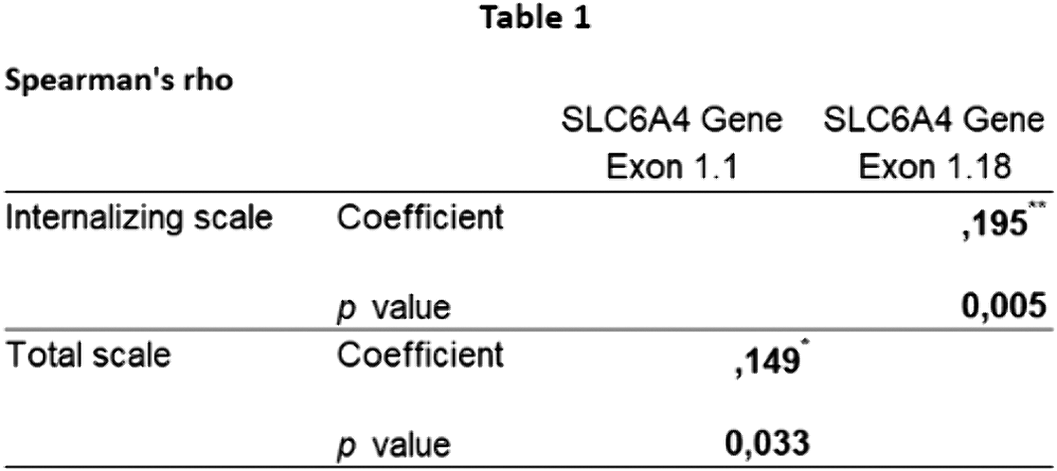
We analyzed methylation within two gene exons: NR3C1 and SLC6A4, which are involved in responses to environmental stressors. We investigated the relationship between methylation, postnatal risk factors and psychopathology assessed by Child Behavior Checklist (CBCL) in our help-seeking sample evaluated in infancy (W1), preadolescence (W2) and adult life (W3).
Methods
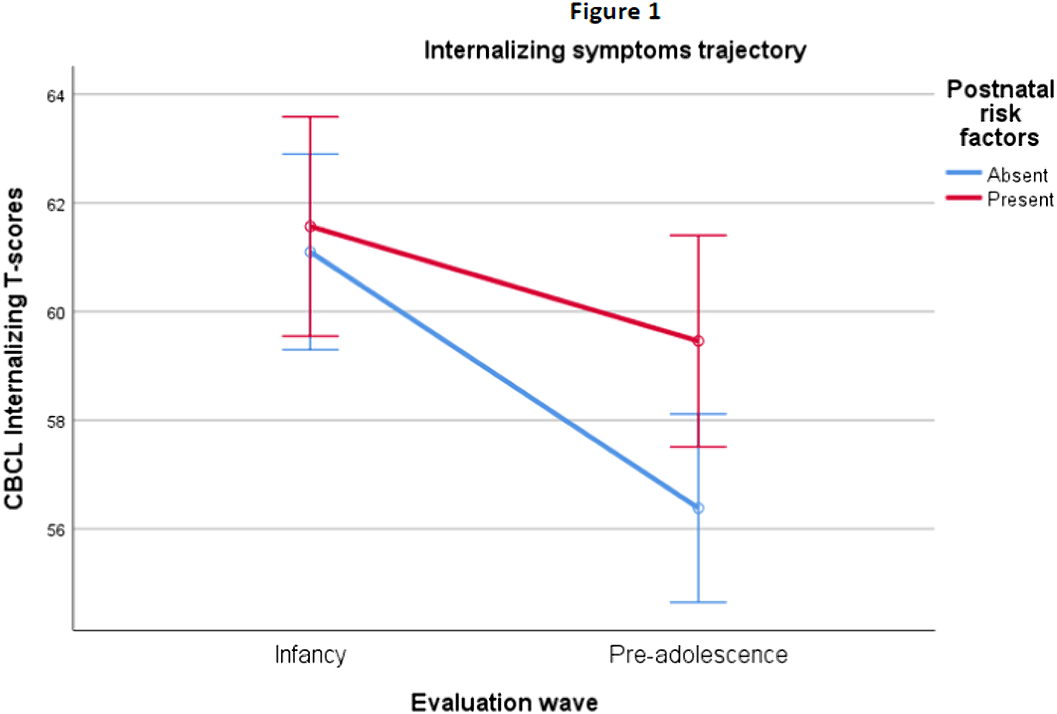
Postnatal risk factors data were collected at W1 in 205 clinical subjects (156 M, 49 F; age=9,13±1,95). The CBCL scores were collected at W1 and W2 (W2 age=14,52±2,12). Data regarding methylation were collected at W2. At W3 we are also collecting clinical scores. A Spearman correlation coefficient was calculated between methylation percentage and clinical data at W2. The externalizing and internalizing trajectories were evaluated through repeated measure ANOVA with postnatal risk factors (presence/absence) as between-groups factor.
Results
Significant associations were found between methylation and internalizing and total clinical scores (Table 1). The rm-ANOVA results showed a significant interaction between the CBCL internalizing score and presence/absence of postnatal risk, with higher internalizing problems in subjects that were exposed to postnatal risk factors. This effect was significant at W2 but not at W1 (Figure 1).
Conclusions
Psychopathological symptoms trajectories could depend on epigenetics and early environmental risk factors. Further analyses will address a Linear Discriminant Analysis to proceed to a machine learning oriented approach.
Several evidence recognizes Brain Derived Neurotrophic Factor (BDNF) as a promising biomarker in the pathophysiology of psychiatric disorders, including Obsessive-Compulsive Disorder (OCD), considering the involvement of epigenetic regulation in BDNF altered expression.
Objectives
This study aims to investigate, in a sample of OCD patients, the epigenetic modulation in terms of levels of methylation and hydroxymethylation on the BDNF gene exon I promoter.
Methods
Fifty OCD patients, recruited from Psychiatry Unit 2, Sacco University Hospital in Milan and fifty healthy controls, comparable by age and gender. Saliva samples were collected by oral swab and epigenetic analysis were performed at the University of Teramo. Statistical analyses were performed with t test with Bonferroni correction.
Results
Data analysis showed a significant decrease in 5-methyl cytosine levels (5mC) (mean OCD: 1.221%; mean CTRL: 1.784%; p < 0.001) and a significant increase in 5-Hydroxy-methyl cytosine levels (5hmC) (mean OCD: 1.018%; mean CTRL: 0.527% p< 0.0001) in BDNF gene exon I promoter of OCD patients compared to controls. Regarding 5mC of site 3 and 5hmC of site 1 and 2 of the exon I promoter CpG islands, no statistical significance was found.
Conclusions
Present results showed significant differences in epigenetic modulation of BDNF gene, which might not be univocally interpreted. They could represent an intrinsic OCD characteristic or the effect of antidepressant drugs, assumed by all recruited patients. Further studies, comparing OCD subjects in treatment vs drug-free, are necessary to define BDNF epigenetic modulation role and its possible use as biomarker in the characterization of OCD.
The current pandemic has only confirmed the need for international collaboration and more extended use of telepsychiatry than before. Unfortunately, regulatory constraints and lack of standardization are posing significant barriers to the internationalization of telepsychiatry. A need for global guidelines and service standardizations is of utmost importance in this rapidly growing but not yet well-established field. By mastering telepsychiatry, the professionals also may enable the remote provision of other eMH approaches complementary to well-known, traditional service(s). However, first, one ought to become familiar with the basics of telepsychiatry. Globally standardized telepsychiatric service and uniform regulations are prerequisites for fruitful international cooperation.
Objectives
- to present the main objectives and messages of the WPA Global Guidelines for Telepsychiatry.
Methods
A structured review of the main challenges, innovations, and settings in the first Global Guidelines for Telepsychiatry, published by WPA.
Results
With proper preparation and thoughtful risk management, telepsychiatry can be an invaluable tool for allowing greater access to care. However, certain prerequisites must be fulfilled to achieve the desired goals. These prerequisites are e.g. choice of the technology, settings, patient/provider preferences as well as competencies and skills, all outlined in this document.
Conclusions
This WPA document may pave the way for the development of global regulations in order to break down the barriers of accessibility for both the professionals as well as for the patients worldwide. Further, it may help professionals in setting up a standardized telepsychiatry service(s) in addition to the existing mental health system(s).
Disclosure
I am the author of WPA Global Guidelines for Telepsychiatry but have no financial interest.
Williams syndrome (WS) is a rare genetic disorder caused by a deletion at chromosome 7q1123. WS is associated with high empathy, relatively good face memory and low social anxiety. Despite these strengths, WS individuals typically have an intellectual disability, difficulties with visuospatial perception, non-social anxiety and complex social cognition. Attention to other’s eyes is crucial for adaptive social understanding. Consequently, eyes trigger quick and automatic gaze shifts in typically developing individuals. It is not known whether this process is atypical in WS.
Objectives
To examine visual attention to other’s eyes in Williams syndrome.
Methods
Individuals with WS (n = 35; mean age 23.5 years) were compared to controls (n = 167) in stratified age groups (7 month, 8-12 years, 13-17 years, adults). Participants were primed to look at either the eyes or the mouth of human faces. The latency and likelihood of a first gaze shift from, or to the eyes, was measured with eye tracking.
Results
WS individuals were less likely, and slower to orient to the eyes than typically developing controls in all age groups from eight years of age (all p <.001), but did not differ from 7 months old infants. In contrast to healthy individuals from eight years and above, WS individuals did not show a preference to orient towards the eyes relative to the mouth.
Conclusions
Despite the hyper-social behavioral phenotype, WS is associated with reduced attention to other’s eyes during early stages of processing. This could contribute to the difficulties with complex social cognition observed in this group.
The growing prevalence of severe cognitive impairment in populations, the involvement of a significant number of people of working age in the medical, psychological and social problems associated with dementia, the insufficiency and inconsistency of information about the mechanisms of formation of these disorders actualize a comprehensive social study of dementia.
Objectives
the psychosocial mechanisms of the formation of clinical, functional disorders in dementia, to develop comprehensive medical and psychosocial programs to help patients with dementia and those involved in caring for them, based on the proposals of the psychosocial model of dementia
Methods
A selective observational comparative dynamic study of 315 people with Alzheimer’s dementia and 214 people who care for the patients was carried out.
Results
Changes in family-role and social parameters, a high level of “expressed” emotions of caregivers have an adverse effect on the development of psychotic (r = 0.618), affective (r = 0.701), behavioral (r = 0.837) dementia disorders. The degree of adherence to anti-dementia therapy by the caregiver is one of the important factors determining the amount of care received by the patient (r = 0.698). Agitation / aggression (r = 0.761), anxiety (r = 0.562), sleep disturbances (r = 0.521) contribute to increased compliance. The low satisfaction of the caregiver with premorbid (r = 0.698) and current (r = 0.653) relationships with the patient leads to a decrease in the compliance of the caregiver.
Conclusions
The mechanism of psychopathological symptoms, functional disorders is heterogeneous, depending on the biological causes and psychosocial conditions of functioning of patients.
There is a lack of objective evaluation with validated tools in school children with intellectual disability (ID). Standardized and validated tools, allowing children evaluations and follow-up, exist but are poorly used. Our action-study wishes to develop evaluation practices to better adapt to the specific needs of children with ID.
Objectives
We evaluated the multidimensional profiles (cognitive, adaptative and behavioral) of children with ID attending regular or adapted school system.
Methods
School children, aged 5 to 13 years old, with mild to moderate ID were enrolled in this French cohort study. The multidimensional evaluation consisted of a school evaluation grid proposed by the French educational system, a scale of school needs (GEVA-sco), an intellectual assessment (WISC IV), a behavior adaptative scale (Vineland II) and a behavior rating scale (the French Nisonger Child Behavior Rating Form (Nisonger CBRF)). The results of this multidimensional assessment were analyzed.
Results
Between November 2014 and June 2016, 121 children were enrolled, 3 children were lost to follow-up. Analysis was performed on 118 children. Seventy one (60.2 %) were male. Fifty-two (44.1%) were aged 6 to 9 years. Sixty-eight (57.6%) children were in regular schools and 50 (42.4%) in adapted schools. Children in regular schools had a higher mean IQ score (57.5) than children in adapted schools (43.5). The adaptative behavior profile of children in regular school is less severe than in children in adapted schools.
Conclusions
Multidimensional evaluations allow optimizing and personalizing support. Evaluation of adaptative behavior is more informative than cognitive profile which does not differentiate between children skills