We partner with a secure submission system to handle manuscript submissions.
Please note:
You will need an account for the submission system, which is separate to your Cambridge Core account. For login and submission support, please visit the
submission and support pages.
Please review this journal's author instructions, particularly the
preparing your materials
page, before submitting your manuscript.
Click Proceed to submission system to continue to our partner's website.
To save this undefined to your undefined account, please select one or more formats and confirm that you agree to abide by our usage policies. If this is the first time you used this feature, you will be asked to authorise Cambridge Core to connect with your undefined account.
Find out more about saving content to .
To send this article to your Kindle, first ensure no-reply@cambridge.org is added to your Approved Personal Document E-mail List under your Personal Document Settings on the Manage Your Content and Devices page of your Amazon account. Then enter the ‘name’ part of your Kindle email address below. Find out more about sending to your Kindle.
Find out more about saving to your Kindle.
Note you can select to save to either the @free.kindle.com or @kindle.com variations. ‘@free.kindle.com’ emails are free but can only be saved to your device when it is connected to wi-fi. ‘@kindle.com’ emails can be delivered even when you are not connected to wi-fi, but note that service fees apply.
A 15-year-old man who comes to the consultation referred from neurology for a poorly progressive tic disorder that is resistant to treatment. This is a patient with no relevant medical history. He has good academic performance, without symptoms of inattention, hyperactivity or impulsivity. He does not present buccophonatory tics
Objectives
To Show guanfacine as a efficient treatment fot tics disorder
Methods
Case report
Results
He has presented complex motor tics as cervical contractions that have had to receive physiotherapeutic treatment. He also presents simple ocular tics. The patient at our evaluation is on a 4 mg dose of pimozide without response. He was previously on risperidone. It was decided to start treatment with guanfacine up to 5 mg with reduction of pimozide, to 1 mg. The patient with this dose adjustment shows a notable improvement in the frequency and intensity of the tics, both cervical and ocular. The patient also refers to a feeling of being calmer and being able to face stressful situations such as being exposed to social relationships, intervening more in class without increasing their anxiety levels.
Conclusions
Guanfacine is a selective alpha-2a adrenergic receptor agonist that has an indication for attention deficit hyperactivity disorder. Like its precursor, clonidine, there is more and more literature that proposes this medication and others for ADHD as useful drugs in pathologies such as tic disorder. It has a safe use profile, which with progressive adjustment and hardly any side effects is placed as a treatment to take into account in this pathology.
We report on the case of a 15 year old young person with a known diagnosis of autism presenting with a rapid and acute regression in functional abilities, decline in expressive speech and bizarre posturing. The symptoms first started during lockdown (April 2020) with anxiety related to school work followed by urinary incontinence, insomnia, muttering to self and incongruent smiling. Initial medical investigations including MRI, lumbar puncture and 24hour EEG were inconclusive, so she was referred to Paediatric Liaison for assessment.
Objectives
We demonstrate the value of a child psychiatry liaison service being involved with young people in an acute medical hospital
Methods
This young person had a thorough psychiatric assessment.
Results
Through daily psychiatric assessment and reviews with the young person, her parent, social care, wider community team, school and Paediatric Inpatient ward in order to expand on the understanding of the young person and develop a case formulation. She was started on oral Olanzapine 2.5mg which was gradually increased to 10mg OD with minimal improvement.
Conclusions
Childhood Disintegrative Disorder (CDD or Heller’s Syndrome) is a rare pervasive disorder presenting as a loss of previously acquired skills after at least two years of normal development. Despite no longer being included in DSM-V, it is important for Psychiatrists to have a working knowledge of CDD and consider other differentials when assessing young people.
Suicide is one of the most common causes of death among young people worldwide. Adolescence is an important developmental period of life due to the increased risk of suicide and the prevalence of psychiatric disorders.
Objectives
To explore the suicidal ideation, intentions and risk factors of adolescents.
Methods
A clinical case study presentation will be performed.
Results
An adolescent female, aged of 16 years old, was admitted to the Department of Psychiatry for Children and Adolescents of a General Hospital, diagnosed with behavioral and emotional disorder and active suicidal ideation on ground of sexual abuse. During her hospitalization, she exhibited self-destructive behaviour by swallowing objects or causing extensive skin scarring as well as serious suicide attempts by hanging. Her emotional and behavioral status was unstable and unpredictable. The adolescent had repeatedly expressed her will to escape from an unbearable life.
Conclusions
The results of the presentation of our clinical case could contribute to the improvement of awareness regarding suicidal behavior in adolescence, which might have a significant effect on the prevention and treatment of this potentially lethal condition.
Autoimmune diseases of central nervous system (CNS) are wide spread in children. In some cases, mental disturbances in such patients are barely noticeable in the beginning, which hinders early detection of risks in the child’s mental development.
Objectives
The study focuses on comparative analysis of the structure of mental disorders in pediatric patients with autoimmune diseases of CNS.
Methods
Research includes two cases: girls aged 14 and 16, one with acute disseminated encephalomyelitis (ADEM), disease onset at 4 years and 11 months, and another with multiple sclerosis (MS), disease onset at 5 years and 5 months. The following methods were used: analysis of patient’s medical record, interview with neurologists, pathopsychological assessment.
Results
Common features in both cases: 1) organic brain disorders; 2) patients do not demonstrate intellectual deterioration, can master regular school curriculum; 3) detected mental disturbances reflect risks for mental and personality development. Specific features: 1) the patient with MS demonstrates polymorphism of mental disorders, while the patient with ADEM — homogeneity of mental disorders; 2) main problems of the patient with MS are related to self-regulation, which makes the general picture similar to pseudo-frontal syndrome; the patient with ADEM has major neurodynamic disturbances, which has similarity to psychoorganic syndrome; 3) predictors of personality disorders detected in case of MS determine the negative prognosis for mental development.
Conclusions
The delineated features evidence for further psychological study of CNS autoimmune diseases and formulation of criteria for clinical psychological assessment. These patients need to be monitored by psychologists to prevent personality disorders.
Faced with a possible overdiagnosis of bipolar disorder in children and adolescents, a new diagnosis has been created in the mental illness classification system. This new diagnosis is named Disruptive Mood Dysregulation Disorder.
Objectives
We propose to carry out a bibliographic review on the new diagnostic category of Disruptive Mood Dysregulation Disorder.
Methods
We present the clinical case of a 10-year-old boy showing severe irritability symptoms.
Results
Disruptive Mood Dysregulation Disorder refers to persistent irritability and frequent episodes of extreme behavioral disturbance in children up to 12 years of age. Onset must occur before 10 years of age and the diagnosis should not be applied to children under 6 years of age. The clinical course of these patients in adolescence and adulthood tends towards unipolar depressive disorders or anxiety disorders rather than bipolar disorders.
Conclusions
The new diagnosis of Disruptive Mood Dysregulation Disorder allows us to differentiate between the classic episodic presentations of mania from the non-episodic ones of severe irritability.
Studies in adults with bipolar disorder (BD), shows that in 25% of cases first affective episode occurs under the age of 13 and in 63-69% under the age of 19. The most difficult problem is the early identification of BD, which starts in adolescence as a result of polymorphism of clinical symptoms, their syndromic incompleteness.
Objectives
Study of the structure of adolescents affective disorders on primary appointment in outpatient psychiatric unit.
Methods
Content analysis, sampling method, statistical method. 120 disease histories of adolescents who first applied for outpatient psychiatric unit in 2019 were used. 93 (77.5%) of them were girls and 27 (22.5%) of them were boys. The average age was 17 years.
Results
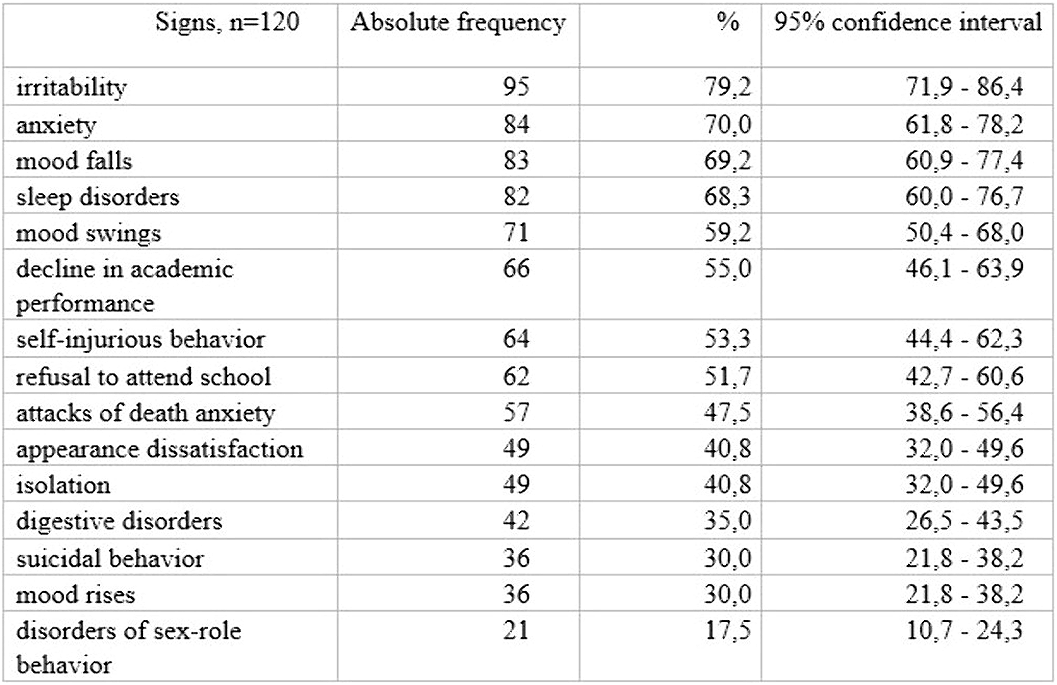
In the structure of initial diagnoses, according to ICD-10, mood disorders [F30-F39] - 56.0% prevailed. [F40-F49] - 25%, [F00-F09] - 6.6%, [F20-F29] - 6.6%, [F50-F59] – 4,2%, [F90-F99] – 1,6% were less likely. Structure of complaints of adolescents and their parents on primary appointment for specialized psychiatric care is shown in Table 1 (p<0,05).
Conclusions
Initial signs of emotional disorders in adolescence are polymorphic, nosologically nonspecific, and can lead to diagnoses that are not limited only by the affective pathology. The most common symptoms (irritability, anxiety, mood falls) can act as transdiagnostic phenomena that must be taken into consideration both in the diagnostic study and in further clinical and dynamic follow-ups and treatment.
Child sexual abuse is a major public health problem in Sri Lanka, with prevalence rates ranging from 14-44%.
Objectives
We aimed to describe the victim and perpetrator characteristics, pattern of disclosure and psychological consequences of sexual abuse in children presenting to a tertiary care hospital in Sri Lanka.
Methods
This was a retrospective file review study of 164 victims who presented to a Teaching Hospital in Colombo, Sri Lanka, with alleged sexual abuse over a period of 5 years from 2015-2019.
Results
Majority of the victims were female and older than 12 years. Majority (73.6%) have been subjected to penetrative sexual abuse with 58.5% of victims reporting more than one incident of abuse. Almost all (99.9%) of the perpetrators were male, with 94.5% being known to the child. Only 42.7% (n=70) of the children revealed about the incident within the first week. Delayed disclosure (i.e. more than 1 week since the incident) was significantly higher in penetrative abuse (p<0.01), multiple incidents of abuse (p<0.01) and in abuse by a known person (p<0.05). Children who disclosed after one week were significantly less likely to disclose about the incident spontaneously (p<0.01). Psychological sequel was seen in 28.7%, with depression being the commonest diagnosis (8.5%). Psychological consequences were significantly in higher those who had physical evidence of abuse (p<0.01), delayed (after 1 week) disclosure (p<0.05) and in those who did not disclose spontaneously (p<0.01).
Conclusions
The victim and perpetrator characteristics, pattern of disclosure is comparable with previous literature.
Rape resulting in pregnancy warrants special attention due to the associated psychosocial and physical adversities. There are no guidelines for the management of teenage pregnancies resulting from rape in Sri Lanka.
Objectives
This case series aims to describe the experience of four teenagers who became pregnant as a result of rape in Sri Lanka.
Methods
This is a case series of 4 pregnant teenagers who became pregnant as a result of rape
Results
This case series highlight the deficiencies in services in Sri Lanka such as lack of legal framework to terminate pregnancy following rape, delay in legal procedure leading to prolonged institutionalization of pregnant teenager, not giving the teenage mothers the choice of breastfeeding and lack of awareness about the psychological consequences of rape and teenage pregnancy.
Conclusions
Formulating a national guideline on managing rape related pregnancy in teenagers in Sri Lanka, with the involvement of all stakeholders is a need of the hour.
Sleep-disordered Breathing (SDB) is a spectrum disorder ranging from primary snoring to obstructive sleep apnea (OSA). One of the most common sleep-disorder in childhood, however remarkably little is known of the effect of SDB on behavioral functions.
Objectives
The aim of our study to investigate the behavioral consequences of SDB compared to children with no history of sleep disorders.
Methods
Two hundred thirty-four children aged 4-10 years participated in the study. The SDB group consists seventy-eight children, sixty-one of the them with OSA and seventeen with primary snoring (average age: 6,7 (SD = 1,83), 32 female/46 male), One hundred fifty-six children participated in the control group (average age: 6,57 years (SD = 1,46), 80 female/76 male). The two groups were matched by age and gender. We used the Attention Deficit Hyperactivity Disorder Rating Scale, Strength and Difficulty Questionnaire, and Child Behavior Checklist to assess the behavioral functions. Furthermore, the OSA-18 Questionnaire was administrated to support the diagnosis of SDB.
Results
According to our results, children with SDB showed a significantly higher level of anxiety and depression and demonstrated significantly higher externalizing (such as attentional problems, hyperactivity, or social problems) and internalizing behavior problems (aggression, rule-breaking behavior).
Conclusions
Due to the neurobehavioral consequences, our finding underlines the importance of the early diagnosis and treatment of sleep-disorder breathing.
Social withdrawal, or hikikomori, is one of Japan’s most serious psychosocial issues. The concept gained international attention around 2010 and widespread psychiatric epidemiological studies have since been conducted.
Objectives
With an understanding of the extensive range of hikikomori circumstances as a spectrum, we aimed to quantitatively measure the severity of hikikomori in adolescent subjects, an age group considered particularly susceptible to the condition, and to identify factors associated with its severity.
Methods
We selected population demographics, socioeconomic data, and psycho-behavioral characteristics as factors related to hikikomori and explored their associations with hikikomori severity using cross-sectional analysis. Subjects were a patient group of middle school students examined as outpatients at a psychiatric clinic during adolescence for a chief complaint of hikikomori and a control group of middle school students matched for sex and age. Subjects’ parents completed a questionnaire pertaining to their child’s hikikomori symptoms and living environment along with the Child Behavior Checklist (CBCL). The data collected was then statistically analyzed.
Results
T-test results demonstrated that scores for all CBCL syndrome scales were significantly higher in the patient group, but no scores fell within the clinical range. Multiple regression analysis revealed that being anxious/depressed, somatic complaints, lack of communication between parents, and overuse of the Internet were statistical predictors of hikikomori severity.
Conclusions
It may be possible to prevent hikikomori from becoming severe if the above predictors are used to identify high-risk individuals requiring active intervention while hikikomori is at an early stage.
Marriages’ dissolution phenomenon had increased in recent years in Tunisia. The impact of divorce on children depends on the interweaving of several factors and is not inevitably pathological. We have noticed in our daily practice a concomitant increase in the number of request for expert opinions concerning children.
Objectives
Determine the clinical children’s profile of separated parents carried out within the framework of legal expertise.
Methods
We carried out a retrospective study in the outpatient child psychiatry ward at Fattouma Bourguiba general hospital in Monastir, Tunisia. Including all the expert reports of children affected by parental separations during a period of two years (2017 to 2019).
Results
56 children were included in our study. The average age were (6.7 years) with a majority of males (58.2%). School failure concerned (24%). In most cases, the request for expertise was made in the context of mistreatment’s suspicion (60.7%), than following the parents’ separation (16.1%). Concerning the clinical picture: a normal psychiatric examination was found in the majority of cases (55.4%), anxiety symptoms concerned (32.1%). Cases of depression, global developmental delay and autism were also found.
Conclusions
According to our study, the vast majority of children presented a normal psychiatric examination. Moreover, a preponderant part of the symptoms seemed to result from educational errors. While parental separation poses risks for children, research shows that these negative effects are not the same for everyone. Several factors can reduce these risks and promote children’s resilience. Thus, first-line psychosocial care should be offered for families and children in seprations’ context.
Anxiety symptoms in childhood represent an important risk factor for developing anxiety disorders in subsequent developmental stages. This study examines the frequency and characteristics of the symptoms of the principal anxiety disorders in children and adolescents using a self-report questionnaire based on the diagnostic categories of the American Psychiatric Association (APA) manual.
Objectives
Our main aim was to have a bigger view of anxiety symptoms spectrum in Albanian children, their frequencies and diferences related to age, gender or other variables.
Methods
A cross-sectional, non-interventional study was conducted on 50 children/adolescents aged 8 to 17 years (45% males), frequenting Child/Adolescent Psychiatric Service, who completed the Spence Children’s Anxiety Scale.
Results
More than one in four of the children and adolescents showed high scores in any anxiety disorder. The anxiety symptoms due to separation were the most frequent in the sample (5.5%), followed by physical fears. Girls scored significantly higher in all disorders (P < .001), except in obsessive-compulsive disorder. Differences were found as regards to age in all disorders, except physical fears, but the effect sizes were only in anxiety due to separation, which decreased with age, and generalized anxiety, which was higher in adolescents than in children.
Conclusions
This study puts emphasizes to the early detection of anxiety symptoms in children, in order to provide the early and effective intervention and prevent the development of anxiety disorders in later life.
Attention deficit hyperactivity (ADHD) disorder is a common childhood neurodevelopmental disorder, and Methylphenidate (MPH) is a first-line therapeutic option for treating ADHD.However, how brain complexity and entropy changes with methylphenidate treatment the clinical implications of possible changes in entropy and the clinical implications of possible changes in entropy have yet to be studied.
Objectives
This study aimed to reveal how the MPH treatment affects the complexity in the brain of children with ADHD by entropy-based qEEG analysis. In addition, the presence of the relationship between possible neurophysiological changes to be detected with clinical variables and how they are two other important questions of this study to be answered.
Methods
During eyes-open resting, EEG signals were recorded from 25 boys with ADHD-combined type before MPH administration and at the end of the 1st month of the treatment. Approximate entropy (ApEn), sample entropy (SampEn), permutation entropy (PermEn) were used to analyse.
Results
A statistically significant decrease in entropy level was found with MPH treatment in the F4 channel according to approximate entropy (ApEn) and sample entropy (SampEn) analysis (p<0.05). In addition, according to permutation entropy (PermEn) analysis, the decrease in entropy with MPH treatment in the regions indicated by F3, F4, P4, T3, T6, and O2 channels was found to be statistically significant (p <0.05).
Conclusions
This is the first study to investigate how MPH treatment affects the complexity in the brain of children with ADHD. Entropy-based qEEG analysis may be a new method that can be used in diagnostic, clinical and prognostic predictions in ADHD.
Attention deficit hyperactivity (ADHD) disorder is a common childhood neurodevelopmental disorder, and Methylphenidate (MPH) is a first-line therapeutic option for treating ADHD.However, how brain connectivity changes with methylphenidate treatment have yet to be studied.
Objectives
This study investigates how the MPH treatment affects the connectivity in the brain of children with ADHD by coherence-based qEEG analysis during rest.
Methods
During eyes-open resting, EEG signals were recorded from 25 boys with ADHD-combined type before MPH administration and at the end of the 1st month of the treatment. Mutual Information (MI),Coherence Function (COH) and Phase Locking Value (PLV) were used to analyse the changes in brain connectivity.
Results
A statistically significant increase in connectivity level was found with MPH treatment between the F3-F4 channels, P3-P4 channels, F7-F8 channels and T5-T6 channels according to PLV, COH and MI analysis (p<0.001).
Conclusions
This is the first study to investigate how MPH treatment affects the connectivity of the brain of children with ADHD. Coherence-based qEEG analysis may be a new method that can be used in diagnostic, clinical and prognostic predictions in ADHD.
During interactions with toddlers, mothers use various mediation strategies to encourage mutual play. Such mediation skills play an important role in the development of toddlers’ communicative skills. Autism Spectrum Disorder (ASD) introduces challenges to this interaction.
Objectives
To study the use of maternal strategies during interaction with ASD and TD toddlers at early lexical levels.
Methods
Nine ASD and fifteen TD dyads participated. Toddlers were matched by lexical levels. The mean age in the ASD was 31.5 months and in TD - 17 months. Each dyad was video-recorded three times, during naturalistic interaction. Mothers’ verbal mediation strategies were divided into five main communicative categories.
Results
1. Exact repetition of toddler’s utterances was similarly used and increased in both groups across the three visits (f (2,44)=3.77, p< 0.05). 2. Significant differences were found between the two groups regarding strategies associated with control of the interaction eg mothers of toddlers with ASD (MASD) made more frequent attempts to redirect their child’s attention (F (1,22)= 74.56, p<0.01). 3. MASD had higher indices of overall talkativeness (F (1,22)= 5.43, p<0.05); use of nonverbal means (F(1,22)= 9,51, p<0.01); simultaneous use of different means of communication (F (1,22)=19.8, p<0.01).
Conclusions
Our results highlight that in some respects, maternal mediation strategies reflect the child’s lexical level. However, our main finding is a distinct interaction style expressed in MASD’s elevated use of verbal and nonverbal mediation strategies. This, in hope of maintaining continuous interaction that could not be otherwise achieved due to their toddlers’ difficulties
Rising prevalence of autism spectrum disorders highlights importance of research priority of development of effective screening procedures for schoolage children.
Objectives
The study aimed to identify the prevalence of ASD among 8-10 y old schoolchildren in Republic of Georgia.
Methods
In 2019 a cross sectional survey in four main cities of Republic of Georgia was conducted, totally 3rd and 4th grade (8-10 y old) 16654 children from 211 public schools were included. The Autism Spectrum Screening Questionnaire (ASSQ), completed by parents and teachers, was used to determine children at risk for ASD.
Results
16654 (response rate 74%) parents were agreed to participate in the study. Parents and teachers rated 770 (5.0%) and 669 children (4.9%), respectively, as screen positive (in top five percentile). Cut-off scores for 99-95 percentiles (top 1-5%) was defined. Boys were more likely to be rated screenpositive than girls. Share of boys rated in the top 5% by parents is 5.6% compared to 4.3% of girls. Teachers place boys in the top 5% even more frequently – 6.4% versus 3.4% girls. Pairwise correlation coefficients (0.53) revealed moderate correlations between scores and according to p-values (< 0.05) all correlations were statistically significant.
Conclusions
The study defined the cut-off scores of ASSQ for 8-10 y old Georgian children and gender difference in prevalence of risk for ASD. Using the ASSQ was an effective instrument and could be used in school settings to identify children with special needs. *This work was supported by Shota Rustaveli National Science Foundation of Georgia (SRNSFG), grant - FR-18-304.
Quality of life (QOL) instruments can provide unique information on various aspects of children’s everyday functioning beyond clinical symptoms and clinical measures. The study of the QOL in the siblings of individuals with an Autism Spectrum Disorder (ASD-siblings) is a new direction in the field of ASD-research.
Objectives
This study aimed to investigate the QOL in ASD-siblings in comparison with an age and sex matched group of siblings of neurotypical children.
Methods
The sample included 233 neurotypical children (8-13 years old) of whom 118 comprised the observational group (ASD-siblings) and 115 comprised the comparison group. The Kidscreen-27 and a demographics questionnaire were administered to all participants.
Results
The two groups differed significantly in all subscales and in the overall score of the Kidscreen-27, with the children in the observation group having a significantly worse quality of life (Mean±sd 111,62±12,43, p<0,001). Additionally, the largest difference in the averages of the subscales occurs in the subscale General Mood and Emotions, where the observation group had significantly lower scores (Mean±sd 23,23±3,69, p<0,001) than the comparison group (Mean±sd 31,27±2,74).
Conclusions
QOL in children has been recognized as an important outcome indicator in detecting subgroups of children at risk within the general population, while ASD-siblings’ QOL is an important concept in the implementation of appropriate services for these children. This study revealed poorer QOL in ASD-siblings and highlighted the importance of assessing QOL in those siblings as well as the use of the Kidscreen-27 as a screening tool in order to detect children at risk of maladjustment.
Mental health problems are frequent among children and seems to predict mental disorders in adulthood.
Objectives
The study aimed whether the gender differences affects the Strengths and Difficulties Questionnaire (SDQ) assessments performed by parents and teachers in Republic of Georgia.
Methods
In 2019 a cross sectional survey in four main cities of Georgia was conducted; Totally 8-10 y old 16654 children from 211 public schools were included. SDQ completed by parents and school teachers was used to determine emotional and behavioral problems among Georgian children.
Results
16654 (74%) parents out of 22553 were agreed to participate in the study. 1565 (9.39%) children were rated screen positive in top five percentile by either parent or teacher or both of them. Cut-off scores for 99-95 percentiles (top 1-5%) was defined. Boys were more likely to be rated screen positive than girls, especially by teachers: parents rated screen positive 7.5% of females, teachers - 7.2%, while males 9.4% and 11.5% respectively. Pairwise correlation coefficients (0.53) revealed moderate correlations according to p-values (< 0.05) between scores and all correlations were statistically significant.
Conclusions
The study defined the cut-off scores of SDQ for 8-10 y old children and a gender differences in prevalence of mental health problems in Georgia. SDQ could be used in primary healthcare and school settings to identify children with special needs. This work was supported by Shota Rustaveli National Science Foundation of Georgia (SRNSFG), grant - FR-18-304.
Street working children are often poor, deprived of love and care, and lack supervision by responsible adults. The Kurdistan region of Iraq has experienced war conflicts for decades. Many families have been displaced and their children forced into the streets. However, little is known about mental health among the street working children in this region.
Objectives
To explore mental health and trauma among street working boys in Duhok.
Methods
A cross sectional study was conducted on street working boys (n=100), eight to 16 years old in Duhok. A control group of age-matched school boys (n=100) were recruited. The Child Behaviour Checklist 6-18 was used for assessment of the children’s competences and behavioural problems. Mental disorders were assessed by using the Mini-International Neuropsychiatric Interview for Children and Adolescence. Experienced trauma was assessed by the Harvard-Uppsala Trauma Questionnaire for Children.
Results
Sixty-one percent of the street working boys had at least one psychiatric disorder (57 % anxiety disorders). Street working boys reported more traumatic events than school boys, 96% vs 64% (X²= 32, p < 0.001), the largest effect size was found for torture (OR 28.4) and the smallest effect size for maltreatment or assault (OR 2.7). Also, they reported higher levels of internalising symptoms, T-score 59.4 (8.2). There was a significantly increased risk of more externalising symptoms with increasing working hours, OR 2.90 [95% CI 1.02; 8.29].
Conclusions
Internalizing symptoms, anxiety disorders and trauma were more common in street working boys compared to school boys. More working hours increased the risk for more externalising symptoms.
Bipolar disorder in children and adolescents is distinguished by a variable and complex clinical expression. Mood is difficult to assess, mood symptoms are often masked and signs of disorganization may be in the limelight. This can be more difficult when adolescents have intellectual disability (ID).
Objectives
This work aims to describe diagnostical and therapeutical features of bipolar disorder in adolescents with ID.
Methods
Case reports about five patients who have been diagnosed with bipolar disorder associated to ID, all seen and treated in child and adolescent psychiatry department of Razi Hospital, in Tunis.
Results
The study focused on three girls and two boys, all with mild to moderate ID. Four patients had psychiatric family history of bipolar disorder and ID. Only one patient was followed since childhood for mixed ADHD. The average age of onset of bipolar disorder was 14 years. Four cases were inaugurated by manic access; the fifth was a depressive disorder followed by a manic shift under sertraline. Only one case was rapidly favorable, under 10mg of Olanzapine, without any recurrence or relapse during 18 months of follow-up. Another case was slower but also favorable, under 10mg of Olanzapine. We found resistance to usual treatments for 2 patients; these did not evolve well under conventional thymoregulators, or different antipsychotic molecules, nor with combinations of two thymoregulators + an antipsychotic. One of them benefited from a combination of clozapine and lithium with excellent response.
Conclusions
Bipolar disorder comorbid with ID in adolescents is a difficult diagnostic entity and particularly hard to manage.