We partner with a secure submission system to handle manuscript submissions.
Please note:
You will need an account for the submission system, which is separate to your Cambridge Core account. For login and submission support, please visit the
submission and support pages.
Please review this journal's author instructions, particularly the
preparing your materials
page, before submitting your manuscript.
Click Proceed to submission system to continue to our partner's website.
To save this undefined to your undefined account, please select one or more formats and confirm that you agree to abide by our usage policies. If this is the first time you used this feature, you will be asked to authorise Cambridge Core to connect with your undefined account.
Find out more about saving content to .
To send this article to your Kindle, first ensure no-reply@cambridge.org is added to your Approved Personal Document E-mail List under your Personal Document Settings on the Manage Your Content and Devices page of your Amazon account. Then enter the ‘name’ part of your Kindle email address below. Find out more about sending to your Kindle.
Find out more about saving to your Kindle.
Note you can select to save to either the @free.kindle.com or @kindle.com variations. ‘@free.kindle.com’ emails are free but can only be saved to your device when it is connected to wi-fi. ‘@kindle.com’ emails can be delivered even when you are not connected to wi-fi, but note that service fees apply.
This systematic review estimates the pooled prevalence (PP) of Conduct Disorder (CD) among 5-to-18-year-old YP living in Europe, based on prevalence rates established in the last five years (LFY).
Objectives
Trends of prevalence rates across countries, gender and level of education were analysed. The random effects pooled prevalence rate (REPPR) for CD was calculated.
Methods
A search strategy was conducted on three databases. Studies were also identified from reference lists and grey literature. Eligible studies were evaluated for reliability, validity and bias, and REPPRs were calculated.
Results
The European REPPR for CD is calculated at 1.5% (Figure1). The REPPR among males is 1.8% whereas the rate among females is 1.0% (Figure2). The prevalence rate of CD in primary school children is 1.4 times lower than the prevalence of secondary school children.
Conclusions
Gender, culture and socioeconomic inequality may contribute towards diagnostic inequality and prevalence differences. It is recommended that these aspects are addressed, and routine screening and early intervention services are developed.
Children in a prodromal state manifesting as truancy or social isolation (hikikomori) often complain of problems that are physical in nature and are subject to significant changes. We developed the Child Psychosis-Risk Screening System (CPSS) that incorporates childhood psycho-behavioral characteristics revealed through a retrospective survey of schizophrenia patients into its algorithm.
Objectives
Our research aimed to test the risk identification of pediatric and psychiatric clinic outpatients using the CPSS.
Methods
We conducted an epidemiological study involving 204 outpatients between the ages of 6 and 14 years who had been examined at a pediatric or psychiatric clinic using the CBCL and clinical data from medical charts. Logistic regression analysis and T-tests were performed using each clinical data variable to clarify the risk of the CPSS calculated from the CBCL data and contributing factors.
Results
The results of the logistic regression analysis demonstrated that the diagnostic category (physical illness or DSM-5 diagnosis) and chief complaint did not contribute to differentiate between the high-risk and low-risk groups. Meanwhile, the environmental factors of “abuse” and “social isolation” did contribute to the discrimination of the two groups.
Conclusions
The fact that the diagnostic category during childhood does not contribute to the discrimination of the high- risk group warrants attention. It is possible that the high-risk group only had a latent endophenotype that had not yet manifested during this period. The factors suggested to have an association with the high-risk group may be reflecting activators and the dynamic state of the critical period for psychosis.
Attention deficit hyperactivity disorder (ADHD) is the most common neurodevelopmental disorder in childhood. ADHD is a risk factor for the development of overweight and obesity. One neuropsychological factor that may play a prominent role in the relationship between ADHD and obesity is executive functioning.
Objectives
The aim of this study is to investigate the relationship between comorbid obesity/overweight and cold executive functions, verbal short-term memory, and learning in children with ADHD. This is the first study to examine relationship between verbal short-term memory-learning and obesity in patients with ADHD.
Methods
This study was conducted with 70 patients with ADHD and 30 healthy controls. In this study, patients diagnosed with ADHD were divided into two groups according to body mass index (BMI) as <85 percentile and ≥85 percentile. Cold executive functions were evaluated by Stroop Test (ST) and Cancellation Test (CT). Serial Digit Learning Test (SDLT) was administered to measure verbal short-term memory and learning capasity. In order to evaluate the severity of ADHD objectively, parents completed the Conners’ Parents Rating Scale-Revised Short Version (CPRS-RS).
Results
The ST, SDLT and CT scores were significantly lower in both groups with ADHD than the control group. The CPRS-RS subscale scores were significantly higher in both groups with ADHD than the control group. There was no statistically significant difference in ST, SDLT, CT scores and CPRS-RS subscale scores between the two groups with ADHD.
Conclusions
This study show that overweight/obesity comorbid with ADHD was not associated with cold executive functions, verbal short-term memory, learning, or ADHD symptom severity.
Brain heterotopia represent a group of rare malformations with a heterogeneous phenotype, ranging from asymptomatic to severe clinical picture (resistant epilepsy, severe developmental delay). The etiology is multifactorial, including both genetic and environmental factors.
Objectives
In this paper we present our experience regarding behavior problems in patients with heterotopia.
Methods
A cohort of 16 pediatric patients with brain heterotopia, six females and ten males, with age at last follow-up ranging from 2 months to 24 years were investigated by clinical examination, electroencephalographic studies, brain imaging, and genomic tests. Specific psychological tests and psychiatric evaluation were performed in all children for behavior problems assessment.
Results
Six individuals presented behavioral problems: autism (three patients) and hyperkinesia with attention deficit (three patients). All of them had intellectual disability or learning problems; five patients had epilepsy, with drug-resistant seizures in four cases. In two cases the behavioral problems occurred before the onset of epileptic seizures.
Conclusions
Behavior problems are important features in patients with brain heterotopia, making the management of these patients more difficult, especially when they occur in association with drug-resistant epilepsy. Acknowledgements: This work was supported partially by grants of the Romanian National Authority for Scientific Research and Innovation CCCDI – UEFISCDI, Projects COFUND-ERANET E-RARE 3-HETER-OMICS-2 Number 87/2019 and 88/2019 within PNCDI III.
The COVID-19 pandemic forced many countries to apply restrictive measures. During the first wave Portugal went through a lockdown, and all the child and adolescents had to stay home and could only contact with the one’s they lived with for several months.
Objectives
This study aimed to evaluate the impact of those restrictions on suicidal ideation in the pediatric population evaluated in a child and adolescent psychiatry emergency care of a tertiary referral hospital.
Methods
We conducted an exploratory retrospective study. All the data from discharge notes were collected between March 15th and June 15th of 2020 (n=59), and in the homologous period of the previous year (n=178). The referral after evaluation (primary care, child and adolescent psychiatry consultation, inpatient unit) was considered a measure of severity.
Results
The demographic variables (sex, age) were homogeneous between the two groups (p ≥ 0,05). 17,4% (n=31) of the sample from 2019, and 16,9% (n=10) of the sample of 2020 had suicidal ideation, which was not statistically different between groups (p=1,000). The referral, after evaluation between groups were also not statistically different (p=0,186).
Conclusions
Even though the proportion of patients with suicidal ideation was homogenous during the two periods, the total number of patients evaluated in the emergency room were lower during the first wave of Covid-19 pandemic. We assume that the population had fear of seeking help in hospital facilities, but we also believe that the pause on school burdens and the reconnection between some families could have function as protective factors.
This systematic review estimates the pooled prevalence (PP) of oppositional defiant disorders (ODD) among 5-to-18-year-old YP living in Europe, based on prevalence rates established in the last five years (LFY).
Objectives
Trends of prevalence rates across countries, gender and level of education were analysed. The random effects pooled prevalence rate (REPPR) for ODD was calculated.
Methods
A search strategy was conducted on three databases. Studies were also identified from reference lists and grey literature. Eligible studies were evaluated for reliability, validity, bias, and the REPPR for ODD was calculated.
Results
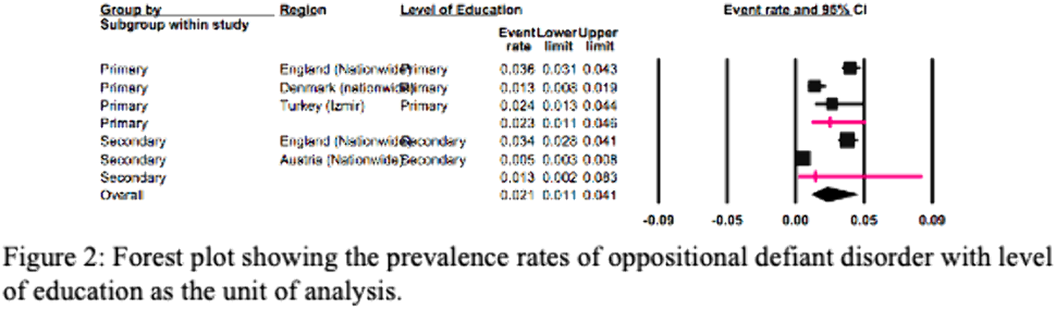
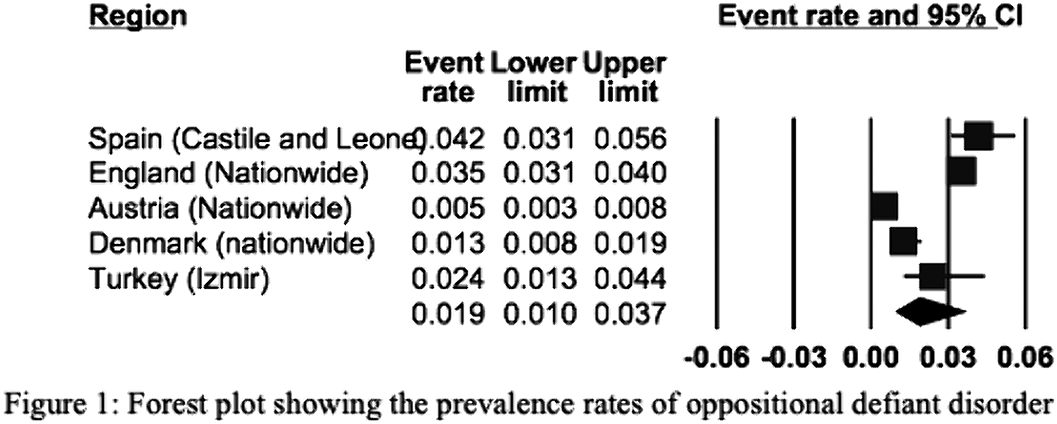
The European REPPR for ODD is calculated at 1.9% (Figure 1). The REPPR among males is 4.8%, whereas the rate among females is 2.7% (95% CI: 0.7%- 1.4%). The prevalence rate of ODD among primary school children is 1.8 times higher than the prevalence of secondary school children (Figure 2).
Conclusions
Gender, culture and socioeconomic diagnostic inequality may contribute to prevalence differences across countries. Routine screening and addressing these aspects may facilitate early intervention.
This is the case of a 15-year-old boy who had been socially isolated in his house for over 1 year. He had become increasingly agitated, but refused any help offered.
Objectives
To establish the role of community treatment in adolescents with mental health problems.
Methods
Summary of the interventions taken place during the treatment
Results
Initially this young person refused any medical treatment, so we tried first supportive therapy and CBT. He dicho not obtain any benefits as he appeared experiencias paranoid ideation and thoughts of being persecuted in the streets. With support from the occupational therapist, the young person started to take care of his personal hygiene. Afterwards he started to take oral medication with partial response. We decided to switch to im treatment. In conjunction with CBT, the young person was gradually able to llaves the house. All the sessions during the first few months took place at his family home. These visits were weekly or twice weekly. Once he left the house, he attended the grupos at the day hospital. After 18 months, he was discharged without medication and he is currently studying for a degree.
Conclusions
Community treatment in adolescent with mental health problems is a better opción to establish good rapport and avoid stressful situations that could take place in an in-patient facilita.
Children affected by social neglect and other forms of abuse are at significant risk of developing mental health problems as well as social, academic, and behavioral functioning difficulties. Some studies have assessed the effectiveness of treatment for children with trauma-attachment disorder. Nevertheless, some questions remain to be answered regarding appropriate treatment.
Objectives
Aim This research identified how filial therapy affects the extent to which foster parents are responsive, sensitive, and attentive to the needs of their children in their care. Subsequently, the study explored how this bond, influenced during filial therapy, affects the signs and symptoms of disinhibited social engagement disorder.
Methods
Method This study used case study as the methodology to research the influence of filial therapy (CPRT) in foster children who show the symptoms of disinhibited social engagement disorder- aged three to six. Two sets of foster parents received a 10-session filial therapy model (CPRT) across 10 weeks. Pre and post measures of the parent-child relationship were analyzed.
Results
Result The findings indicate that filial therapy greatly enhances the bond between foster parents and children with DSEDs. Moreover, these improvements in the bond diminished the symptoms of disinhibited social engagement disorder.
Conclusions
Conclusion The impact of filial therapy as a responsive intervention reduced the symptoms of disinhibited social engagement disorder. The symptoms have declined very likely as a result of rebuilding, regenerating, and enhancing the relationship between foster children and foster parents.
In the assessment of suicidal behavior, recent studies describe the great influence of an environmental component with adverse life events and stressors that can influence self-harm ideation and gesture.
Objectives
1. To analyze the reasons for consultation of adolescents between 11 and 17 years of age who consult for suicidal behavior. 2. To estimate the frequency of the different socio-family life events.
Methods
A retrospective review of the emergency room visits in the last 3 months was carried out. Sociodemographic data, vital events, reason for consultation and evolution are collected in the following 30 days after consultation in the emergency room.
Results
Data were collected from 16 adolescents who consulted in the emergency room for suicidal ideation / gesture in a period of 3 months, of which 43% (7) were women and 56% (9) were men between 11 and 18 years old. The reasons recorded as stressful life events were: 22% unstructured family environment, 10% death of a close relative, 43% little parental supervision, 26% end of a romantic relationship, 5% legal problems, 2% sexual or physical abuse, 70 % academic problems, 3% bullying. It was observed that in 63% of the cases they presented more than one adverse experience.
Conclusions
Suicidal ideation and behavior are frequently preceded by different adverse life events that can be minimized or go unnoticed and undervalued. A meticulous medical history can clarify some of the reasons that influence the hopelessness and clinical anguish that the suicidal patient presents. Its early detection provides the opportunity for an early and specialized approach.
When we talk about cycloid psychosis we have doubts about their nosological enclave; whether they should be considered as a subform of schizophrenia or as independent psychoses.Some solutions were proposed, such as the thesis of mixed psychoses (Kretschmer) or that of intermediate forms (Bleuler, Schneider). Cycloid psychoses and bouffée delirante are recognized in ICD-10 under the name of acute polymorphic disorder without symptoms of schizophrenia (F23.0) and with symptoms of schizophrenia (F23.1).
Objectives
Clinical case
Methods
We present the case of a 16-year-old patient with no psychiatric history, with medical background of epilepsy; she was in fllow-up by Neurology and in treatment with valproate.Neurology indicates to stop treatment; it is then whwn the patient begins to appear disoriented, confused, with significant anguish and lability and regressive behaviors.She has sudden mood swings (from laughing to crying); sudden changes in emotional reaction (from distress to anger) and sudden changes in behavior (from agitation to prostration); verbiage with pressure of speech and dysprosodia; delusional ideation and incongruous affect; visual, auditive and kinesthetic hallucinations with important repercussion. We request blood and urine tests, drug test, EEG, cranial MRI.
Results
She presents fluctuating, polymorphic and unstable affective and psychotic symptoms. What is the most appropriate diagnosis? We treat the patient with antipsychotic, mood stabilizer and anxiolytic treatment.
Conclusions
Psychopathology in early ages is not so clearly defined and it can take very different forms. The diagnosis of cycloid psychosis can be useful as well as necessary to describe certain patients with similar characteristics and different from other groups.
Internet addiction disorder (IAD) is the compulsive and problematic use of the internet, resulting in significant functional impairment in several life domains. This happens when an individual engages in online activities disregarding daily responsibilities or other interests, and not realizing its negative consequences. Although not officially recognized as a disorder in the Diagnostic and Statistical Manual of Mental Disorders, Fifth Edition (DSM-V), the relationships between digital media use and mental health has been under debate and discussion amongst experts due to presenting some features of excessive use, withdrawal phenomena, tolerance, and negative repercussions typical of many substance abuse disorders.
Objectives
To present an overview of theoretical considerations on IAD and its eventual inclusion in the next version of the DSM.
Methods
Review of the most recent literature regarding internet addiction disorder. The research was carried out through the PubMed, MedLine, SpringerLink and LILACS databases, using the terms “internet addiction”, “addiction disorders” and “social media”, until December 2020.
Results
There is controversy around the diagnosis of internet addiction, including whether it is a unique clinical entity or a manifestation of other underlying psychiatric disorders, raising complex questions of causality. Since there are no standardized definition, there is lack of evidence-based recommendations to its approach.
Conclusions
Research suggests that some individuals dealing with internet addiction are at significant risk, therefore merit professional care. Further research is needed, with carefully controlled studies, emphasizing incapacity, prognosis and response to treatment, in order to consider internet addiction as a disease, and include it in DSM’s next edition.
The relevance of this research is determined by the fact that an important scientific task of the modern clinical classification of mental disorders is the productive combination of the most valuable for the practical use of categorial and dimensional (in terms of the weight and depth of each dimensia) of the characteristics in in a particular clinical picture of a disease.
Objectives
The goal of the research is to validate the new categorical-dimensional criteria necessary for the verification of schizotypal disorder.
Methods
The information base of the research included medical data on 150 patients with schizotypal disorder. Categorical characteristic used according to the systematics of schizotypal disorder (Kotsiubinskii A.P, 2018) published in the National Guide «Psychiatry», which includes the following syndromes: obsessive-phobic, dysmorphophobic, non-delusional hypochondria, heboid, histrionophoric, impulsive-dysfunctional, schizoaffective, dissociative-disintegrative, autistic, dismotivative, amotivative. Our systematics was used with following demensia: positive, affective, negative, cognitive, disordered behavior, dissociative and coenestesipatic. Guided by the principle of five-level representation of each dimensia (from «0» to «4») in accordance with DSM-V and the informative systematics of dimensia was developed with each of dimensia also has rate from «0» to «4».
Results
This diagnostic approach made it possible to correlate the categorial and dimensional characteristics, both to each other and to the criteria of the condition of the patients’ state with the prototype of schizotypal disorder (in the range of «1» to «5»).
Conclusions
This has made it possible to more accurately diagnose non-psychotic forms of mental illness, in particular: differentiate schizotypal disorder «sui generis» and schizotypal personality disorder.
Studies about Game Transfer Phenomena (GTP) have demonstrated lingering effects of playing video games manifesting as sensory, cognitive, and motoric intrusions (e.g., seeing images or hearing voices from the game after playing), transient changes in perception and self-agency. GTP are common among non-clinical players, though those with mental disorders are more susceptible. Gamers tend to appraise GTP as pleasant. Distress has been reported when GTP are experienced frequently and with specific content.
Objectives
To show the interplay between GTP and patients’ symptomatology and the benefits of using the GTP framework in clinical contexts.
Methods
GTP were assessed via clinical interviews and with a validated GTP scale (three cases, males, 10-16 years old, playing time 6-10 h/day).
Results
The cases were characterised by i) incorporation of videogame content into hallucinations and delusions, ii) identification with a videogame character and subsequent distress provoked by hearing the character’s voice and iii) self-induced GTP as self-soothing behaviour when reducing playing time. Main GTP manifestations were in the auditory modality as sounds or voices. The primary clinical diagnoses were gaming disorder, depressive disorder, and psychosis.
Conclusions
On one hand, GTP can be pleasurable and a way to cope with withdrawal symptoms from gaming disorder, though it can lead to compulsive behaviours and dissociation. On the other hand, GTP can be interpreted negatively and fulfil delusions that provoke distress and compromise mental stability. The cases reveal that the GTP framework can be an effective psycho-pedagogic method and support differential diagnosis.
Valproic acid (VPA) is a commonly prescribed medication for epilepsy, migraine and especially bipolar disorder therapy. Although the common adverse effect associated with VPA are typically benign, less common adverse effects can occur; these include acute pancreatitis.
Objectives
Describe the clinical and therapeutic characteristics of a case of acute pancreatitis induced by VPA with a review of the literature.
Methods
We report the case of a patient who presented an acute pancreatitis induced by VPA. The data was collected from the patient’s medical file. A review of the literature was performed by selecting articles from the PubMed search engine using ‘acute pancreatitis and valproic acid’ and ‘drug induced acute pancreatitis’ as key words.
Results
This is a 51-year-old male patient with a history of type 2 diabetes, dyslipidaemia and psychiatric follow-up for bipolar disorder type I on lithium. He was admitted for a resistant depressive episode. We opted for the combination of two mood stabilizers (VPA and lithium). On the third day of treatment, the patient reported epigastric pain with incoercible vomiting. Laboratory tests showed increased levels of pancreatic enzymes and a biological inflammatory syndrome. The diagnosis of acute stage A pancreatitis was made.VPA was discontinued and the patient was put on symptomatic treatment with favourable outcome after one week. The etiological investigation ruled out other causes of acute pancreatitis. As a result, iatrogenic origin was retained.
Conclusions
This case supports the idea that acute pancreatitis may be induced by VPA, it has no predictable factors.
People suffering from chronic diseases, especially epilepsy, are more likely to suffer from neurobehavioral disorders, like psychotic states. Postictal psychosis (PIP) is one of these potentially serious complications, that classically follows exacerbations of seizures.
Objectives
The present paper aimed to study the clinical and therapeutic aspects of PIP.
Methods
We report a case of PIP, which involved a patient hospitalized in psychiatry department, and discuss it in light of the relevant literature.
Results
We report the case of a 27-year-old man, with medical history of generalized epilepsy which was well stabilized under treatment (carbamazepine 600 mg/day). The patient was hospitalized for dangerous behaviors after having experienced 2 episodes of seizure activity in context of poor therapeutic adherence. Psychiatric assessment revealed a psychomotor instability, a pressured speech and hallucinatory behavior. There were no delirium symptoms. Neurological examination showed no localization signs, and cerebral imaging was normal. The patient was treated with benzodiazepines (Diazepam), associated to antipsychotics (Haloperidol). His antiepileptic drug was quickly reintroduced. After 48 hours of treatment, psychiatric symptoms improved. The patient returned to its baseline condition after 7 days.
Conclusions
The short-term prognosis of PPI is often favorable, compared to other psychotic disorders. However, more severe psychiatric disorders can potentially develop in the long-term, raising diagnostic and therapeutic difficulties. Thus, a good collaboration between psychiatrists and neurologists is highly desirable in order to better adapt the treatment.
Delusional parasitosis (DP), also know as Ekbom syndrome and in some cases as Morgellons, was first described in the late 17th century in France. It is an obsessive phobic state in which the patient believes that the is infested by parasites. In the hallucinatory state, they frequently remove parts of the skin, identifying them as parasites. The cause of DP is unknown. Evidence supporting the dopamine theory defend that the inhibition of dopamine reuptake (for example cocaine and amphetamines) induce symptoms such as formication.
Objectives
Through the description of the following clinical case, we emphasize its clinical features and complexities.
Methods
Review of DP in light of a clinical case
Results
A 48-year-old woman was brought to the psychiatric emergency due to psychotic symptoms following cocaine use. She had a history of drug abuse. She was apparently asymptomatic until October 2019, when, in the background of vague sensation of something crawling under his skin, she developed a sudden onset belief that she had been infested by insects that crawled under his skin. Previous medical observation found no reason for a skin infection or infestation. Skin examination revealed itch marks and skin excoriations in the abdomen. Mental status examination revealed anxious and depressive affect, delusion of parasitosis, tactile hallucination and impaired insight. Routine hemogram and urinalysis was unremarkable, except for the detection of cocaine.
Conclusions
Delusional parasitosis often presents to nonpsychiatric medical professionals. An awareness of such ilness, with an early recognition and timely referral are management cornerstones in order to successfully diagnose and treat patients.
Tourette’s syndrome (ST) is a neuropsychiatric disorder that presents with combination of motor and vocal tics for at least one year time.Only few cases of comorbidity with psychotic disorder has been described.
Objectives
We present a case report of a patient with ST, obsessive compulsive disorder, posttraumatic stress disorder that resulted in chronic schizophrenia-like psychosis, and family hystory of tics and psychosis.
Methods
A case – based family study, literature review and statistic data analysis.
Results
The patient (male, born in 1997 otherwise healthy)presented at the age of 6 with spitting.He subsequently progressed with severe motor tics, vocalizations, coprolalia, impulsivity, destructivity, repetitive motor rituals.No treatment showed to be efficacious and safe. He dropped out of the school, the family has to move to the rural area; his social withdrawal was intensified by psychotrauma (assaulted by police officer due to seemingly disorderly conduct). At the age of late adolescence he started to make fantastic statements. Later on he admitted having visual and audial hallucinations and responding to them; the Kandinsky–Clérambault syndrome was detected. Symptoms and exitement are partially controlled by diazepam and clozapine; the patient needs assistance in all routines of self – care.The patient’s mother has a mild form of motor tics; her mother developed persistent delusions in her late thirties (without disorders of perception and social disfunction).
Conclusions
The study demonstrantes genetic interconnecting between TS, tics and psychosis; hyperactivity in the dopaminergic system of the brain may be involved in all three disorders. National statistics of TS have to be reviewed and improved.
Obsessive-compulsive symptoms (OCS) are common in schizophrenia, with a prevalence ranging from 12 to 25%. They affect negatively disease outcome. Patients with comorbid OCS present more frequently resistant psychotic symptoms. Besides, the appearance and aggravation of OSC are more commonly reported with atypical antipsychotics.
Objectives
To present through a clinical case and a brief literature review the treatment challenge of obsessive-compulsive symptoms in schizophrenia.
Methods
We reported the case of Mr. M.S., treated in our department since 2008 for comorbid schizophrenia and OCS, and discussed therapeutic alternatives through a literature review.
Results
Mr. M.S. a 34-year-old male diagnosed with comorbid schizophrenia and OCS at age 20. To control psychotic symptoms, the patient received several trials of anti-psychotics with little improvement. We concluded that it was resistant schizophrenia. The introduction of clozapine reaching 300 mg daily led to significant improvement of psychotic symptoms but worsened OCS. The adjunction of fluoxetine and cognitive-behavioral therapy (CBT) was unsuccessful to manage obsessive symptoms. We opted for the association of aripiprazole 20 mg daily and clozapine, the doses of which were gradually tapered down to 150 mg daily. This association has guaranteed the improvement of both psychotic and obsessive symptoms.
Conclusions
Conclusion This clinical vignette highlights the need for clinical awareness about the possible exacerbation of OCS with atypical antipsychotics in schizophrenia.
Chemsex is the term used to describe the use of psichoactives drugs to practice sex, mostly among men who have sex with other men. When drugs are administered by intravenously it is know as slamming or slamsex. Mephedrone is drug more used to this practice, in combination with other as anfetamines. This practice has been associated with a lot of psychiatric and organic complications.
Objectives
Describe a case about one of chemsex complications such as drug- induce psychosis. Moreover, show the multiple medical complications associated with this practice.
Methods
Patient’s data is obtained from medical history, psychiatric interviews carried out during his hospitalizations and his psychological follow-up in CAID.
Results
45 year-old man patient was admitted into a psychiatric unit due to paranoid ideation, behavioral disturbances and heteroaggressive behavior after mephedrone, amphetamines and other drugs intoxication in the context of slamsex practice. He has a history of two previous autolytic attempts but no psychotic episodes. After one week of hospitalization and antipsychotic treatment psychotic symptons disappear. Concerning his medical history, he was infected for HIV, syphilis, hepatitis A, visceral Leishmania.
Conclusions
It is necessary to be aware of the increased in chemsex and slamsex rates and therefore of the comorbilities that have associated. Rapid detection is important in order to reduce and control the severe addiction they entail (especially intravenous consumption).
In the literature, there are conflicting data regarding the recovery of mental disorders, in particular, pathologies of the emotional, personality, behavioral and cognitive spheres, in patients after surgical treatment of tumors of the diencephalic region.
Objectives
To evaluate the dynamics of psychopathological disorders after removal of a craniopharyngioma.
Methods
45 patients (18–68 y.o.), operated through transcranial access. The follow-up period ranged from 3 months to 9 years (on average 2.8 + 0.4). The main method is psychopathological, supplemented by rating scales and questionnaires.
Results
In the late postoperative period, mental disorders were detected in 75% of patients (Table 1). Table 1. Dynamics of the main psychopathological symptom complexes (n = 45).
Disorders (may be a combination)
Before surgery (n,%)
2 weeks after (n,%)
18 months after (n,%)
Emotional and volitional
27 (60%)
27 (60%)
15 (33%)
Cognitive - Korsakov syndrome
18 (40%) 4 (9%)
27 (59%) 8 (18%)
18 (40%) 7 (15%)
Personality
21 (46%)
25 (55%)
23 (51%)
The table shows that emotional-volitional disorders have a clear positive dynamics by 18 months after surgery compared with the preoperative level. Korsakov’s syndrome and personality disorders are less favorable. 23 patients (52%) returned to their previous profession; 22 (48%) stopped working due to a severe degree of disability, of which 7 (15%) need constant supervision.
Conclusions
The positive dynamics of psychopathological symptoms is observed only within 1.5 years after the removal of the craniopharyngioma, in the future they remain without a tendency to improve. 22 patients (48%) stopped working. The most severe degree of disability is 15% patients.