We partner with a secure submission system to handle manuscript submissions.
Please note:
You will need an account for the submission system, which is separate to your Cambridge Core account. For login and submission support, please visit the
submission and support pages.
Please review this journal's author instructions, particularly the
preparing your materials
page, before submitting your manuscript.
Click Proceed to submission system to continue to our partner's website.
To save this undefined to your undefined account, please select one or more formats and confirm that you agree to abide by our usage policies. If this is the first time you used this feature, you will be asked to authorise Cambridge Core to connect with your undefined account.
Find out more about saving content to .
To send this article to your Kindle, first ensure no-reply@cambridge.org is added to your Approved Personal Document E-mail List under your Personal Document Settings on the Manage Your Content and Devices page of your Amazon account. Then enter the ‘name’ part of your Kindle email address below. Find out more about sending to your Kindle.
Find out more about saving to your Kindle.
Note you can select to save to either the @free.kindle.com or @kindle.com variations. ‘@free.kindle.com’ emails are free but can only be saved to your device when it is connected to wi-fi. ‘@kindle.com’ emails can be delivered even when you are not connected to wi-fi, but note that service fees apply.
To nutritionally analyse lunches provided for 3–4-year-old children attending school nurseries. Energy and nutrient content are compared with nutrient frameworks underpinning voluntary guidelines for early years settings (EYS) and mandatory standards for infant schools (4–7-year-olds).
Design:
A cross-sectional study, recording all main meals, vegetarian meals, jacket potato options, sandwich options and all desserts and accompaniments provided over 5 consecutive days in each school. Two portions of each meal were collected each day and weighed. Recipe and portion weight data were entered into nutrient analysis software.
Setting:
School nurseries where lunch was provided by the school.
Subjects:
Nine schools, providing a total of 161 meals.
Results:
Lunches contained more energy (1881 kJ/450 kcal), fat (15·5 g), free sugars (10·5 g) and Na (424 mg) than suggested by the nutrient framework for EYS. Carbohydrate (60·6 g), protein (16·8 g), fibre (6·7 g), Fe (2·4 mg), Zn (2·0 mg), Ca (202 mg), vitamin A (304 µg) and vitamin C (19 mg) also exceeded minimum recommendations. Compared with a revised nutrient framework for infant schools, energy was within range, whilst saturated fat, free sugars and Na were above maximum recommendations for this age group, and Zn was below. Sandwich meals were lower in vitamin C (P < 0·001–P = 0·05) and Fe (P = 0·012–P = 0·017) and higher in Na (P < 0·001–P = 0·003) and Ca (P < 0·001–P = 0·05).
Conclusion:
Lunches provided for children attending school nurseries are more in line with the framework for 4–7-year-olds. Free sugars, saturated fat and Na are areas of concern consistent with previous studies. Protein is three times more than recommended. Large portions of cakes and biscuits contribute to excess energy provision.
The WHO recommends that adults consume less than 5 g of salt per day to reduce the risk of CVD. This study aims to examine the average population daily salt intake in the fifty-three Member States of the WHO European Region.
Design:
A systematic review was conducted to examine the most up-to-date salt intake data for adults published between 2000 and 2022. Data were obtained from peer-reviewed and grey literature, WHO surveys and studies, as well as from national and global experts.
Setting:
The fifty-three Member States of the WHO European Region.
Participants:
People aged 12 years or more.
Results:
We identified fifty studies published between 2010 and 2021. Most countries in the WHO European Region (n 52, 98 %) reported salt intake above WHO recommended maximum levels. In almost all countries (n 52, 98 %), men consume more salt than women, ranging between 5·39 and 18·51 g for men and 4·27 and 16·14 g for women. Generally, Western and Northern European countries have the lowest average salt intake, whilst Eastern European and Central Asian countries have the highest average. Forty-two percentage of the fifty-three countries (n 22) measured salt intake using 24 h urinary collection, considered the gold standard method.
Conclusions:
This study found that salt intakes in the WHO European Region are significantly above WHO recommended levels. Most Member States of the Region have conducted some form of population salt intake. However, methodologies to estimate salt intake are highly disparate and underestimations are very likely.
To examine the labelling status of trans-fat of pre-packaged foods sold in Hong Kong.
Design:
Data from 19 027 items in the 2019 FoodSwitch Hong Kong database were used. Ingredient lists were screened to identify specific (e.g. partially hydrogenated vegetable oil, PHVO) and non-specific trans-fat ingredient indicators (e.g. hydrogenated oil). Trans-fat content was obtained from the on-pack nutrition labels, which was converted into proportion of total fat (%total fat). Descriptive statistics were calculated for trans-fat content and the number of specific, non-specific and total trans-fat ingredients indicators found on the ingredients lists. Comparisons were made between regions using one-way ANOVA and χ2 for continuous and categorical variables, respectively.
Setting:
Cross-sectional audit.
Participants:
Not applicable.
Results:
A total of 729 items (3·8 % of all products) reported to contain industrially produced trans-fat, with a median of 0·4 g/100 g or 100 ml (interquartile range (IQR): 0·1–0·6) and 1·2 %totalfat (IQR: 0·6–2·9). ‘Bread and bakery products’ had the highest proportion of items with industrially produced trans-fat (18·9 %). ‘Non-alcoholic beverages’ had the highest proportion of products of ‘false negatives’ labelling (e.g. labelled as 0 trans-fat but contains PHVO; 59·3 %). The majority of products with trans-fat indicator originated from Asia (70 %).
Conclusions:
According to the labelling ∼4 % of pre-packaged food and beverages sold in Hong Kong in 2019 contained industrially produced trans-fat, and a third of these had trans-fat >2 %total fat. The ambiguous trans-fat labelling in Hong Kong may not effectively assist consumers in identifying products free from industrially produced trans-fat.
To describe environmentally sustainable (ES) and healthy food provision practices in childcare services in Victoria, Australia.
Design:
Cross-sectional study.
Setting:
Childcare services providing food onsite.
Participants:
Staff completed an online survey that explored ES food provision practices including purchasing seasonal/local food, food waste awareness/management, and food cost/child/d. A purposively sampled subgroup conducted weighed audits to determine compliance with guidelines and total waste, serving waste (prepared, not served) and plate waste.
Results:
Survey results found 8 % of services (n 129) had previously conducted food waste audits. Service audits (n 12) found 27 % total food waste (range: 9 % - 64 %). Statistically significant differences in plate waste were found between services who had previously conducted food waste audits (7 %) and those who had not (17 %) (P = 0·04). The most common ES practice was ‘providing seasonal food’; the least common was ‘maintaining a compost system’ and ‘less packaged foods’. Most services (95 %) purchased foods from supermarkets with 23 % purchasing from farmers’ markets. This was statistically lower for regional/rural services (8 %), compared to metropolitan services (27 %) (P = 0·04). Twenty-seven per cent of services spent AUD2·50 or less per child per day on food. Only one audited service provided a menu compliant with childcare food provision guidelines.
Conclusions:
Childcare settings procure and provide large volumes of food; however, food waste awareness appears limited, and environmentally sustainable food procurement practices may be less affordable and difficult to achieve. Understanding the impact of food waste awareness on food waste practices and food costs across time merits further research.
Limitations of traditional geospatial measures, like the modified Retail Food Environment Index (mRFEI), are well documented. In response, we aimed to: (1) extend existing food environment measures by inductively developing subcategories to increase the granularity of healthy v. less healthy food retailers; (2) establish replicable coding processes and procedures; and (3) demonstrate how a food retailer codebook and database can be used in healthy public policy advocacy.
Design:
We expanded the mRFEI measure such that ‘healthy’ food retailers included grocery stores, supermarkets, hypermarkets, wholesalers, bulk food stores, produce outlets, butchers, delis, fish and seafood shops, juice/smoothie bars, and fresh and healthy quick-service retailers; and ‘less healthy’ food retailers included fast-food restaurants, convenience stores, coffee shops, dollar stores, pharmacies, bubble tea restaurants, candy stores, frozen dessert restaurants, bakeries, and food trucks. Based on 2021 government food premise licences, we used geographic information systems software to evaluate spatial accessibility of healthy and less healthy food retailers across census tracts and in proximity to schools, calculating differences between the traditional v. expanded mRFEI.
Setting:
Calgary and Edmonton, Canada.
Participants:
N/A.
Results:
Of the 10 828 food retailers geocoded, 26 % were included using traditional mRFEI measures, while 53 % were included using our expanded categorisation. Changes in mean mRFEI across census tracts were minimal, but the healthfulness of food environments surrounding schools significantly decreased.
Conclusions:
Overall, we show how our mRFEI adaptation, and transparent reporting on its use, can promote more nuanced and comprehensive food environment assessments to better support local research, policy and practice innovations.
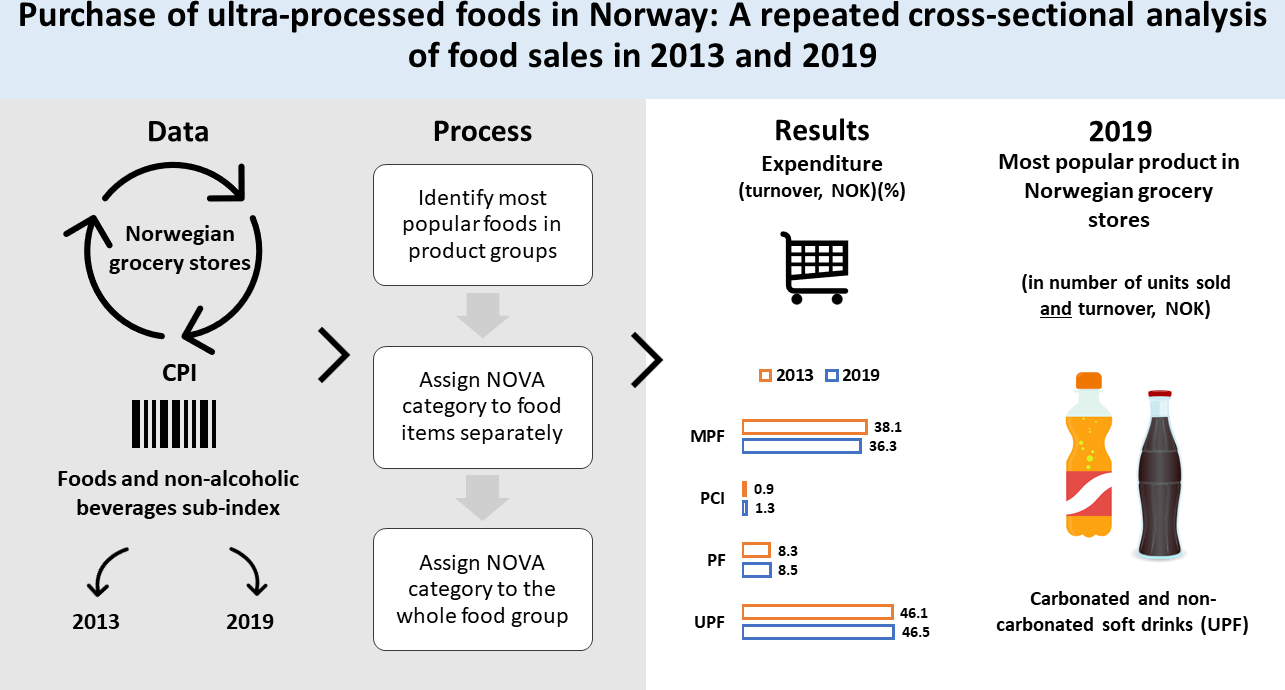
A dietary pattern dominated by ultra-processed foods has been associated with non-communicable diseases in several studies. A previous study from 2013 found a high share of ultra-processed foods in Norwegian food sales. This study aimed to investigate the current share of ultra-processed foods in Norway and the development in expenditure on ultra-processed foods from 2013.
Design:
A repeated cross-sectional analysis of scanner data from the Consumer Price Index from September 2013 and 2019 and an investigation of the processing degree according to the NOVA classification system.
Setting:
Food sales in Norway.
Participants:
Norwegian grocery stores (n 180, for both time periods).
Results:
The share of expenditure in 2019 was highest for ultra-processed foods (46·5 %) and minimally or unprocessed foods (36·3 %), followed by processed foods (8·5 %) and processed culinary ingredients (1·3 %). An increasing degree of processing was found for several of the food groups between 2013 and 2019; however, most effect sizes were weak. In 2019, soft drinks became the most frequently purchased food item, surpassing milk and cheese, with the highest expenditure in Norwegian grocery stores. Increases in expenditure on ultra-processed foods were mainly due to increased expenditures on soft drinks, sweets and potato products.
Conclusions:
A high share of expenditure on ultra-processed food was found in Norway, which may imply a high consumption of these foods. The change in expenditure of NOVA groups between 2013 and 2019 was small. Carbonated and non-carbonated soft drinks were the most frequently purchased products in Norwegian grocery stores and contributed to most of the expenditures.
The emerging concept of ‘food justice’ describes a social movement and a set of principles. It align with the goals of social justice, demanding recognition of human rights, equal opportunity, fair treatment and is participatory and community specific. The aim of this study was to investigate the conceptualisation of food justice and to explore how community participation is positioned in food justice scholarship.
Design:
A scoping review of peer-reviewed literature was conducted using the term ‘food justice’. This study used a five-step scoping review protocol. The databases included Scopus, Web of Science and Medline (OVID). Data were extracted on country of origin, research discipline, study type and conceptualisations of food justice. Reflexive thematic analysis was used to identify the themes.
Results:
The search identified 546 abstracts of which ninety peer-reviewed studies met the inclusion criteria. Thematic analysis identified five themes of food justice across these ninety studies: (1) social equity, (2) food security, (3) food systems transformation, (4) community participation and agency and (5) environmental sustainability.
Conclusions:
Current conceptualisations of food justice are evolving. Together, these five themes, using the term food justice, embrace a more holistic and structural view of the food system. They emphasise healthy, sustainable and equitable food as a human right and acknowledge the need to address structural barriers to that right. Community participation and agency in food justice decision-making is critical for transformative change towards a healthy, sustainable, and more just food system.
To determine if customer purchases at small food stores are associated with healthfulness of the diet as approximated by skin carotenoids.
Design:
This is a cross-sectional survey of customers in small food stores regarding demographics and food purchases. Food and beverage purchases were classified as ‘healthy’ or ‘non-healthy’ and ‘carotenoid’ v. ‘non-carotenoid’ using a systematic classification scheme. Fruit and vegetable intake was objectively assessed using a non-invasive device to measure skin carotenoids. Associations between variables of interest were examined using Pearson’s correlation coefficients, t tests and multiple linear regression analyses.
Setting:
Twenty-two small food retail stores in rural (n 7 stores) and urban (n 15) areas of North Carolina.
Participants:
Customers of small food stores
Results:
Of study participants (n 1086), 55·1 % were male, 60·0 % were African American/Black and 4·2 % were Hispanic, with a mean age of 43·5 years. Overall, 36 % purchased at least one healthy item, and 7·6 % of participants purchased a carotenoid-containing food/beverage. Healthy foods and beverages purchased included produce, lean meats, 100 % juices, plain popcorn, plain nuts, milk and yogurt. Unhealthy items included non-100 % juices, crackers, chips, candy, cakes and donuts. Purchase of a healthy or carotenoid-containing item was positively associated with skin carotenoid scores (P = 0·002 and 0·006, respectively).
Conclusions:
A relatively small proportion of customers purchased any healthy or carotenoid-containing foods and beverages, and those who did purchase healthy options had higher skin carotenoid scores. Future research should confirm these findings in different populations.
To inform strategies aimed at improving blood pressure (BP) control and reducing salt intake, we assessed educational inequalities in high blood pressure (HBP) awareness, treatment and control; physician’s advice on salt reduction; and salt knowledge, perceptions and consumption behaviours in Eastern Europe and Central Asia.
Design:
Data were collected in cross-sectional, population-based nationally representative surveys, using a multi-stage clustered sampling design. Five HBP awareness, treatment and control categories were created from measured BP and hypertension medication use. Education and other variables were self-reported. Weighted multinomial mixed-effects regression models, adjusted for confounders, were used to assess differences across education categories.
Settings:
Nine Eastern European and Central Asian countries (Armenia, Azerbaijan, Belarus, Georgia, Kyrgyzstan, Republic of Moldova, Tajikistan, Turkey and Uzbekistan).
Participants:
Nationally representative samples of 30 455 adults aged 25–65 years.
Results:
HBP awareness, treatment and control varied substantially by education. The coverage of physician’s advice on salt was less frequent among participants with lower education, and those with untreated HBP or unaware of their HBP. The education gradient was evident in salt knowledge and perceptions of salt intake but not in salt consumption behaviours. Improved salt knowledge and perceptions were more prevalent among participants who received physician’s advice on salt reduction.
Conclusions:
There is a strong education gradient in HBP awareness, treatment and control as well as salt knowledge and perceived intake. Enhancements in public and patient knowledge and awareness of HBP and its risk factors targeting socio-economically disadvantaged groups are urgently needed to alleviate the growing HBP burden in low- and middle-income countries.
To examine changes in the proportions of daily, weekly and occasional consumers of sugar-sweetened soda in six European countries that introduced/updated a tax between 2001–2002 and 2017–2018 and in neighbouring comparison countries (without a tax).
Design:
Repeated cross-sectional surveys.
Setting:
Health Behaviour in School-aged Children study, spanning five survey years (school years 2001–2002 to 2017–2018).
Participants:
Nationally representative samples of 13-year- and 15-year-old adolescents (n 236 623, 51·0 % girls).
Results:
Tax sizes (€0·02/l to €0·22/l) and pre-tax soda consumption were heterogeneous across countries. Prevalence of daily soda consumption reduced in the survey year following tax implementation in Latvia (from 17·9 to 11·9 %, P = 0·01), Finland (4·2 to 2·5 %, P = 0·001), Belgium (35·1 to 27·8 %, P < 0·001) and Portugal (17·4 to 14·9 %, P = 0·02), but not in Hungary (29·8 to 31·3 %, P = 0·47) or France (29·4 to 28·2 %, P = 0·27). However, reductions were similar (Finland) or smaller (Belgium, Portugal) than those in the comparison countries, except in Latvia where the reduction was larger (Pinteraction < 0·001). Prevalence of weekly soda consumption remained stable (Finland, Hungary and France) or increased (Latvia, Belgium); only Portugal experienced a decline (P < 0·001), which was larger than in the comparison country (Pinteraction < 0·001). Prevalence of occasional soda consumption (<1x/week) did not rise after implementation of the tax in Latvia, Finland, Hungary, France or Belgium, or the rise was similar to the comparison country in Portugal (Pinteraction = 0·15).
Conclusions:
Countries with a soda tax did not experience larger beneficial changes in post-tax adolescent consumption frequency of soda than comparison countries. Further studies, with different taxation types, are needed in the adolescent population.
There is growing evidence that childhood malnutrition is associated with non-communicable diseases (NCD) in adulthood and that body composition mediates some of this association. This review aims to determine if childhood body composition can be used to predict later-life cardiometabolic NCD and which measures of body composition predicts future NCD.
Design:
Electronic databases were searched for articles where: children aged under 5 years had body composition measured; cardiometabolic health outcomes were measured a minimum of 10 years later.
Setting:
The databases Embase, Medline and Global Health were searched through July 2020.
Participants:
Children aged under 5 years with a follow-up of minimum 10 years.
Results:
Twenty-nine studies met the inclusion criteria. Though a poor proxy measure of body composition, body mass index (BMI) was commonly reported (n 28, 97 %). 25 % of these studies included an additional measure (ponderal index or skinfold thickness). Few studies adjusted for current body size (n 11, 39 %).
Conclusions:
Many studies reported that low infant BMI and high childhood BMI were associated with an increased risk of NCD-related outcomes in later life but no conclusions can be made about the exact timing of child malnutrition and consequent impact on NCD. Because studies focussed on BMI rather than direct measures of body composition, nothing can be said about which measures of body composition in childhood are most useful. Future research on child nutrition and long-term outcomes is urgently needed and should include validated body composition assessments as well as standard anthropometric and BMI measurements.
To assess the association between child ultra-processed food (UPF) consumption and home-school learning environment characteristics during school closures due to the COVID-19 pandemic in schoolchildren with low- and middle income in Chile.
Design:
Cross-sectional. UPF consumption was collected using the Nova screener. We apply the structured days hypothesis (SDH) to assess home-school learning environment characteristics with three constructs that summarised school preparedness for online teaching and learning, school closure difficulties for caregivers and child routine. We explored associations between child UPF consumption and home-school environment characteristics using multivariate linear regression analyses after controlling for child demographic and school characteristics.
Setting:
Low- and middle-income neighbourhoods in southeastern Santiago, Chile.
Participants:
Children from the Food Environment Chilean Cohort (n 428, 8–10 years old).
Results:
Based on the Nova score, child mean consumption of UPF was 4·3 (sd 1·9) groups. We found a statistically significant negative association between child routine for eating, play and study and child UPF consumption when we adjusted for child sociodemographic (model 1: β = –0·19, (95 % CI –0·40, 0·02)) and school characteristics (model 2: β = –0·20, (95 % CI –0·41, 0·00)). Associations between school preparedness for online teaching or school closure difficulties and UPF were not statistically significant.
Conclusions:
Variations in child routines during the COVID-19 pandemic were negatively associated with UPF intake in schoolchildren with low- and middle income. Our findings are consistent with the SDH, suggesting the school environment helps regulate eating behaviours. Future research should evaluate what happens when children return to in-person classes at school.
To examine associations of household food insecurity with health and obesogenic behaviours among pregnant women enrolled in an obesity prevention programme in the greater Boston area.
Design:
Cross-sectional evaluation. Data were collected from structured questionnaires that included a validated two-item screener to assess household food insecurity. We used separate multivariable linear and logistic regression models to quantify the association between household food insecurity and maternal health behaviours (daily consumption of fruits and vegetables, sugar-sweetened beverages and fast food, physical activity, screen time, and sleep), mental health outcomes (depression and stress), hyperglycaemia status and gestational weight gain.
Setting:
Three community health centres that primarily serve low-income and racial/ethnic minority patients in Revere, Chelsea and Dorchester, Massachusetts.
Participants:
Totally, 858 pregnant women participating in the First 1,000 Days program, a quasi-experimental trial.
Results:
Approximately 21 % of women reported household food insecurity. In adjusted analysis, household food insecurity was associated with low fruit and vegetable intake (β = −0·31 daily servings; 95 % CI −0·52, −0·10), more screen time (β = 0·32 daily hours; 95 % CI 0·04, 0·61), less sleep (β = −0·32 daily hours; 95 % CI −0·63, −0·01), and greater odds of current (adjusted odds ratio (AOR) 4·42; 95 % CI 2·33, 8·35) or past depression (AOR 3·01; 95 % CI 2·08, 4·35), and high stress (AOR 2·91; 95 % CI 1·98, 4·28).
Conclusions:
In our sample of mostly low-income, racial/ethnic minority pregnant women, household food insecurity was associated with mental health and behaviours known to increase the likelihood of obesity.
The substantial changes in the physical and social environment during the transition from primary to secondary school may significantly impact adolescents’ energy balance-related behaviours (i.e. dietary behaviour, sedentary behaviour, sleep behaviour and physical activity (PA)). This is the first review systematically summarising evidence on changes in four energy balance-related behaviours of adolescents across the school transition from primary to secondary school.
Design:
For this systematic review, the electronic databases Embase, PsycINFO and SPORTDiscus were searched for relevant studies from inception to August 2021. PubMed was searched for relevant studies from inception to September 2022. Inclusion criteria were: (i) longitudinal studies reporting; (ii) one or more energy balance-related behaviours; and (iii) across the school transition, that is, with measurement(s) during both primary and secondary school.
Setting:
Transition from primary to secondary school
Participants:
Adolescents across the transition from primary to secondary school.
Results:
Thirty-four studies were eligible. We found strong evidence for an increase in sedentary time, moderate evidence for a decrease in fruit and vegetable consumption, and inconclusive evidence for a change in total, light, and moderate-to-vigorous PA, active transport, screen time, unhealthy snack consumption, and sugar-sweetened beverages consumption among adolescents across the school transition.
Conclusions:
During the transition from primary to secondary school, sedentary time and fruit and vegetable consumption tend to change unfavourably. More high-quality, longitudinal research is needed specifically on changes in energy balance-related behaviour across the school transition, especially regarding sleep behaviour. (Prospero registration: CRD42018084799)
The WHO has urged member states to develop preparedness plans for infant and young child feeding (IYCF) during emergencies. Ireland has no such plan. We aimed to identify the needs of caregivers in Ireland with regards IYCF during the COVID-19 pandemic.
Design:
Online survey conducted in May–June 2020.
Setting:
Ireland, during the first period of severely restricted movement due to COVID-19 (lockdown).
Participants:
Respondents (n 745) were primary caregivers of a child under 2 years; they were primarily well educated and likely of higher socio-economic status.
Results:
Among those who breastfed, being unable to access breast-feeding support groups and being unable to access in-person, one-to-one breast-feeding assistance were the biggest challenges reported. Nearly three quarters of those who had their babies during lockdown reported these challenges: 72·8 % and 68·8 %, respectively. For those using formula, the main challenges were structural in nature; approximately two-thirds of those who had their baby prior to lockdown feared there would be formula shortages and a third were unable to purchase formula due to shortages.
Conclusions:
Regardless of how their babies were fed, parents in Ireland experienced multiple challenges with infant feeding during the COVID-19 crisis. Breast-feeding should be protected, supported and promoted, particularly during an infectious disease pandemic. Additionally, assurances around supply of infant formula could reduce parental stress during a pandemic or emergency. An IYCF in emergencies plan would clearly set out how we could best support and protect the nutrition of the most vulnerable members of our population.
This study estimates the prevalence of, and associations between, family food insecurity and overweight/obesity among Native Hawaiian and Pacific Islander (NHPI) adolescents and explores socio-demographic factors which might have a moderation effect on the association.
Design:
Cross-sectional study using 2014 NHPI-National Health Interview Survey data reported by a parent or guardian. Family-level food security was assessed by the US Department of Agriculture 10-item questionnaire. BMI for age and sex ≥ 85th and 95th percentiles defined overweight and obesity, respectively, according to US Centers for Disease Control and Prevention criteria.
Setting:
The USA, including all 50 states and the District of Columbia.
Participants:
383 NHPI adolescents aged 12–17 in the USA.
Results:
A third (33·5 %) of NHPI adolescents aged 12–17 were overweight (19·1 %) or obese (14·4 %); 8·1 % had low food security; and 8·5 % had very low food security. Mean family food security score was 1·06, which corresponds to marginal food security. We found no association between family food insecurity and adolescent overweight/obesity or between any other covariates and overweight/obesity, except for family Supplemental Nutrition Assistance Program (SNAP) participation. Odds of being overweight/obese were 77 % lower for adolescents in families participating in SNAP (OR: 0·23, 95 % CI: 0·08, 0·64, P = 0·007). The association between SNAP participation and lower odds of overweight/obesity was particularly pronounced for adolescent girls in food-insecure families.
Conclusions:
The association between SNAP participation and lower odds of overweight/obesity suggests potential benefit of research to determine whether interventions to increase SNAP enrollment would improve NHPI adolescents’ health outcomes.
There is a broad spectrum of dietary supplements (DS) and their accessibility worldwide. However, little is known about the prevalence of DS use among Bangladeshi adolescents. This study estimates the prevalence, correlates and common conditions related to DS use.
Design:
A cross-sectional, convenient sampling strategy was adopted using an interviewer-administered, structured questionnaire.
Setting:
Kurigram and Patuakhali districts of Bangladesh.
Participants:
702 adolescents aged 10–19 years.
Results:
The overall prevalence of DS use was 83 %. The majority of participants (93·4 %) agreed that DS were good for health, and 28·3 % reported general health and well-being as the reason for using DS. The most frequently used supplements were multivitamins (38·6 %) and Ca (37 %). DS use was more common among adolescents who had ≤5 siblings, good health status, no chronic diseases, a positive impression that DS are good for health and who had the tendency to encourage DS to others. DS use was also higher among those who received DS information from healthcare providers, professional literature, friends, family and relatives.
Conclusions:
The prevalence of DS use is relatively higher among Bangladeshi adolescents compared to Bangladeshi adults and adolescents from other countries, highlighting the inclination towards DS use. Guidelines for safe DS use for adolescents are warranted to control DS use and prevent adverse effects.
The main objective was to investigate the association of household food insecurity (HFI) with child oral health. A secondary objective was to explore potential dietary and non-dietary mediators of the HFI–child oral health relationship.
Design:
Cross-sectional data from the nationally representative Ecuadorian National Health and Nutrition Survey (2018) were analysed. The data included self-reported child oral health, HFI (Food Insecurity Experience Scale), diet (FFQ) and oral care behaviours (toothbrushing frequency, toothpaste use). The association of HFI with the reported number of oral health problems was examined with stereotype logistic regression. Parallel mediation analysis was used to explore potential dietary (highly fermentable carbohydrate foods, plain water) and non-dietary (toothbrushing) mediators of the HFI–oral health relationship. Bias-corrected standard errors and 95 % CI were obtained using non-parametric bootstrapping (10 000 repetitions). Effect size was measured by percent mediation (PM).
Setting:
Ecuador.
Participants:
5–17-year-old children (n 23 261).
Results:
HFI affected 23 % of child households. 38·5 % of children have at least one oral health problem. HFI was associated with a greater number of oral health problems: 1–2 problems (adjusted odds ratio (AOR) = 1·37; 95 % CI (1·15, 1·58); P = 0·0001), 3–4 problems (AOR = 2·21; 95 % CI (1·98, 2·44); P = 0·0001), 5–6 problems (AOR = 2·57; 95 % CI (2·27, 2·88); P = 0·0001). The HFI–oral health relationship was partially mediated by highly fermentable carbohydrate foods (PM = 4·3 %), plain water (PM = 1·8 %) and toothbrushing frequency (PM = 3·3 %).
Conclusions:
HFI was associated with poorer child oral health. The HFI–oral health relationship was partially mediated by dietary and non-dietary factors. Longitudinal studies are needed to replicate our findings and investigate the role of other potential mediators.
The relationships between childhood weight self-misperception and obesity-related factors particularly health markers have not been extensively discussed. This study aims to examine the associations between weight self-misperception and obesity-related knowledge, attitudes, lifestyles and cardio-metabolic markers among Chinese paediatric population.
Design:
Cross-sectional study.
Setting:
Data sourced from a national survey in Chinese seven provinces in 2013.
Participants:
Children and adolescents aged 5–19 years.
Results:
Of the total 14 079 participants, there were 14·5 % and 2·2 % participants over-estimated and under-perceived their weight, respectively. Multi-variable logistic regression was applied to calculate OR and 95 % CI (95 % Cl) of obesity-related behaviours and cardio-metabolic markers by actual and perceived weight status. Individuals who perceived themselves as overweight/obese were more likely to have prolonged screen time, insufficient dairy intake and over sugar-sweetened beverages consumption (all P < 0·05), regardless of their weight. Furthermore, actual overweight/obese individuals had higher odds of abnormal cardio-metabolic markers, but a smaller magnitude of association was found among weight under-estimators. Among non-overweight/obese individuals, weight over-estimation was positively associated with abdominal obesity (OR: 10·49, 95 % CI: 7·45, 14·76), elevated blood pressure (OR: 1·30, 95 % CI: 1·12, 1·51) and dyslipidemia (OR: 1·43, 95 % CI: 1·29, 1·58).
Conclusions:
Weight over-perception was more prevalent than under-estimation, particularly in girls. Weight over-estimators tended to master better knowledge but behave more unhealthily; both weight over-perception and actual overweight/obesity status were associated with poorer cardio-metabolic markers. Future obesity intervention programmes should additionally pay attention to the population with inaccurate estimation of weight who were easily overlooked.
Scalable methods are required for population dietary monitoring. The Supermarket Transaction Records In Dietary Evaluation (STRIDE) study compares dietary estimates from supermarket transactions with an online FFQ.
Design:
Participants were recruited in four waves, accounting for seasonal dietary variation. Purchases were collected for 1 year during and 1 year prior to the study. Bland–Altman agreement and limits of agreement (LoA) were calculated for energy, sugar, fat, saturated fat, protein and sodium (absolute and relative).
Setting:
This study was partnered with a large UK retailer.
Participants:
Totally, 1788 participants from four UK regions were recruited from the retailer’s loyalty card customer database, according to breadth and frequency of purchases. Six hundred and eighty-six participants were included for analysis.
Results:
The analysis sample were mostly female (72 %), with a mean age of 56 years (sd 13). The ratio of purchases to intakes varied depending on amounts purchased and consumed; purchases under-estimated intakes for smaller amounts on average, but over-estimated for larger amounts. For absolute measures, the LoA across households were wide, for example, for energy intake of 2000 kcal, purchases could under- or over-estimate intake by a factor of 5; values could be between 400 kcal and 10000 kcal. LoA for relative (energy-adjusted) estimates were smaller, for example, for 14 % of total energy from saturated fat, purchase estimates may be between 7 % and 27 %.
Conclusions:
Agreement between purchases and intake was highly variable, strongest for smaller loyal households and for relative values. For some customers, relative nutrient purchases are a reasonable proxy for dietary composition indicating utility in population-level dietary research.