



R1. Introduction
We are grateful to our commentators for engaging with our target article and providing thought-provoking responses. In what follows, we discuss each of the major groups of issues raised. In many cases, these interconnect. The issues are varied. Some commentaries review additional sources of supportive evidence that we did not include in the target article. Some raise issues that turn on misapprehensions of what we claimed, misapprehensions that can be sorted out by defining terms and clarifying levels of analysis. Still others fill in ideas about proximate mechanisms, an issue not covered in our target article. Several commentaries offer alternative accounts of the empirical evidence we reviewed or draw attention to its limitations. Finally, many of the most difficult issues raised involve understanding how the IH relates to other, possibly better-known, explanatory approaches to obesity. The IH stems from reasoning about the normal functioning of evolved weight-regulation mechanisms. How does this articulate with literatures that see obesity as a metabolic dysfunction or regard overeating as a failure of self-control? We have not been able to answer every point of detail, but we have endeavoured to cover the overarching or recurrent themes.
R2. Proximate and ultimate explanations
A useful distinction can be made between ultimate and proximate explanations for a phenotypic or behavioural pattern (Scott-Phillips et al. Reference Scott-Phillips, Dickins and West2011; Tinbergen Reference Tinbergen1963). Ultimate explanations are based on how the phenotypic or behavioural pattern contributes to survival and reproduction, and hence offer an account of why that particular pattern has been retained over generations as part of the organism's phenotypic repertoire. For example, for trees in temperate latitudes, having full leaves in winter is disadvantageous because the photosynthetic yield from foliage at this time of year is insufficient to outweigh the cost of maintaining the foliage and the increased likelihood of weather damage when a tree is in full leaf. Thus, many temperate trees have evolved a deciduous pattern; they grow full leaves in spring and drop them in autumn, thus balancing the benefits of photosynthesis when there is more sunshine and the costs of having leaves when there is not. This is an ultimate-level explanation. Likewise, the IH as we present it in the target article is an ultimate-level hypothesis; it seeks to explain why, in terms of benefits to evolutionary fitness, individuals might maintain higher fat reserves under conditions of insecurity than under conditions of security. Ultimate-level explanations are vital for explaining the ecological patterning of a phenotype in a satisfactory way.
Proximate explanations deal with the mechanisms by which the behaviour or phenotypic pattern of interest is triggered. In general, there are many possible (and perhaps non-exclusive) proximate mechanisms that could deliver any given ultimate-level function. For example, some deciduous trees are cued to sprout leaves by day length, while others are cued by temperature – two different proximate mechanisms for achieving the same ultimate function. Importantly, the proximate explanation need not involve the organism representing, at any level, what the ultimate function of the pattern is. Trees do not need to know or represent why it is they sprout leaves in spring in order to do so effectively. Rather, ancestral trees that sprouted leaves in spring and dropped them in autumn, however that was caused, have more descendants living today than trees that did not. Often, an ultimate function is delivered by a varied suite of different mechanisms operating in concert and with considerable redundancy; this is known to be true, for example, of animal navigation (Frost & Mouritsen Reference Frost and Mouritsen2006).
Although behavioural biologists debate the limits to which functional explanation can be pursued independently of understanding mechanisms and vice versa (Fawcett et al. Reference Fawcett, Hamblin and Giraldeau2013; McNamara & Houston Reference McNamara and Houston2009), all agree that an explanation in terms of a proximate mechanism is not an alternative to an explanation in terms of an ultimate function. This is important in the current case. For example, Mullan, Ntoumanis, Thøgersen-Ntoumani, & Lipp (Mullan et al.) point out that people's immediate motivations for eating are often to do with taste and pleasure, rather than gaining calories. This is quite true, but to include taste and pleasure in our formal model on the same basis as evolutionary fitness would be to confuse proximate and ultimate levels of analysis. The ultimate function of eating is to obtain energy and nutrients; the proximate mechanisms by which our evolved brains do this include making food tasty and eating pleasurable. These two statements are both true, not alternatives to one another.
Similarly, “culture” and “diet” (Lozano) are not alternatives to the IH, but pathways through which food insecurity could affect body weights. Ert & Heiman suggest that the findings of the empirical literature on food insecurity and body weight could be explained by the IH, but could equally well be explained by changes to temporal discounting or the feeling of scarcity brought on by food insecurity. Ert & Heiman describe these as “alternative psychological mechanisms” to the IH. However, we didn't propose any psychological mechanisms in the target article, so these obviously cannot be alternative ones! Rather than temporal discounting or the feeling of scarcity being alternatives to the IH, they could be part of a suite of psychological mechanisms that deliver increases in energy intake relative to expenditure under conditions of food insecurity, as the IH requires.
Our target article did not go into the question of proximate mechanisms at all, a fact that many commentators picked up on. We concur with them that the issue of proximate mechanisms is of critical importance. Its intentional absence was explained by limitations on what could be covered in one article. As behavioural ecologists often do, we began our enquiry from considering ultimate payoffs and hence determining the kinds of strategies that one would expect to see emerging via natural selection (and the commentary by Mattei extends this strategic logic). We did so in a way that was agnostic about the mechanisms by which weight regulation is actually achieved.
This agnostic opening gambit does not mean we deny the existence or importance of such mechanisms. Understanding mechanism is crucial not only for a complete understanding of how something works, but also for particular relevance to understanding how phenotypes become maladapted. To return to our trees example, under rapid global warming, trees that use a temperature-based mechanism to cue coming into leaf will become progressively maladapted to actual patterns of available solar radiation (they will sprout leaves earlier and earlier), whereas trees that use day length will remain adapted. We thus fully concur with Higginson, McNamara, & Dall (Higginson et al.) that exploring the (no doubt multiple) mechanisms individuals have evolved to extract information from their environment about future energy need and energy availability will be critical to understanding why average body masses have become so unprecedentedly high in many modern populations, and why they become extremely high in some individuals (and, in eating disorders, extremely low in others; per Nesse). Understanding proximate cues also offers possibilities for understanding how it might be possible to intervene to change outcomes, short of changing the whole ecology of society (Cardel, Pavela, Dhurandharc, & Allison [Cardel et al.]; Petit & Spence). Ultimate understanding can only be a starting point for these kinds of enquiry; where a phenotype becomes maladapted, you also need to understand the interaction between evolved mechanisms and current environmental inputs.
R3. Varieties of proximate mechanism
Both DeJesus and Wells suggested that the IH implies that humans consciously reason about the probability of future shortfall and the resulting need to carry fat reserves. We were surprised by this, as the target article makes no such claim, and the claim strikes us as implausible. If mice and greenfinches can solve problems of weight regulation under intermittent food supply (presumably) without the need for conscious reasoning, it would be strange to assume that humans require conscious reasoning to achieve the same ends. The problem may lie with the term “decision making” that we used; for us, this does not imply conscious deliberation, or even necessarily the involvement of the brain. It simply describes any kind of mechanism that maps some information from the environment onto some kind of phenotypic output. It may have different connotations for others, so we are glad to clarify.
On a related note, Bentley & O'Brien argue that the IH belongs to the class of explanations in the upper left corner of their explanation space. This is the quadrant where decisions are made individually by reasoning agents to whom the payoffs of the different alternatives are transparent. We don't agree with this characterisation. The IH no more requires the payoffs for storing more fat to be transparent to the mind than the existence of tanning requires that melanocytes can represent the payoffs to having a lighter or darker skin. In fact, in Western populations, there probably are no payoffs to carrying more fat when food insecure, transparent or otherwise. Rather, the IH contends that there are evolved mechanisms that, when presented with particular types of cue, respond with changes to food motivation and/or energy expenditure that result in more fat storage. They respond in this way because ancestors who responded in this way to ancestral food insecurity left more descendants than ancestors who lacked this response.
But what, then, can we say about the proximate mechanisms likely to be involved? We will not repeat at length the useful discussions on potential mechanisms by DeJesus; Petit & Spence; Coppin; Blackwell; and Ambroziak, Azañón, & Longo (Ambroziak et al.) as well as others. We agree that there are likely to be multiple, largely unconscious and automatic pathways by which experiences that in ancestral environments predicted the likelihood of future food shortfall lead to increases in food consumption, shifts in food preference, and possibly changes in energy expenditure. The mechanisms may well alter the appraised or experienced pleasure and reward value of food, particularly of those subtypes of food that are most dense in energy. We also welcome Ambroziak et al.’s reminder that the mechanisms must also involve an individual's assessment of his or her own current bodily state, an assessment that can be inaccurate, for example, in the case of eating disorders. There may be a special role for the hypothalamic–pituitary–adrenal (HPA) axis (Blackwell). Hunger is associated with increased HPA activity (Erickson et al. Reference Erickson, Drevets and Schulkin2003). Regular experience of serious hunger would thus become encoded in the individual in the form of frequent glucocorticoid stress responses, and ex hypothesi such a pattern would cause a shift in appetite. Indeed, there is good evidence, including experimental evidence (Tataranni et al. Reference Tataranni, Larson, Snitker, Young, Flatt and Ravussin1996), for the existence of this pathway (see Epel et al. Reference Epel, Lapidus, McEwen and Brownell2001).
A consequence of the existence of this HPA mechanism would be that anything other than food insecurity that caused a frequent glucocorticoid stress response would also have the potential to produce weight gain. There is widespread evidence for psychosocial stress promoting weight gain, as several of our commentators (e.g., DeJesus; Blackwell; Smith) point out. These associations can be seen as by-products of the glucocorticoid stress response being part of the mechanism that stores extra energy in response to food insecurity. Essentially, all kinds of stressful experiences that in contemporary environments do not predict, or only very weakly predict, future food scarcity evoke mechanisms whose evolved function was to deal with food scarcity.
Chen and Dittmann & Maner discuss the possible role of childhood in setting adult body weight. They link the IH to a body of recent work arguing that childhood experience provides the developing person with information about the adult world into which they will mature, and hence sets them on a path towards developing the appropriate phenotypic strategy for that world. We agree with these commentators that this possibility would not be incompatible with the IH but an extension of it, and that there is a large body of correlational evidence linking childhood psychosocial adversity with high adult body weight or altered eating (see Danese & Tan [Reference Danese and Tan2014] and sect. 7.1 of target article). From an evolutionary point of view, the difficulty with these arguments is that, given that food availability is likely to have fluctuated over short timescales in ancestral environments, it is hard to see how it could be adaptive to use childhood experience as information about food availability in the adult world that an individual will experience only years later. Wells (Reference Wells2007b) made this point forcefully and repeats it in his commentary here (Wells; see also Nettle et al. Reference Nettle, Frankenhuis and Rickard2013). Retaining full plasticity into adulthood would appear to be enormously superior from an adaptive point of view over canalisation during childhood, and indeed, fat reserves can change quite dramatically in adulthood. To solve this issue is beyond the scope of this article. It may be that there are mechanistic or developmental constraints on adult plasticity that help explain why this should be the case, when using information from the adult environment would seem more beneficial.
Several commentators (DeJesus; Mata, Dallacker, & Hertwig [Mata et al.]) point out that eating is a social activity and, therefore, food consumption is influenced by a number of different social processes. We fully agree. Again, we would not see social determination as conceptually an alternative to the IH. It is not just that social factors such as power, wealth, and status determine food insecurity. It is that the mechanisms by which individuals extract information about their food ecology and food needs may include cues provided, passively or actively, by others. (For this reason, just as we do not agree that the IH resides in the upper part of the explanation space discussed by Bentley & O'Brien, we do not agree that it resides in the left side either.) Although the existence of social transmission is not an alternative to the IH at the conceptual level, it does make the epidemiological predictions more complex. For example, as Mata et al. point out, if some individuals buffer others from the effects of food insecurity, then we may fail to find associations where the theory predicts they should exist (e.g., perhaps in the case of children). If the perception of food insecurity is transmitted socially from person to person, then, even if this is basically an adaptive mechanism, there can be considerable non-adaptive cultural momentum. Eating patterns can perpetuate in particular social groups for a long time even if the initiating ecological conditions have been removed, and they can diffuse through networks not just to individuals who are actually food insecure, but to their secure associates too. These kinds of momentums and inertias arising from social transmission have been extensively discussed in the cultural evolution literature (Colleran Reference Colleran2016; Richerson & Boyd Reference Richerson and Boyd2005).
R4. Constraint versus adaptationist explanations
The IH as discussed in the target article is an adaptationist hypothesis. That is, it attributes higher body weights in food-insecure social groups to the operation of evolved adaptive mechanisms for weight regulation. Note that adaptationist does not mean adaptive; if the current environment is sufficiently different from those over which the mechanism evolved, then the output of the mechanism will not maximize current fitness, even if the mechanism is functioning normally and has evolved through natural selection.
Several commentators proposed alternative explanations for the observed evidence, based instead on some kind of psychological constraint. For example, Sacco and Dohle & Hofmann invoke the idea that people with adverse lives may be too depleted or overloaded to exert the self-control needed to avoid overeating in an affluent environment, and Wells relatedly suggests that poverty reduces the agency required to resist commercial interests. (Wells refers to this as a reverse-causation argument to the IH, which it is not; the causality is in the same direction as in our argument, but via a different pathway to the one we proposed.) Rather than seeing these proposals as just proximate mechanisms delivering the ultimate function specified by the IH, we see them as arguments of a different kind. They characterise the consumption decisions of food-insecure people as, fundamentally, errors arising from not having the psychological capacity available to make better decisions (i.e., arising from psychological constraints). This is different from seeing them as automatic decisions that would have been beneficial, under the given environmental cues, in ancestral environments (i.e., arising from adaptations).
Constraint explanations are often invoked to explain the behaviour of the poor, though there are alternative adaptationist interpretations of the same phenomena (Nettle Reference Nettle2010; Pepper & Nettle Reference Pepper and Nettle2017). We admit it can be challenging empirically to distinguish between the predictions of the two classes of explanation. We make several observations. The idea that there exists some kind of domain-general self-control or self-regulatory capacity in humans that can get depleted is contested, and it may not be well supported by evidence (Carter et al. Reference Carter, Kofler, Forster and McCullough2015; Kurzban Reference Kurzban2016). A number of experiments have attempted to experimentally deplete self-control to examine the impact on food consumption, and the average effect in these studies does not clearly differ from zero (Carter et al. Reference Carter, Kofler, Forster and McCullough2015). Second, even if such a general self-control capacity did exist, it is not clear how much of the variation in people's body weights it would explain. Only a subsection of population reports using effortful restraint to control their eating, and this subsection tends to have higher, not lower, body weights than those who describe their eating as unrestrained (Rudermann Reference Rudermann1986). Thus, having greater resources for effortful restraint or self-control does not seem a promising avenue for explaining why more people in the most privileged social groups remain thin.
Related to constraints explanations is the widespread argument that the growth of obesity is explained by the marketing of sugar and fast food (mentioned here by Bentley & O'Brien and Mullan et al.). But this is not in itself an explanation; one would also need to explain why people are susceptible to such marketing, and, in particular, why more insecure social groups appear to be more susceptible than others. Deeper principles are needed to explain such differential susceptibility, as Smith points out. The IH offers an alternative way of interpreting such differential susceptibility to ideas about constraints on self-control or agency.
R5. Dysfunction versus adaptationist explanations
Wells makes the important distinction between extra fat reserves and obesity (see also Blackwell). The IH as proposed provides no explanation for obesity (defined as extremely or pathologically high body weight). It offers an account of why food-secure individuals might carry more body fat than food-secure individuals, not of why anyone would have body mass indexes (BMIs) of 30 or 40. In a sense, we agree; we should strictly have titled our article “Food security as a driver of variation in body weight in humans.” Wells stresses that obesity results from systems having gone wrong (dysfunction), not the operation of adaptive weight-regulation mechanisms. These kinds of debates often occur in the evolutionary medicine literature; how relevant is it to understand the normal function of the mood system in order to explain clinical depression, where the system has gone wrong (Nesse Reference Nesse2000)?
Our response would be that many extreme cases of obesity no doubt involve metabolic dysfunction, but BMI in contemporary populations follows a continuous distribution with no point of discontinuity in it. Thus, it is not obvious exactly where normal (i.e., maladaptive but not arising from system dysfunction) responses to an evolutionarily novel environment end and system dysfunction begins. In almost all studies, obesity is defined phenotypically using arbitrary BMI cutoffs. Thus, if food insecurity increases body weight over what it otherwise would be, then the proportion of individuals falling above the cutoff line will be higher under food insecurity than food security, wherever the line is set. This will be true regardless of whether metabolic pathology is present in the most obese individuals. Thus, a critical question for the relevance of the IH is whether social determinants like poverty and food insecurity are associated with a rightward shift in the whole distribution of body weights, in which case normally functioning adaptive weight-regulation mechanisms might be relevant, or the movement of a number of individuals from a healthy to a diseased mode of the distribution, in which case increased pathology is a more useful avenue of explanation.
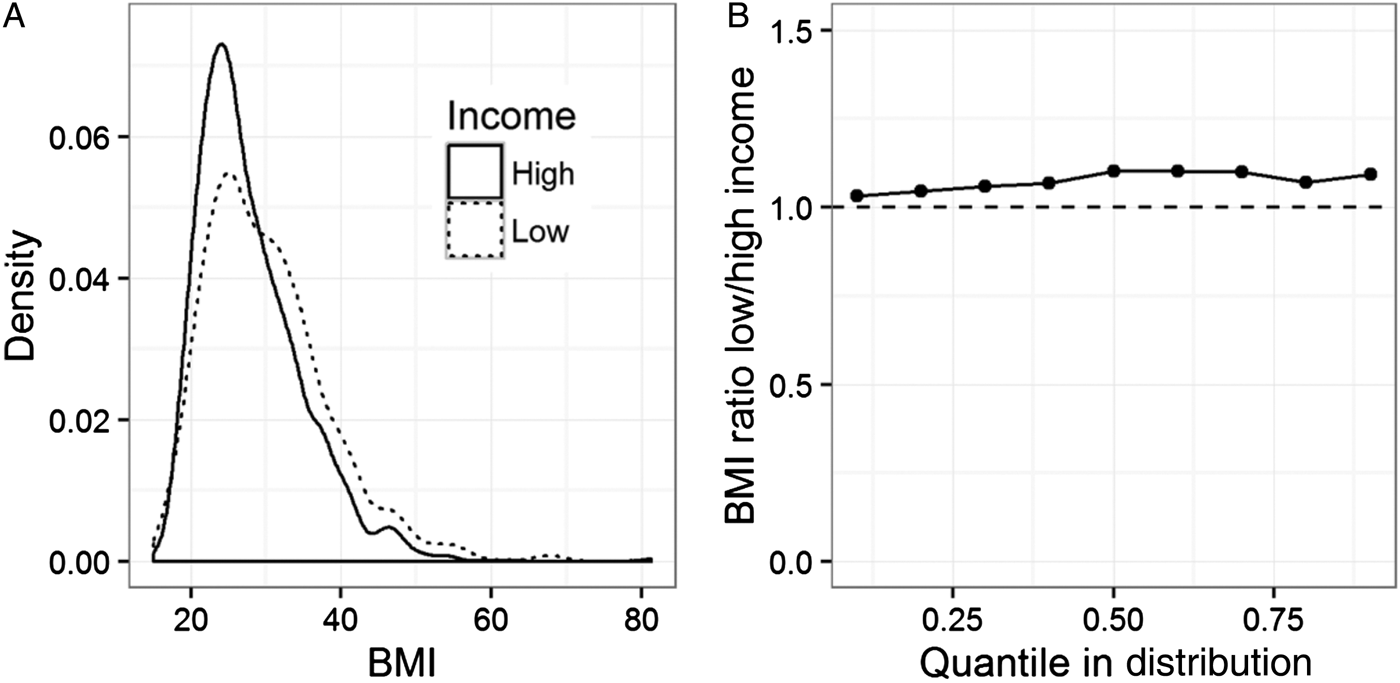
Figure R1a plots the distributions of BMIs for adult women in the United States (from the 1999–2004 National Health and Nutrition Examination Survey [NHANES]), separated into high- and low-income households. (We are dividing by household income here rather than by food insecurity, as those were the variables immediately available to us. Given the strong association between income and food insecurity in the United States [Gundersen et al. Reference Gundersen, Kreider and Pepper2011a], it is a reasonable conjecture that the pattern would be similar if we divided people into food secure and food insecure.)
Distribution of BMI among adult U.S. women, from the National Health and Nutrition Examination Survey (NHANES), 1999–2004, using the NHANES R package (Pruim Reference Pruim2015). (A) Density plot of BMI for women in high-income households (> 200% of federal poverty level) and low-income households (≤ 200% of federal poverty level). (B) The ratio of BMI in low- and high-income households at each decile of the distribution. At every decile of the distribution, women from low-income households have higher BMI than their counterparts from high-income households.

As Figure R1a shows, the whole distribution of BMIs is shifted to the right in the low-income households. One simple mechanism producing this pattern would be an increase in body weight in poor women that applied multiplicatively (i.e., every low-income woman carries x% more weight than she would if rich). Figure R1b shows that such a shift is descriptively fairly accurate, by displaying the ratio of BMIs in poor as compared to rich households at each decile point in the distribution. Every decile point of the distribution is higher among the poor; that is, a woman in the thinnest 20% of poor women is heavier than a woman in the thinnest 20% of rich women. The proportionate increase is in the range of 3–10% for each decile and varies relatively little across the distribution. This is compatible with the meta-analytic evidence that food insecurity is associated with body weight regardless of whether the study uses mean BMI as the outcome variable or the probability of exceeding a cutoff. It is also compatible with our observation that associations are stronger when the higher BMI cutoff of 30 is used compared to 25. If the hypothesised weight-shift is multiplicative, then it will increase the right-skew of the distribution and produce the largest absolute (not proportional) difference at the highest body weights.
One reading of this evidence, then, is that body weight is multiply determined by factors including the food ecology, energy expenditure patterns, genetic variation, and the prevalence of metabolic or other pathologies, but cues of food insecurity also produce a proportionate increase in body weight (relative to not experiencing those cues). This would mean that problems of high and very high body weight would be exacerbated by food insecurity, even though food insecurity was not the sole shaper of the distribution. We absolutely accept that such multiple determinants must be at work, as we make clear in the target article. If food insecurity were the only driver, then, as Lozano points out, we should expect Western populations to have lower average adiposity than subsistence ones, which is clearly not the case. (On a related note, we find it strange that Lozano characterises us as dismissing the evolutionary mismatch hypothesis. We do not. We agree with him that the IH as we define it here is a variant of, not an alternative to, the evolutionary mismatch hypothesis. He compares us to a tobacco company denying the smoking–cancer link because not every smoker gets cancer. On the contrary, one can accept that smoking causes cancer and still be interested in why some people are more vulnerable to the carcinogenic effects of smoking than are other people.)
A number of commentators suggest pathways by which weight regulation might become dysfunctional, through positive feedback between one component of the system and others, spiralling to the extremes of obesity (Coppin; Blackwell; Davies, Cheke, & Clayton [Davies et al.]) or anorexia (Nesse). These positive feedback loops potentially explain the “ratchet effect” mentioned by Wells and Higginson et al., whereby individuals who are already overweight become more so over the long term. The existence of such ratchets may explain the right-skew of the distribution BMI in Western populations (Lang et al. Reference Lang, De Sterck and Abrams2016). However, the insurance principle is still relevant, because anything that causes the initial shift of body weight to the right will increase the probability of such positive feedback processes becoming established.
R6. The evidence base and alternative explanations for it
Lozano is technically incorrect when he says that only one out of six tests of the predictions of the IH using the food insecurity literature is significant. The single omnibus test at the heart of any meta-analysis – does the observed association differ significantly from zero in the whole data set? – is significant in the current case, which is one out of one. However, we go on to show that gender and country income are strong moderators of the overall association. More broadly, though, we agree with Lozano that the evidence base we review is equivocal and problematic, and it certainly does not offer emphatic support for the IH. There are two issues. First, although we offered some post hoc speculations about why associations might be weaker in men (sect. 6.2) and in low-income countries (sect. 6.3), it would be much more convincing if there were some evidence that the insurance principle was at work in these contexts, even if the response were more subtle.
Second, the significant correlational evidence that we found in women does not demonstrate causality; the association may indeed be explained by other processes or factors (Boden & McLeod). This is not unique to the food-insecurity literature. Indeed, it is a problem for all of epidemiology. It is not sufficient, though, to opine that such processes or factors could exist. We need testable proposals for what they are. As such, we welcome Hruschka & Han’s alternative account based on selection (lighter women end up in more food-secure households) rather than causation. This is indeed an alternative mechanism that could explain the distributions in Fig. R1. The selection account would seem to imply that (1) the association between food insecurity and body weight would disappear when socioeconomic variables such as income are controlled for, and (2) there should be no longitudinal prediction of weight gain by food insecurity, only a cross-sectional association. Our meta-analysis suggests that neither of these is the case. Nonetheless, Hruschka & Han's suggestion is a cogent one, and the predictions of selection versus causation need to be rigorously tested with data.
Two developments are needed to improve the evidence base and make a more definitive determination on the value of the IH. First, the range of evidence considered needs to be broadened. Our meta-analysis was restricted to studies using the food insecurity questionnaires as predictors and BMI as outcome. Such studies have a number of limitations, as discussed by Nesse, Smith, and others. Broadening the scope to include more general measures of economic insecurity as predictors increases the range of available high-quality evidence substantially, as Smith points out in his valuable commentary. Crucially, this evidence is often longitudinal and points to economic insecurity as a predictor of weight gain in men as well as women. Similarly, Tapper reviews evidence that children exposed to food restriction increase their food consumption, as the IH requires. Thus, although the evidence we meta-analysed does not find associations in children, there are other sources of evidence that the hypothesized response does exist. For non-Western societies, the food insecurity questionnaire-studies may find no average association, but there is evidence of fat reserves functioning to buffer seasonality and other forms of stochastic resource fluctuation in such societies (Wells Reference Wells2012a; Reference Wells2012b). Indeed, Wells (Reference Wells2012b), on the basis of non-Western and paleontological evidence, specifically argues that the human tendency to store fat is a risk-management strategy for dealing with environmental fluctuation, which is the essence of the IH.
Second, the research designs need to become stronger, as Boden & McLeod point out. The food insecurity literature is dominated with cross-sectional studies that have limited value for investigating causality. As many of our commentators point out (Dohle & Hofmann; Hruschka & Han; Mullan et al.; Boden & McLeod), we need more longitudinal evidence, which helps distinguish selection from causation. We also need instrumental-variable or natural-experiment studies. Examples could be policy changes affecting food insecurity that are introduced in one jurisdiction but not a neighbouring one, or exogenous events that expose some people but not others to temporary food restriction. These would allow better estimation of causal impact. Ultimately, we agree with Cardel et al. that randomized control trials are required to test the IH. Food stamp programmes may offer an opportunity here. In the United States, the Supplemental Nutrition Assistance Program (SNAP, commonly known as “food stamps”) provides a monthly monetary amount for purchasing food. Families tend to use it up in the first three weeks of the month, producing a repeating cycle of consumption and hunger. Several studies have found that programme participation significantly predicts weight gain, including among men in some cases (reviewed by DeBono et al. Reference DeBono, Ross and Berrang-Ford2012; Dinour et al. Reference Dinour, Bergen and Yeh2007). Randomized control trials could compare the impacts of different programme designs leading to greater or lesser temporal variation in availability. The predictions of the IH are clear. Smaller-scale experiments would also be valuable; for example, micro-comparisons of eating behaviour after short-term experimental manipulation of perceived food insecurity would help demonstrate if there really is a causal pathway of the kind the IH requires (cf. Cardel et al. Reference Cardel, Johnson, Beck, Dhurandhar, Keita, Tomczik, Pavela, Huo, Janicke, Muller, Piff, Peters, Hill and Allison2015).
R7. Assumptions and predictions of our formal model
Several commentators questioned the applicability of a theory and formal model based on birds to mammals, such as humans. To clarify, there is nothing about the insurance principle or the formal model we present in the target article that is specific to birds, or any more applicable to birds than mammals. The model is general. The best experimental tests happen to have been in birds, though as Nesse points out there is supportive mammalian evidence too. Hill, Proffitt Leyva, & DelPriore (Hill et al.) argue that the model is too simplistic in not reflecting that one of the functions of fat stores is to fund reproduction. We agree that funding reproduction is an important function of adipose tissue, and moreover that sex differences in reproduction explain sex differences in adiposity. However, our model is not incompatible with this. All our formal model does is provide an algorithm for answering the question: If there is a given mapping between fat reserves and fitness in each time period, and a given probability of finding food in each time period, then what is the optimal amount of energy to consume and store? Although, for ease of exposition, we introduced our model by talking about the chances of surviving the time period, the model is actually agnostic about which factors determine the mapping between fat reserves and fitness. Survival, reproduction, and immunity could all contribute to setting the shape of the function shown in Fig. 1A of the target article. The model can be used to investigate the predicted effect of being a different sex simply by varying the shape of the mapping (sect. 6.2).
Hill et al. outline the need for models that explain why different taxa with different ecologies and lifecycles show different patterns of adiposity (and especially dimorphism in adiposity). We agree on the need for such models, but that is not what we were trying to do in this target article. In fact, it is complementary. Our model takes as input a mapping between fat reserves and fitness, and gives as output an optimal eating policy. Other kinds of models are needed that give a mapping between fat reserves and fitness as their output, using features of the organism's ecology, biology, and life history as the input, and thus making comparative predictions. Having said this, we agree with Hill et al. and Chen that another avenue for explaining the apparent sex difference in responsiveness to food insecurity is that cues of food insecurity, for women, might not only affect the reserves they need to store in order to execute a given reproductive strategy, but also affect what reproductive strategy they choose to execute. This deserves further investigation and formal modelling.
Wells suggests that the predictions of the model are falsified for humans, because the model predicts that those who are currently thinnest should gain weight, and those who are currently fattest should lose weight, whereas in human obesity, those whose body weights are highest to start with gain the most over time. But this is to confuse long-term and short-term dynamics. Over the short term, there is abundant human evidence that after a person's body weight is perturbed in either direction (e.g., due to illness or experimental intervention), it returns fairly rapidly close to a predisturbance, individual-specific set point (Speakman et al. Reference Speakman, Levitsky, Allison, Bray, de Castro, Clegg, Clapham, Dulloo, Gruer, Haw, Hebebrand, Hetherington, Higgs, Jebb, Loos, Luckman, Luke, Mohammed-Ali, O'Rahilly, Pereira, Perusse, Robinson, Rolls, Symonds and Westerterp-Plantenga2011).
The short-term dynamics of human BMI distributions are dominated by regression to the centre: Those with high BMIs lose weight whereas those with low BMIs gain weight (Lang et al. Reference Lang, De Sterck and Abrams2016). This is what our formal model predicts. What we need to explain is the interindividual variation in what the set point is (and, relatedly, why the set point increases over time in some people). Here is where there is a role for chronic exposure to environmental factors, including but certainly not limited to food insecurity. Wells is right that the long-term increases in individual set points appears to be proportional to existing BMI; this is what explains the right-skew of the BMI distribution in Western populations (Lang et al. Reference Lang, De Sterck and Abrams2016). This points to the importance of ratchet effects, as discussed in section R5. Such proportionality does not arise in any obvious way from our formal model or the other behavioural-ecological models on which we based ours. To explain them will require better understanding of the proximate mechanisms involved in weight regulation, the potential for positive feedback among such mechanisms, and the mismatch between current and ancestral environments. On this point we are in agreement with Higginson et al., and with Wells (Reference Wells2012b).
R8. Concluding remarks
We take several lessons away from this exercise. The first is that you can think you have been clear, but find that others have taken you to mean something quite different from what you intended. This is a particular peril of interdisciplinary efforts and seems to be acute whenever behavioural ecologists bring their arguments – which are based on a different level of analysis and may use the familiar terms with different meanings – to the scholarly communities of psychology, biomedicine, and public health. We are grateful to have had the chance to clarify some of these misunderstandings. Second, for a topic like obesity, there is more material to cover than can possibly be included in one article. Commentators were not shy in bringing this to light. In some cases, the additional material represents extensions and elaborations, and it is useful to be able to discuss these here. In other cases, we omitted evidence or distinctions that would have considerably improved our target article (by broadening the evidence base and thus averting some of the misunderstandings) had it been dealt with originally. We have highlighted some of these cases above.
The third lesson is that to explain a phenomenon like obesity involves not just integrating multiple factors at the same level of the explanatory web, but multiple levels of factors (e.g., information about the evolved function of weight-regulation mechanisms, about proximate psychological and physiological mechanisms, about pathology and dysregulation, about developmental influences, and about contemporary food ecologies and the inequalities in them). Achieving this integration is extremely challenging, as the existence of poorly connected literatures in each of these different areas demonstrates; each of the literatures takes a different set of axioms and assumptions about relevance as its starting point. The variation in the commentaries shows this very clearly. Regardless of what value the IH as set out in our target article turns out to have, if any, we feel that the attempt to integrate these different kinds of information has been a valuable one.



Target article
Food insecurity as a driver of obesity in humans: The insurance hypothesis
Related commentaries (25)
A game theory appraisal of the insurance hypothesis: Specific polymorphisms in the energy homeostasis network as imprints of a successful minimax strategy
A life-history theory perspective on obesity
Anorexia: A perverse effect of attempting to control the starvation response
Anti-fat discrimination in marriage more clearly explains the poverty–obesity paradox
Appraising food insecurity
Children respond to food restriction by increasing food consumption
Committed to the insurance hypothesis of obesity
Eating and body image: Does food insecurity make us feel thinner?
Epidemiological foundations for the insurance hypothesis: Methodological considerations
Episodic memory as an explanation for the insurance hypothesis in obesity
Expanding the insurance hypothesis of obesity with physiological cues
Future research directions for the insurance hypothesis regarding food insecurity and obesity
Household-level financial uncertainty could be the primary driver of the global obesity epidemic
Implicit attitudes, eating behavior, and the development of obesity
Mapping multiple drivers of human obesity
Obesity as self-regulation failure: A “disease of affluence” that selectively hits the less affluent?
Obesity is not just elevated adiposity, it is also a state of metabolic perturbation
Potential psychological accounts for the relation between food insecurity and body overweight
Predicting human adiposity – sometimes – with food insecurity: Broaden the model for better accuracy
Social nature of eating could explain missing link between food insecurity and childhood obesity
The life history model of the insurance hypothesis
Toward a mechanistic understanding of the impact of food insecurity on obesity
Towards a behavioural ecology of obesity
Using food insecurity in health prevention to promote consumer's embodied self-regulation
“It's a bit more complicated than that”: A broader perspective on determinants of obesity
Author response
Adaptive principles of weight regulation: Insufficient, but perhaps necessary, for understanding obesity