






No CrossRef data available.
Article contents
A game theory appraisal of the insurance hypothesis: Specific polymorphisms in the energy homeostasis network as imprints of a successful minimax strategy
Published online by Cambridge University Press: 11 May 2017
Abstract
The existence of specific polymorphisms in genes of key hormones of the energy homeostasis network that have been shown to predispose to obesity and the so-called metabolic syndrome provides further biological support for the proposed insurance hypothesis. In a broader sense, such polymorphisms can be understood as biological imprints of an evolutionarily successful minimax strategy employed by ancient Homo sapiens subpopulations in a one-player game against nature.
Information
- Type
- Open Peer Commentary
- Information
- Copyright
- Copyright © Cambridge University Press 2017
References
Chang, C.-S., Lu, Y.-J., Chang, H.-H., Hsu, S.-H., Kuo, P.-H., Shieh, C.-C., Yao, W.-J., Hsu, M.-C., Young, K.-C., Lin, W.-Y., Huang, K.-C., Wu, C.-H. & Tsai, Y.-S. (2016) Role of adiponectin gene variants, adipokines and hydrometry-based percent body fat in metabolically healthy and abnormal obesity. Obesity Research & Clinical Practice pii:S1871–403X(16)30031-X. doi: 10.1016/j.orcp.2016.05.003.CrossRefGoogle Scholar
Chen, B.-S. & Ho, S.-J. (2014) The stochastic evolutionary game for a population of biological networks under natural selection. Evolutionary Bioinformatics Online
10:17–38. doi: 10.4137/EBO.S13227. eCollection 2014.Google Scholar
Mărginean, C. O., Mărginean, C., Voidăzan, S., Meliţ, L., Crauciuc, A., Dauicu, C. & Bănescu, C. (2016) Correlations between leptin gene polymorphisms 223 a/G, 1019 G/a, 492 G/C, 976 C/a, and anthropometrical and biochemical parameters in children with obesity: a prospective case-control study in a Romanian population – The Nutrichild Study. Medicine (Baltimore)
95(12):e3115. doi: 10.1097/MD.0000000000003115.Google Scholar
Meier, U. & Gressner, A. M. (2004) Endocrine regulation of energy metabolism: Review of pathobiochemical and clinical chemical aspects of leptin, ghrelin, adiponectin, and resistin. Clinical Chemistry
50(9):1511–25.CrossRefGoogle ScholarPubMed
Milnor, J. W. (1951) Games against nature. RM-679; U. S. Air Force Project RAND Research Memorandum. RAND. Available at: http://www.rand.org/pubs/research_memoranda/RM0679.html.Google Scholar
Mora, M., Adam, V., Palomera, E., Blesa, S., Diaz, G., Buquet, X., Serra-Prat, M., Martin-Escudero, J. C., Palanca, A., Chaves, J. F., Puig-Domingo, M. & The Matarό Aging Study Group (2015) Ghrelin gene variants influence on metabolic syndrome components in aged Spanish population. PLoS ONE
10(9):e0136931. doi: 10.1371/journal.pone.0136931.Google Scholar
Neel, J. V. (1999) The “thrifty genotype” in 1998. Nutrition Reviews
57(5 Pt 2):S2–S9.Google Scholar
Pfeiffer, T. & Schuster, S. (2005) Game-theoretical approaches to studying the evolution of biochemical systems. Trends in Biochemical Sciences
30(1):20–25.Google Scholar
Schuster, S., Kreft, J. U., Schroeter, A. & Pfeiffer, T. (2008) Use of game-theoretical methods in biochemistry and biophysics. Journal of Biological Physics
34(1–2):1–17. doi: 10.1007/s10867-008-9101-4.Google Scholar
Schuster, S., de Figueiredo, L. F., Schroeter, A. & Kaleta, C. (2011) Combining metabolic pathway analysis with evolutionary game theory: explaining the occurrence of low-yield pathways by an analytic optimization approach. Biosystems
105(2):147–53.Google Scholar
Speakman, J. R. (2008) Thrifty genes for obesity, an attractive but flawed idea, and an alternative perspective: The “drifty gene” hypothesis. International Journal of Obesity
32(11):1611–17. Available at: http://doi.org/10.1038/ijo.2008.161.Google Scholar
Thaler, R. H. (1988) Anomalies: The winner's curse. Journal of Economic Perspectives
2(1):191–202. doi: 10.1257/jep.2.1.191. JSTOR 1942752.Google Scholar
von Neumann, J. & Morgenstern, O., (1947) Theory of games and economic behavior. Princeton University Press.Google Scholar
Zhu, X., Jiang, L., Ye, M., Sun, L., Gragnoli, C & Wu, R. (2016) Integrating evolutionary game theory into mechanistic genotype-phenotype mapping. Trends in Genetics
32(5):256–68. doi: 10.1016/j.tig.2016.02.004.Google Scholar
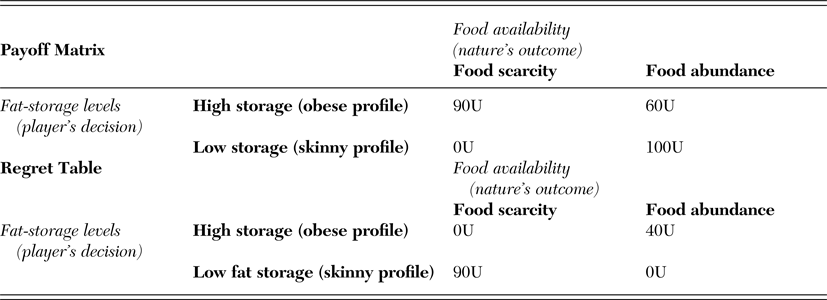
Table 1. Top: Payoff matrix for the proposed one-player game-against nature. The subjective expected utility is represented by cardinal payoffs (from 0 to 100U [utility units or Utils]). Bottom: The constructed “regret table,” which can be used to estimate the optimal option according to the minimax regret principle.
I congratulate Nettle et al. for their tour de force not only in describing the basic tenets of their new insurance hypothesis, but also in attempting to provide empirical evidence for the basic assumptions employed by this new theoretical paradigm. The existence of specific polymorphisms in genes of key hormones of the energy homeostasis network that have been shown to predispose to obesity and the so-called metabolic syndrome (Chang et al. Reference Chang, Lu, Chang, Hsu, Kuo, Shieh, Yao, Hsu, Young, Lin, Huang, Wu and Tsai2016; Mărginean et al. Reference Mărginean, Mărginean, Voidăzan, Meliţ, Crauciuc, Dauicu and Bănescu2016; Mora et al. Reference Mora, Adam, Palomera, Blesa, Diaz, Buquet, Serra-Prat, Martin-Escudero, Palanca, Chaves and Puig-Domingo2015) provide further biological support for the proposed insurance hypothesis. In a broader sense, polymorphisms in the genes of leptin, adiponectin, resistin, peptide YY, and ghrelin (Meier & Gressner Reference Meier and Gressner2004), for example, can be understood as biological imprints of an evolutionarily successful minimax strategy employed by subpopulations of ancient Homo sapiens to optimize their energy homeostasis in the face of uncertainty regarding the future availability of food resources.
The minimax theorem was initially proposed by John von Neumann in 1928 (von Neumann & Morgenstern Reference von Neumann and Morgenstern1947). In basic terms, the minimax strategy, which is essentially risk-averse, focuses on avoiding the worst outcome, although it may not necessarily lead to the best possible outcome. In the so-called one-player games against nature (which will be the focus of this discussion), the terms minimax (minimizing the opponent's maximum payoff) and maximin (minimizing one's own maximum loss) can be used interchangeably as, by definition, nature has no payoffs.
The minimax strategy stands in opposition to other possible rational alternatives, such as the maximax strategy, a risk-taking option that involves selecting the alternative that may lead to the maximum available payoff; the so-called minimax regret strategy, a par excellence risk-neutral strategy that focuses on minimizing the maximum regret; and the principle of expected utility maximization, which is usually employed when nature's probability distribution is known and which recommends choosing the highest expected payoff after weighting each contingency by its probability.
In a recent study (Chen & Ho Reference Chen and Ho2014), it has been demonstrated that minimax strategies are widely used by complex biological networks to maintain a robust stability of the phenotypic trait of interest in the face of random genetic variations and unpredictable environmental disturbances. It has already been shown that evolutionary game theory can be successfully used to model the evolution of several biochemical systems (Pfeiffer & Schuster Reference Pfeiffer and Schuster2005; Schuster et al. Reference Schuster, Kreft, Schroeter and Pfeiffer2008; Reference Schuster, de Figueiredo, Schroeter and Kaleta2011; Zhu et al. Reference Zhu, Jiang, Ye, Sun, Gragnoli and Wu2016). Alternatively, it is also possible to model the evolutionary behavior of individual biochemical systems as a whole, focusing on the desired phenotypic trait and using standard game theory approaches. In this sense, the scenario of interest in the target article can be represented as a one-player game against nature (Milnor Reference Milnor1951) (Table 1, top). In such a situation, in the face of uncertainty regarding the future availability of food resources, the minimax strategy would lead to the development of a robust energy-conserving phenotype focused on avoiding the worst outcome (i.e., starvation to death), although it could potentially lead to suboptimal general health outcomes due to obesity-induced diseases.
Top: Payoff matrix for the proposed one-player game-against nature. The subjective expected utility is represented by cardinal payoffs (from 0 to 100U [utility units or Utils]). Bottom: The constructed “regret table,” which can be used to estimate the optimal option according to the minimax regret principle.
In the proposed one-player game against nature representing the food-availability versus fat-storage levels scenario (Table 1, top), the minimax principle would recommend that the player choose the option of high levels of fat storage (obese profile), which would possibly yield the best of the worst possible outcomes (Table 1, top – first row, second column: 60U). The maximax principle, conversely, would recommend that the player choose the option of low levels of fat storage (skinny profile), as it is the option that could possibly lead to the best outcome (Table 1, top – second row, second column: 100U). As it can be easily noted, although possessing some degree of rationality, the maximax principle (which is sometimes sarcastically described as “aim for the best, but get the worst”) is inherently weak, as it disregards the probability distribution of nature's outcomes, being often adopted by naive decision makers such as young children. The maximum regret for each option can be calculated by first estimating the maximum profit for each one of nature's outcomes in the initial payoff matrix (i.e., 90U for food scarcity and 100U for food abundance). Then a new “regret table”’ (Table 1, bottom) is constructed by subtracting the largest payoff obtained for that specific column by each cell's value. Ultimately, the value in each cell will represent the maximum regret for that specific outcome. In this case, the minimax regret principle would recommend the choice of high levels of fat storage (obese profile), as it is the one that minimizes the maximum regret (Table 1, bottom – first row, second column: 40U).
Taking into account the discussion above, I believe that instead of an exclusively psychological mechanism that, either consciously or subconsciously, leads to suboptimal prediction of the future availability of food resources, the insurance hypothesis proposed by Nettle et al. should be understood as a more deeply rooted mechanism involved in the evolutionary dynamics of human biology. In such a scenario, specific polymorphisms in the genes of key hormones of the energy homeostasis network seem to have provided an adaptive advantage to the subpopulations that harbored such traits. According to this framework, food insecurity, and not necessarily real alternated cycles of food abundance and famine (as required by the outdated thrifty genotype hypothesis; Neel Reference Neel1999) or the necessity of elimination of the fitness costs for obesity (as required by the implausible drifty genotype hypothesis; Speakman Reference Speakman2008), should be understood as the pivotal driver for the evolutionary success of obesity. According to this framework, the deleterious health effects of obesity and its wide prevalence in modern society may ultimately represent the “winner's curse” (Thaler Reference Thaler1988) of an evolutionarily successful minimax strategy selected by subpopulations of ancient Homo sapiens individuals. In such early evolutionary stages, in the face of greater uncertainty regarding the future availability of food resources, subsistence and survival were the key objectives to be achieved by such an energy homeostasis system, and any obesity-related biological disadvantages were only minor uncertain side effects located in a future too remote to be taken into account.