





No CrossRef data available.
Article contents
Mapping multiple drivers of human obesity
Published online by Cambridge University Press: 11 May 2017
Abstract
The insurance hypothesis is a reasonable explanation for the current obesity epidemic. One alternative explanation is that the marketing of high-sugar foods, especially sugar-sweetened beverages, drives the rise in obesity. Another prominent hypothesis is that obesity spreads through social influence. We offer a framework for estimating the extent to which these different models explain the rise in obesity.
Information
- Type
- Open Peer Commentary
- Information
- Copyright
- Copyright © Cambridge University Press 2017
References
Basu, S., Yoffe, P., Hills, N. & Lustig, R. H. (2013) The relationship of sugar to population-level diabetes prevalence: An econometric analysis of repeated cross-sectional data. PLoS ONE
8(2):e57873.Google Scholar
Bentley, R. A. & O'Brien, M. J. (2016) Collective behaviour, uncertainty and environmental change. Philosophical Transactions of the Royal Society A: Mathematical, Physical and Engineering Sciences
373:20140461.Google Scholar
Bentley, R. A., O'Brien, M. J. & Brock, W. A. (2014) Mapping collective behavior in the big-data era. Behavioral and Brain Sciences
37:63–119.Google Scholar
Brock, W. A., Bentley, R. A., O'Brien, M. J. & Caiado, C. C. S. (2014) Estimating a path through a map of decision making. PLoS ONE
9(11):e111022.Google Scholar
Caiado, C. C. S., Brock, W. A., Bentley, R. A. & O'Brien, M. J. (2016) Fitness landscapes among many options under social influence. Journal of Theoretical Biology
405:5–16.Google Scholar
Christakis, N. A. & Fowler, J. H. (2007) The spread of obesity in a large social network over 32 years. New England Journal of Medicine
357:370–79.Google Scholar
Christakis, N. A. & Fowler, J. H. (2013) Social contagion theory: Examining dynamic social networks and human behavior. Statistics in Medicine
32:556–77.Google Scholar
DellaVigna, S. & Malmendier, U. (2006) Paying not to go to the gym. American Economic Review
96:694–719.Google Scholar
Guiteras, R., Levinsohn, J. & Mobarak, A. M. (2015) Encouraging sanitation investment in the developing world: A cluster-randomized trial. Science
348:903–906.Google Scholar
Hernandez, D. C. & Pressler, E. (2014) Accumulation of childhood poverty on young adult overweight or obese status: Race/ethnicity and gender disparities. Journal of Epidemiology and Community Health
68:478–84.Google Scholar
Johnson, R. J., Segal, M. S., Sautin, Y., Nakagawa, T., Feig, D. I., Kang, D. H., Gersch, M. S., Benner, S. & Sánchez-Lozada, L. G. (2007) Potential role of sugar (fructose) in the epidemic of hypertension, obesity and the metabolic syndrome, diabetes, kidney disease, and cardiovascular disease. American Journal of Clinical Nutrition
86:899–906.Google Scholar
Kearns, C. E., Schmidt, L. A. & Glantz, S. A. (2016) Sugar industry and coronary heart disease research: A historical analysis of internal industry documents. JAMA Internal Medicine
176(11):1680–85. doi: 10.1001/jamainternmed.2016.5394.Google Scholar
Nestle, M. (2016) Food industry funding of nutrition research: The relevance of history for current debates. JAMA Internal Medicine
176(11):1685–86. doi: 10.1001/jamainternmed.2016.5400.Google Scholar
Ogden, C. L., Carroll, M. D., Kit, B. K. & Flegal, K. M. (2014) Prevalence of childhood and adult obesity in the United States, 2011–2012. JAMA
311(8):806–14. doi: 10.1001/jama.2014.732.Google Scholar
Schroeder, S. A. (2007) We can do better – Improving the health of the American people. New England Journal of Medicine
357:1221–28.Google Scholar
Shalizi, C. R. & Thomas, A. C. (2010) Homophily and contagion are genetically confounded in observational social network studies. Sociological Methods and Research
40:211–39.Google Scholar
Shrewsbury, V. & Wardle, J. (2012) Socioeconomic status and adiposity in childhood: a systematic review of cross-sectional studies
1990–2005. Obesity
16:275–84.Google Scholar
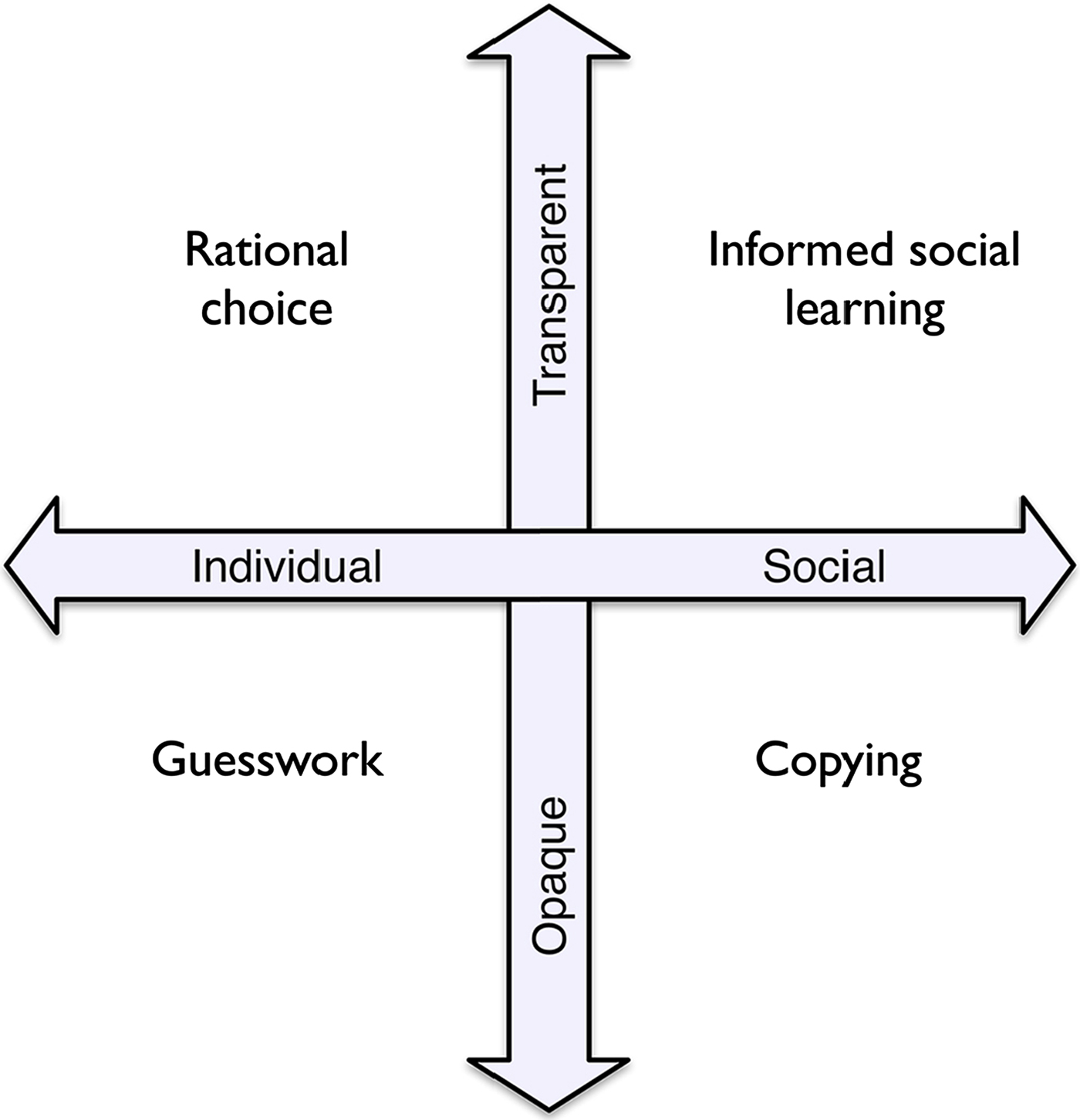
Figure 1. A four-quadrant heuristic map for understanding different domains of human decision making, based on whether a decision is made independently or socially and on the transparency of options and payoffs. Source: Bentley et al. (2014, Fig. 1).
 You have
Access
The United States is well known as a generally high-income country, but what is less well known is the fact that over a third of Americans are classified as being obese (Ogden et al. Reference Ogden, Carroll, Kit and Flegal2014) – two-thirds if “overweight” is figured in – with more than 100,000 deaths per year attributed to obesity. Despite the intentions of many to lose weight, the problem has been exceptionally resilient at multiple scales, from individuals who try to change personal habits (DellaVigna & Malmendier Reference DellaVigna and Malmendier2006) to health or government organizations that address the problem at a population scale (Schroeder Reference Schroeder2007). Given their different types and scales of analysis, different social sciences (economics, psychology, anthropology, sociology) tend to favor different explanations for the evolution of dietary habits.
In the target article, Nettle et al. propose a version of the standard evolutionary-psychology hypothesis that modern obesity is a result of high availability of food to Paleolithic hunter-gatherers, who stored calories as fat whenever famine loomed. Nettle et al.’s insurance hypothesis is quite reasonable (Shrewsbury & Wardle Reference Shrewsbury and Wardle2012) – indeed, storage against food uncertainty is the commonly understood purpose of fat – and falls comfortably alongside numerous other plausible hypotheses for obesity. In community medicine, for example, hypotheses about behavioral change center on information and supply (Guiteras et al. Reference Guiteras, Levinsohn and Mobarak2015). Regarding sugar, the supply side includes factors such as widespread marketing of inexpensive high-sugar foods, especially sugar-sweetened beverages, that may drive the rise in obesity (Johnson et al. Reference Johnson, Segal, Sautin, Nakagawa, Feig, Kang, Gersch, Benner and Sánchez-Lozada2007), diabetes (Basu et al. Reference Basu, Yoffe, Hills and Lustig2013), and heart disease (Kearns et al. Reference Kearns, Schmidt and Glantz2016). Urban geography, furthermore, can bound food supply, creating high-sugar “oases” within food deserts, causing obesity and diabetes to disproportionately affect the poor.
On the information side is a deluge of food advertising, diet fads, conflicting medical advice, and social-media messaging (Nestle Reference Nestle2016). If humans make boundedly rational decisions, some might figuratively reside in an information desert, where the true costs and benefits of their decisions are too far away and thus not transparent. Similarly, present bias favors the affordability and immediate gratification of sugar compared to its longer-terms risks, which are farther away. In this environment of information overload, evidence-based information may have an attenuated effect.
One important question in all this is the role that social learning plays in the rise in obesity. Dietary habits tend to be resilient, embedded as they are in religion, cultural traditions, and nutritional needs. Intergenerational, or vertical, learning, together with family economics, can have lasting effects on dietary choices and thus on obesity rates (Hernandez & Pressler Reference Hernandez and Pressler2014). Recently, a more horizontal social-learning effect has been proposed, the hypothesis being that obesity spreads through social influence (Christakis & Fowler Reference Christakis and Fowler2013). This hypothesis has received sharp criticism, however, for not distinguishing between social influence and homophily, which can yield the same clustering of obesity in social or kin networks (Shalizi & Thomas Reference Shalizi and Thomas2010). In other words, the observation that a person is 57% more likely to be obese if a friend is obese (Christakis & Fowler Reference Christakis and Fowler2007) could be the result of either social influence or homophily.
Recently, in a target article in BBS (Bentley et al. Reference Bentley, O'Brien and Brock2014), we proposed a parsimonious, data-driven heuristic map containing four quadrants that can be used to gauge the relative importance of social influence and transparency of payoffs for any human behavior (Bentley & O'Brien Reference Bentley and O'Brien2016) (see Fig. 1 here). In terms of those two variables with respect to diet, the insurance hypothesis corresponds to highly transparent payoffs and negligible social influence. Conversely, the contagion hypothesis comprises high social influence but little transparency about inherent costs and benefits of a behavior. We have subsequently parameterized our map to estimate the relative strength of these factors from real data (Brock et al. Reference Brock, Bentley, O'Brien and Caiado2014; Caiado et al. Reference Caiado, Brock, Bentley and O'Brien2016).
A four-quadrant heuristic map for understanding different domains of human decision making, based on whether a decision is made independently or socially and on the transparency of options and payoffs. Source: Bentley et al. (Reference Bentley, O'Brien and Brock2014, Fig. 1).
Putting examples into the quadrants, the insurance hypothesis would be in the upper left corner, characterized by individual choice and transparent payoffs. Cases of homophily would also occur in the upper left. Family dietary transitions would fall into the upper right quadrant, characterized by social learning with a transparent rationale. In this case, transparency is in terms of the prestige of the person from whom one is learning a behavior rather than in terms of the payoff of the behavior itself. In the lower right quadrant is contagion theory, which holds that obesity diffuses through social networks, including friends and family, because there is little distinction in from whom one learns dietary habits. In the lower left quadrant is information overload, where consumers may stand in front of a wall of sugary drinks at a gas station, or even a college-campus store, and just pick one. The position of a given case within one of these quadrants will be indicated by its pattern of behavioral data, through time and across the distribution of options.
Importantly, the different positions also carry different implications for intervention. The upper left would recommend “supply” interventions, such as introducing real grocery stores into an urban food desert. In the upper right, interventions might need to address family traditions, for example, and encourage teaching new dietary habits to children, especially given that older generations have been deliberately misinformed about certain foods. In the lower right, the social diffusion of obesity could be mitigated by somehow altering the social-network structure, which could include social-media approaches. Finally, information overload in the lower left would involve better messaging and communications campaigns that make the benefits of better diets more transparent against all background noise.
None of these strategies is always the case, but our point is they are very different, and without knowing which path to pursue, we'd be all over the map. In summary, we agree that the insurance hypothesis is powerful and valid, and knowing when and where it applies is crucial to making use of it.