I applaud the main aspects of the music and social bonding (MSB) framework proposed by Savage et al. (social bonding as an overarching evolutionary function; gene-culture coevolution; musicality deriving from a set of “proto-musical” components; an inter-disciplinary approach). However, I believe that their case can be bolstered if a few weaknesses are addressed. Thus, I offer some constructive criticism and elaboration here, focusing on two aspects: predictions and mechanisms.
First, I argue that although much of the evidence reviewed in the target article is (more or less) consistent with the MSB hypothesis, it does not provide anything like unequivocal support for the notion. As Savage et al. note, there is no shortage of hypotheses about why and how music evolved – the difficulty lies in distinguishing their merits. One function of a framework is thus to offer predictions that are specific, novel, and falsifiable.
However, the predictions provided by Savage et al. are in many cases either too trivial or too vague to distinguish between rival hypotheses. For instance, Savage et al. predict that “social bonding functions should be distributed widely in space and time.” What, exactly, counts as “widely”? And what is novel about the prediction? We have abundant evidence that music performs bonding functions across cultures, but does this by itself offer unique support to the MSB hypothesis about the origin of music? To illustrate, nearly all musical events across the world involve movement; does this uniquely support the hypothesis that music originally evolved to stimulate movement?
Similarly, Savage et al. predict that bonding via nonmusical methods like language, ritual and sports should be enhanced by the addition of musical components. To the extent that we really need further evidence to show that this is the case, wouldn't positive findings merely be proof of the emotional power of music, as opposed to specifically supporting the MSB hypothesis?
Savage et al. further argue that the MSB hypothesis may be tested by disrupting the “reward systems” that appear to be involved in social bonding. However, if bonding is reduced when such systems are disrupted, it merely confirms that emotion is a key aspect of social bonding – it hardly supports the MSB hypothesis per se. (Moreover, elevated levels of oxytocin found during social bonding may be regarded as the outcome of the emotion-induction process that confirms that bonding is taking place, rather than the psychological cause of this effect.)
The lack of precision extends to the overall statement that “the MSB hypothesis proposes that human musicality has been shaped by biological and cultural evolution.” I find it hard to think of how it could have been otherwise.
My second line of criticism is that despite the authors' acknowledgment that emotion is a key aspect of social bonding, they do not engage sufficiently with the psychological – as opposed to neurological – mechanisms underlying emotions. They outline direct links between design features of music and neural substrates, but neglect the functional level of analysis needed to link the two. Only a functional account can truly explain why and how music enhances social bonding, and thus brings people together across barriers of language and culture (Juslin, Barradas, Ovsiannikow, Limmo, & Thompson, Reference Juslin, Barradas, Ovsiannikow, Limmo and Thompson2016).
Moreover, fairly course reference to “reward systems” of the brain fails to do justice to the multiple ways such rewards (emotions is perhaps a better term) may be produced. The case can be made that the “mechanistic cycle” shown in Figure 2 of the Savage et al. target article is underspecified or incomplete by suggesting a single route – all bonding effects are not tied to “action-perception circuits.” (Elsewhere, the authors themselves mention memory, albeit briefly.)
Perhaps, in their pursuit of a “mechanistic” approach, searching for answers “in engineering terms” (e.g., “what is it for?”), the authors are, unwillingly and temporarily, falling victim to what Nesse (Reference Nesse2020) refers to as “tacit creationism”: viewing organisms as if they are products of design, without attributing the design to a deity.
Machines serve purposes envisioned by a designer. Bodies are shaped by natural selection. Machines have distinct parts, which serve specific functions. Most parts of the body serve multiple functions, and many functions (e.g., emotions) are distributed among many parts. The resulting complex causal connections frustrate attempts to frame a simple description, such as the “mechanistic cycle” proposed by Savage et al.
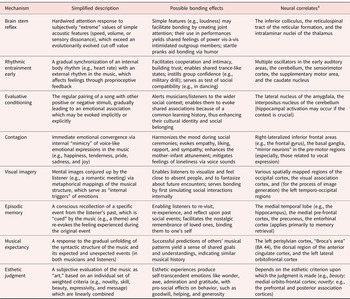
I argue that social-bonding effects of music are mediated by multiple and partly redundant emotion mechanisms (Juslin, Reference Juslin2019) that involve additional (partly distinct) brain networks (Juslin & Sakka, Reference Juslin, Sakka, Thaut and Hodges2019), both sensori-motoric mechanisms reflecting concurrent interaction and mechanisms involving detached mental representations, which enable mental travel in time and space. All of the mechanisms may contribute, in their own unique ways, to social bonding – some more than others (see Table 1 for some preliminary examples).
Table 1.Emotion mechanisms and their possible bonding effects and neural correlates
Because these mechanisms can evoke emotions at multiple levels of the brain, social bonding may occur at several levels simultaneously. The iterative process through which the proto-musical components arose initially is mirrored by the gradual evolutionary development of emotion mechanisms, which enabled novel forms of social bonding. Savage et al. focus on participatory musical activities, but as noted by the authors, even solo listening can support social bonding goals.
Perhaps the apparent risk of circularity of the MSB hypothesis (Mehr & Krasnow, Reference Mehr and Krasnow2017) can be addressed by arguing that already existing emotion mechanisms enhanced social bonding, and that the subsequent invention of music built upon, and extended, that foundation in ways that because of its effects on social bonding became subject to natural selection.
Music is social, through and through. And I agree with Savage et al. that the social bonding and coalition signaling hypotheses are not mutually exclusive. Social bonding effects might contribute to coalition formation and signaling, whereas coalition signaling might contribute to social bonding through its contagious effects. However, if the MSB framework truly aspires to be the most comprehensive theory to date of the biological and cultural evolution of music, it needs closer consideration of the psychological mediation between musical design features and social bonding effects.







I applaud the main aspects of the music and social bonding (MSB) framework proposed by Savage et al. (social bonding as an overarching evolutionary function; gene-culture coevolution; musicality deriving from a set of “proto-musical” components; an inter-disciplinary approach). However, I believe that their case can be bolstered if a few weaknesses are addressed. Thus, I offer some constructive criticism and elaboration here, focusing on two aspects: predictions and mechanisms.
First, I argue that although much of the evidence reviewed in the target article is (more or less) consistent with the MSB hypothesis, it does not provide anything like unequivocal support for the notion. As Savage et al. note, there is no shortage of hypotheses about why and how music evolved – the difficulty lies in distinguishing their merits. One function of a framework is thus to offer predictions that are specific, novel, and falsifiable.
However, the predictions provided by Savage et al. are in many cases either too trivial or too vague to distinguish between rival hypotheses. For instance, Savage et al. predict that “social bonding functions should be distributed widely in space and time.” What, exactly, counts as “widely”? And what is novel about the prediction? We have abundant evidence that music performs bonding functions across cultures, but does this by itself offer unique support to the MSB hypothesis about the origin of music? To illustrate, nearly all musical events across the world involve movement; does this uniquely support the hypothesis that music originally evolved to stimulate movement?
Similarly, Savage et al. predict that bonding via nonmusical methods like language, ritual and sports should be enhanced by the addition of musical components. To the extent that we really need further evidence to show that this is the case, wouldn't positive findings merely be proof of the emotional power of music, as opposed to specifically supporting the MSB hypothesis?
Savage et al. further argue that the MSB hypothesis may be tested by disrupting the “reward systems” that appear to be involved in social bonding. However, if bonding is reduced when such systems are disrupted, it merely confirms that emotion is a key aspect of social bonding – it hardly supports the MSB hypothesis per se. (Moreover, elevated levels of oxytocin found during social bonding may be regarded as the outcome of the emotion-induction process that confirms that bonding is taking place, rather than the psychological cause of this effect.)
The lack of precision extends to the overall statement that “the MSB hypothesis proposes that human musicality has been shaped by biological and cultural evolution.” I find it hard to think of how it could have been otherwise.
My second line of criticism is that despite the authors' acknowledgment that emotion is a key aspect of social bonding, they do not engage sufficiently with the psychological – as opposed to neurological – mechanisms underlying emotions. They outline direct links between design features of music and neural substrates, but neglect the functional level of analysis needed to link the two. Only a functional account can truly explain why and how music enhances social bonding, and thus brings people together across barriers of language and culture (Juslin, Barradas, Ovsiannikow, Limmo, & Thompson, Reference Juslin, Barradas, Ovsiannikow, Limmo and Thompson2016).
Moreover, fairly course reference to “reward systems” of the brain fails to do justice to the multiple ways such rewards (emotions is perhaps a better term) may be produced. The case can be made that the “mechanistic cycle” shown in Figure 2 of the Savage et al. target article is underspecified or incomplete by suggesting a single route – all bonding effects are not tied to “action-perception circuits.” (Elsewhere, the authors themselves mention memory, albeit briefly.)
Perhaps, in their pursuit of a “mechanistic” approach, searching for answers “in engineering terms” (e.g., “what is it for?”), the authors are, unwillingly and temporarily, falling victim to what Nesse (Reference Nesse2020) refers to as “tacit creationism”: viewing organisms as if they are products of design, without attributing the design to a deity.
Machines serve purposes envisioned by a designer. Bodies are shaped by natural selection. Machines have distinct parts, which serve specific functions. Most parts of the body serve multiple functions, and many functions (e.g., emotions) are distributed among many parts. The resulting complex causal connections frustrate attempts to frame a simple description, such as the “mechanistic cycle” proposed by Savage et al.
I argue that social-bonding effects of music are mediated by multiple and partly redundant emotion mechanisms (Juslin, Reference Juslin2019) that involve additional (partly distinct) brain networks (Juslin & Sakka, Reference Juslin, Sakka, Thaut and Hodges2019), both sensori-motoric mechanisms reflecting concurrent interaction and mechanisms involving detached mental representations, which enable mental travel in time and space. All of the mechanisms may contribute, in their own unique ways, to social bonding – some more than others (see Table 1 for some preliminary examples).
Emotion mechanisms and their possible bonding effects and neural correlates
Note: For further explanations of mechanisms and empirical evidence, see Juslin (Reference Juslin2019, sects. 3 and 4). For further information about neural correlates, see review in Juslin and Sakka (Reference Juslin, Sakka, Thaut and Hodges2019, pp. 301–304). The eight mechanisms are jointly referred to as the BRECVEMA framework.
a The predictions focus on networks that distinguish among mechanisms, rather than those that are common (auditory analysis, felt emotion).
Because these mechanisms can evoke emotions at multiple levels of the brain, social bonding may occur at several levels simultaneously. The iterative process through which the proto-musical components arose initially is mirrored by the gradual evolutionary development of emotion mechanisms, which enabled novel forms of social bonding. Savage et al. focus on participatory musical activities, but as noted by the authors, even solo listening can support social bonding goals.
Perhaps the apparent risk of circularity of the MSB hypothesis (Mehr & Krasnow, Reference Mehr and Krasnow2017) can be addressed by arguing that already existing emotion mechanisms enhanced social bonding, and that the subsequent invention of music built upon, and extended, that foundation in ways that because of its effects on social bonding became subject to natural selection.
Music is social, through and through. And I agree with Savage et al. that the social bonding and coalition signaling hypotheses are not mutually exclusive. Social bonding effects might contribute to coalition formation and signaling, whereas coalition signaling might contribute to social bonding through its contagious effects. However, if the MSB framework truly aspires to be the most comprehensive theory to date of the biological and cultural evolution of music, it needs closer consideration of the psychological mediation between musical design features and social bonding effects.
Financial support
This research received no specific grant from any funding agency, commercial, or not-for-profit sectors.
Conflict of interest
None.