






No CrossRef data available.
Article contents
Music and dance are two parallel routes for creating social cohesion
Published online by Cambridge University Press: 30 September 2021
Abstract
Savage et al. do an excellent job of making the case for social bonding in general, but do a less good job of distinguishing the manners by which dance and music achieve this. It is important to see dance and music as two parallel and interactive mechanisms that employ the “group body” and “group voice,” respectively, in engendering social cohesion.
Information
- Type
- Open Peer Commentary
- Information
- Copyright
- Copyright © The Author(s), 2021. Published by Cambridge University Press
References
Arom, S., & Khalfa, J. (1998). Une raison en acte: Pensée formelle et systématique musicale dans les sociétés de tradition orale. Revue de Musicologie, 84, 5–17.CrossRefGoogle Scholar
Bell, A. V., Richerson, P. J., & McElreath, R. (2009). Culture rather than genes provides greater scope for the evolution of large-scale human prosociality. Proceedings of the National Academy of Sciences, 106, 17671–17674. https://doi.org/10.1073/pnas.0903232106.CrossRefGoogle ScholarPubMed
Boyd, R., & Richerson, P. J. (1985). Culture and the evolutionary process. University of Chicago Press.Google Scholar
Brown, S. (2000). Evolutionary models of music: From sexual selection to group selection. In Tonneau, F. & Thompson, N. S. (Eds.), Perspectives in ethology. 13: Behavior, evolution and culture (pp. 231–281). Plenum Publishers.CrossRefGoogle Scholar
Brown, S., & Parsons, L. M. (2008). The neuroscience of dance. Scientific American, 299, 32–37.CrossRefGoogle ScholarPubMed
Darwin, C. (1871). The descent of man, and selection in relation to sex. Princeton University Press.Google Scholar
Dugatkin, L. A., & Reeve, H. K. (1994). Behavioral ecology and the levels of selection: Dissolving the group selection controversy. Advances in the Study of Behavior, 23, 101–133.CrossRefGoogle Scholar
Jordania, J. (2006). Who asked the first question? The origins of human choral singing, intelligence, language and speech. Logos.Google Scholar
Lomax, A. (1968). Folk song style and culture. American Association for the Advancement of Science.Google Scholar
Miller, G. F. (2000). Evolution of human music through sexual selection. In Wallin, N. L., Merker, B. & Brown, S. (Eds.), The origins of music (pp. 329–360). MIT Press.Google Scholar
Prum, R. O. (2012). Aesthetic evolution by mate choice: Darwin's really dangerous idea. Philosophical Transactions of the Royal Society B: Biological Sciences, 367, 2253–2265. https://doi.org/10.1098/rstb.2011.0285.CrossRefGoogle ScholarPubMed
Radcliffe-Brown, A. (1922). The Andaman islanders: A study in social anthropology. Cambridge University Press.Google Scholar
Smaldino, P. E. (2014). The cultural evolution of emergent group-level traits. Behavioral and Brain Sciences, 37, 243–295. https://doi.org/10.1017/S0140525X13001544.CrossRefGoogle ScholarPubMed
Sober, E., & Wilson, D. S. (1998). Unto others: The evolution and psychology of unselfish behavior. Harvard University Press.Google Scholar
Wilson, D. S., & Wilson, E. O. (2007). Rethinking the theoretical foundation of sociobiology. Quarterly Review of Biology, 82, 327–348. https://doi.org/10.1086/703580.CrossRefGoogle ScholarPubMed
Wilson, E. O. (2012). The social conquest of the earth. Liveright Publishing Corporation.Google Scholar
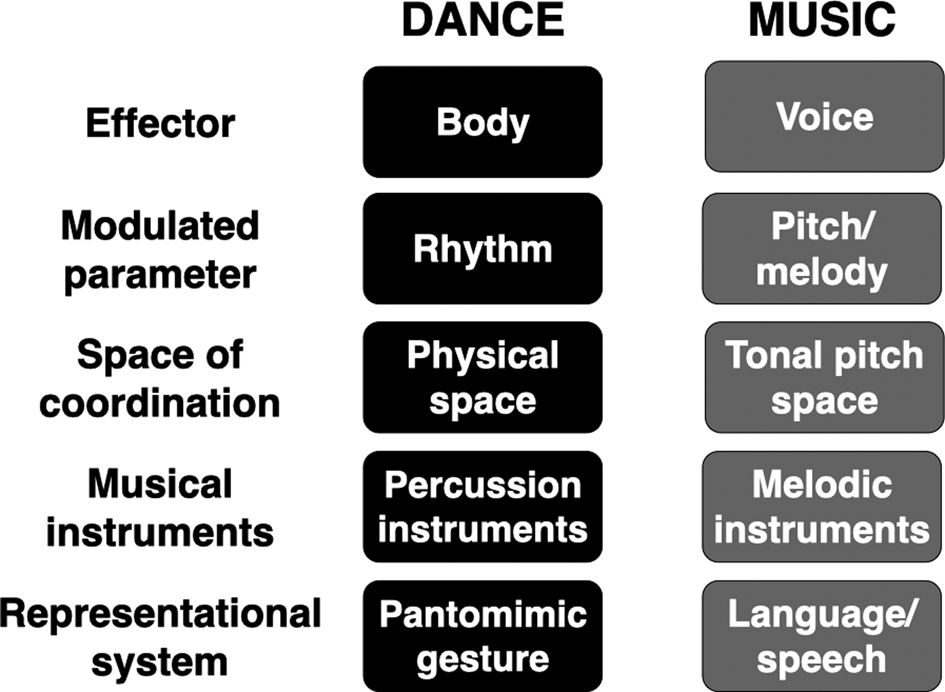
Figure 1. Parallel properties of dance and music.
Target article
Related commentaries (60)
A boldly comparative approach will strengthen co-evolutionary accounts of musicality's origins
A neurodevelopmental disorders perspective into music, social attention, and social bonding
An evolutionary theory of music needs to care about developmental timing
Credible signalling and social bonds: Ultimately drawing on the same idea
Functional and evolutionary parallels between birdsong and human musicality
Is neural entrainment to rhythms the basis of social bonding through music?
Music as a trait in evolutionary theory: A musicological perspective
Not by signalling alone: Music's mosaicism undermines the search for a proper function
Oxytocin as an allostatic agent in the social bonding effects of music
Sound sleep: Lullabies as a test case for the neurobiological effects of music
The music and social bonding hypothesis does require multilevel selection
Darwin, in The Descent of Man (Reference Darwin1871), was the first person to point out that music was utterly mysterious from the standpoint of natural selection as a mechanism to support individual survival. He suggested instead that music could potentially be an example of his alternative mechanism of sexual selection, whereby music would function as an esthetic display to attract mates (Miller, Reference Miller, Wallin, Merker and Brown2000; Prum, Reference Prum2012), rather than promoting survival per se. However, an examination of the musical anthropology literature – totally separate from concerns about evolutionary mechanisms – casts strong doubt on this hypothesis. It shows that music in traditional cultures is not used for courtship in the manner that Darwin imagined, but that it is instead produced overwhelmingly by and for groups (Lomax, Reference Lomax1968; Merriam, Reference Merriam1964), principally in contexts of group-wide concern (Arom & Khalfa, Reference Arom and Khalfa1998).
By the time that our book The Origins of Music was published in 2000 (Wallin, Merker, & Brown, Reference Wallin, Merker and Brown2000), the scorecard was pretty much at this point. Similar to Darwin, nobody was seriously advocating a pure natural-selection argument for music, and so the debate was polarized between sexual selection for mate attraction and theoretical notions about group functionality. I described this in detail in Brown (Reference Brown, Tonneau and Thompson2000). Two decades later, the debate has not really budged from where it was in 2000. The only difference is that the group-functionalist account has been given new clothing in the name of social bonding and coalition building. But, it's the same old story. If music's evolutionary advantage is not about individuals competing with one another for survival, and not about males competing with one another for mates, then it's about enhancing group solidarity by increasing people's altruistic tendency to cooperate with group members – both non-kin and kin – by means of an engagement in collective, participative rituals involving music.
Another thing that hasn't budged over the years is the visceral resistance to seeing music's cooperative advantages as implicating some form of group or multi-level selection. However, no matter how you slice the issue, it ultimately comes down to the evolutionary problem of altruism and cooperation (Bell, Richerson, & McElreath, Reference Bell, Richerson and McElreath2009; Boyd & Richerson, Reference Boyd and Richerson1985; Dugatkin & Reeve, Reference Dugatkin and Reeve1994; Smaldino, Reference Smaldino2014; Sober & Wilson, Reference Sober and Wilson1998; Wilson, Reference Wilson2012; Wilson & Wilson, Reference Wilson and Wilson2007). Group music-making is no less problematic in this regard than the phenomenon of an individual running into a burning building to save a stranger. Social bonding is merely a means to an end. That end is something along the lines of being willing to participate in a potentially deadly hunt of a large mammal. The music-making ritual comes before the hunt (not during it) in order to influence people's willingness to make self-sacrifices on behalf of the group and engage in a life-threatening endeavor.
The article by Savage et al. is an excellent exposition of the group-functionalist account of music, while even including the terrain of sexual selection for mate attraction and kin-selection accounts based on mother–infant interaction. There is something for everyone in this article, except for a hard-core natural selectionist arguing for individual-level survival advantages of music. The breadth of the cross-disciplinary coverage is impressive and highly commendable. The article is an outstanding addition to other group-functionalist accounts of music, whether from an evolutionary perspective or from the anthropological perspective that has dominated ethnomusicology since classic texts such as Merriam's (Reference Merriam1964) The Anthropology of Music and Blacking's (Reference Blacking1974) How Musical is Man. An important idea that is implicit in the social bonding hypothesis but that is not really stated is that music evolved as something choral from its inception and that its most significant design features are its textural properties (Jordania, Reference Jordania2006).
My main critique of the article is that music and dance are not adequately distinguished, and that a better version of the social bonding argument would view group dancing and group chorusing as two parallel routes for achieving bonding via different manners of interpersonal coordination. I can't think of a more insightful description of this duality than Radcliffe-Brown's (Reference Radcliffe-Brown1922) classic analysis of the group rituals of the Andaman Islanders: “the primary function of [the] rhythmical nature of the dance is to enable a number of persons to join in the same actions and perform them as one body,” and “song first came into general use in human society because it provides a means by which a number of persons can utter the same series of sounds together and as with one voice” (pp. 247–248, emphases added). Savage et al. do an excellent job of making the case for social bonding in general, but do a less good job of distinguishing the distinct manners by which dance and music achieve this, instead giving most of the attention to music. I think it is more reasonable to see dance and music as two parallel routes to social bonding that employ the group body and group voice, respectively (Fig. 1). Dance and music differ not only in the principal motor effectors used, but also in the types of parameters that are modulated, the space in which coordination occurs, associations with musical instruments, and associations with semantic representational systems. It is, thus, important to see social bonding as occurring by means of two parallel and interactive mechanisms, rather than calling this collective suite of corporeal and vocal behaviors “music,” as the authors tend to. As I've argued previously, body percussion provides the ideal interface between dance and music as rhythmic phenomena (Brown & Parsons, Reference Brown and Parsons2008).
Parallel properties of dance and music.
Two decades after evolutionary musicology took off, I feel that we are more or less at the same point as where we started. However, Savage et al. have made a very important contribution to the group-functionalist account of music. My suggestions for future study are to better define the contributions of dance and music to social bonding, as well as to overcome the resistance to invoking group selection mechanisms in explaining the most synchronous and prosocial group behaviors in the entire human repertoire, namely group dancing and chorusing.
Financial support
This study was funded by grants from the Social Sciences and Humanities Research Council of Canada (SSHRC) and the Natural Sciences and Engineering Research Council of Canada (NSERC).
Conflict of interest
None.