






No CrossRef data available.
Article contents
Musicality was not selected for, rather humans have a good reason to learn music
Published online by Cambridge University Press: 30 September 2021
Abstract
We propose that not social bonding, but rather a different mechanism underlies the development of musicality: being unable to survive alone. The evolutionary constraint of being dependent on other humans for survival provides the ultimate driving force for acquiring human faculties such as sociality and musicality, through mechanisms of learning and neural plasticity. This evolutionary mechanism maximizes adaptation to a dynamic environment.
Information
- Type
- Open Peer Commentary
- Information
- Copyright
- Copyright © The Author(s), 2021. Published by Cambridge University Press
References
Arrieta, M. C., Stiemsma, L. T., Amenyogbe, N., Brown, E., & Finlay, B. (2014). The intestinal microbiome in early life: Health and disease. Frontiers in Immunology, 5, 427. https://doi.org/10.3389/fimmu.2014.00427.CrossRefGoogle ScholarPubMed
Atzil, S., Gao, W., Fradkin, I., & Barrett, L. F. (2018). Growing a social brain. Nature Human Behaviour, 2(9), 624–636. https://doi.org/10.1038/s41562-018-0384-6.CrossRefGoogle ScholarPubMed
Atzil, S., & Gendron, M. (2017). Bio-behavioral synchrony promotes the development of conceptualized emotions. Current Opinion in Psychology, 17, 162–169. https://doi.org/10.1016/j.copsyc.2017.07.009.CrossRefGoogle ScholarPubMed
Baldassano, C., Hasson, U., & Norman, K. A. (2018). Representation of real-world event schemas during narrative perception. Journal of Neuroscience, 38(45), 9689–9699. https://doi.org/10.1523/JNEUROSCI.0251-18.2018.CrossRefGoogle ScholarPubMed
Barrett, L. F., & Simmons, W. K. (2015). Interoceptive predictions in the brain. Nature Reviews Neuroscience, 16(7), 419–429. https://doi.org/10.1038/nrn3950.CrossRefGoogle Scholar
Bernardi, L., Porta, C., & Sleight, P. (2006). Cardiovascular, cerebrovascular, and respiratory changes induced by different types of music in musicians and non-musicians: The importance of silence. Heart, 92(4), 445–452. https://doi.org/10.1136/hrt.2005.064600.CrossRefGoogle ScholarPubMed
Cirelli, L. K., Jurewicz, Z. B., & Trehub, S. E. (2019). Effects of maternal singing style on mother–infant arousal and behavior. Journal of Cognitive Neuroscience, 32(7), 1213–1220. https://doi.org/10.1162/jocn_a_01402.CrossRefGoogle ScholarPubMed
Clark, A. (2013). Whatever next? Predictive brains, situated agents, and the future of cognitive science. Behavioral and Brain Sciences, 36(3), 181–204. https://doi.org/10.1017/S0140525X12000477.CrossRefGoogle ScholarPubMed
Den Ouden, H. E. M., Daunizeau, J., Roiser, J., Friston, K. J., & Stephan, K. E. (2010). Striatal prediction error modulates cortical coupling. Journal of Neuroscience, 30(9), 3210–3219. https://doi.org/10.1523/JNEUROSCI.4458-09.2010.CrossRefGoogle ScholarPubMed
Feldman, R., Keren, M., Gross-Rozval, O., & Tyano, S. (2004). Mother–child touch patterns in infant feeding disorders: Relation to maternal, child, and environmental factors. Journal of the American Academy of Child and Adolescent Psychiatry, 43(9), 1089–1097. https://doi.org/10.1097/01.chi.0000132810.98922.83.CrossRefGoogle Scholar
Feldstein Ewing, S. W., Claus, E. D., Hudson, K. A., Filbey, F. M., Yakes Jimenez, E., Lisdahl, K. M., & Kong, A. S. (2017). Overweight adolescents’ brain response to sweetened beverages mirrors addiction pathways. Brain Imaging and Behavior, 11(4), 925–935. https://doi.org/10.1007/s11682-016-9564-z.CrossRefGoogle ScholarPubMed
Friston, K. (2005). A theory of cortical responses. Philosophical Transactions of the Royal Society B: Biological Sciences, 360(1456), 815–836. https://doi.org/10.1098/rstb.2005.1622.CrossRefGoogle ScholarPubMed
Kleckner, I. R., Zhang, J., Touroutoglou, A., Chanes, L., Xia, C., Simmons, W. K., … Feldman Barrett, L. (2017). Evidence for a large-scale brain system supporting allostasis and interoception in humans. Nature Human Behaviour, 1(5), 1–14. https://doi.org/10.1038/s41562-017-0069.CrossRefGoogle ScholarPubMed
Konečni, V. J., Wanic, R. A., & Brown, A. (2007). Emotional and aesthetic antecedents and consequences of music-induced thrills. American Journal of Psychology, 120(4), 619–643. https://doi.org/10.2307/20445428.Google ScholarPubMed
McEwen, B. S., & Wingfield, J. C. (2003). The concept of allostasis in biology and biomedicine. Hormones and Behavior, 43(1), 2–15. https://doi.org/10.1016/S0018-506X(02)00024-7.CrossRefGoogle ScholarPubMed
Pezzulo, G., Rigoli, F., & Friston, K. (2015). Active inference, homeostatic regulation and adaptive behavioural control. Progress in Neurobiology, 134, 17–35. https://doi.org/10.1016/j.pneurobio.2015.09.001.CrossRefGoogle ScholarPubMed
Scott, D. J., Heitzeg, M. M., Koeppe, R. A., Stohler, C. S., & Zubieta, J. K. (2006). Variations in the human pain stress experience mediated by ventral and dorsal basal ganglia dopamine activity. Journal of Neuroscience, 26(42), 10789–10795. https://doi.org/10.1523/JNEUROSCI.2577-06.2006.CrossRefGoogle ScholarPubMed
Seth, A. K. (2013). Interoceptive inference, emotion, and the embodied self. Trends in Cognitive Sciences, 17(11), 565–573. https://doi.org/10.1016/j.tics.2013.09.007.CrossRefGoogle ScholarPubMed
Sterling, P. (2012). Allostasis: A model of predictive regulation. Physiology and Behavior, 106(1), 5–15. https://doi.org/10.1016/j.physbeh.2011.06.004.CrossRefGoogle Scholar
Volkow, N. D., & Morales, M. (2015). The brain on drugs: From reward to addiction. Cell, 162(4), 712–725. https://doi.org/10.1016/j.cell.2015.07.046.CrossRefGoogle ScholarPubMed
Winberg, J. (2005). Mother and newborn baby: Mutual regulation of physiology and behavior – A selective review. Developmental Psychobiology, 47(3), 217–229. https://doi.org/10.1002/dev.20094.CrossRefGoogle ScholarPubMed
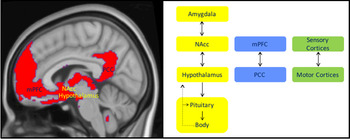
Figure 1. A domain-general neural system for motivated behaviors in humans. This domain-general neural system contains midline cortices in the medial prefrontal cortex (mPFC) (including the anterior cingulate cortex [ACC]), and posterior cingulate cortex (PCC); subcortical structures of the amygdala, nucleus accumbens (NAcc) and hypothalamus; and sensory-motor cortices. The mPFC and PCC represent abstract concepts (Baldassano, Hasson, & Norman, 2018), like a human or a song (in blue). These associative cortices, along with other cortico-limbic structures, rely on past experience to issue predictions to sensory-motor cortices (in green), to regulate behavior and perception (Den Ouden et al., 2010; Pezzulo et al., 2015). They also project downstream to the body, predicting and regulating allostasis (Barrett & Simmons, 2015) (in yellow). This circuitry is plastic and can associate any learned concept or behavior, which is relevant for reward and prediction, to allostasis regulation in the body. In that sense, this circuitry is not exclusively related to sociality or musicality, but rather is a domain-general mechanism, which can be wired to support any motivated behavior with allostatic consequences.
Target article
Related commentaries (60)
A boldly comparative approach will strengthen co-evolutionary accounts of musicality's origins
A neurodevelopmental disorders perspective into music, social attention, and social bonding
An evolutionary theory of music needs to care about developmental timing
Credible signalling and social bonds: Ultimately drawing on the same idea
Functional and evolutionary parallels between birdsong and human musicality
Is neural entrainment to rhythms the basis of social bonding through music?
Music as a trait in evolutionary theory: A musicological perspective
Not by signalling alone: Music's mosaicism undermines the search for a proper function
Oxytocin as an allostatic agent in the social bonding effects of music
Sound sleep: Lullabies as a test case for the neurobiological effects of music
The music and social bonding hypothesis does require multilevel selection
Both Mehr et al. and Savage et al. agree that music supports social behaviors. Although Mehr and colleagues propose that musicality evolved to support specific behaviors, Savage et al. construct a general framework, suggesting that musicality evolved to promote sociality at large. These ideas rely on the assumption that sociality, in itself, was selected for in evolution as an inborn faculty. However, in contrary to a cumbersome evolutionary solution implementing inborn faculties, the brain could have evolved with one ultimate feature: to be able to wire ad hoc to the environment, optimizing survival in any cultural nice. Such an evolutionary plan is sufficient to ensure the acquisition of profound human characteristics through learning if they are relevant for survival, including (but not limited to) sociality (Atzil, Gao, Fradkin, & Barrett, Reference Atzil, Gao, Fradkin and Barrett2018) and musicality.
Learning is guided by the need of an organism to optimize the internal milieu (Pezzulo, Rigoli, & Friston, Reference Pezzulo, Rigoli and Friston2015). Allostasis is the ongoing adjustment of the internal milieu necessary for survival, growth, and reproduction (Sterling, Reference Sterling2012). In social animals, allostasis is fundamentally social because of one evolutionary constraint: offspring cannot survive alone (Atzil et al., Reference Atzil, Gao, Fradkin and Barrett2018). They depend on a conspecific, a caregiver, to regulate their allostatic processes, including energy expenditure, temperature (Winberg, Reference Winberg2005), immunity (Arrieta, Stiemsma, Amenyogbe, Brown, & Finlay, Reference Arrieta, Stiemsma, Amenyogbe, Brown and Finlay2014), and arousal (Cirelli, Jurewicz, & Trehub, Reference Cirelli, Jurewicz and Trehub2019). By providing these needs, the caregiver's allostatic support is rewarding and reinforces bonding. Moreover, infants learn to regulate allostasis via social interactions (Atzil & Gendron, Reference Atzil and Gendron2017). At first, social regulation is physical, relying on touch (Feldman, Keren, Gross-Rozval, & Tyano, Reference Feldman, Keren, Gross-Rozval and Tyano2004) and vocalizations (Cirelli et al., Reference Cirelli, Jurewicz and Trehub2019). With development, cultural constructs are prone to be learned and become salient and rewarding as well. Gradually, guided by allostatic motivation, young humans acquire social behaviors and concepts, and become social experts (Atzil et al., Reference Atzil, Gao, Fradkin and Barrett2018). Consequently, any behavior or concept secondary to sociality, such as musicality, would be further learned rather than genetically selected for.
Not only social stimuli, but rather any concrete or abstract stimulus that impacts allostasis will be stabilized through learning. These include natural rewards such as food, but in humans also abstract cultural products such as language, art, religion, money, and most relevantly-music. These abstract constructs become meaningful to humans' survival through learning and stabilize across societies and generations, even though they are not heritable in a domain-specific manner. Yet, music is special because it is dual-valued, and holds both concrete physical faculties and abstract information, which was culturally imbued. For example, an anthem, which contains both concrete sensory input and abstract information about group identity, is extremely powerful in regulating humans (Konečni, Wanic, & Brown, Reference Konečni, Wanic and Brown2007). This dual concrete–abstract effect of music on allostasis aligns with Savage et al.'s idea that musicality is more powerful than grooming (concrete stimulus) or language (abstract stimulus). It is also in line with Mehr et al.'s hypothesis on the role of musicality in parental care. As infants develop and acquire abstract knowledge, musicality provides a developmental bridge between concrete and abstract regulation.
Savage et al. propose that musicality and sociality share an underlying mechanism of prediction and reward. However, prediction and reward are domain-general processes of learning. In any context, the brain learns statistical regularities in the environment to actively generate predictions (Clark, Reference Clark2013; Friston, Reference Friston2005). Prediction is crucial for survival and partly what separates the terms allostasis from homeostasis (Sterling, Reference Sterling2012). Although in homeostasis a deviation from a set-point elicits reaction, allostasis is a process where the brain integrates prior knowledge to anticipate upcoming needs, preparing the organism to react in advance (McEwen & Wingfield, Reference McEwen and Wingfield2003). Thus, the evolutionary development of domain-general functions such as prediction and reward, can underlie the learning of any statistical pattern relevant for predicting allostasis. In social context, infants rely on statistical regularities of parental care for allostasis. For example, for a hungry infant, the parent is a reliable predictor for an upcoming increase in glucose levels, which is in turn rewarding and reinforces further interaction. Similarly, listening to a fast bit tune predicts changes in levels of arousal (Bernardi, Porta, & Sleight, Reference Bernardi, Porta and Sleight2006). Thus, beyond the idea that music is rewarding because it improves social predictions, suggested by Savage et al., music is rewarding because it directly improves allostatic predictions. In this sense, sociality and musicality can be considered cultural patterns, learned because they are useful to improve allostatic predictions.
Accordingly, the neural mechanism underlying reward and prediction, which process music and social information, is not selective but rather underlies every motivated behavior that is relevant for allostasis (Kleckner et al., Reference Kleckner, Zhang, Touroutoglou, Chanes, Xia, Simmons and Feldman Barrett2017; Seth, Reference Seth2013), such as feeding (Feldstein Ewing et al., Reference Feldstein Ewing, Claus, Hudson, Filbey, Yakes Jimenez, Lisdahl and Kong2017), avoiding pain (Scott, Heitzeg, Koeppe, Stohler, & Zubieta, Reference Scott, Heitzeg, Koeppe, Stohler and Zubieta2006), and seeking drugs (Volkow & Morales, Reference Volkow and Morales2015). In this domain-general circuit, cortico-limbic structures rely on prior knowledge to propagate prediction signals to sensory-motor cortices to regulate perception-action (Den Ouden, Daunizeau, Roiser, Friston, & Stephan, Reference Den Ouden, Daunizeau, Roiser, Friston and Stephan2010; Pezzulo et al., Reference Pezzulo, Rigoli and Friston2015). Predictions also projects downstream to the body via the hypothalamus-pituitary-adrenal (HPA) axis and autonomic nervous system to regulate allostasis (Barrett & Simmons, Reference Barrett and Simmons2015; Pezzulo et al., Reference Pezzulo, Rigoli and Friston2015) (Fig. 1). Although prediction and reward are domain-general functions that are relevant for survival in any niche, the particulars of a certain niche are dynamic. Accordingly, an adaptive brain is one that can learn them ad hoc. Given the plasticity of the brain, every statistical regularity that allows reliable prediction about allostasis will be represented in the cortex and neurally associated with allostasis through this circuit. Because social information and music are extremely useful for allostatic predictions, they efficiently attain this neural circuitry.
A domain-general neural system for motivated behaviors in humans. This domain-general neural system contains midline cortices in the medial prefrontal cortex (mPFC) (including the anterior cingulate cortex [ACC]), and posterior cingulate cortex (PCC); subcortical structures of the amygdala, nucleus accumbens (NAcc) and hypothalamus; and sensory-motor cortices. The mPFC and PCC represent abstract concepts (Baldassano, Hasson, & Norman, Reference Baldassano, Hasson and Norman2018), like a human or a song (in blue). These associative cortices, along with other cortico-limbic structures, rely on past experience to issue predictions to sensory-motor cortices (in green), to regulate behavior and perception (Den Ouden et al., Reference Den Ouden, Daunizeau, Roiser, Friston and Stephan2010; Pezzulo et al., Reference Pezzulo, Rigoli and Friston2015). They also project downstream to the body, predicting and regulating allostasis (Barrett & Simmons, Reference Barrett and Simmons2015) (in yellow). This circuitry is plastic and can associate any learned concept or behavior, which is relevant for reward and prediction, to allostasis regulation in the body. In that sense, this circuitry is not exclusively related to sociality or musicality, but rather is a domain-general mechanism, which can be wired to support any motivated behavior with allostatic consequences.
To conclude, music is a cultural product. Because of its rewarding and predictive values, humans are repeatedly reinforced to learn it and to pass it on to the next generations, not necessarily through specific genetic adaptations. All animals rely on prediction and reward to survive. Humans developed an especially wide and complex range of cues in multiple levels of abstraction that support prediction of allostasis. Although musicality and sociality rely on shared mechanisms, it does not mean that these mechanisms evolved specifically for them. Alternatively, a rather simple evolutionary constraint of social dependency for survival, along with neural plasticity, is sufficient to ensure the cross-generation transmission of both sociality and musicality. We propose an alternative mechanism, by which musicality and sociality are dynamic and were thus not genetically selected for in a domain-specific manner. Instead, a domain-general mechanism of reward and prediction was selected for to improve survival by being flexible and wired to the environment. This ensures that behavior is culturally sculptured in an ongoing process that maximizes adaptation. This theoretical approach provides a parsimonious explanation for the role of music in human culture.
Financial support
This research received no specific grant from any funding agency, commercial, or not-for-profit sectors.
Conflict of interest
None.