





No CrossRef data available.
Article contents
Gender differences in partner and ex-partner dreams
Published online by Cambridge University Press: 01 June 2026
Abstract
The dream studies support the notion that partner dreams are more negatively toned in women compared to men, indicating that women do not profit as much from partnerships as men. Furthermore, the findings indicate that the consequences of break-ups might be more stressful for women than men on an emotional level, contrary to the claim in the target article.
Information
- Type
- Open Peer Commentary
- Information
- Copyright
- © The Author(s), 2026. Published by Cambridge University Press
References
Erlacher, D., & Schredl, M. (2010). Frequency of sport dreams in athletes. International Journal of Dream Research, 3, 91–94. https://doi.org/10.11588/ijodr.2010.1.584
Google Scholar
Malinowski, J. E., & Horton, C. L. (2014). Evidence for the preferential incorporation of emotional waking-life experiences into dreams. Dreaming, 24(1), 18–31. https://doi.org/10.1037/a0036017
CrossRefGoogle Scholar
Moverley, M., Schredl, M., & Göritz, A. S. (2018). Media dreaming and media consumption – An online study. International Journal of Dream Research, 11(2), 127–134. https://doi.org/10.11588/ijodr.2018.2.46416
Google Scholar
Schredl, M. (2001). Dreams of singles: Effects of waking-life social contacts on dream content. Personality and Individual Differences, 31, 269–275. https://doi.org/10.1016/S0191-8869(00)00135-5
CrossRefGoogle Scholar
Schredl, M. (2011). Dreams of a romantic partner in a dream series: Comparing relationship periods with periods of being separated. International Journal of Dream Research, 4, 127–131. https://doi.org/10.11588/ijodr.2011.2.9150
Google Scholar
Schredl, M. (2018). Researching dreams: The fundamentals. Palgrave Macmillan.10.1007/978-3-319-95453-0CrossRefGoogle Scholar
Schredl, M. (2024). Continuity between waking life and dreaming: A research note and study in adolescents. Imagination, Cognition and Personality, 44(1), 104–116. https://doi.org/10.1177/02762366241254818
CrossRefGoogle Scholar
Schredl, M., Berres, S., Klingauf, A., Schellhaas, S., & Göritz, A. S. (2015). Factors affecting the frequency of music dreams: An online study. International Journal of Dream Research, 8(2), 139–141. https://doi.org/10.11588/ijodr.2015.2.23473
Google Scholar
Schredl, M., Cadiñanos Echevarria, N., Saint Macary, L., & Weiss, A. F. (2020). Partners and ex-partners in dreams: An online survey. International Journal of Dream Research, 13(2), 274–280. https://doi.org/10.11588/ijodr.2020.2.75338
Google Scholar
Schredl, M., Cadiñanos Echevarria, N., Saint Macary, L., & Weiss, A. F. (2021). Dreaming about one’s own children: An online survey. Imagination, Cognition and Personality, 41(2), 222–237. https://doi.org/10.1177/02762366211017421
CrossRefGoogle Scholar
Schredl, M., Desch, S., Röming, F., & Spachmann, A. (2009). Erotic dreams and their relationship to waking-life sexuality. Sexologies, 18, 38–43. https://doi.org/10.1016/j.sexol.2008.05.001
CrossRefGoogle Scholar
Schredl, M., & Neuhäusler, A. (2019). With or without you? Dreaming about the romantic partner – A case study. International Journal of Dream Research, 12(1), 141–146. https://doi.org/10.11588/ijodr.2019.1.59638
Google Scholar
Schredl, M., & Reinhard, I. (2012). Frequency of a romantic partner in a dream series. Dreaming, 22(4), 223–229. https://doi.org/10.1037/a0030252
CrossRefGoogle Scholar
Schredl, M., & Wood, L. C. (2021). Partners and ex-partners in dreams: A diary study. Clocks & Sleep, 3(2), 289–297. https://doi.org/10.3390/clockssleep3020018
CrossRefGoogle ScholarPubMed
Selterman, D., Apetroaia, A., & Waters, E. (2012). Script-like attachment representations in dreams containing current romantic partners. Attachment & Human Development, 14(5), 501–515. https://doi.org/10.1080/14616734.2012.706395
CrossRefGoogle ScholarPubMed
Selterman, D., & Drigotas, S. (2009). Attachment styles and emotional content, stress, and conflict in dreams of romantic partners. Dreaming, 19, 135–151. https://doi.org/10.1037/a0017087
CrossRefGoogle Scholar
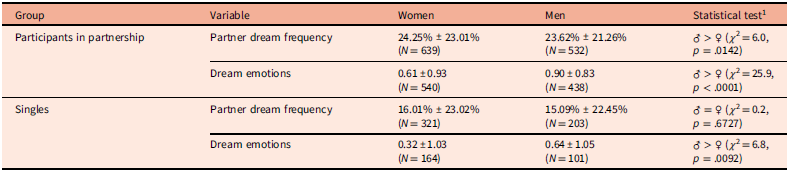
Table 1. Frequency and emotions of partner dreams

Table 2. Emotions of interactions with partners and ex-partners in dreams
Target article
Related commentaries (43)
A memory lens on gender differences in romantic relationships
Broader gender inequities shape why romantic relationships matter more to men than to women
Concluding that romantic relationships matter more to men than to women is too simple
Culture, not nature: How traditional masculinity shapes male attitudes toward relationships
Do romantic relationships matter more to men than to women? An evolutionary psychology perspective
Impaired emotional regulation in the elderly men following female partner loss
Men’s dependence in intimate relationships has broader harm beyond men’s wellbeing
Parenthood as an inflection point for men and women’s patterns of interdependence
Synthetic love in the digital age: AI-mediated emotional investment and gendered romantic dependence
The cultural plasticity of intimacy behavior: A socioecological attachment perspective
Well-being and resilience against oppressive narratives after romantic dissolution
Who benefits most from romantic relationships and who bears the burdens?
 You have
Access
The authors of the target article pointed out that using self-reports, subjective perceptions of attitudes regarding romantic or sexual topics might not be free from biases, for example, shaped by gender stereotypes or cultural background. Hence, the question arises whether there are other approaches for investigating the question of whether romantic relationships matter more to men than to women. As dream content reflects waking life, the so-called continuity hypothesis of dreaming (Schredl, Reference Schredl2018), especially issues close to the heart (Malinowski & Horton, Reference Malinowski and Horton2014), one would expect that romantic topics and even relationship break-ups show up in dreams. Indeed, a variety of studies (Schredl et al., Reference Schredl, Cadiñanos Echevarria, Saint Macary and Weiss2020; Schredl & Reinhard, Reference Schredl and Reinhard2012; Selterman & Drigotas, Reference Selterman and Drigotas2009) showed that romantic partners are present in 20% to 30% of the dreams remembered by the dreamer. The empirical evidence for the continuity hypothesis was also provided for other topics such as music (Schredl et al., Reference Schredl, Berres, Klingauf, Schellhaas and Göritz2015), media consumption (Moverley, Schredl, & Göritz, Reference Moverley, Schredl and Göritz2018), or sports (Erlacher & Schredl, Reference Erlacher and Schredl2010). Another example is the “parental investment theory” mentioned in the target article; mothers tend to dream significantly more often about their children than fathers: About 20% of the remembered dreams of mothers included their own children compared to about 13% in the dreams of fathers (Schredl et al., Reference Schredl, Cadiñanos Echevarria, Saint Macary and Weiss2021). In the following, dream studies investigating the research questions addressed in the target article will be reviewed.
If romantic relationships matter more to men compared to women, one would expect that men dream more often about their partners compared to women. Indeed, one study (Schredl et al., Reference Schredl, Cadiñanos Echevarria, Saint Macary and Weiss2020) found a small but significant difference (effect size = 0.144) regarding partner dream percentage (see Table 1). The mean differences in partner dream frequency were different after controlling for age as the men were significantly older than women (58.85 ± 13.70 yrs. vs. 50.48 ± 12.75 yrs.) and the partner dream frequency decreased with age (r = ˗.207, p < .0001). Whereas one study in young students (Schredl et al., Reference Schredl, Desch, Röming and Spachmann2009) showed an even larger effect size (d = 1.158) with men reporting more partner dreams compared to women, two other studies in adolescents (Schredl, Reference Schredl2024) and young adults (Schredl, Reference Schredl2001) did not find gender differences. Given the large sample size and the broad age range of the Schredl et al. (Reference Schredl, Cadiñanos Echevarria, Saint Macary and Weiss2020) study, the dream studies seem to support the notion that romantic relationships do matter more to men than to women.
Frequency and emotions of partner dreams
Note: Data from Schredl et al. (Reference Schredl, Cadiñanos Echevarria, Saint Macary and Weiss2020), five-point emotional scale ranging from −2 to +2, 1Ordinal regression with age and gender, gender effect depicted (for the frequency data the categorized variable was used).
The stronger striving of men for a partnership should reflect in a higher percentage of partner dreams in singles, that is, dreaming of having a partnership. However, the studies (Schredl, Reference Schredl2001, Reference Schredl2024; Schredl et al., Reference Schredl, Cadiñanos Echevarria, Saint Macary and Weiss2020) looking at the gender difference in partner dream frequency in persons without a partnership did not find any gender difference (see also Table 1). On the other hand, single men reported more often erotic dreams compared to single women, whereas there was no gender difference in erotic dream frequency in persons with stable partnerships (Schredl, Reference Schredl2001), indicating that one motivation for starting a relationship mentioned in the target article (higher sexual motivation in men) is reflected in dreams. The gender difference in emotional tone of partner dreams in singles (see Table 1) supports the notion that men expect the relationship to have more benefits for them compared to women.
The benefits of a romantic relationship should – according to the continuity hypothesis (Schredl, Reference Schredl2018) – be reflected by more positive partner dreams. Men reported on average more positively toned partner dreams compared to women (see Table 1). This finding supports the hypothesis formulated in the target article that men gain more mental and physical health benefits from romantic relationships than women. Negative emotions related to interactions with the partner in the dream, on the other hand, were more prominent in women compared to men (see Table 2). In a similar way, Selterman, Apetroaia, and Waters (Reference Selterman, Apetroaia and Waters2012) reported that the attachment toward the partner in the dream was less secure in women compared to men. This might reflect the findings reported in the target article that women experience emotional support in romantic relationships less often than men. Dream studies corroborate that romantic relationships might provide more benefits for men compared to women on a subjective level.
Emotions of interactions with partners and ex-partners in dreams
Note: Data from Schredl and Wood (Reference Schredl and Wood2021), 1Mixed model analysis.
One feature that might be related to the emotional quality of the relationship dissolution might be emotional tone of ex-partner dreams. In both studies (Schredl et al., Reference Schredl, Cadiñanos Echevarria, Saint Macary and Weiss2020; Schredl & Wood, Reference Schredl and Wood2021), women tend to report more negatively toned ex-partner dreams than men – indicating that the psychological suffering might be more pronounced for women. Even in single case studies, the ex-partner’s dreams of a female dreamer were mainly negatively toned (Schredl & Neuhäusler, Reference Schredl and Neuhäusler2019), whereas a male dreamer reported positive and negative emotions equally often in relationship to the ex-partner in his dreams (Schredl, Reference Schredl2011). These findings would support the hypothesis that women, on a psychological level, suffer more after relationship break-ups compared to men – even though they receive more emotional support in their social network (see target article).
To summarize, the findings regarding partner and ex-partner dreams provide a window into the emotional aspects of romantic partnerships and their break-ups and, thus, can complement the studies using self-reports and subjective perceptions of the waking state. One could argue that possible biases due to gender stereotypes and cultural backgrounds in regard to romantic relationships are not that pronounced as the task at hand is simply reporting a dream (or the frequency of a specific topic regarding all remembered dreams). The dream studies support the notion that partner dreams are more negatively toned in women compared to men, indicating that women do not profit as much from partnerships as men, especially in the emotion domain. Furthermore, the findings indicate that the consequences of break-ups might be more stressful for women than men on an emotional level, contrary to the claim in the target article. Researching partner and ex-partner dreams might help to understand the gender differences in relation to romantic relationships.
Financial support
This research received no specific grant from any funding agency, commercial, or not-for-profit sectors.
Competing interests
None.