Introduction
The target article presents an evolutionary account of cognitive complexity (CC), claiming that it emerges from synergistic interactions between multiple traits in multiple lineages. Increasing CC is ascribed to the emergence and layering of multiple traits (body, sensory, brain, motor, and cognitive; sections 1A, 1B, 8). Higher-level combinations (e.g., laminated visual processing, flexible limbs, and high-speed movement) scaffold general-purpose intelligence of increasing CC. The target article does not explicitly define CC in cognitive terms. This is our aim.
We draw on two core concepts of the target article, active sensing and trait-linkage, to unify the evolution and development of CC from Annelids to Humans in terms of a common mechanism: SARA-C (Search, Align, Relate, Abstract, and Cognize) in an integrated unit. Active sensing and information-and-response integration across traits are the evolutionary background of SARA-C (Demetriou et al., Reference Demetriou, Kazali, Spanoudis, Makris and Kazi2024). Cognizance emerges from online neural encoding of differences between current and previous states of organism-environment interactions. SARA-C is the scaffold for g within and across species.
Modeling CC from annelids to humans
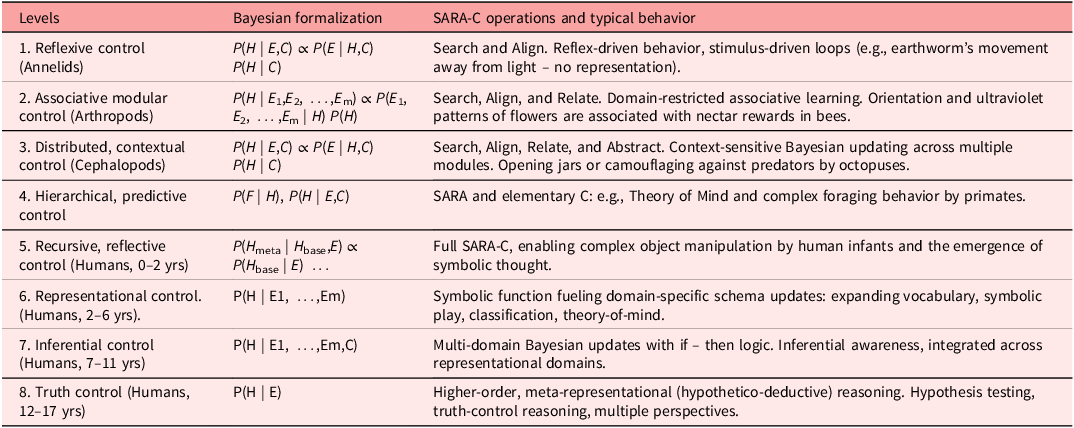
From reflexive responses in simpler organisms to recursive reasoning in humans, we situate g as an emergent property of active search, integration, reflection, and representation on relations, recursively redefined as implied by evolutionary models of intelligence (Burkart, Schubiger, & Van Schaik, Reference Burkart, Schubiger and Van Schaik2017; Woodley of Menie & Peñaherrera-Aguirre, Reference Menie and Peñaherrera-Aguirre2023) and consciousness (Jablonka & Ginsburg, Reference Jablonka and Ginsburg2022). We formalize SARA-C using Bayesian generative models, drawing on well-established computational frameworks (e.g., Friston, Reference Friston2010; Khan & Rue, Reference Khan and Rue2023). We demonstrate how cognitive processes become progressively deeper in phylogeny and ontogeny, culminating in human-level recursive reasoning and meta-representation. Equation (1) shows the general model. Table 1 shows the Bayesian formalization of SARA-C across species and developmental levels.
Table 1.Bayesian formalization of the SARA-C mechanism across species and developmental levels
Symbols are defined in Table 1. A Bayesian cognitive system maintains a posterior distribution over its hypothesis space (H), iteratively refining its internal models of the world as new evidence arrives. By design, organisms search for further observations (E) or manipulate the environment to reduce uncertainty in H, implicating active sensing or active inference (Friston, Reference Friston2010). Hence, SARA-C operations are defined as follows:
Search: Active sampling of the environment to acquire evidence E.
Align: Bayesian update of P(H | E), aligning new information with existing priors P(H).
Relate: Integrating evidence across modules, forming joint hypotheses linking information sources.
Abstract: Identifying higher-level patterns that reduce complexity in the H.
Cognize: Reflecting or recursing upon internal representations, enabling self-monitoring and meta-representation (Hmeta).
Below, we illustrate how these operations map onto increasingly complex phylogenetic stages, modeling the phyla discussed in the commentary.
The evolution of SARA-C across phyla
Stage 1: Reflexive control
In Annelids, relational integration is limited to simple reflexive loops: simple search and align mechanisms allow stimulus-bound control underlying reflex-driven behaviors; there is no representation or goal-directed interaction. The nervous system consists of segmented ganglia operating independently, enabling localized responses to stimuli (Giurfa, Reference Giurfa2003; Stuart, Reference Stuart1970). Annelid brain exemplifies reactive control systems, where behavior is directly linked to external stimuli without any higher-order processing. In Bayesian terms, reflexive responses can be modeled as shown in Equation (1) (Table 1). Cognition remains at a zeroth-order level: Search is detection of salient stimuli, and Align is immediate posterior update; remaining SARA-C operations are absent.
Stage 2: Associative modular control
Arthropods represent an evolutionary step forward, with modular nervous systems supporting task-specific integration of sensory inputs. Centralized ganglia (e.g., mushroom bodies) enable memory and associative learning (Strausfeld & Hirth, Reference Strausfeld and Hirth2013; Strausfeld et al., Reference Strausfeld, Hansen, Li, Gomez and Ito1998). This modular architecture enables foraging and navigation, where multiple sensory modalities – vision, olfaction, and tactile inputs – are combined to guide actions. A bee associates ultraviolet patterns of flowers with nectar rewards, demonstrating domain-specific learning. Search and align mechanisms integrate relations across modular sensory systems serving species’ important tasks. Rudimentary abstraction enables learning to navigate in the environment. Associative learning involves updating probabilities based on recurring patterns (see Equation (2), Table 1). This integration reflects a g-like structure, indicating that SARA-C, however basic, operates as a unit, reflecting an executive function-like ability accounting for within-species individual differences in learning (Woodley of Menie & Peñaherrera-Aguirre, Reference Menie and Peñaherrera-Aguirre2023). SARA-C is implemented by Search (multi-modal), Align (associative learning), and Relate processes (combining color and odor cues for foraging) with minimal Abstract, enabling domain-specific inferences.
Stage 3: Distributed contextual control
Cephalopods, such as octopuses, demonstrate a shift toward distributed control systems with remarkable flexibility. Over two-thirds of their neurons reside outside the central brain, in their arms, enabling localized decision-making and fine motor control (Hochner, Reference Hochner2013). This distributed architecture allows flexible interactions with the environment, including novel problem solving, such as opening jars (Godfrey-Smith, Reference Godfrey-Smith2016). Therefore, contextual episodic control based on multi-modal relational integration and abstraction is present, implying some form of context-dependent awareness (e.g., color changing according to context). Cephalopod cognition integrates context by weighting evidence across distributed systems, encoding situational factors, and allowing local motor programs to adapt in real time (Equation (3), Table 1). Advanced Relate and preliminary Abstract operations are present, but no Cognize as a meta-representation.
Stage 4: Hierarchical, predictive control
Vertebrates demonstrate hierarchical control, integrating sensory inputs, motor outputs, and internal states through centralized brain systems. Predictive models emerge, representing future outcomes and action planning. The prefrontal cortex, hippocampus, and cerebellum form a network enabling cross-domain integration and rule-based reasoning (Passingham & Wise, Reference Passingham and Wise2012). In primates, these capabilities extend to understanding others’ intentions, enabling cooperation and competition, which includes systematic Abstraction and rudimentary Cognizance. These possibilities are expressed in hierarchical generative models that can anticipate future outcomes F (Equation (4), Table 1).
Stage 5: Recursive, reflective control
Humans display full-blown recursion and meta-representation (Cognize) (e.g., “I know that you know”) (Equation (5), Table 1). Capacity for nested symbolic reasoning is grounded in neural connectivity supporting executive control and self-referential thought, associated with the default mode network (Buckner, Andrews-Hanna, & Schacter, Reference Buckner, Andrews-Hanna and Schacter2008). All five SARA-C operations are realized at high complexity: Search (including hypothesis-driven exploration), Align (complex Bayesian updates), Relate (multi-domain integration), Abstract (universal laws, concepts), Cognize (recursive, reflective, meta-cognitive processes).
Stages 6–8: Advanced development (adolescents–adults)
Beyond early childhood, SARA-C extends to attention control and representational coordination (Stage 6), rule-based inference (Stage 7), and principle-based truth control (Stage 8) (Equations 6–8 in Table 1) (Demetriou et al., Reference Demetriou, Kazali, Spanoudis, Makris and Kazi2024).
Discussion: Implications for g
Active sensing and trait-linkage provide the background for an emergent general cognitive factor across species and human development. Our model clarifies how g may arise naturally from an organism’s capacity to (i) search for and unify information across domains, (ii) abstract beyond specific contexts, and (iii) reflect on its own representations. At simpler levels (e.g., arthropods), these capacities appear domain-specific, becoming increasingly general, abstract, and recursive along with phylogenesis and human development. SARA-C is the g of all gs, implying that even rudimentary levels of SARA-C demonstrate g-like constraints of cognitive possibilities. Hence, even if phenomenologically modular in less complex phyla, SARA-C defines the functional ceiling in which species operate (Woodley of Menie & Peñaherrera-Aguirre, Reference Menie and Peñaherrera-Aguirre2023). Behavioral patterns may not be integrated across functions, but the species’ SARA-C sets the ceiling of organism-environment interactions. Hence, parallel trajectories across phylogenesis and ontogenesis underscore that the same core processes shape the emergence of higher cognition, expressed in developmental differences in executive and inferential possibilities. This unifying account allows comparative studies and computational modeling, enabling modeling of how new levels of SARA-C evolved in response to environmental, social, and neural constraints. The authors of the target article would enrich their account if they would explicitly specify how their proposed levels of CC are associated with attention, memory, inference, and recursion processes implied by SARA-C as detailed here.







Introduction
The target article presents an evolutionary account of cognitive complexity (CC), claiming that it emerges from synergistic interactions between multiple traits in multiple lineages. Increasing CC is ascribed to the emergence and layering of multiple traits (body, sensory, brain, motor, and cognitive; sections 1A, 1B, 8). Higher-level combinations (e.g., laminated visual processing, flexible limbs, and high-speed movement) scaffold general-purpose intelligence of increasing CC. The target article does not explicitly define CC in cognitive terms. This is our aim.
We draw on two core concepts of the target article, active sensing and trait-linkage, to unify the evolution and development of CC from Annelids to Humans in terms of a common mechanism: SARA-C (Search, Align, Relate, Abstract, and Cognize) in an integrated unit. Active sensing and information-and-response integration across traits are the evolutionary background of SARA-C (Demetriou et al., Reference Demetriou, Kazali, Spanoudis, Makris and Kazi2024). Cognizance emerges from online neural encoding of differences between current and previous states of organism-environment interactions. SARA-C is the scaffold for g within and across species.
Modeling CC from annelids to humans
From reflexive responses in simpler organisms to recursive reasoning in humans, we situate g as an emergent property of active search, integration, reflection, and representation on relations, recursively redefined as implied by evolutionary models of intelligence (Burkart, Schubiger, & Van Schaik, Reference Burkart, Schubiger and Van Schaik2017; Woodley of Menie & Peñaherrera-Aguirre, Reference Menie and Peñaherrera-Aguirre2023) and consciousness (Jablonka & Ginsburg, Reference Jablonka and Ginsburg2022). We formalize SARA-C using Bayesian generative models, drawing on well-established computational frameworks (e.g., Friston, Reference Friston2010; Khan & Rue, Reference Khan and Rue2023). We demonstrate how cognitive processes become progressively deeper in phylogeny and ontogeny, culminating in human-level recursive reasoning and meta-representation. Equation (1) shows the general model. Table 1 shows the Bayesian formalization of SARA-C across species and developmental levels.
Bayesian formalization of the SARA-C mechanism across species and developmental levels
Note: H denotes a hypothesis or hidden state of the environment. E = {E 1 , E 2 , …,E m } denotes available evidence or sensory input. C denotes contextual variables that shape how evidence is interpreted. F denotes future or predicted states, relevant for planning or foresight.
Symbols are defined in Table 1. A Bayesian cognitive system maintains a posterior distribution over its hypothesis space (H), iteratively refining its internal models of the world as new evidence arrives. By design, organisms search for further observations (E) or manipulate the environment to reduce uncertainty in H, implicating active sensing or active inference (Friston, Reference Friston2010). Hence, SARA-C operations are defined as follows:
Search: Active sampling of the environment to acquire evidence E.
Align: Bayesian update of P(H | E), aligning new information with existing priors P(H).
Relate: Integrating evidence across modules, forming joint hypotheses linking information sources.
Abstract: Identifying higher-level patterns that reduce complexity in the H.
Cognize: Reflecting or recursing upon internal representations, enabling self-monitoring and meta-representation (Hmeta).
Below, we illustrate how these operations map onto increasingly complex phylogenetic stages, modeling the phyla discussed in the commentary.
The evolution of SARA-C across phyla
Stage 1: Reflexive control
In Annelids, relational integration is limited to simple reflexive loops: simple search and align mechanisms allow stimulus-bound control underlying reflex-driven behaviors; there is no representation or goal-directed interaction. The nervous system consists of segmented ganglia operating independently, enabling localized responses to stimuli (Giurfa, Reference Giurfa2003; Stuart, Reference Stuart1970). Annelid brain exemplifies reactive control systems, where behavior is directly linked to external stimuli without any higher-order processing. In Bayesian terms, reflexive responses can be modeled as shown in Equation (1) (Table 1). Cognition remains at a zeroth-order level: Search is detection of salient stimuli, and Align is immediate posterior update; remaining SARA-C operations are absent.
Stage 2: Associative modular control
Arthropods represent an evolutionary step forward, with modular nervous systems supporting task-specific integration of sensory inputs. Centralized ganglia (e.g., mushroom bodies) enable memory and associative learning (Strausfeld & Hirth, Reference Strausfeld and Hirth2013; Strausfeld et al., Reference Strausfeld, Hansen, Li, Gomez and Ito1998). This modular architecture enables foraging and navigation, where multiple sensory modalities – vision, olfaction, and tactile inputs – are combined to guide actions. A bee associates ultraviolet patterns of flowers with nectar rewards, demonstrating domain-specific learning. Search and align mechanisms integrate relations across modular sensory systems serving species’ important tasks. Rudimentary abstraction enables learning to navigate in the environment. Associative learning involves updating probabilities based on recurring patterns (see Equation (2), Table 1). This integration reflects a g-like structure, indicating that SARA-C, however basic, operates as a unit, reflecting an executive function-like ability accounting for within-species individual differences in learning (Woodley of Menie & Peñaherrera-Aguirre, Reference Menie and Peñaherrera-Aguirre2023). SARA-C is implemented by Search (multi-modal), Align (associative learning), and Relate processes (combining color and odor cues for foraging) with minimal Abstract, enabling domain-specific inferences.
Stage 3: Distributed contextual control
Cephalopods, such as octopuses, demonstrate a shift toward distributed control systems with remarkable flexibility. Over two-thirds of their neurons reside outside the central brain, in their arms, enabling localized decision-making and fine motor control (Hochner, Reference Hochner2013). This distributed architecture allows flexible interactions with the environment, including novel problem solving, such as opening jars (Godfrey-Smith, Reference Godfrey-Smith2016). Therefore, contextual episodic control based on multi-modal relational integration and abstraction is present, implying some form of context-dependent awareness (e.g., color changing according to context). Cephalopod cognition integrates context by weighting evidence across distributed systems, encoding situational factors, and allowing local motor programs to adapt in real time (Equation (3), Table 1). Advanced Relate and preliminary Abstract operations are present, but no Cognize as a meta-representation.
Stage 4: Hierarchical, predictive control
Vertebrates demonstrate hierarchical control, integrating sensory inputs, motor outputs, and internal states through centralized brain systems. Predictive models emerge, representing future outcomes and action planning. The prefrontal cortex, hippocampus, and cerebellum form a network enabling cross-domain integration and rule-based reasoning (Passingham & Wise, Reference Passingham and Wise2012). In primates, these capabilities extend to understanding others’ intentions, enabling cooperation and competition, which includes systematic Abstraction and rudimentary Cognizance. These possibilities are expressed in hierarchical generative models that can anticipate future outcomes F (Equation (4), Table 1).
Stage 5: Recursive, reflective control
Humans display full-blown recursion and meta-representation (Cognize) (e.g., “I know that you know”) (Equation (5), Table 1). Capacity for nested symbolic reasoning is grounded in neural connectivity supporting executive control and self-referential thought, associated with the default mode network (Buckner, Andrews-Hanna, & Schacter, Reference Buckner, Andrews-Hanna and Schacter2008). All five SARA-C operations are realized at high complexity: Search (including hypothesis-driven exploration), Align (complex Bayesian updates), Relate (multi-domain integration), Abstract (universal laws, concepts), Cognize (recursive, reflective, meta-cognitive processes).
Stages 6–8: Advanced development (adolescents–adults)
Beyond early childhood, SARA-C extends to attention control and representational coordination (Stage 6), rule-based inference (Stage 7), and principle-based truth control (Stage 8) (Equations 6–8 in Table 1) (Demetriou et al., Reference Demetriou, Kazali, Spanoudis, Makris and Kazi2024).
Discussion: Implications for g
Active sensing and trait-linkage provide the background for an emergent general cognitive factor across species and human development. Our model clarifies how g may arise naturally from an organism’s capacity to (i) search for and unify information across domains, (ii) abstract beyond specific contexts, and (iii) reflect on its own representations. At simpler levels (e.g., arthropods), these capacities appear domain-specific, becoming increasingly general, abstract, and recursive along with phylogenesis and human development. SARA-C is the g of all gs, implying that even rudimentary levels of SARA-C demonstrate g-like constraints of cognitive possibilities. Hence, even if phenomenologically modular in less complex phyla, SARA-C defines the functional ceiling in which species operate (Woodley of Menie & Peñaherrera-Aguirre, Reference Menie and Peñaherrera-Aguirre2023). Behavioral patterns may not be integrated across functions, but the species’ SARA-C sets the ceiling of organism-environment interactions. Hence, parallel trajectories across phylogenesis and ontogenesis underscore that the same core processes shape the emergence of higher cognition, expressed in developmental differences in executive and inferential possibilities. This unifying account allows comparative studies and computational modeling, enabling modeling of how new levels of SARA-C evolved in response to environmental, social, and neural constraints. The authors of the target article would enrich their account if they would explicitly specify how their proposed levels of CC are associated with attention, memory, inference, and recursion processes implied by SARA-C as detailed here.
Acknowledgements
Special thanks are due to Michael Woodley of Menie for his comments on an earlier version of this commentary.
Financial support
There was no funding for this paper.
Competing interests
There is no conflict of interest.