



1. Introduction
Across the lifespan, people tend to view having a happy romantic relationship as one of their most important life goals, surpassing goals such as career success or personal fulfillment (Buchinger et al., Reference Buchinger, Richter and Heckhausen2022). It is, therefore, no surprise that many singles look for a romantic relationship, many people want to maintain their relationships, and most experience a sense of loss when a relationship ends. But are there systematic differences between men and women? For example, do women more than men need a partner to be truly happy? According to popular media, being involved in a romantic relationship seems to contribute more to happiness among women than among men. As a case in point, many commercials aimed at teenage girls focus on romance, but the topic is virtually absent in commercials aimed at teenage boys (Buijzen & Valkenburg, Reference Buijzen and Valkenburg2002). Similarly, in romantic comedies, single women, unlike single men, are displayed as unhappy about their singlehood and in search of true love (Igrec, Reference Igrec2022). In women’s magazines, a focus on romantic relationships is far more common than in men’s magazines (Coffey-Glover, Reference Coffey-Glover2019). The gender differences conveyed by various media also mirror popular beliefs: People typically assume that romantic relationships are more central to women’s than to men’s lives (Hyde, Delamater, & Byers, Reference Hyde, Delamater and Byers2009). Accordingly, both men and women widely believe that women are the ones who fall in love faster, think about saying “I love you” sooner, and confess their love first (Ackerman, Griskevicius, & Li, Reference Ackerman, Griskevicius and Li2011; Harrison & Shortall, Reference Harrison and Shortall2011; Watkins et al., Reference Watkins, Bovet, Fernandez, Leongómez, Żelaźniewicz, Corrêa Varella and Wagstaff2022).
However, when examining men’s and women’s responses to anonymous surveys, a very different picture emerges, revealing that romantic relationships may be more consequential to men than to women. Single men, for example, typically strive harder to initiate romantic relationships than single women do. Once in a relationship, men tend to experience greater benefits from having a romantic partner and are less likely to end the relationship. Following relationship breakups, men suffer more from relationship dissolution. As we will see, these broad findings suggest that psychologically-based dependence might outweigh resource-based dependence (e.g., income differences between men and women), making romantic relationships more consequential on average for men relative to women.
Numerous findings support these gender differences. For example, in contrast to portrayals in media, adolescent girls, as compared to boys, are less likely to believe that a romantic partner is required to be truly happy (Scheling & Richter, Reference Scheling and Richter2021). Moreover, adult men, as compared to women, are more likely to think that life without a partner is empty and makes one incomplete as a person (Dykstra & Fokkema, Reference Dykstra and Fokkema2007). These gendered beliefs match the actual effects that relationship status has on both men’s and women’s well-being: Compared to women, men derive greater mental and physical health benefits from having a romantic partner (Chipperfield & Havens, Reference Chipperfield and Havens2001; Ramezankhani, Azizi, & Hadaegh, Reference Ramezankhani, Azizi and Hadaegh2019; Stronge, Overall, & Sibley, Reference Stronge, Overall and Sibley2019). Both divorce and nonmarital dissolutions are typically initiated by women, not men (Brinig & Allen, Reference Brinig and Allen2000; Kalmijn & Poortman, Reference Kalmijn and Poortman2006; Morris, Reiber, & Roman, Reference Morris, Reiber and Roman2015; Wahring, Neyer, Hoppmann, Ram, & Gerstorf, Reference Wahring, Neyer, Hoppmann, Ram and Gerstorf2025). After a breakup of a mixed-gender relationship, men more so than women tend to hold favorable feelings and attitudes toward their ex-partners (Athenstaedt et al., Reference Athenstaedt, Brohmer, Simpson, Müller, Schindling, Bacik and Van Lange2020). Men also report feeling less well during singlehood (Leopold, Reference Leopold2018; Tashiro & Frazier, Reference Tashiro and Frazier2003), up to the point that men are more prone to have a reduced life expectancy and an increased risk of suicide relative to women (Sbarra, Law, & Portley, Reference Sbarra, Law and Portley2011; Shaw et al., Reference Shaw, Cullen, Graham, Lyall, Mackay, Okolie, Pearsall, Ward, John and Smith2021).
When comparing men and women in this article, we focus on differences between cisgender men and women (i.e., men and women whose gender identity matches the gender they were assigned at birth) involved in mixed-gender romantic relationships. We do so because (a) our primary focus is on differences between men and women in particular, and (b) there currently is an insufficient amount of research on people who have other gender identities and different sexual orientations. Moreover, due to the limited research on non-Western samples, most of the findings in this review are based on Western, educated, industrialized, rich, and democratic samples (WEIRD; Henrich, Heine, & Norenzayan, Reference Henrich, Heine and Norenzayan2010). However, we discuss the potential impact that sexual orientation and culture may have on the reviewed effects in the future directions section near the end of the article.
The major goal of the present article is to evaluate the evidence relevant to men’s stronger need for relationship partners and present process models that explain these differences. In doing so, we address basic differences between men and women in their dependence on romantic relationships, advancing a model that proposes that men depend more on their romantic partners for intimacy and emotional support than women do – a model that conflicts with widely held assumptions and beliefs that romantic relationships matter more to women than to men. We provide a comprehensive analysis by evaluating our model for four distinct stages of romantic involvement: relationship formation, romantic involvement, relationship dissolution, and relationship aftermath. The findings are evaluated and discussed concerning various lines of theory and research that focus on psychological outcomes, specifically the need for intimacy and emotional support, which may be a critical need that affects men’s comparatively greater dependence on their partners in romantic relationships. The key findings about differences between men and women in relationship initiation, benefits of involvement, dissolution initiation, and costs of dissolution are presented in Table 1. Table 1 also presents evidence for the basic mechanism that men perceive less intimacy and less emotional support from their social ties beyond romantic partners which, according to our model, helps to explain why men, relative to women, strive more to establish relationships, benefit more from relationship involvement, are less likely to initiate breakups, and suffer more from relationship dissolution.
Key Findings and Effect Sizes Across Findings and Propositions

2. The Need for Intimacy and Emotional Support
Across many different social contexts, a major determinant of the quality of social interaction outcomes is the needs of the people who are engaging in them (Van Lange & Balliet, Reference Van Lange, Balliet, Mikulincer, Shaver, Simpson and Dovidio2015). When important needs of a particular person are fulfilled in a given situation, the person’s outcomes tend to be more satisfying. People, therefore, have a strong need for intimacy, which includes the desire to disclose to others and feel close to them (Kirby, Baucom, & Peterman, Reference Kirby, Baucom and Peterman2005; Reis & Shaver, Reference Reis, Shaver, Duck, Hay, Hobfoll, Ickes and Montgomery1988). Receiving and providing emotional support increases the fulfillment of the need for intimacy, whereas not receiving and not providing emotional support tends to decrease it. The need for intimacy is also associated with communal caregiving, in which partners are concerned about each other’s well-being, which results in feelings of safety and security (Reis, Reference Reis, Van Lange, Higgins and Kruglanski2021). This includes providing not only explicit forms of support, such as paying attention to and devoting time to one’s partner but also more subtle forms of support and understanding, such as disclosing to one’s partner and being a responsive listener (Bolger & Amarel, Reference Bolger and Amarel2007; Howland & Simpson, Reference Howland and Simpson2010; Reis & Shaver, Reference Reis, Shaver, Duck, Hay, Hobfoll, Ickes and Montgomery1988; Simpson, Reference Simpson2007; Simpson & Overall, Reference Simpson and Overall2014). The need for intimacy, in other words, is strongly linked to feeling understood, validated, and cared for (Reis, Reference Reis, Van Lange, Higgins and Kruglanski2021).
From a complementary perspective, the fulfillment of the need for intimacy also depends on seeking and receiving emotional support. This is a major facet of social support, which is defined as including “intimacy and attachment, reassurance, and being able to confide in and rely on another – all of which contribute to the feeling that one is loved or cared about” (Schaefer, Coyne, & Lazarus, Reference Schaefer, Coyne and Lazarus1981). When feeling supported, a person perceives that the support provider (their partner) “gets the facts right” about oneself (understanding), provides respect and appreciation (validation), and focuses on one’s well-being (caring) (Finkel, Simpson, & Eastwick, Reference Finkel, Simpson and Eastwick2017; Reis, Reference Reis, Van Lange, Higgins and Kruglanski2021; Reis, Lemay, & Finkenauer, Reference Reis, Lemay and Finkenauer2017). Over time, repeated experiences of emotional support create a sense of connection that facilitates attachment to one’s partner, which is critical to fulfilling intimacy needs. It also is important to receive emotional support from partners, especially when one experiences negative emotions or challenging situations that call for forms of support provided in unconditional ways (Clark & Aragón, Reference Clark, Aragón, Simpson and Campbell2013; Clark & Mills, Reference Clark and Mills1979; Crocker & Canevello, Reference Crocker and Canevello2008; Reis, Maniaci, & Rogge, Reference Reis, Maniaci and Rogge2017).
Emotional support is often provided by romantic partners in ongoing relationships (Clark & Reis, Reference Clark and Reis1988; Finkel et al., Reference Finkel, Simpson and Eastwick2017; Reis, Reference Reis, Van Lange, Higgins and Kruglanski2021; Reis et al., Reference Reis, Maniaci and Rogge2017b; Reis & Itzchakov, Reference Reis and Itzchakov2023). At the same time, romantic partners are not the only close persons who can provide such support. Frequently, siblings, longstanding friends, close colleagues, and others also provide some level of intimacy and some degree of emotional support (Ermer & Proulx, Reference Ermer and Proulx2020; Galambos, Fang, Horne, Johnson, & Krahn, Reference Galambos, Fang, Horne, Johnson and Krahn2018; Gordillo et al., Reference Gordillo, Fekete, Platteau, Antoni, Schneiderman and Nöstlinger2009; Liebler & Sandefur, Reference Liebler and Sandefur2002; Reis & Itzchakov, Reference Reis and Itzchakov2023). In what follows, we first outline theoretical explanations for gender differences in social behavior, including differences in emotional support. We then propose that, relative to men, women, on average, have closer social ties outside of their romantic relationships that often serve their needs for intimacy and, when needed, emotional support. This, in turn, creates stronger dependence in men on their romantic partners, which at least partially explains why men are more strongly focused on initiating new relationships, benefit more from their maintenance, are less likely to initiate dissolution and have greater difficulty when coping with dissolution.
2.1 Theoretical Explanations of Differences between Men and Women in Social Behavior
Several theoretical models have been developed to explain the average differences in social behavior between men and women. In the present review, we primarily follow the perspective of Wood and Eagly’s biosocial framework, including social role theory (Eagly & Wood, Reference Eagly and Wood2012; Wood & Eagly, Reference Wood and Eagly2002). However, we also consider two complementary perspectives that are highly relevant to this topic. All three theoretical models address evolved biological differences between men and women. Viewed together, these models help to explain gender differences in social behavior, including why they exist in many people across most cultures. After outlining the three theoretical perspectives on differences between men and women in historical order, we delve into the relevance of interdependence theory to our work (Kelley et al., Reference Kelley, Holmes, Kerr, Reis, Rusbult and Van Lange2003).
A central perspective developed to explain some of the differences between men and women discussed in this paper is parental investment and sexual strategies theory (Buss & Schmitt, Reference Buss and Schmitt1993; Trivers, Reference Trivers and Campbell1972). According to parental investment theory, different amounts of parental investment devoted to children account for why females and males in many species differ in certain physical attributes (e.g., relative body size) as well as certain psychological and behavioral characteristics (e.g., kin care). Trivers (Reference Trivers and Campbell1972) proposed that in species in which one sex initially invests more time, effort, and resources into producing and raising offspring (usually women, in the case of humans), the other sex (usually men) must compete to mate with the higher-investing sex. The intrasexual competition that occurs between men, therefore, could have produced some of the average gender differences described in this paper. Indeed, in most if not all studied cultures, men (relative to women) are more motivated to find dating partners (Neel, Kenrick, White, & Neuberg, Reference Neel, Kenrick, White and Neuberg2016; Pick et al., Reference Pick, Ko, Kenrick, Wiezel, Wormley, Awad, Al-Shawaf, Barry, Bereby-Meyer, Boonyasiriwat, Brandstätter, Ceylan-Batur, Choy, Crispim, Cruz, David, David, Defelipe, Elmas and Varnum2022) and are more interested in casual, short-term sexual relationships (Buss & Schmitt, Reference Buss and Schmitt1993; Schmitt, Reference Schmitt2005). Conversely, women (relative to men) in virtually all cultures are more motivated to provide kin care (Neel et al., Reference Neel, Kenrick, White and Neuberg2016; Pick et al., Reference Pick, Ko, Kenrick, Wiezel, Wormley, Awad, Al-Shawaf, Barry, Bereby-Meyer, Boonyasiriwat, Brandstätter, Ceylan-Batur, Choy, Crispim, Cruz, David, David, Defelipe, Elmas and Varnum2022), prefer long-term, committed sexual relationships to short-term ones (Buss & Schmitt, Reference Buss and Schmitt1993; Schmitt, Reference Schmitt2005), and place greater emphasis on relationship maintenance and parenting goals (Kenrick, Neuberg, Griskevicius, Becker, & Schaller, Reference Kenrick, Neuberg, Griskevicius, Becker and Schaller2010). There is, of course, variation within each gender as well as within and between cultures on each of these outcomes, but the average differences between men and women are robust. Women’s greater tendency to value and engage in relationship maintenance and parenting goals might be linked to their stronger emphasis on intimacy and exchanging emotions with others, whereas men’s greater interest in short-term mating may explain why they are more motivated to initiate romantic relationships. As we argue in our section on complementary contributors to differences between men and women, the greater sexual motivation of men could explain one of the major gender differences discussed in this paper.
A second perspective is derived from tend-and-befriend theory (Taylor et al., Reference Taylor, Klein, Lewis, Gruenewald, Gurung and Updegraff2000), which focuses mainly on differences between men and women in caring and parenting. According to this theory, women (relative to men) are more inclined to turn to others when distressed in a tending and befriending manner – that is, banding together with others for mutual support, resources, and protection. This response, which involves the release of oxytocin known to facilitate affiliation and emotional bonding with other people (Carter, Lederhendler, & Kirkpatrick, Reference Carter, Lederhendler and Kirkpatrick1999), should have increased their children’s survival in evolutionary environments, thereby increasing women’s inclusive fitness. The stronger tendency of women to engage in tend-and-befriend responses might also explain average differences between women and men regarding the nature of their friendships and social networks. For example, beginning early in life, girls tend to form more intimate “face-to-face” relationships with peers characterized by higher levels of self-disclosure and greater emotional intimacy, whereas boys tend to form more “transactional” relationships with peers that are activity-centered and are usually characterized by less emotional sharing and intimacy (Caldwell & Peplau, Reference Caldwell and Peplau1982; David-Barrett et al., Reference David-Barrett, Rotkirch, Carney, Izquierdo, Krems, Townley, McDaniell, Byrne-Smith and Dunbar2015; Fehr, Reference Fehr1995; Rose & Rudolph, Reference Rose and Rudolph2006). These differences are likely to affect the size and quality of women’s relative to men’s social networks in adulthood, with most women developing somewhat larger social networks containing more close friends on whom they can depend on when support, resources, or comfort are needed.
A third major perspective is Wood and Eagly’s biosocial framework, with special emphasis on social role theory, which integrates biological and cultural processes to explain and understand average gender differences (Eagly & Wood, Reference Eagly and Wood2012; Wood & Eagly, Reference Wood and Eagly2002). According to this perspective, average gender differences stem primarily from the interaction between the specialized physical and reproductive attributes of each gender, particularly men’s greater size and physical strength and women’s reproduction tied to gestation and lactation/breast-feeding children, along with the economic and social structural features of the culture in which women and men live. The biosocial model, therefore, views the different psychological and behavioral attributes of women and men as emergent characteristics based on their evolved features, their different developmental and social experiences, and the roles and activities they assume within their culture. Furthermore, the specific norms, expectations, rules, and roles that define their culture typically reward, sustain, and sometimes magnify the psychological and behavioral gender differences discussed below, effectively perpetuating them. For example, gender roles and expectations in combination with the social roles that women and men typically have within their culture (e.g., men as income providers, women as homemakers who provide care to others) guide their social behavior (Eagly & Wood, Reference Eagly and Wood2012). This process, in turn, is mediated by socialization processes (Bussey & Bandura, Reference Bussey and Bandura1999) that are further reinforced by expectancy confirmation (Deaux & Major, Reference Deaux and Major1987) and self-regulation (e.g., Cross & Madson, Reference Cross and Madson1997) processes. As we elaborate later in the paper, these socialization processes can also include gender-specific learning about the disclosure of personal matters that promote gender differences in relationship initiation, involvement, and dissolution, which are reviewed later in the paper.
Each of the three perspectives provides valuable insights and a strong theoretical foundation for understanding the possible origins of gender differences in social relationships. In combination, they highlight the roles of both biology and culture in understanding differences between men and women, with a prominent focus on evolved differences in the social learning of norms associated with differences between men and women. In addition to these three theories, our perspective incorporates key assumptions of interdependence theory, an influential theory of social interaction and relationships (Kelley et al., Reference Kelley, Holmes, Kerr, Reis, Rusbult and Van Lange2003; Rusbult & Van Lange, Reference Rusbult and Van Lange2003). Our model, for example, assumes that dependence is a key driver of relationship initiation, involvement, and dissolution. Moreover, our model shares with interdependence theory the notion that need gratification occurs not only in one’s current intimate relationship but also in alternative relationships, which affects the level of dependence on the current partner/relationship. Accordingly, current relationship outcomes are determined not only by the comparison of the quality of alternative relationships a person perceives to be available but also by the degree to which important psychological outcomes such as sharing intimacy and emotional support can be obtained in alternative relationships.
In addition, our perspective extends interdependence theory in two major ways. First, we focus on a novel set of outcomes (sexual, psychological, and practical outcomes) and explain the tight interconnections between psychological and sexual outcomes in particular. Across its long history, interdependence theory has not sufficiently addressed gender differences between these and other important outcomes (Kelley & Thibaut, Reference Kelley and Thibaut1978; Rusbult & Van Lange, Reference Rusbult and Van Lange2003). This was a deliberate choice made by early interdependence theorists because the theory focuses on different structures of interdependence with no conceptual focus on the specific type of outcomes or differences between men and women. However, given the robust average differences between men and women reviewed below, including different gender norms, it is important from a theoretical standpoint to distinguish between the sexual, psychological, and practical outcomes that women and men can obtain in their relationships.
2.2 Men Depend on Romantic Partners More for Intimacy and Emotional Support
Intimacy and emotional support provide psychological outcomes that help to explain why romantic relationships benefit both men and women, given that social ties are crucial for mental and physical health (Umberson & Montez, Reference Umberson and Montez2010). According to a meta-analysis (Holt-Lunstad, Smith, & Layton, Reference Holt-Lunstad, Smith and Layton2010), social support is a strong predictor of mortality, exceeding risk factors such as alcohol consumption, obesity, and physical inactivity, and this appears to be equally true for men and women. Emotional support is a key component of the association between social support and health outcomes because it facilitates better coping in distressing situations (Burleson, Reference Burleson2003; Gordillo et al., Reference Gordillo, Fekete, Platteau, Antoni, Schneiderman and Nöstlinger2009; Horstman, Holman, & Johnsen, Reference Horstman, Holman and Johnsen2021; Reference Morelli, Lee, Arnn and ZakiMorelli, Lee, Arnn, & Zaki, J., Reference Morelli, Lee, Arnn and Zaki2015; Poon, Zeman, Miller-Slough, Sanders, & Crespo, Reference Poon, Zeman, Miller-Slough, Sanders and Crespo2017; Yang, Wang, & Yao, Reference Yang, Wang and Yao2022).
Men’s global perceptions of social support depend more on their relationship status than is true for women (Kafetsios, Reference Kafetsios2007; Stronge et al., Reference Stronge, Overall and Sibley2019). Men also tend to view their romantic partners as their primary resource of emotional support much more often than women do. For example, 49% of men in a US study claimed that their romantic partner was their primary confidant, whereas only 20% of women did (Umberson, Chen, House, Hopkins, & Slaten, Reference Umberson, Chen, House, Hopkins and Slaten1996). Likewise, 80% of men, but only approximately 50% of women, viewed their partner as their closest person in a UK study (Liao, McMunn, Mejía, & Brunner, Reference Liao, McMunn, Mejía and Brunner2018). Women, therefore, tend to be the central source of emotional connection for most men, a key difference that may explain why men tend to report greater emotional attachment to their partners than women do
Why do men rely more strongly on their partners to receive emotional support than women do? We suggest that men, compared to women, perceive fewer opportunities for fulfillment of their intimacy needs and reception of emotional support outside of romantic relationships. Most research in this area relies heavily on self-reports, which focus on subjective perceptions. It is plausible, however, that these perceptions to a large degree reflect an underlying reality – one in which men actually have fewer sources of intimacy and emotional support than women (even at a young age). This combination of subjective perceptions and objective reality may help explain why men are less likely than women to seek or find intimacy and emotional support in their networks (see Figure 1).
The Development of Men’s and Women’s Dependence on Romantic Relationships.
Note: The greater dependence of men than women on their romantic relationships is indicated by the relative size of the boxes.

What is the evidence? When it comes to emotional matters, young men in particular tend to rely less on their friends and family than women do (although this effect is not evident in some non-Western cultures; Ryan, La Guardia, Solky-Butzel, Chirkov, & Kim, Reference Ryan, Guardia, Solky-Butzel, Chirkov and Kim2005). Indeed, findings involving adolescents as well as young, middle-aged, and older adults from countries such as the Netherlands, the UK, and the US all indicate that men tend to receive less emotional support from friends and family than women do (Carr, Reference Carr2004; Colarossi, Blumenfeld, Havold, & Wigfield, Reference Colarossi, Blumenfeld, Havold and Wigfield2001; Dykstra & Fokkema, Reference Dykstra and Fokkema2007; Galambos et al., Reference Galambos, Fang, Horne, Johnson and Krahn2018; Kalmijn, Reference Kalmijn2007; Matthews, Stansfeld, & Power, Reference Matthews, Stansfeld and Power1999; Rosenthal, Gesten, & Shiffman, Reference Rosenthal, Gesten and Shiffman1986; Rueger, Malecki, & Demaray, Reference Rueger, Malecki and Demaray2008). Consistent with this, adolescent girls, relative to adolescent boys, report that their friends care for them or listen carefully to their point of view more frequently (Colarossi et al., Reference Colarossi, Blumenfeld, Havold and Wigfield2001).
This difference is also present beyond adolescence. For example, middle-aged women are more likely than middle-aged men to agree with statements such as “There is always someone close by who I can confide in” or “I can always fall back on my friends if I have to” (Dykstra & Fokkema, Reference Dykstra and Fokkema2007). Moreover, elderly women, relative to elderly men, indicate that they feel more cared for by relatives and friends and that their friends and relatives are more willing to listen to them when they want to discuss worries or problems (Carr, Reference Carr2004). Given men’s typically lower levels of intimacy need fulfillment in interactions with family and friends, men report less satisfaction with friend and family relationships than women and this dissatisfaction is associated with men’s perceptions of less global social support from family and friends (Schmitt & Kurdek, Reference Schmitt and Kurdek1985).
Men’s lower levels of friend and family emotional support are also associated with their lower levels of perceived emotional support. In a study of more than half a million men and women from the UK, participants were asked how often they were able to confide in someone close to them (Shaw et al., Reference Shaw, Cullen, Graham, Lyall, Mackay, Okolie, Pearsall, Ward, John and Smith2021). While most men and women received some emotional support, nineteen percent of men stated that they never had any emotional support, whereas only eleven percent of women stated this (Shaw et al., Reference Shaw, Cullen, Graham, Lyall, Mackay, Okolie, Pearsall, Ward, John and Smith2021). Accordingly, men are more likely than women to report lacking close others in whom they can confide and on whom they can depend (Adamczyk, Reference Adamczyk2016; Barreto et al., Reference Barreto, Victor, Hammond, Eccles, Richins and Qualter2021; Dykstra & Fokkema, Reference Dykstra and Fokkema2007; von Soest, Luhmann, & Gerstorf, Reference von Soest, Luhmann and Gerstorf2020).
2.3 Men Learn Not to Disclose to Others
Why do men receive less emotional support from friends and family than women? The outcome of most social interactions depends not only on the needs of the interacting persons but also on the behaviors that each person engages in to fulfill their needs (Van Lange & Balliet, Reference Van Lange, Balliet, Mikulincer, Shaver, Simpson and Dovidio2015). During interactions with people besides their romantic partners, men are less likely than women to disclose personal matters to others. Also, men tend to have less knowledge about their male friends’ attitudes and feelings than women have about their female friends, which may limit the degree of emotional support that men typically exchange in their interactions with friends (Milardo, Reference Milardo1987). Even when adult participants are asked to report a personal emotional event in narrative form, women tend to express more sadness than men (Hess et al., Reference Hess, Senecal, Kirouac, Herrera, Philippot and Kleck2000). The gender difference in disclosing one’s personal experiences and emotions is already evident well before adulthood: Boys in middle childhood and adolescence, as compared to girls of the same age, are already less inclined to disclose to friends (Borowski & Rose, Reference Borowski and Rose2022; Rose et al., Reference Rose, Schwartz-Mette, Smith, Asher, Swenson, Carlson and Waller2012) and, in some studies, their families (Pasqualini & De Rose, Reference Pasqualini and De Rose2020).
So why do men and boys disclose fewer emotional experiences than women and girls? The literature provides some clues. In line with social role theory (Eagly & Wood, Reference Eagly and Wood2012; Wood & Eagly, Reference Wood and Eagly2002), one likely reason is that social norms favor self-disclosure more for women than men. For example, primary and middle-school boys are less likely than girls to agree that people should openly show their feelings and boys tend to report fewer positive feelings following emotional expression than girls do (Zeman & Shipman, Reference Zeman and Shipman1996). Middle childhood to mid-adolescent boys, relative to girls, also expect that talking about their problems with friends will result in fewer positive outcomes and they also expect feeling weird or that it will ‘waste time’ (Rose et al., Reference Rose, Schwartz-Mette, Smith, Asher, Swenson, Carlson and Waller2012).
Gendered beliefs regarding whether people in general (or participants themselves) should or should not disclose personal issues to others match the social norms that persist in many Western societies. Men, for example, evaluate other men who express emotional intimacy more negatively than men who do not express intimacy, which is linked to the stereotype that men should not appear vulnerable (Gaia, Reference Gaia2013). Both men and women also tend to perceive emotionality as an undesirable trait for men, but a desirable trait for women (Prentice & Carranza, Reference Prentice and Carranza2002). Moreover, both implicitly and explicitly, men expect to experience and express emotions like sadness and fear significantly less often and less intensely than they expect women to do (Hess et al., Reference Hess, Senecal, Kirouac, Herrera, Philippot and Kleck2000; Plant, Hyde, Keltner, & Devine, Reference Plant, Hyde, Keltner and Devine2000). As pointed out by a meta-analysis including studies dating from the 1940s until the 2010s, people have ascribed communal traits, such as being emotional and nurturing, more to women than to men (Eagly, Nater, Miller, Kaufmann, & Sczesny, Reference Eagly, Nater, Miller, Kaufmann and Sczesny2020). However, experience-sampling research reveals that men and women experience an equal amount of negative emotions in their daily lives (Barrett, Robin, Pietromonaco, & Eyssell, Reference Barrett, Robin, Pietromonaco and Eyssell1998; Luginbuehl & Schoebi, Reference Luginbuehl and Schoebi2020; Rusu, Apostu, Turliuc, & Hilpert, Reference Rusu, Apostu, Turliuc and Hilpert2023).
Differential expectations and norms for sharing emotional information are already evident at young ages in both boys and girls. For example, US adults consider 3-year-old boys who are described as more caring and emotional as possessing less desirable and atypical traits compared to girls described by the same words. Conversely, adults perceive boys described by feminine traits such as “sensitive” as less likable than boys described by masculine traits (Sullivan, Moss-Racusin, Lopez, & Williams, Reference Sullivan, Moss-Racusin, Lopez and Williams2018). More generally, the exchange of emotional experience and intimacy can be viewed as part of different gender roles that describe and often prescribe different behaviors for women than men. Feminine gender roles emphasize communion such as expressing warmth and niceness, whereas masculine gender roles emphasize agency such as expressing dominance and assertiveness (Wood & Eagly, Reference Wood and Eagly2002; for differences in communication and topics, see Caldwell & Peplau, Reference Caldwell and Peplau1982; Haas, Reference Haas1979). Such gender roles are strongly linked to expectations held by others, especially in situations where other specific norms are less salient – such as informal situations with friends rather than in formal ones where specific employment roles may be quite powerful (Eagly & Wood, Reference Eagly and Wood2012). Many situations in which men and women at a young age experience such differential roles, as observers and actors, tend to be quite informal (e.g., observing parents at home, or interacting with other children at the playground).
From early childhood onward, men and women implicitly and explicitly learn about these social norms. For example, when talking to their preschool daughters versus their sons, parents tend to place greater emphasis on language related to sadness and emotional aspects of events in general (Fivush, Brotman, Buckner, & Goodman, Reference Fivush, Brotman, Buckner and Goodman2000; Mascaro, Rentscher, Hackett, Mehl, & Rilling, Reference Mascaro, Rentscher, Hackett, Mehl and Rilling2017). When talking to their children about pictures displaying gender-ambiguous sad or happy children, parents tend to use the label girl more often than boy (van der Pol et al., Reference van der Pol, Groeneveld, van Berkel, Endendijk, Hallers-Haalboom, Bakermans-Kranenburg and Mesman2015). When children express sadness, their parents tend to reward their daughters more than their sons, while they are more likely to punish their sons than their daughters for the same behavior (Garside & Klimes-Dougan, Reference Garside and Klimes-Dougan2002; Shortt et al., Reference Shortt, Katz, Allen, Leve, Davis and Sheeber2016). The notion that it is appropriate for girls/women (but not boys/men) to display these emotions may be further evoked or strengthened by peer groups (Lindsey, Reference Lindsey2016) and other social contacts, including mass media. For instance, female politicians are more often displayed expressing strong emotions in the news than male politicians are (Renner & Masch, Reference Renner and Masch2019).
In sum, compared to women, men tend to learn from an early age that they should not express vulnerability to others. As a result, men disclose less to others, which leads them to receive less emotional support from their friends and family and, accordingly, depend more on their romantic partners for emotional support and the fulfillment of their intimacy needs.
2.4 Complementary Contributors to Differences Between Men and Women
Our focus is on intimacy and emotional support as the important sources of dependence of men more so than women in most cross-gender relationships. At the same time, our theoretical analysis (i.e., parental investment/sexual strategies, biological and cultural processes, tend-and-befriend) extends psychological outcomes deriving from intimacy and emotional support. As shown in Figure 2, we suggest the importance of two complementary sources of dependence: practical and sexual outcomes. Beyond the issue of dependence, we propose that intimate partner violence may also affect gender-specific experiences in romantic relationships.
Sources and Consequences of Men’s and Women’s Dependence.
Note: The greater importance of psychological outcomes as a source of greater dependence by men than by women is indicated by the relative size of the boxes and arrows.

One important practical contributor to gender differences in the psychological impact of romantic relationships may be the unequal distribution of household chores and care at home. The higher level of support generally provided by women may not only entail intimacy and emotional support, but also the provision of practical support (see practical outcomes, Figure 2). This is consistent with women’s greater tendency to engage in greater parental and relationship investment, the gender-based social roles that are reinforced in most cultures, and women’s stronger inclination to tend-and-befriend. The empirical evidence behind these claims is strong. For example, relative to men, women spend substantially more time and effort doing unpaid care work, including both the execution and planning of tasks as part of home organization (Ervin, Taouk, Alfonzo, Hewitt, & King, Reference Ervin, Taouk, Alfonzo, Hewitt and King2022; Reich-Stiebert, Froehlich, & Voltmer, Reference Reich-Stiebert, Froehlich and Voltmer2023). The unequal distribution of household duties between romantic partners is not without costs and is associated with lower levels of mental and physical health in women (Eek & Axmon, Reference Eek and Axmon2015; Meyer, Zill, Dilba, Gerlach, & Schumann, Reference Meyer, Zill, Dilba, Gerlach and Schumann2021; Zamberlan, Gioachin, & Gritti, Reference Zamberlan, Gioachin and Gritti2021). Men, therefore, may benefit more from having a romantic partner because their partner typically does most of the daily chores and activities at home, leaving men with fewer chores and more time for other, more enjoyable activities than when they are single. Cast another way, many men who shift from living with a partner to living on their own may suddenly need to spend significantly more time on household chores, resulting in both a greater burden of household activities and less time for pleasant activities. In contrast, most women who become single may encounter comparatively fewer household activities (by no longer having a partner in the home) and discover greater time to spend on other, more enjoyable activities.
Another practical factor that could contribute to the relatively stronger effect of relationship status on men’s versus women’s health may be the impact of female romantic partners on men’s health behavior. A US panel study indicated that women are more likely than men to remind their partners to protect their health in mixed-gender relationships (Umberson, Reference Umberson1992). Further research indicates that relationship status has a stronger effect on men’s than women’s frequency of visiting a doctor (Neimann & Schmitz, Reference Neimann and Schmitz2010), and the association between more frequent spousal reminders for medical help-seeking and fewer physical health problems is stronger among men (Markey et al., Reference Markey, Markey and Gray2007). However, multiple studies also find that romantic involvement is not associated with gender-specific effects on other health behaviors such as eating behavior, physical activity, drinking, and smoking behaviors (Markey et al., Reference Markey, Markey and Gray2007; Neimann & Schmitz, Reference Neimann and Schmitz2010; Young et al., Reference Young, Burke and Curran2019), whereas other research finds that women and men benefit from engaging in different health behaviors depending on the quality of their health and health behaviors before their partners influenced them (Skoyen, Blank, Corkery, & Butler, Reference Skoyen, Blank, Corkery and Butler2013). Moreover, joint health behaviors, such as exercising or eating together as a couple, are equally associated with both men’s and women’s health satisfaction, medication use, and concordance with their partners’ health outcomes (Wilson & Novak, Reference Wilson and Novak2022).
Consistent with parental investment theory and sexual strategies theory, men also differ from women in their interest in short-term mating, a tendency related to a stronger sex drive. According to a meta-analysis involving more than 200 studies, men, compared to women, tend to have a higher sex drive as indexed by their reports of sexual cognitions, affect, and behavior (Frankenbach, Weber, Loschelder, Kilger, & Friese, Reference Frankenbach, Weber, Loschelder, Kilger and Friese2022). The stronger sex drive among men could explain the relatively greater tendency for men to pursue and initiate sex with romantic partners, and it might also help to explain why men are prone to fall in love faster than women. For example, differences in sex drive might, to some degree, account for men being more likely to experience love at first sight and to fall in love more quickly than women (Zsok et al., Reference Zsok, Haucke, De Wit and Barelds2017). Likewise, women who have a higher sex drive also report falling in love more frequently than women with an average or low sex drive (Galperin & Haselton, Reference Galperin and Haselton2010). Later in relationship formation, men may then confess their love first to secure regular sex in the future. Sexual outcomes, therefore, are likely to be a stronger source of dependence for men than for women, which may motivate men to more strongly initiate new relationships, to less strongly initiate breakups, and to experience greater pain following breakups (see Figure 2). However, it is important to note that men’s and women’s reports of sexual issues are also affected by stigma such as the sexual double standard – the more negative evaluation of women’s as compared to men’s sexual behaviors (Conley & Klein, Reference Conley and Klein2022). Thus, differences between men and women in reports of sex drive and their associations with striving for a romantic partner may not be free from self-report, selective recall, or other biases.
Another aspect that may contribute to the gender differences described in this paper is prior experiences of intimate partner violence. As revealed by a systematic review, the experience of intimate partner violence is associated with lower mental health among both men and women (Lagdon et al., Reference Lagdon, Armour and Stringer2014). US research finds that women and men are equally likely to experience psychological and physical violence by an intimate partner, but women are more likely to experience stalking and severe forms of physical violence, putting them at greater risk of suffering injuries from intimate partner violence. Most strikingly, women are more than twice as likely as men to experience sexual violence from an intimate partner (Leemis et al., Reference Leemis, Friar, Khatiwada, Chen, Kresnow, Smith, Caslin and Basile2022). Since women are more likely to encounter dreadful experiences in relationships, they may, on average, not only benefit less from relationship involvement in terms of their well-being and health, but also experience more positive emotions and fewer adverse well-being consequences following a breakup.
Even though practical outcomes, sexual outcomes, and intimate partner violence are all important, we focus a little more strongly on psychological outcomes for four reasons. First, intimacy and emotional support are likely to be intertwined with sexual outcomes. Indeed, experience sampling research demonstrates that emotional intimacy predicts sexual desire, which in turn is associated with sexual interactions with romantic partners (van Lankveld et al., Reference van Lankveld, Jacobs, Thewissen, Dewitte and Verboon2018). Second, our empirical review reveals pronounced gender differences in the (perceived) availability of intimacy and emotional support beyond romantic relationships (see Figure 1). Third, intimacy and emotional support yield psychological outcomes that are less easy to obtain from others if such social interaction patterns have not been obtained in the past. For example, it is often easier to find some forms of practical support elsewhere, such as house cleaning, tax administration, or health support when it is needed. Fourth, the need for intimacy and emotional support is pivotal in all four phases of relationships, including initiation, involvement, dissolution, and aftermath as we discuss in more detail below.
It t is important to elaborate briefly on sexual, psychological, and practical outcomes as sources of dependence. First, we are not claiming that these are the only sources of dependence. There are other sources, with one compelling example being financial dependence. In some relationships, certain partners (e.g., those in traditional relationships, especially women) are less likely to initiate breakups for financial reasons because they have partners who provide the resources (e.g., wealth, income) needed to have a decent standard of living for themselves or their children (Rusbult & Martz, Reference Rusbult and Martz1995). Also, psychological outcomes are broader than only the sharing of intimacy and emotional support. A compelling example is companionship, with a focus on enjoyable shared activities. This form of connection has been shown to also provide other important psychological and health benefits in many ongoing romantic relationships (e.g., Stadler et al., Reference Stadler, Scholz, Bolger, Shrout, Knoll and Lüscher2023). Thus, the model presented in Figure 2 is not comprehensive; instead, it focuses on those sources of dependence that are most central to addressing our main question: whether romantic relationships are more important to men than to women.
3. Gendered Stages of Relationships
Based on disclosing less and, in turn, receiving less emotional support from friends and family, men typically come to depend more on their romantic partners (most often women) to fulfill their need for intimacy than is true for women, on average. As we articulate below, men may, therefore, want a partner more than women because they, to a greater extent than women, expect that their emotional and intimacy needs will be met in a romantic relationship. Specifically, men may benefit more from having a romantic partner than women on average because their emotional exchanges, particularly in terms of receiving emotional support, and the fulfillment of their intimacy needs will be greater if they are in a relationship. Additionally, men may suffer more from relationship dissolution because they experience a steeper decrease in emotional exchanges and, therefore, need fulfillment compared to women, on average.
3.1 Relationship Formation: Men Strive More to Establish Relationships
In most romantic relationship formation scenarios before a romantic relationship has begun, prospective romantic partners are mutually independent: At this point, neither partner has any impact on the other, either positively or negatively (Kelley et al., Reference Kelley, Holmes, Kerr, Reis, Rusbult and Van Lange2003). This mutual independence comes with some advantages, such as the possibility to make decisions independently of another person’s needs, goals, or concerns. However, it also has some disadvantages, such as not being able to profit from the various benefits, such as emotional support, which a romantic partner and relationship can provide. When faced with a romantic opportunity, people consciously and subconsciously evaluate the costs and benefits that a potential romantic partner holds, and they should be more willing to transition from singlehood into a romantic relationship the more that potential positive impacts outweigh potential negative impacts (Kelley et al., Reference Kelley, Holmes, Kerr, Reis, Rusbult and Van Lange2003). As discussed earlier, men, relative to women, tend to receive less emotional support from friends and family (Kalmijn, Reference Kalmijn2007; Liao et al., Reference Liao, McMunn, Mejía and Brunner2018; Liebler & Sandefur, Reference Liebler and Sandefur2002), meaning that romantic partners should be in a position to provide relatively larger increases in intimacy need fulfillment for men. Given the strong link between emotional support and general well-being (Burleson, Reference Burleson2003; Gordillo et al., Reference Gordillo, Fekete, Platteau, Antoni, Schneiderman and Nöstlinger2009; Horstman et al., Reference Horstman, Holman and Johnsen2021; Morelli et al., Reference Morelli, Lee, Arnn and Zaki2015; Poon et al., Reference Poon, Zeman, Miller-Slough, Sanders and Crespo2017; Yang et al., Reference Yang, Wang and Yao2022), men should, therefore, typically expect and reap more benefits upon entering a romantic relationship than is true of women.
Consistent with this premise, men evaluate having a romantic partner/relationship as providing a more favorable overall balance of benefits relative to costs: Not only do men, compared to women, tend to believe a romantic relationship is more central to their well-being (Dykstra & Fokkema, Reference Dykstra and Fokkema2007; Scheling & Richter, Reference Scheling and Richter2021); they also are more likely to believe in love at first sight, idealize their partners, and believe that no barrier is too strong to get in the way of love (Knox & Sporakowski, Reference Knox and Sporakowski1968; Sharp & Ganong, Reference Sharp and Ganong2000; Sprecher & Metts, Reference Sprecher and Metts1989; Sprecher & Toro-Morn, Reference Sprecher and Toro-Morn2002). Both their romantic beliefs and the stronger anticipated benefits for well-being should make men, on average, more likely than women to evaluate a romantic opportunity as more positive in general. Accordingly, other things being equal, men should be more strongly motivated than women to transition from singlehood to a romantic relationship. Several findings are consistent with this claim. For example, 61% of single men, but only 38% of single women, reported they were looking for a romantic relationship or dates in a recent US study (Brown, 2021). Recent studies on young and middle-aged adults find that, on average, men tend to wish for a new partner more than women do (Hoan & MacDonald, Reference Hoan and MacDonald2024; Wahring et al., Reference Wahring, Neyer, Hoppmann, Ram and Gerstorf2025). Strikingly, widowed older men, compared to widowed older women, report about twice as much willingness to date and remarry (Carr, Reference Carr2004). This finding is associated with men’s lower levels of perceived emotional support: Among men, who mostly received less support than the average woman, one standard deviation increase in emotional support from friends was associated with a 70% decrease in the desire to remarry. Among women, the same increase in emotional support from friends was associated with only a 30% decrease in the desire to remarry (Carr, Reference Carr2004). Similarly, cross-sectional research on never-married adults suggests that men desire marriage more and this greater desire is associated with their lower levels of received social support (Frazier et al., Reference Frazier, Arikian, Benson, Losoff and Maurer1996).
Given men’s relatively greater willingness to relinquish their independence and enter beneficial romantic relationships, based at least in part on their need for intimacy, men should also be more motivated to take the first big step from singlehood to relationship formation: falling in love. As expected, men do, on average, report having fallen in love faster in their most recent relationship than women, and they also anticipate that they will fall in love faster in the future than women do (Harrison & Shortall, Reference Harrison and Shortall2011). Men also report a higher number of love-at-first-sight experiences (Galperin & Haselton, Reference Galperin and Haselton2010; Northrup, C., Schwartz, P., & Witte, Reference Northrup, Schwartz and Witte2013; Zsok, Haucke, De Wit, & Barelds, Reference Zsok, Haucke, De Wit and Barelds2017), with one study of 100,000 US adults finding that 48% of men, but only 28% of women, had ever fallen in love at first sight (Northrup et al., Reference Northrup, Schwartz and Witte2013). As a result, men tend to fall in love more often than women do (Montgomery, Reference Montgomery2005). Young women, for instance, report on average two previous instances of falling in love, whereas men report around three (Cruces, Hawrylak, & Delegido, Reference Cruces, Hawrylak and Delegido2015). Men also tend to report a higher incidence of unreciprocated love (Cruces et al., Reference Cruces, Hawrylak and Delegido2015; Galperin & Haselton, Reference Galperin and Haselton2010). In line with the findings for adults, adolescent boys are consistently more likely than girls of the same age to report that they have already been in love and that they are currently in love (Montgomery, Reference Montgomery2005; Montgomery & Sorell, Reference Montgomery and Sorell1998).
Given that men, in line with their more meaningful increase of intimacy need fulfillment, anticipate more benefits from a romantic relationship than women do, men should also, on average, be more motivated and happier about increasing their level of commitment to their romantic partners. In fact, men are more likely than women to be the first partners to confess their love (Brantley, Knox, & Zusman, Reference Brantley, Knox and Zusman2002). In a multi-study project, young men reported saying “I love you” on average 42 days earlier than young women did (Ackerman et al., Reference Ackerman, Griskevicius and Li2011). Moreover, 70% of couples in a second study agreed that the male partner said “I love you” first (Ackerman et al., Reference Ackerman, Griskevicius and Li2011). The finding that men tend to confess their love first has recently been replicated in a cross-national study: In Australia, Brazil, Chile, Colombia, Poland, and the UK, both female and male heterosexual participants tended to report that the male partner confessed their love first in their last or current romantic relationship (Watkins et al., Reference Watkins, Bovet, Fernandez, Leongómez, Żelaźniewicz, Corrêa Varella and Wagstaff2022).
In sum, given the comparatively higher levels of emotional support provided by romantic partners to men in particular, men typically anticipate greater benefits from a romantic relationship, want a romantic partner more, tend to fall in love faster and more often, and commit to a new partner faster than women do. Men’s stronger concern with relationship formation matches the effect that gender has on what follows: relationship involvement and its assorted benefits.
3.2 Relationship Involvement: Men Benefit More
Social interactions that result in good outcomes usually generate positive emotions (Kelley et al., Reference Kelley, Holmes, Kerr, Reis, Rusbult and Van Lange2003). Although romantic relationships come with both costs and benefits (Kelley et al., Reference Kelley, Holmes, Kerr, Reis, Rusbult and Van Lange2003), good relationships tend to have more positive than negative outcomes in general, due in part to the positive effects of emotional support (Clark & Reis, Reference Clark and Reis1988; Finkel et al., Reference Finkel, Simpson and Eastwick2017; Reis, Reference Reis, Van Lange, Higgins and Kruglanski2021; Reis, Maniaci, et al., Reference Reis, Maniaci and Rogge2017; Reis & Itzchakov, Reference Reis and Itzchakov2023) and enhanced well-being (Stronge et al., Reference Stronge, Overall and Sibley2019). However, men, on average, not only anticipate more positive outcomes from being in a romantic relationship than women do (Dykstra & Fokkema, Reference Dykstra and Fokkema2007; Scheling & Richter, Reference Scheling and Richter2021); they also experience more positive outcomes once in a romantic relationship, which translates into better health outcomes than remaining single. Indeed, compared to women, relationship status tends to impact men’s mental and physical health more positively.
Transitioning from singlehood to a romantic relationship appears to have direct benefits on men´s mental health. The positive effect of having a romantic relationship on specific aspects of well-being, such as self-esteem and life satisfaction, tends to be slightly stronger for men than women (Stronge et al., Reference Stronge, Overall and Sibley2019). One key variable that helps explain this difference between men and women is the overall level of perceived support, indicating that men benefit more from romantic relationships due to their lower support they receive from friends and family but do receive from romantic partners (Stronge et al., Reference Stronge, Overall and Sibley2019). The positive impact of relationship status also protects men from developing mental health problems. For example, a study on young and middle-aged adults found that while singlehood was associated with more depressive symptoms among both men and women, this association was significantly stronger among men (Grundström, Konttinen, Berg, & Kiviruusu, Reference Grundström, Konttinen, Berg and Kiviruusu2021). A different study found that cohabitation with a partner and marital status were negatively linked to men’s, but not women’s, levels of depressive symptoms, perceived stress, and loneliness (Wright & Brown, Reference Wright and Brown2017). In contrast, not being involved in a romantic relationship has negative effects on the mental health of men. The lack of a romantic partner in the household, for instance, predicts the onset of depression in men, but not in women (Sonnenberg et al., Reference Sonnenberg, Deeg, Van Tilburg, Vink, Stek and Beekman2013). Moreover, a large UK study discovered that living alone, as compared to living with a close partner, doubled the suicide risk among men, whereas living arrangements were not associated with women’s suicide risk (Shaw et al., Reference Shaw, Cullen, Graham, Lyall, Mackay, Okolie, Pearsall, Ward, John and Smith2021).
As alluded to earlier, being in a romantic relationship also has stronger effects on men’s relative to women’s physical health. Middle-aged men, for example, have higher levels of inflammatory markers with an increasing number of romantic breakups and a longer period of living alone; however, none of these associations are found for women (Davidsen, Carstensen, Kriegbaum, Bruunsgaard, & Lund, Reference Davidsen, Carstensen, Kriegbaum, Bruunsgaard and Lund2022). Moreover, the risk of developing hypertension is twice as high for men who never married than it is for married men, but marital status is not associated with women’s hypertension risk (Ramezankhani et al., Reference Ramezankhani, Azizi and Hadaegh2019). According to large-scale meta-analyses, while all-cause mortality is higher among never-married, divorced, and separated men and women than among their married counterparts, the effect of marital status is slightly stronger for men than women (Sbarra et al., Reference Sbarra, Law and Portley2011; Wang et al., Reference Wang, Jiao, Nie, O’Neil, Huang, Zhang, Han, Liu, Zhu, Yu and Woodward2020). Importantly, women’s stronger support network outside of their romantic relationship appears to be a key factor in explaining the relatively higher rates of mortality among unmarried and widowed men (Monin & Clark, Reference Monin and Clark2011). Thus, compared to women, men tend to experience more positive mental and physical health outcomes from having a spouse or partner, but also more negative outcomes from not having one.
3.3 Relationship Dissolution: Men Are Less Likely to Initiate Breakups
Who is most likely to initiate a breakup? Considering that men both anticipate and realistically receive greater emotional benefits from being involved in romantic relationships, they should also be less likely to initiate most breakups. Indeed, women are listed twice as often as men in terms of which partner initiates a divorce (Kalmijn & Poortman, Reference Kalmijn and Poortman2006). Both divorced men and, to a greater extent, women state that it was the woman who first talked about divorce, filed for it, and wanted it more (Amato & Previti, Reference Amato and Previti2004). Overall, women initiate most divorces (around 70%), with the remaining divorce cases being equally split into mutual initiation and initiation by the husband (Brinig & Allen, Reference Brinig and Allen2000; Rosenfeld, Reference Rosenfeld, Alwin, Felmlee and Kreager2018). Likewise, regardless of age, women also initiate breakups more often than men in non-marital romantic relationships, as revealed by reports by both them and their partners (Brüning, Reference Brüning2022; Helgeson, Reference Helgeson1994; Morris et al., Reference Morris, Reiber and Roman2015; Rosenfeld, Reference Rosenfeld, Alwin, Felmlee and Kreager2018; Wahring et al., Reference Wahring, Neyer, Hoppmann, Ram and Gerstorf2025). Once separation is initiated and romantic involvement ends, further gender differences emerge, especially concerning how individuals mentally and physically cope with breakups and the loss of a romantic partner.
3.4 Relationship Aftermath: Men Suffer More
When a romantic relationship dissolves, one partner often experiences greater costs following the dissolution than the other partner. This asymmetry implies that one partner was more dependent on the relationship, which, in turn, implies that, other things being equal, one partner should be more vulnerable following a breakup than the other partner (Kelley et al., Reference Kelley, Holmes, Kerr, Reis, Rusbult and Van Lange2003; Rusbult & Van Lange, Reference Rusbult and Van Lange2003; Simpson, Reference Simpson1987).
As previously illustrated, men tend to gain a greater and more meaningful expansion of support by entering a romantic relationship than women typically do (Stronge et al., Reference Stronge, Overall and Sibley2019) and, accordingly, men both anticipate and receive greater psychological benefits from their romantic relationships (Dykstra & Fokkema, Reference Dykstra and Fokkema2007; Scheling & Richter, Reference Scheling and Richter2021; Sonnenberg et al., Reference Sonnenberg, Deeg, Van Tilburg, Vink, Stek and Beekman2013; Stronge et al., Reference Stronge, Overall and Sibley2019; Wright & Brown, Reference Wright and Brown2017). A breakup should, therefore, affect men to a greater extent than it typically affects women, resulting in different cognitive, emotional, and behavioral reactions. Consistent with the notion that men expect and benefit more from romantic relationships, men envision fewer benefits from a breakup than women do (Helgeson, Reference Helgeson1994). Moreover, men typically experience less growth than women following relationship dissolution, and they are less likely to report positive changes such as having learned what they want in a partner and relationship (Bevvino & Sharkin, Reference Bevvino and Sharkin2003; Tashiro & Frazier, Reference Tashiro and Frazier2003). But even feelings and beliefs regarding ex-partners differ between men and women. Research across samples in in Austria, Germany, and the US finds that men tend to view their ex-partners more positively than women do (Athenstaedt et al., Reference Athenstaedt, Brohmer, Simpson, Müller, Schindling, Bacik and Van Lange2020; Grüning, Loose, & Krueger, Reference Grüning, Loose and Krueger2023). Moreover, compared to women, men’s more positive evaluations of their ex-partners are associated with the relatively higher level of social support they reported receiving from their ex-partners (Athenstaedt et al., Reference Athenstaedt, Brohmer, Simpson, Müller, Schindling, Bacik and Van Lange2020).
Driven by their relatively greater dependence on their romantic partners for emotional support and their resulting greater vulnerability to separations, men typically remain emotionally attached longer to their ex-partners than women do (Shimek & Bello, Reference Shimek and Bello2014). In addition, breakups tend to impact men’s emotions more negatively. A lower proportion of men than women say they have experienced positive emotions such as relief or joy after a breakup (Carter, Knox, & Hall, Reference Carter, Knox and Hall2018; Choo, Levine, & Hatfield, Reference Choo, Levine and Hatfield1996). Although men and women tend to report having experienced equally strong post-relationship grief, which refers to negative emotional and physical responses to breakups, almost twice as many men than women describe that they continue to struggle with post-relationship grief symptoms such as sadness or insomnia when reporting how past breakups have affected them (Morris & Reiber, Reference Morris and Reiber2011). Moreover, a higher proportion of men than women say that their recovery from post-relationship grief took longer than a year (Morris & Reiber, Reference Morris and Reiber2011).
More negative emotional reactions to breakups are associated with stronger detrimental effects on the mental health outcomes of men. For example, 40% of men, but only 20% of women, report frequent feelings of loneliness during the year of their divorce (Leopold, Reference Leopold2018). Moreover, when losing a spouse due to either divorce or a partner’s death, life satisfaction decreases more sharply for men than women (Chipperfield & Havens, Reference Chipperfield and Havens2001; Preetz, Reference Preetz2022; van Scheppingen & Leopold, Reference van Scheppingen and Leopold2020). The stronger effect that separation has on men’s mental health may ultimately lead to premature death for some men. Divorce, for example, predicts suicide in men, but not in women (Kposowa, Reference Kposowa2000; Kposowa et al., Reference Kposowa, Ezzat and Breault2020). Furthermore, men’s life expectancy drastically declines when their partner dies, whereas partner death is less detrimental for women. In a large meta-analysis involving more than 500 million people, men’s mortality risk increased by 27% following their spouse’s death, whereas women’s mortality risk increased by only 15%, a meaningful effect even if statistically very small in size (Shor, Roelfs, Bugyi, & Schwartz, Reference Shor, Roelfs, Bugyi and Schwartz2012).
Given their more negative evaluations and emotional reactions regarding romantic breakups, relationship dissolution should, on average, be harder for men than women to respond to and cope with adequately. Indeed, women tend to engage in more active coping following a breakup than men do (Athenstaedt et al., Reference Athenstaedt, Brohmer, Simpson, Müller, Schindling, Bacik and Van Lange2020). More specifically, men, on average, are more likely to enact unhealthy coping styles, such as increasing consumption of drugs and alcohol, whereas women are more likely to engage in healthier coping styles, such as seeking emotional support from their family and friends (Davis, Shaver, & Vernon, Reference Davis, Shaver and Vernon2003; Gehl et al., Reference Gehl, Brassard, Dugal, Lefebvre, Daigneault, Francoeur and Lecomte2024; Shimek & Bello, Reference Shimek and Bello2014).
Finally, given their relatively greater dependence on their romantic partners and relationships for emotional support, men are both more willing and more likely than women to form new romantic relationships sooner after a relationship has ended. One important reason is that a new relationship helps men cope with recent breakups and find intimacy and emotional support from new romantic partners (Shimek & Bello, Reference Shimek and Bello2014). Supporting this, a recent review indicates that men are more likely to remarry than women (Raley & Sweeney, Reference Raley and Sweeney2020). More strikingly, in a sample of middle-aged and older widowed and divorced people, men were six times more likely than women to report beginning a new romantic relationship (de Jong Gierveld, Reference de Jong Gierveld2004), a finding that can be partially, but not fully, explained by the increasing ratio of women to men over the life course (Goodkind & Rosenblum, Reference Goodkind and Rosenblum2023).
3.5 Evidence for the Roles of Intimacy and Emotional Support
Four empirical studies so far directly support the idea that emotional support explains the documented gender differences in relationship formation, involvement, dissolution, and aftermath: A study on never-married adults found an association between men’s greater desire to marry and their lower levels of received social support (Frazier et al., Reference Frazier, Arikian, Benson, Losoff and Maurer1996). Research on widowed older adults reveals a strong effect of receiving emotional support from friends on men’s greater desire a romantic partner: Men, on average, receive significantly less emotional support from their friends than women do (Carr, Reference Carr2004). As noted earlier, a striking finding is that one standard deviation increase in emotional support from friends is associated with a decrease in the desire to remarry by more than two-thirds among men (Carr, Reference Carr2004). Relevant to the higher benefits that men receive from being in romantic relationships, a panel study found that perceived social support was associated with differences between men and women in the strength of the associations between relationship status and both life satisfaction and self-esteem (Stronge et al., Reference Stronge, Overall and Sibley2019). Finally, concerning men’s higher suffering in response to relationship dissolution, compared to women, men’s more positive evaluation of their ex-partner was associated with the relatively higher level of social support they received from their ex-partner (Athenstaedt et al., Reference Athenstaedt, Brohmer, Simpson, Müller, Schindling, Bacik and Van Lange2020).
Multiple other recent studies have documented clear links between social support and the health and well-being benefits of relationship involvement (see Girme, Park, & MacDonald, Reference Girme, Park and MacDonald2022, for a review). However, to our knowledge, no research article to date has connected these findings to gender differences across the four relationship stages. That said, some scholars have suggested that specific gender differences may be associated with women’s stronger support network beyond their romantic relationships. For example, this mechanism has been construed as a key variable in explaining the stronger effects of divorce on men’s health (Helgeson & Mascatelli, Reference Helgeson, Mascatelli, Vangelisti and Perlman2018) and men’s well-being (Marshall, Reference Marshall, Chrisler and McCreary2010), as well as the relatively higher mortality rates among unmarried and widowed men (Monin & Clark, Reference Monin and Clark2011).
In sum, we propose a model that helps explain the gender differences at the four relationship stages in terms of norms that inhibit or support sharing intimacy and emotional support, which derive from broader norms of masculinity and femininity (see Figure 1). Relative to women, men learn to not express vulnerability to others. In turn, men are less likely to seek and receive emotional support from their friends and family and become more dependent on their romantic partners for intimacy and emotional support. Because romantic partners primarily fulfill men’s need for intimacy and emotional support, men tend to strive for a partner more, benefit more from relationship involvement, are less likely to initiate breakups, and suffer more from relationship dissolution. On the other hand, based on traditional norms of femininity, women learn to express vulnerability to others. In turn, women are more likely to seek and receive emotional support from their friends and family and become less dependent on their romantic partners for intimacy and support needs. Accordingly, women tend to strive for a partner less, benefit less from relationship involvement, are more likely to initiate breakups, and suffer less from relationship dissolution (see Figure 2).
As alluded to earlier, practical and sexual dependence as well as intimate partner violence may contribute to gender differences at all four relationship stages. It is important to note that our model’s focus on intimacy and emotional support can explain the differences between men and women across all four stages, ranging from relationship formation to involvement, to breakup initiation, to aftermath. The complementary explanations, however, seem primarily relevant to one or two of the relationship stages. For instance, the unequal distribution of household chores and care at home between women and men may contribute to differences in the benefits (and costs) of relationship involvement and the costs (and benefits) of breakups on health and well-being. However, it may not directly explain gender differences in relationship formation. Additionally, the gendered effect of relationship status on medical help-seeking may contribute to the health benefits of relationship involvement, but it does not directly explain why men suffer more psychologically following dissolution, or why they strive more strongly to forge relationships.
Are there other sources of dependence that could impact behavior at all four stages of relationships? It is possible that differences in sex drive, with men typically having a stronger sex drive than women, could also partially explain gender differences across all four relationship phases. Indeed, romantic relationships may provide many men with “an assurance” of some gratification of their sexual needs. But as noted earlier, the gratification of intimacy and sex are often intertwined. The experience of severe forms of partner violence in past or current relationships, which tend to be more prevalent among women than men and thus put women at greater risk of suffering from injuries inflicted by a partner, may also shape differences in behavior in all four phases of relationships. Of note, even though intimate partner violence is a major societal problem, most women (and men) do not experience severe forms of it (Leemis et al., Reference Leemis, Friar, Khatiwada, Chen, Kresnow, Smith, Caslin and Basile2022), whereas the need for intimacy impacts virtually all people.
3.6 Contradictory Evidence
We acknowledge that some prior studies have found no or occasionally reverse gender differences in the experiences and behaviors discussed above. For example, contrary to the prevailing finding that men, on average, report stronger romantic beliefs than women do, one study found more romantic beliefs such as the belief in love at first sight and the belief in the existence of an ideal mate among young women than young men from India, the US, and Turkey (Medora, Larson, Hortačsu, & Dave, Reference Medora, Larson, Hortačsu and Dave2002). One possible explanation might be that gender effects vary depending on the specific beliefs asked about, or that there may be gendered generational shifts in some romantic beliefs (Medora et al., Reference Medora, Larson, Hortačsu and Dave2002), but not others (Weaver & Ganong, Reference Weaver and Ganong2004). Another study found that the effect of divorce on suicide risk was equally high in both Norwegian men and women (Øien-Ødegaard, Hauge, & Reneflot, Reference Øien-Ødegaard, Hauge and Reneflot2021), suggesting that the gender difference in this regard is not universal. Finally, a Swedish study found that only men who divorced at least 5 years ago report a decline in health compared to married men, but that divorce is not associated with subsequent declines in women’s health (Gähler, Reference Gähler2006). Similarly, a recent study on mostly unmarried young and middle-aged German adults found no gender differences in changes in life satisfaction, depressive symptoms, and loneliness following relationship dissolution (Wahring et al., Reference Wahring, Neyer, Hoppmann, Ram and Gerstorf2025). These findings suggest that the gendered effects of relationship dissolution on health and well-being may partly depend on factors such as the duration of singlehood, marital status, or be subject to cross-societal differences.
There are also some findings suggesting that men are not always more strongly oriented to relationship maintenance, or at least exhibiting behaviors that seem oriented to maintenance. For example, once in a relationship, women, relative to men, often devote more effort to maintaining their relationships by offering more emotional support and disclosing more to their partners (Dykstra & de Jong Gierveld, Reference Dykstra and de Jong Gierveld2004; Liao et al., Reference Liao, McMunn, Mejía and Brunner2018; Ogolsky & Bowers, Reference Ogolsky and Bowers2013; Umberson et al., Reference Umberson, Chen, House, Hopkins and Slaten1996). When considering longitudinal actor and partner effects, women’s emotional support, in turn, is associated more strongly than men’s with both their own and their partner’s relationship satisfaction one year later (Horne & Johnson, Reference Horne and Johnson2019), suggesting that women tend to assume a larger role in maintaining good, high-quality relationships than men do. Why do women typically invest more than men into sustaining relationship quality, particularly if romantic relationships may be less consequential for them (Dykstra & Fokkema, Reference Dykstra and Fokkema2007; Scheling & Richter, Reference Scheling and Richter2021) and women appear to benefit less from being in romantic relationships (Davidsen et al., Reference Davidsen, Carstensen, Kriegbaum, Bruunsgaard and Lund2022; Stronge et al., Reference Stronge, Overall and Sibley2019)? Importantly, women not only tend to provide more support to their male partners than vice versa; they also tend to provide more support to others compared to men in general (Liebler & Sandefur, Reference Liebler and Sandefur2002). We propose that the most likely explanation is that women’s greater provision of support stems primarily from traditional social norms that attribute nurturing and supportive behaviors to femininity, which results in women becoming those who primarily mind and manage romantic relationships (Horne & Johnson, Reference Horne and Johnson2019). This account is consistent with the broader theoretical perspectives we outlined earlier, including tend-and-befriend theory.
Moreover, although men tend to benefit more from being in a relationship than women do, this may not always be reflected in all perceptions of benefits. One study found that women perceive to receive more health benefits from their partners than vice versa, even though men typically receive more health benefits from their partners than women do (Markey et al., Reference Markey, Markey and Gray2007). Another study found that men and women report experiencing similar amounts of momentary love for each other in their relationship, and both report elevated levels of well-being in the presence of their partner (Bhargava, Reference Bhargava2023). Indeed, a meta-analysis reveals that women and men of the same age, in relationships of comparable duration, do not exhibit significant differences in their average levels of romantic relationship satisfaction (Bühler et al., Reference Bühler, Krauss and Orth2021). Thus, even though men on average expect that having a romantic partner will be more beneficial and benefit more from involvement in romantic relationships, the emotional attachment in ongoing relationships may often be equally strong for both men and women. Nevertheless, women still tend to provide more emotional support to romantic partners than men do. Extending this line of reasoning, it seems plausible that women, more than men, may translate relationship maintenance needs into activities like providing emotional and practical support. This, in turn, offers men greater benefits from the relationship and makes them less likely to initiate a breakup, but makes them more likely to suffer seriously if the relationship ends (see Figure 2).
Finally, there is a strong line of research that does not directly find evidence of gender differences is women’s and men’s general desire for ongoing relationships to persist over time. Specifically, research in the tradition of the investment model has not consistently revealed evidence for clear differences between men and women in their level of commitment to ongoing relationships (Agnew, Rusbult, Van Lange, & Langston, Reference Agnew, Rusbult, Van Lange and Langston1998; Rusbult, Verette, Whitney, Slovik, & Lipkus, Reference Rusbult, Verette, Whitney, Slovik and Lipkus1991; Rusbult, Martz, & Agnew, Reference Rusbult, Martz and Agnew1998; Van Lange et al., Reference Van Lange, Rusbult, Drigotas, Arriaga, Witcher and Cox1997). Thus, it is possible that women and men do not differ in their overall appraisals of their long-term attachment and dependence in romantic relationships, at least as captured by the concept of commitment. While commitment is a robust predictor of voluntary breakups (Rusbult & Van Lange, Reference Rusbult and Van Lange2003), the primary reason(s) for voluntary breakups that are not predicted by commitment may be those where gender differences exist. For example, one might speculate that even though men and women, on average, report equal levels of commitment when their relationships are going well, when things are not going well, women have a stronger tendency than men to initiate breakups. As noted earlier, women generally are more “prepared” to end relationships than men are (Amato & Previti, Reference Amato and Previti2004; Brinig & Allen, Reference Brinig and Allen2000; Brüning, Reference Brüning2022; Helgeson, Reference Helgeson1994; Rosenfeld, Reference Rosenfeld, Alwin, Felmlee and Kreager2018), whereas men typically want to remain in ongoing relationships because they are more dependent on their partners to meet their basic intimacy needs.
4 Broader Implications
The gender differences in the psychological importance of romantic relationships and the assumed role of emotional support outlined above have several implications for friendships, including the role of friendships with women for men. Moreover, the gender differences in breakup initiation challenge important theoretical perspectives on differences between men and women in romantic relationships.
4.1 Enhancing Friendships
The findings reviewed above suggest that relative to women, men have significantly fewer emotionally supportive interactions with their friends and family members. Indeed, when it comes to friendships, men report that they prefer group settings, whereas women favor dyadic, face-to-face interactions more (David-Barrett et al., Reference David-Barrett, Rotkirch, Carney, Izquierdo, Krems, Townley, McDaniell, Byrne-Smith and Dunbar2015). Dyadic situations are often better suited for receiving and giving emotional support because they involve disclosing to just one person, usually someone with whom a person has close ties. Both men and women can benefit from opening up in these dyadic settings, and men, in particular, could especially benefit from communicating in dyadic settings more often with non-romantic relationship partners (Peperkoorn et al., Reference Peperkoorn, Becker, Balliet, Columbus, Molho and Van Lange2020).
Women also tend to provide more support to each other than men typically do with their male interaction partners, reflecting the fact that receiving and providing support typically are reciprocal processes. Research in the US has shown that almost half of all women, but only around 20% of men, are characterized as “emotional support exchangers” in terms of both providing and receiving emotional support (Liebler & Sandefur, Reference Liebler and Sandefur2002). Mutually giving and receiving relationships, however, tend to be the healthiest (Chen et al., Reference Chen, Lam, Finegood, Turiano, Mroczek and Miller2021). Thus, the gender stereotype that men should not express vulnerability (Fivush, Reference Fivush1989; Fivush et al., Reference Fivush, Brotman, Buckner and Goodman2000; Gaia, Reference Gaia2013; Hess et al., Reference Hess, Senecal, Kirouac, Herrera, Philippot and Kleck2000; Prentice & Carranza, Reference Prentice and Carranza2002; van der Pol et al., Reference van der Pol, Groeneveld, van Berkel, Endendijk, Hallers-Haalboom, Bakermans-Kranenburg and Mesman2015; Zaman & Fivush, Reference Zaman and Fivush2013) may pose barriers for men to developing mutually supportive relationships. All people, regardless of their gender, can benefit from jointly seeking and offering emotional support during interactions with significant others. To make interaction partners feel better understood, for example, individuals can engage in active listening techniques such as paraphrasing their interaction partner’s message, asking questions building on their message, and displaying nonverbal cues such as responsive nodding (Weger, Cole, & Akbulut, Reference Weger, Cole and Akbulut2019). Individuals can also ask others to engage in more active listening and reflection while interacting with them.
4.2 The Role of Cross-Gender Friendships
If men, in particular, do not succeed in making their friendships with other men more intimate, building friendships with women may be a valuable alternative option. Cross-gender friendships have become more common and are more widely accepted nowadays, with more than 80% of people of any gender and age agreeing that men and women can “just be friends” (Dinic, Reference Dinic2021; Felmlee, Sweet, & Sinclair, Reference Felmlee, Sweet and Sinclair2012; Gardiner, Reference Gardiner2019). Having a high-quality cross-gender friendship is associated with more happiness for both men and women (Procsal, Demir, Doğan, Özen, & Sümer, Reference Procsal, Demir, Doğan, Özen, Sümer and Demir2015). Cross-gender friendships may especially benefit men who lack supportive same-gender friendships. Regardless of a friend’s gender, women tend to be more supportive listeners and engage in less distancing or unsupportive responses to a friend’s disclosure than is true of men (Leaper, Reference Leaper2000). Accordingly, men typically experience greater emotional support, intimacy, and closeness in cross-gender than in same-gender friendships (Werking, Reference Werking1997).
On the downside, in many mixed-gender romantic relationships, an individual’s cross-gender friendships may, at times, evoke jealousy in their romantic partners (Gilchrist-Petty & Bennett, Reference Gilchrist-Petty and Bennett2019). Jealousy may sometimes be grounded on actual sexual or romantic interests by one or both of the cross-gender friends. Indeed, some people are sexually attracted to their cross-gender friends and become interested in dating them, even if they (or their cross-gender friend) are involved in a romantic relationship with someone else (Bleske-Rechek et al., Reference Bleske-Rechek, Somers, Micke, Erickson, Matteson, Stocco, Schumacher and Ritchie2012). Single men tend to experience a higher degree of attraction to their cross-gender friends than single women do, and men tend to overestimate their female friends’ attraction to them, whereas women tend to estimate their male friend’s attraction more accurately (Bleske-Rechek et al., Reference Bleske-Rechek, Somers, Micke, Erickson, Matteson, Stocco, Schumacher and Ritchie2012). Thus, for individuals who have cross-gender friendships, but especially for men, it may help to reflect on whether attraction and romantic interest in a friend are mutual and significant enough to undermine one or both friends’ current romantic relationship. Moreover, respectful, open, and honest communication with a friend may be beneficial in terms of clarifying the kind of relationship that exists between friends (Gardiner, Reference Gardiner2019).
4.3. Explaining Differences between Men and Women in Long-Term Mating
We have incorporated various theoretical perspectives in this paper, including parental investment and sexual strategies theory, tend-and-befriend theory, and the biosocial model, placing special emphasis on social role theory. The evidence we have reviewed indicates that men tend to be more likely to initiate relationships, a finding that all three theoretical perspectives explain. However, we have also reviewed evidence that women are more likely than men to initiate breakups in romantic relationships. This finding poses challenges to parental investment and sexual strategies theory, which proposes that women should typically be inclined to adopt a long-term perspective toward romantic relationships. How can this finding be understood?
One potential answer comes from another major evolutionary model of human mating and parenting. According to Strategic Pluralism Theory (Gangestad & Simpson, Reference Gangestad and Simpson2000), women should have evolved to enact different mating strategies depending on the quality of their local environment, the prevalence of local pathogens, and the need for biparental care to raise their children successfully to reproductive age. When the local environment was harsh (difficult/dangerous), pathogens were prevalent, and/or biparental care was not needed (due to kin alloparenting), women in evolutionary history would have been more likely to engage in short-term relationships with men who possessed certain characteristics (e.g., pathogen-resistance as evidenced by certain men’s health/vigor). Moreover, men in evolutionary history who did not possess these attributes would have been more successful reproductively by providing greater paternal care and investing in long-term, more exclusive mating relationships. A complementary answer is that, through recent changes in the distribution of labor, women have become less dependent on men. Because of this, many women now have more freedom to initiate breakups because they can afford it financially (Rusbult & Martz, Reference Rusbult and Martz1995) or they are less dependent on men from a psychological perspective, as we have argued in this paper. Of course, there may be other plausible theoretical explanations, but we regard cultural evolutionary processes as a critical part of the broader explanation.
5. Future Directions
According to our model, the proposed differences between men and women center primarily on the sharing of intimacy and emotional support. Although our review is based on a good deal of empirical evidence, only a few studies provide direct evidence of the gender difference in dependence impacting intimacy and emotional support and how this process unfolds in women and men in the context of their romantic relationships (see Athenstaedt et al., Reference Athenstaedt, Brohmer, Simpson, Müller, Schindling, Bacik and Van Lange2020; Carr, Reference Carr2004; Stronge et al., Reference Stronge, Overall and Sibley2019). We therefore recommend research that addresses these mechanisms more directly. In particular, we suggest the need for research that follows single people who are currently dating someone. For example, experience sampling and diary methods could illuminate the reasons underlying the well-established gender differences associated with falling in love and love confessions, as well as how both relate to baseline scores and day-to-day shifts in emotional support received from friends and family.
Longitudinal panel data could be analyzed to track how differences in the provision and receipt of emotional support contribute to differences in men and women who are coping with separation, divorce, or bereavement. Such longitudinal research is also important to illuminate the direction of the effects discussed in this paper. For instance, the health advantage of relationship involvement is likely to be bidirectional, such that poorer health hinders people from entering or remaining in relationships, but health is also typically enhanced by relationship involvement. Current studies differ in their conclusions about the actual direction of these effects (Braithwaite & Holt-Lunstad, Reference Braithwaite and Holt-Lunstad2017; Kohn & Averett, Reference Kohn and Averett2014; Kulu, Mikolai, & Franke, Reference Kulu, Mikolai and Franke2024; Rapp & Stauder, Reference Rapp and Stauder2020). In addition, future longitudinal research should include control groups. When studying changes in well-being following a breakup, for example, one needs to compare participants who have experienced a breakup to those who have continued their relationship. This type of design will allow researchers to disentangle general trends and changes specific to the breakup experience. To create control groups, we recommend propensity-score matching (van Scheppingen & Leopold, Reference van Scheppingen and Leopold2020), as this method assures that baseline differences between the groups are minimized.
Another agenda for future research involves providing more direct evidence that socialization patterns beginning early in life shape people’s dependence on romantic partners concerning their need for intimacy and emotional support later in life. Some evidence already shows that adolescent girls and boys engage in similar levels of disclosure to their parents and receive similar levels of emotional support from them, but girls tend to disclose more to their friends and receive more emotional support from them than boys typically do (Borowski & Rose, Reference Borowski and Rose2022; Colarossi et al., Reference Colarossi, Blumenfeld, Havold and Wigfield2001; Rose et al., Reference Rose, Schwartz-Mette, Smith, Asher, Swenson, Carlson and Waller2012). Moreover, boys tend to have more intimate friendships in early and middle adolescence, but they often lose them by late adolescence, despite wanting to keep these friendships (Way, Reference Way2013). Future studies should examine whether such experiences (or lack of them) generate differences between men and women in opportunities for the exchange of emotional support outside of romantic relationships.
It is important to note that some key findings reviewed above are based on samples of mostly young adults. Cases in point are studies on who falls in love and who confesses their love first in relationships (e.g., Ackerman et al., Reference Ackerman, Griskevicius and Li2011; Cruces et al., Reference Cruces, Hawrylak and Delegido2015; Galperin & Haselton, Reference Galperin and Haselton2010; Harrison & Shortall, Reference Harrison and Shortall2011; Montgomery & Sorell, Reference Montgomery and Sorell1998; Watkins et al., Reference Watkins, Bovet, Fernandez, Leongómez, Żelaźniewicz, Corrêa Varella and Wagstaff2022; Zsok et al., Reference Zsok, Haucke, De Wit and Barelds2017). Moreover, most studies focus on specific age groups, making comparisons across age groups difficult. Nevertheless, older adults, both women, and men, tend to report greater happiness and receiving more support from interacting with their close social contacts (Birditt & Fingerman, Reference Birditt and Fingerman2003; Carstensen, Mikels, & Mather, Reference Carstensen, Mikels, Mather, Birren and Schaire2006; Charles & Piazza, Reference Charles and Piazza2007; Schnittker, Reference Schnittker2007). This may result from older adults optimizing their social relationships by reducing their total number of social contacts and focusing more on closer, more rewarding ties (Carstensen et al., Reference Carstensen, Mikels, Mather, Birren and Schaire2006). Accordingly, gender differences in the exchange of emotional support, desire for a new partner, benefits of romantic involvement, and dissatisfaction following separation and divorce may be less pronounced among older adults. Indeed, although meta-analyses on the effect of marital dissolution and bereavement on mortality generally find that this effect is stronger for men, they also report that these differences are smaller for older adults (Shor, Roelfs, Bugyi, & Schwartz, Reference Shor, Roelfs, Bugyi and Schwartz2012; Reference Shor, Roelfs, Curreli, Clemow, Burg and SchwartzShor, Roelfs, Curreli, et al., Reference Shor, Roelfs, Curreli, Clemow, Burg and Schwartz2012).
Next to the possible age effect, it is also plausible that there are historical changes in the gender effects. As revealed by a recent meta-analysis (Eagly et al., Reference Eagly, Nater, Miller, Kaufmann and Sczesny2020), the ascription of communal traits such as emotionality and sensitivity to women versus men has increased since the 1940s. This implies that gender differences in the exchange of emotional support and many of the relationship variables discussed in this paper may have increased over time. At the same time, some gender differences could have become smaller, at least in many WEIRD countries. For example, several decades ago, divorces were associated with more adverse psychological and monetary consequences for women, as their participation in the labor market was limited and they were more financially dependent on their husbands (McKeever & Wolfinger, Reference McKeever and Wolfinger2001; Tach & Eads, Reference Tach and Eads2015). Thus, while men may suffer more from relationship dissolution today, women may have suffered more from it in earlier times. Long-running panel studies spanning decades are a promising tool for disentangling possible age and cohort effects.
Another point related to the generalizability of the findings reviewed here is our primary focus on different-gender couples. In future work, it will be important to examine how bisexual, homosexual, and heterosexual men and women differ in the importance they place on finding and maintaining a romantic partner/relationship and how they deal with breakups. Some initial evidence suggests that, in terms of well-being, individuals benefit just as much from same-gender as from mixed-gender romantic relationships, and that differences between men and women are less pronounced (Chen & van Ours, Reference Chen and van Ours2018; Solazzo, Gorman, & Denney, Reference Solazzo, Gorman and Denney2020). There may be various reasons for this outcome. Homosexuality and bisexuality, for example, are associated with a higher likelihood of gender-non-conforming behaviors and attitudes (Kahn & Halpern, Reference Kahn and Halpern2019). Moreover, homosexual and bisexual men, relative to heterosexual men, tend to be more strongly attached to their best friends and have relatively more cross-gender friends (Baiocco et al., Reference Baiocco, Santamaria, Lonigro, Ioverno, Baumgartner and Laghi2014; Diamond & Dubé, Reference Diamond and Dubé2002). Young men tend to report opening up more about their personal experiences and emotions in cross-gender than in same-gender interactions (Borowski & Rose, Reference Borowski and Rose2022). Thus, compared to heterosexual men and women, gay and bisexual men may differ less in relation to bisexual and lesbian women in terms of emotional self-disclosure and the exchange of emotional support received from social ties outside of their romantic partners/relationships.
Finally, the research reviewed here relies strongly on Northern American and Western European samples. However, the association between gender and the psychological importance of romantic relationships may be even stronger in some other cultures. For example, emotional support has a stronger association with well-being in more interdependent cultures – such as the Philippines and Japan – compared to more independent cultures – such as the European Americans (Uchida, Kitayama, Mesquita, Reyes, & Morling, Reference Uchida, Kitayama, Mesquita, Reyes and Morling2008). Thus, in line with our reviewed findings and model, it is plausible that differences between men and women may be even stronger in some interdependent cultures. As a further case in point, in China life satisfaction among men is more strongly associated with relationship status than life satisfaction is among women (Liu, Li, & Feldman, Reference Liu, Li and Feldman2013). Also, our findings may be more pronounced in masculine cultures where men are even less prone to share their vulnerabilities outside their romantic relationships (Ryan et al., Reference Ryan, Guardia, Solky-Butzel, Chirkov and Kim2005). Thus, the differences between men and women in dependence on emotional support stemming from romantic partners/relationships reviewed here might also be found in different cultures.
6. Concluding Remarks
Based on the broad literature on heterosexual relationships, we found evidence for four propositions. Relative to women, (a) men tend to be more strongly focused on romantic relationship formation, (b) men tend to benefit more from romantic relationship involvement, (c) men are less likely to initiate breakups, and (d) men tend to suffer more following relationship dissolution. We proposed that these differences are primarily rooted in the broader notion that men, compared to women, depend more strongly on their romantic partners for emotional support and intimacy needs (see also Finkel, Reference Finkel2017). We also suggest that this is principally because men are less likely to seek and find intimacy and exchange of emotional support with their social ties outside of their romantic relationships, most likely because social norms to share vulnerability are less favorable for men than for women. It is important to emphasize that no other theory or model to our knowledge is capable of accounting for all of these gender differences across all four relationship stages.
It is also important to acknowledge that these conclusions may not be equally valid for all groups of people or for different cultures. The emotional dependence of men in romantic relationships may be less pronounced among older people and for romantic involvements other than heterosexual ones. The findings, however, may generalize to other cultures than simply WEIRD ones, including, for example, more masculine cultures where the norms against sharing vulnerabilities among men tend to be even stronger. These are important research agendas for the future.
This review is deeply rooted in the assumption that interdependence has several components. Although economic or material forms of interdependence, such as differences in wealth and income, are often emphasized, our model highlights the need for intimacy and emotional support, which can only be fulfilled socially. Norms and socialization that operate in many societies typically discourage the communication and sharing of vulnerabilities more strongly among men than among women. Such gender roles are likely to be pivotal to understanding why men are more strongly dependent on their intimate partners, and why they have more to lose when a romantic relationship ends (Clark & Reis, Reference Clark and Reis1988; Marshall, Reference Marshall, Chrisler and McCreary2010; Reis, Reference Reis, Canary and Dindia1998). Indeed, the health-related consequences can be substantial for men in particular, as indicated by the fact that relationship involvement clearly increases and relationship dissolution clearly decreases men’s more than women’s mental and physical health, including men’s rate of mortality (Kposowa, Reference Kposowa2000; Kposowa et al., Reference Kposowa, Ezzat and Breault2020; Monin & Clark, Reference Monin and Clark2011; Ramezankhani et al., Reference Ramezankhani, Azizi and Hadaegh2019; Stronge et al., Reference Stronge, Overall and Sibley2019). We know that the fulfillment of social needs is fundamental to well-being and health because close others routinely help people cope with daily hassles and chronic stressors in life (Clark & Aragón, Reference Clark, Aragón, Simpson and Campbell2013; Clark & Mills, Reference Clark and Mills1979; Crocker & Canevello, Reference Crocker and Canevello2008; Reis et al., Reference Reis, Maniaci and Rogge2017). For all people, the sharing of intimacy and emotional support is essential to positive personal and interpersonal outcomes. If societies develop and evolve so that roles in social life become less gender-specific, we hope that men will be able to more openly express their emotions and show their vulnerabilities. If so, their needs for intimacy and support will more likely be fulfilled.
Funding Statement
This research is partially supported by an Ammodo Science Award, a team prize from the Royal Dutch Academy of Sciences, to the third author.
Conflicts of Interest Statement
The authors declare none.

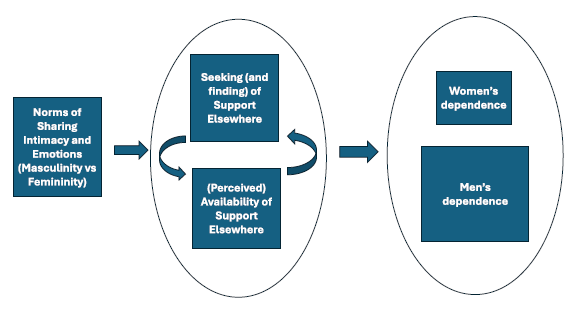
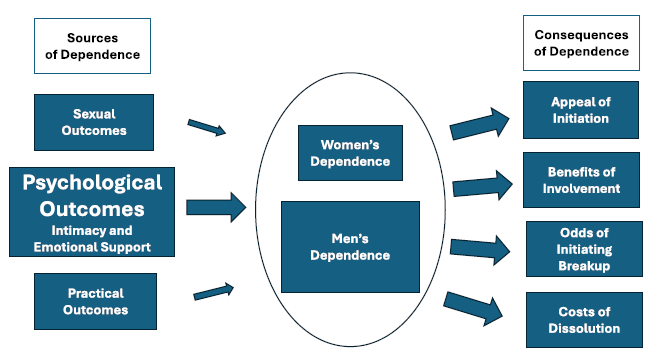



Target article
Romantic Relationships Matter More to Men than to Women
Related commentaries (43)
Sexual relationships matter more to men than to women
A cultural lens on romantic dependence
A matter of context: Gender differences vary across life stage, historical context, and individual characteristics
A memory lens on gender differences in romantic relationships
Are men more dependent or more powerful than women?
Beyond social structures: An evolutionary network perspective on gendered romantic dependency
Broader gender inequities shape why romantic relationships matter more to men than to women
Concluding that romantic relationships matter more to men than to women is too simple
Considering error management theory can provide a more comprehensive model as to why romantic relationships matter more to men than women
Culture, not nature: How traditional masculinity shapes male attitudes toward relationships
Desperate to connect: Men’s dependence on romantic relationship in a competitive mating landscape
Do romantic relationships matter less to women than to men because men provide lower-quality emotional support?
Do romantic relationships matter more to men than to women? An evolutionary psychology perspective
Evolutionary reasons why men are more likely to engage in romantic behavior than women
Fear of relationship dissolution: The influence of gendered post-breakup life course expectations
Gender differences in partner and ex-partner dreams
If men benefit more, should women demand more? A commentary on relationship dependence and mate selectivity
Impaired emotional regulation in the elderly men following female partner loss
Inconsistent use of evolutionary frameworks in accounts of romantic relationships
Men’s dependence in intimate relationships has broader harm beyond men’s wellbeing
Morality in romantic relationships
Only genderless society can solve the problem of emotional support for men
Parenthood as an inflection point for men and women’s patterns of interdependence
Parsimony and basic principles in human “romantic” relationships
Partner-serving moral cognition helps men to maintain romantic relationships from which they benefit more than women
Profound romantic relationships matter more to women than to men
Reassessing romantic dependency: Gendered vulnerabilities and cultural realities beyond the Western lens
Romantic relationships matter more to men than to women: Based on Darwinian gender differences of fitness-enhancing effects in having sexual partners
Scant evidence, sweeping claim: Do romantic relationships matter more to men?
Sex and romance are close evolutionary bedfellows
Synthetic love in the digital age: AI-mediated emotional investment and gendered romantic dependence
Testing sex differences in the relationship context needs the inclusion of gay and lesbian couples
The asymmetric structure of male-female bonding explains gender differences in relationship dependence
The costs and rewards of men’s romantic dependence: A gendered perspective
The cultural plasticity of intimacy behavior: A socioecological attachment perspective
The obsolete male and the mismatch in sexual desire
The support-deficit perspective is now the parsimonious explanation for gender differences in human mating
Unveiling gender dynamics in romantic relationships: A comprehensive analysis
Using self-determination theory to consider gender differences in the importance of romantic relationships
Well-being and resilience against oppressive narratives after romantic dissolution
Who benefits most from romantic relationships and who bears the burdens?
Why do romantic relationships matter more to men than to women? The commitment problem and market competition for useful men
Why does the belief that women are more romantic persist despite empirical evidence?
Author response
Understanding gender differences across relationship stages requires integrating evolutionary, ontological, and proximate mechanisms