A landmark moment in neuroscience came with the reevaluation of the avian brain, long dismissed as incapable of mammalian-like intelligence simply because it lacked a layered cortex. Only later did the evidence of complex problem-solving, planning, and even tool use force a paradigm shift, recognizing that a differently organized brain, based on nuclear structures, can support sophisticated cognition (Emery & Clayton, Reference Emery and Clayton2005; Jarvis et al., Reference Jarvis, Güntürkün, Bruce, Csillag, Karten, Kuenzel and Butler2005). In the same spirit, here we question the assumption that cognitive complexity follows a single evolutionary trajectory tied to centralization. In the target article, Coombs and Trestman classify cnidarians as “brainless” and devoid of advanced behavioral or cognitive traits. This perspective may neglect the possibility that alternative neural architectures can, in principle, support functionally analogous outcomes. Indeed, the box jellyfish (Tripedalia cystophora; Cubozoa), whose nervous system is diffused with three nerve rings, has been demonstrated to be capable of associative learning by integrating visual and mechanical stimuli (Bielecki et al., Reference Bielecki, Nielsen, Nachman and Garm2023). This evidence underscores how decentralized systems can support experience-dependent modulation of behavior. However, the scarcity of behavioral and cognitive studies on non-centralized organisms results in a substantial gap in our understanding of these systems, perpetuating the misconception that complex cognition inherently requires centralized control.
Building on this theoretical premise, we designed a simple yet revealing experiment on moon jellyfish (Aurelia spp.; Scyphozoa) – which feature a diffused nerve net and two marginal nerve rings – to test for cognitive markers such as memory and novelty preference (neophilic behavior).
We tested a total of 16 juvenile moon jellyfish within a tank divided into three sections: the central compartment in which we inserted the animal at the beginning of the observation time (length × width, 4 × 14 cm) and two lateral areas (8 × 14 cm each) where the stimuli were presented. The stimuli consisted of two glass objects differing in size and shape: a transparent tube (height × width, 5.5 × 1.5 cm) and a green marble (1.5 cm in diameter). The latter was placed on a plastic base (0.9 × 1.5 cm) to provide stability underwater. The walls and floor of the tank were covered with white plastic material. The apparatus was lit by one fluorescent lamp (6.5 W). The water level (salinity: 32 ppt; NO3 concentration: 20–25 mg/L, 22° ± 2°C) was set to 9 cm.
Two phases were set up: the exposure phase and the test phase. In the exposure phase, we introduced one of the two stimuli (e.g., the test tube) five min before testing. The first object presented, hereafter called the “familiar” object, was positioned in the center of one of the two stimulus areas. To control for spatial bias, in half of the cases, the familiar object was placed on the left side. Also, half of the animals were initially exposed to the cylinder. A single jellyfish was gently transferred using a jellyfish net into a transparent cylinder (6 cm diameter) in the center of the tank. After two minutes of acclimation, the cylinder was removed, and the jellyfish position in the three areas (two choice areas and the central compartment) was recorded for 25 min. At the end of this period, the animal was confined again under the cylinder and stayed there for a one-minute interval.
In the successive test phase, the jellyfish was presented with both the earlier, familiar object (e.g., the test tube) and an unfamiliar object (the marble), each positioned in the opposite stimulus area. Half of the animals encountered the familiar object in the same location as during the exposure phase, while the other half saw it placed on the previously unoccupied side. The behavior of the animals was recorded for another 25 minutes (Figure 1).
Figure 1.(a) Stimuli used (tube and marble); (b) Experimental apparatus and example of a choice.
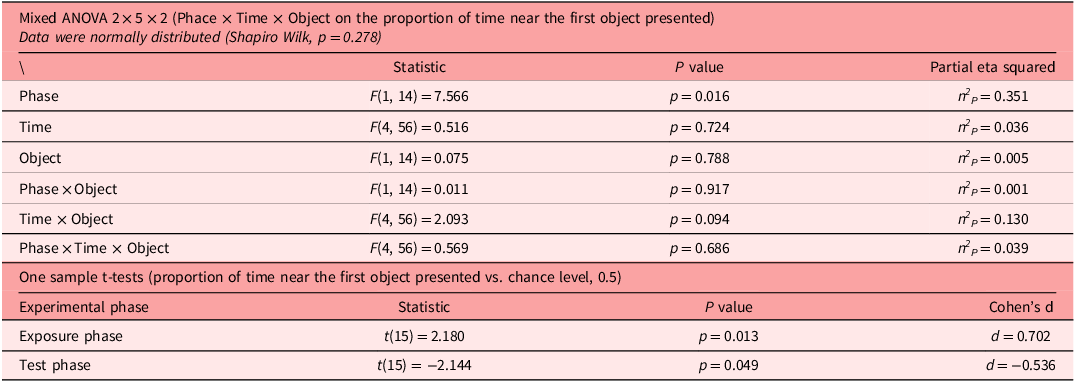
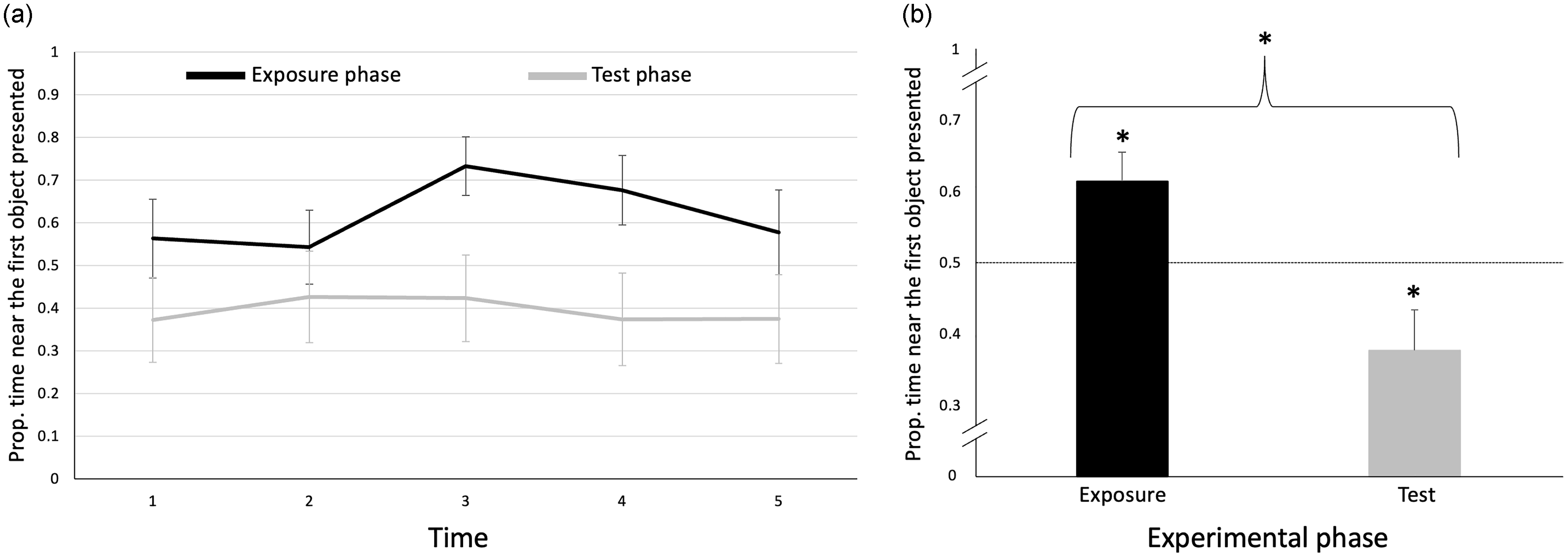
The mixed ANOVA conducted on the proportion of time spent near the first object presented (see Table 1) revealed a main effect of the experimental phase, indicating that the jellyfish initially explored the unique object during the exposure phase and subsequently preferred to explore the novel object during the test phase. This behavior was consistent throughout the observation periods and was not influenced by the type of object (Figure 2). A one-sample t-test conducted separately for each phase supports the hypothesis of curiosity-driven behavior in exploring objects in the environment.
Table 1.Statistical analyses (ANOVA, t-tests, and effect sizes)
Figure 2.In the exposure phase, jellyfish spent more time near the object presented. In the test phase, they explored more the novel object than the familiar one. (a) The proportion of time spent near the first object presented as a function of time (five blocks interval); (b) The overall proportion of time spent near the first object presented in the two phases. Asterisks denote a significant departure from chance. For both (a) and (b) bars refer to the standard error of the means (* p < 0.05).
In sum, we found that jellyfish is actively engaged with novel objects in the environment: during the exposure phase, they explored the single available object, and in the test phase, they exhibited a clear preference for the novel one. These findings provide the first evidence of both short-term memory for familiar objects and curiosity-like behavior toward novel objects in a scyphozoan jellyfish. In cognitive ethology, curiosity is defined as the motivation to seek out information in the environment (e.g., Franks et al., Reference Franks, Gaffney, Graham and Weary2023) and is typically observed in cognitively complex species or those with advanced neural architectures (Hall et al., Reference Hall, Melfi, Burns, McGill and Doyle2018). In our test, jellyfish exhibited exploratory behavior aimed at identifying potential food sources, with short-term retention enhancing the opportunity to subsequently investigate alternative options. Indeed, moon jellyfish are planktonic feeders, but they still behave as predators that capture and consume small, free-floating organisms such as zooplankton and fish larvae by using their stinging tentacles and oral arms. Therefore, our results challenge the prevailing view that advanced cognitive traits are exclusive to animals with centralized nervous systems, having Aurelia spp. a decentralized, radially organized nerve net lacking a central brain and relying instead on a diffuse neural network, two marginal neural rings connected with specialized sensory structures (rhopalia) (Pallasdies et al., Reference Pallasdies, Goedeke, Braun and Memmesheimer2019).
Rather than treating such cases as anomalies, we argue that species should be understood as manifesting cognitive traits shaped by the ecological demands of their evolutionary niche. This calls for a more inclusive framework to study cognition across diverse body plans and neural architectures.








A landmark moment in neuroscience came with the reevaluation of the avian brain, long dismissed as incapable of mammalian-like intelligence simply because it lacked a layered cortex. Only later did the evidence of complex problem-solving, planning, and even tool use force a paradigm shift, recognizing that a differently organized brain, based on nuclear structures, can support sophisticated cognition (Emery & Clayton, Reference Emery and Clayton2005; Jarvis et al., Reference Jarvis, Güntürkün, Bruce, Csillag, Karten, Kuenzel and Butler2005). In the same spirit, here we question the assumption that cognitive complexity follows a single evolutionary trajectory tied to centralization. In the target article, Coombs and Trestman classify cnidarians as “brainless” and devoid of advanced behavioral or cognitive traits. This perspective may neglect the possibility that alternative neural architectures can, in principle, support functionally analogous outcomes. Indeed, the box jellyfish (Tripedalia cystophora; Cubozoa), whose nervous system is diffused with three nerve rings, has been demonstrated to be capable of associative learning by integrating visual and mechanical stimuli (Bielecki et al., Reference Bielecki, Nielsen, Nachman and Garm2023). This evidence underscores how decentralized systems can support experience-dependent modulation of behavior. However, the scarcity of behavioral and cognitive studies on non-centralized organisms results in a substantial gap in our understanding of these systems, perpetuating the misconception that complex cognition inherently requires centralized control.
Building on this theoretical premise, we designed a simple yet revealing experiment on moon jellyfish (Aurelia spp.; Scyphozoa) – which feature a diffused nerve net and two marginal nerve rings – to test for cognitive markers such as memory and novelty preference (neophilic behavior).
We tested a total of 16 juvenile moon jellyfish within a tank divided into three sections: the central compartment in which we inserted the animal at the beginning of the observation time (length × width, 4 × 14 cm) and two lateral areas (8 × 14 cm each) where the stimuli were presented. The stimuli consisted of two glass objects differing in size and shape: a transparent tube (height × width, 5.5 × 1.5 cm) and a green marble (1.5 cm in diameter). The latter was placed on a plastic base (0.9 × 1.5 cm) to provide stability underwater. The walls and floor of the tank were covered with white plastic material. The apparatus was lit by one fluorescent lamp (6.5 W). The water level (salinity: 32 ppt; NO3 concentration: 20–25 mg/L, 22° ± 2°C) was set to 9 cm.
Two phases were set up: the exposure phase and the test phase. In the exposure phase, we introduced one of the two stimuli (e.g., the test tube) five min before testing. The first object presented, hereafter called the “familiar” object, was positioned in the center of one of the two stimulus areas. To control for spatial bias, in half of the cases, the familiar object was placed on the left side. Also, half of the animals were initially exposed to the cylinder. A single jellyfish was gently transferred using a jellyfish net into a transparent cylinder (6 cm diameter) in the center of the tank. After two minutes of acclimation, the cylinder was removed, and the jellyfish position in the three areas (two choice areas and the central compartment) was recorded for 25 min. At the end of this period, the animal was confined again under the cylinder and stayed there for a one-minute interval.
In the successive test phase, the jellyfish was presented with both the earlier, familiar object (e.g., the test tube) and an unfamiliar object (the marble), each positioned in the opposite stimulus area. Half of the animals encountered the familiar object in the same location as during the exposure phase, while the other half saw it placed on the previously unoccupied side. The behavior of the animals was recorded for another 25 minutes (Figure 1).
(a) Stimuli used (tube and marble); (b) Experimental apparatus and example of a choice.
The mixed ANOVA conducted on the proportion of time spent near the first object presented (see Table 1) revealed a main effect of the experimental phase, indicating that the jellyfish initially explored the unique object during the exposure phase and subsequently preferred to explore the novel object during the test phase. This behavior was consistent throughout the observation periods and was not influenced by the type of object (Figure 2). A one-sample t-test conducted separately for each phase supports the hypothesis of curiosity-driven behavior in exploring objects in the environment.
Statistical analyses (ANOVA, t-tests, and effect sizes)
In the exposure phase, jellyfish spent more time near the object presented. In the test phase, they explored more the novel object than the familiar one. (a) The proportion of time spent near the first object presented as a function of time (five blocks interval); (b) The overall proportion of time spent near the first object presented in the two phases. Asterisks denote a significant departure from chance. For both (a) and (b) bars refer to the standard error of the means (* p < 0.05).
In sum, we found that jellyfish is actively engaged with novel objects in the environment: during the exposure phase, they explored the single available object, and in the test phase, they exhibited a clear preference for the novel one. These findings provide the first evidence of both short-term memory for familiar objects and curiosity-like behavior toward novel objects in a scyphozoan jellyfish. In cognitive ethology, curiosity is defined as the motivation to seek out information in the environment (e.g., Franks et al., Reference Franks, Gaffney, Graham and Weary2023) and is typically observed in cognitively complex species or those with advanced neural architectures (Hall et al., Reference Hall, Melfi, Burns, McGill and Doyle2018). In our test, jellyfish exhibited exploratory behavior aimed at identifying potential food sources, with short-term retention enhancing the opportunity to subsequently investigate alternative options. Indeed, moon jellyfish are planktonic feeders, but they still behave as predators that capture and consume small, free-floating organisms such as zooplankton and fish larvae by using their stinging tentacles and oral arms. Therefore, our results challenge the prevailing view that advanced cognitive traits are exclusive to animals with centralized nervous systems, having Aurelia spp. a decentralized, radially organized nerve net lacking a central brain and relying instead on a diffuse neural network, two marginal neural rings connected with specialized sensory structures (rhopalia) (Pallasdies et al., Reference Pallasdies, Goedeke, Braun and Memmesheimer2019).
Rather than treating such cases as anomalies, we argue that species should be understood as manifesting cognitive traits shaped by the ecological demands of their evolutionary niche. This calls for a more inclusive framework to study cognition across diverse body plans and neural architectures.
Acknowledgments
We want to thank Trenton Charles Young for his help in testing the animals.
Financial support
This study was funded by the DOR grant from the University of Padova to C. Agrillo.
Competing interests
None.