




No CrossRef data available.
Article contents
Local resource depletion hypothesis as a mechanism for action selection in the brain
Published online by Cambridge University Press: 04 December 2013
Abstract
As a comment on Kurzban et al.'s opportunity cost model, we propose an alternative view of mental effort and the action selection mechanism in the brain. Our hypothesis utilizes local resource depletion within neuronal networks, which justifies from a neurophysiological perspective why mental fatigue diminishes after switching to a novel task and explains action selection by means of neural competition theory.
Information
- Type
- Open Peer Commentary
- Information
- Copyright
- Copyright © Cambridge University Press 2013
References
Barrouillet, P., Gavens, N., Vergauwe, E., Gaillard, V. & Camos, V. (2009) Working memory span development: A time-based resource-sharing model account. Developmental Psychology
45(2):477.Google Scholar
Bullmore, E. & Sporns, O. (2012) The economy of brain network organization. Nature Reviews Neuroscience
13(5):336–49.CrossRefGoogle ScholarPubMed
Cisek, P. (2007) Cortical mechanisms of action selection: The affordance competition hypothesis. Philosophical Transactions of the Royal Society, B: Biological Sciences
362:1585–99.CrossRefGoogle ScholarPubMed
Denker, A. & Rizzoli, S. O. (2010) Synaptic vesicle pools: An update. Frontiers in Synaptic Neuroscience
2:135. doi: 10.3389/fnsyn.2010.0013.Google Scholar
Hasselmo, M. E. (2006) The role of acetylcholine in learning and memory. Current Opinion in Neurobiology
16:710–15.CrossRefGoogle ScholarPubMed
Hasselmo, M. E. & Stern, C. E. (2006) Mechanisms underlying working memory for novel information. Trends in Cognitive Sciences
10(11):487–93.Google Scholar
Jensen, O. & Lisman, J. E. (1998) An oscillatory short-term memory buffer model can account for data on the Sternberg task. The Journal of Neuroscience
18(24):10688–99.Google Scholar
Kamiński, J., Brzezicka, A. & Wróbel, A. (2011) Short term memory capacity (7+/−2) predicted by theta to gamma cycle length ratio. Neurobiology of Learning and Memory
95:19–23.Google Scholar
Krueger, J. M., Rector, D. M., Roy, S., Van Dongen, H. P., Belenky, G. & Panksepp, J. (2008) Sleep as a fundamental property of neuronal assemblies. Nature Reviews Neuroscience
9(12):910–19.CrossRefGoogle ScholarPubMed
Lisman, J. E. & Idiart, M. (1995) Storage of 7+/-2 short-term memories in oscillatory subcycles. Science
267:10.Google Scholar
Logie, R. H. (2011) The functional organization and capacity limits of working memory. Current Directions in Psychological Science
20(4):240–45.CrossRefGoogle Scholar
Pastoll, H., Solanka, L., van Rossum, M. C. & Nolan, M. F. (2013) Feedback inhibition enables theta-nested gamma oscillations and grid firing fields. Neuron
77(1):141–54.Google Scholar
Sarter, M. & Parikh, V. (2005) Choline transporters, cholinergic transmission and cognition. Nature Reviews Neuroscience
6(1):48–56.CrossRefGoogle ScholarPubMed
Vyazovskiy, V. V., Olcese, U., Hanlon, E. C., Nir, Y., Cirelli, C. & Tononi, G. (2011) Local sleep in awake rats. Nature
472(7344):443–47.Google Scholar
Zucker, R. S. & Regehr, W. G. (2002) Short-term synaptic plasticity. Annual Review of Physiology
64:355–405.Google Scholar
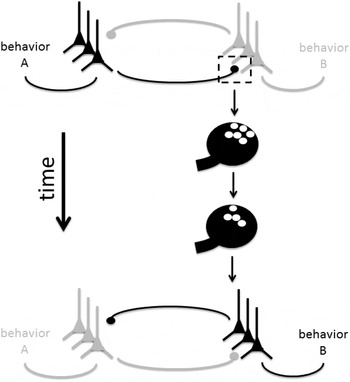
Figure 1. A graphical representation of the local depletion hypothesis. In the upper scheme a neural ensemble underlying behavior A is a “winner,” effectively inhibiting activity of the neural network underlying behavior B. After a certain period of time locally accessible resources of “neural fuel” (i.e., synaptic vesicles) in ensemble A would diminish, leading to a decrease of inhibition exerted on ensemble B and therefore allowing ensemble B to “win” a competition and inhibit the activity of ensemble A.
Revealing the process of action selection is crucial for understanding and predicting human behavior. Kurzban and colleagues put forward an interesting evolutionary and economically inspired description of the opportunity cost model as a putative mechanism for action selection by the human mind. However, the authors unexpectedly omit several experimentally supported models of the working memory system (e.g., Barrouillet et al. Reference Barrouillet, Gavens, Vergauwe, Gaillard and Camos2009; Logie Reference Logie2011), which emphasize the existence of resource-sharing or distinct cognitive resources as a crucial aspect of the human mind. We propose an alternative view of mental limits, which explains the action selection mechanism from a neurophysiological perspective. Referring to neural underpinnings of their model, Kurzban et al. point out that prefronto-striatal dopaminergic pathways play an important role in the action selection mechanism, a thesis supported mostly by functional magnetic resonance imaging (fMRI) data. We think that results from human and animal electrophysiological experiments would add much to the understanding of both mental effort and action selection processes. Below we explain our proposal for understanding the physiological foundations of mental effort and posit their possible effect on the action selection mechanism.
While analyzing possible physiological correlates of mental effort, Kurzban et al. conclude that there is no good candidate for the explanation of both behavioral effects and fMRI data. They discuss glucose as such a potential source of energy for what we can call “mind work” but they reject this possibility, stating that no data show a relation between feeling of effort and glucose consumption (sect. 4.1). We propose to treat physiological resources more locally, as prone both to depletion and refill (which could take place at a slow or quick pace). From such a point of view one can propose a good candidate for a limitation of physiological resources underlying mental fatigue. It is known that periods of highly elevated neuronal activity lead to a decrease in synaptic efficacy (Zucker & Regehr Reference Zucker and Regehr2002). This phenomenon reflects the depletion of a readily releasable pool of synaptic vesicles (Denker & Rizzoli Reference Denker and Rizzoli2010), which in turn might lead to decreased availability of “neural fuel.” As a physiological “fuel” prone to depletion on a local (but not global) scale, we propose available pools of neurotransmitters (Denker & Rizzoli Reference Denker and Rizzoli2010) and/or locally released neuromodulators (Hasselmo Reference Hasselmo2006; Hasselmo & Stern Reference Hasselmo and Stern2006). This notion is supported by several studies showing that administration of acetylcholine diminishes fatigue resulting from task execution while simultaneously improving performance (e.g., Hasselmo & Stern Reference Hasselmo and Stern2006; Sarter & Parikh Reference Sarter and Parikh2005).
It is therefore feasible that a highly activated neural circuit cannot work efficiently for long periods of time, due to a depletable pool of resources. The hypothesis of local resource depletion is supported by electrophysiological recordings from freely behaving rats that exhibited a phenomenon called “local-network sleep” (Krueger et al. Reference Krueger, Rector, Roy, Van Dongen, Belenky and Panksepp2008). With elongation of an awakened state, some of the studied cortical neural networks briefly went “offline” as in sleep, and were accompanied by slow waves in the local electroencephalogram (EEG). Such observations increased in frequency with the duration of the awakened state, and were accompanied by progressively impaired behavior despite the rats’ continuous activity and a globally “awake” EEG (Vyazovskiy et al. Reference Vyazovskiy, Olcese, Hanlon, Nir, Cirelli and Tononi2011). With these data at hand we propose – instead of a “global” resource hypothesis such as Kurzban et al.'s – a local resource depletion hypothesis. Such a hypothesis simply explains why mental fatigue is diminished after switching to a novel task: In such a situation a new, not depleted, neural ensemble (or novel part of the same network) would be engaged.
The proposed phenomenon of local resource depletion could also affect action selection. Competition between neural ensembles has long been used as a convincing neurophysiological mechanism to explain selection of action in the brain, supported by many computational models and empirical data. Very important and seemingly relevant to Kurzban et al.'s model is the idea of selecting ongoing activity according to the result of competition between neural ensembles, proposed by Bullmore and Sporns (Reference Bullmore and Sporns2012). This view of the action selection process not only posits a mechanism for flexible and fast-changing emergence of topographically and functionally distinct neuronal populations, but also allows for an economic and efficient method of information exchange and – what is crucial in this context – for trade-offs between neuronal ensembles and picking the “winner.” Paul Cisek's “affordance competition hypothesis” represents a similar argument, proposing constant competition between currently available actions as a way of dealing with fast-changing sensory inputs from the environment and therefore constituting a neurophysiological mechanism for selection of action in the brain (Cisek Reference Cisek2007).
Crucial in our proposal is that a switch between active neuronal assemblies could be initiated by a decrease of long-lasting activity in the first assembly caused by resource depletion (see Fig. 1). This switch would shift the system towards different behavior by engaging new neuronal circuits, resulting in a diminished experience of fatigue. An advantage of our local resource depletion hypothesis is that, in contrast to Kurzban et al.'s proposal, it does not require assignment of control functions (i.e., opportunity costs calculation or action selection) to the particular brain structure.
A graphical representation of the local depletion hypothesis. In the upper scheme a neural ensemble underlying behavior A is a “winner,” effectively inhibiting activity of the neural network underlying behavior B. After a certain period of time locally accessible resources of “neural fuel” (i.e., synaptic vesicles) in ensemble A would diminish, leading to a decrease of inhibition exerted on ensemble B and therefore allowing ensemble B to “win” a competition and inhibit the activity of ensemble A.
On a more general level, Kurzban and colleagues discuss cognitive limitations as a crucial feature of the human mind. We would like to enrich this view by recalling an existing hypothesis, which could help to understand this limitation at a physiological level. Lisman and Idiart (Reference Lisman and Idiart1995) proposed a model assuming that maximal capacity of working memory is determined by the number of individual gamma cycles that can fit within one theta cycle. Such a hypothesis is strongly supported by animal experiments (Pastoll et al. Reference Pastoll, Solanka, van Rossum and Nolan2013), modeling work (Jensen & Lisman Reference Jensen and Lisman1998), and human EEG observations (Kamiński et al Reference Kamiński, Brzezicka and Wróbel2011). These data allow a neuronal level to be taken into account when discussing any new model of cognitive brain processing limitations.