




No CrossRef data available.
Article contents
The economics of cognitive effort
Published online by Cambridge University Press: 04 December 2013
Abstract
If cognitive effort indexes opportunity costs, it should be investigated like other cost factors including risk and delay. We discuss recent methodological advances in behavioral economics and neuroeconomics, highlighting our own work in measuring the subjective (economic) value of cognitive effort. We discuss the implications of Kurzban et al.'s proposal and how some of its predictions may be untestable without behavioral economic formalisms.
Information
- Type
- Open Peer Commentary
- Information
- Copyright
- Copyright © Cambridge University Press 2013
References
Alessi, S. M. & Petry, N. M. (2003) Pathological gambling severity is associated with impulsivity in a delay discounting procedure. Behavioural Processes
64(3):345–54. doi:10.1016/S0376-6357(03)00150-5.Google Scholar
Bickel, W. K., Miller, M. L., Yi, R., Kowal, B. P., Lindquist, D. M. & Pitcock, J. A. (2007) Behavioral and neuroeconomics of drug addiction: Competing neural systems and temporal discounting processes. Drug and Alcohol Dependence
90:S85–S91. doi:10.1016/j.drugalcdep.2006.09.016.Google Scholar
Botvinick, M. M., Huffstetler, S. & McGuire, J. T. (2009) Effort discounting in human nucleus accumbens. Cognitive, Affective, and Behavioral Neuroscience
9(1):16–27. doi:10.3758/CABN.9.1.16.CrossRefGoogle ScholarPubMed
Cacioppo, J. T. & Petty, R. E. (1982) The need for cognition. Journal of Personality and Social Psychology
42(1):116–31.Google Scholar
Cocker, P. J., Hosking, J. G., Benoit, J. & Winstanley, C. A. (2012) Sensitivity to cognitive effort mediates psychostimulant effects on a novel rodent cost-benefit decision-making task. Neuropsychopharmacology
37(8):1825–37. doi:10.1038/npp.2012.30.Google Scholar
Frederick, S., Loewenstein, G. & O'Donoghue, T. (2002) Time discounting and time preference: A critical review. Journal of Economic Literature
40(2):351–401.CrossRefGoogle Scholar
Green, L. & Myerson, J. (2004) A discounting framework for choice with delayed and probabilistic rewards. Psychological Bulletin
130(5):769–92. doi:10.1037/0033-2909.130.5.769.Google Scholar
Huettel, S. A., Stowe, C. J., Gordon, E. M., Warner, B. T. & Platt, M. L. (2006) Neural signatures of economic preferences for risk and ambiguity. Neuron
49(5):765–75. doi:10.1016/j.neuron.2006.01.024.Google Scholar
Kable, J. W. & Glimcher, P. W. (2007) The neural correlates of subjective value during intertemporal choice. Nature Neuroscience
10(12):1625–33.Google Scholar
Kennerley, S. W., Dahmubed, A. F., Lara, A. H. & Wallis, J. D. (2009) Neurons in the frontal lobe encode the value of multiple decision variables. Journal of Cognitive Neuroscience
21(6):1162–78.CrossRefGoogle ScholarPubMed
Kollins, S. H. (2003) Delay discounting is associated with substance use in college students. Addictive Behaviors
28(6):1167–73. doi:10.1016/S0306-4603(02)00220-4.Google Scholar
Kool, W., McGuire, J. T., Rosen, Z. B. & Botvinick, M. M. (2010) Decision making and the avoidance of cognitive demand. Journal of Experimental Psychology: General
139(4):665–82. doi:10.1037/a0020198.Google Scholar
Madden, G. J., Petry, N. M. & Johnson, P. S. (2009) Pathological gamblers discount probabilistic rewards less steeply than matched controls. Experimental and Clinical Psychopharmacology
17(5):283–90. doi:10.1037/a0016806.Google Scholar
McGuire, J. T. & Botvinick, M. M. (2010) Prefrontal cortex, cognitive control, and the registration of decision costs. Proceedings of the National Academy of Sciences USA
107(17):7922–26.CrossRefGoogle ScholarPubMed
Padoa-Schioppa, C. (2011) Neurobiology of economic choice: A good-based model. Annual Review of Neuroscience
34(1):333–59. doi:10.1146/annurev-neuro-061010-113648.Google Scholar
Peters, J. & Büchel, C. (2009) Overlapping and distinct neural systems code for subjective value during intertemporal and risky decision making. Journal of Neuroscience
29(50):15727–34.Google Scholar
Rangel, A., Camerer, C. & Montague, P. R. (2008) A framework for studying the neurobiology of value-based decision making. Nature Reviews Neuroscience
9(7):545–56. doi:10.1038/nrn2357.Google Scholar
Salamone, J. D., Correa, M., Nunes, E. J., Randall, P. A. & Pardo, M. (2012) The behavioral pharmacology of effort-related choice behavior: Dopamine, adenosine and beyond. Journal of the Experimental Analysis of Behavior
97(1):125–46. doi:10.1901/jeab.2012.97-125.Google Scholar
Thaler, R. (1981) Some empirical evidence on dynamic inconsistency. Economics Letters
8(3):201–207.Google Scholar
Venables, L. & Fairclough, S. H. (2009) The influence of performance feedback on goal-setting and mental effort regulation. Motivation and Emotion
33(1):63–74.CrossRefGoogle Scholar
Westbrook, A., Kester, D., & Braver, T. S. (2013) What is the subjective cost of cognitive effort? Load, trait, and aging effects revealed by economic preference. PLoS One
8(7). doi:10.1371/journal.pone.0068210.t004
CrossRefGoogle ScholarPubMed
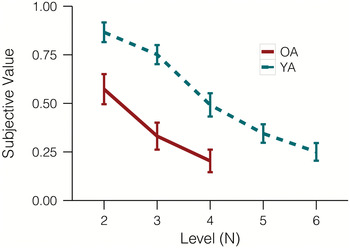
Figure 1. Subjective value of a cash offer, or conversely, motivation to engage with a task, decreases with increasing working memory load for both young adults (YA) and older adults (OA).
Kurzban and colleagues posit phenomenal effort as a marker of opportunity cost, and thus as input to an economic decision about the subjective value of cognitive engagement. As such, cognitive effort is ripe for behavioral economic investigation. If effort represents a cost, formalisms developed in behavioral and neuroeconomic research can be used to quantify that cost. Moreover, many of the extensive implications of the authors' hypothesis may be untestable without objective cost measures. To distinguish their proposal from resource models, Kurzban et al. suggest indexing effort expenditure with performance. As we discuss below, however, performance has a complicated relationship with effort. Furthermore, humans can make effort-based decisions in an offline manner (i.e., during an unengaged period); this points to the need for offline indices of cognitive effort. The full potential of Kurzban et al.'s essentially economic theory will only be realized once variables of interest are formalized within a behavioral economic framework.
Broadly, behavioral economics is concerned with formal methods for probing the influence of choice dimensions on decision-making. The discipline has yielded a wealth of information about the extent to which cost factors, including delay (Frederick et al. Reference Frederick, Loewenstein and O'Donoghue2002), risk (Green & Myerson Reference Green and Myerson2004), and physical effort (Salamone et al. Reference Salamone, Correa, Nunes, Randall and Pardo2012), impact decisions about goal pursuit. Cost measures combined with neurophysiological and imaging techniques have elucidated the neural systems responsible for economic decision-making (Huettel et al. Reference Huettel, Stowe, Gordon, Warner and Platt2006; Kable & Glimcher Reference Kable and Glimcher2007; Kennerley et al. Reference Kennerley, Dahmubed, Lara and Wallis2009; Padoa-Schioppa Reference Padoa-Schioppa2011; Peters & Büchel Reference Peters and Büchel2009; Rangel et al. Reference Rangel, Camerer and Montague2008; Salamone et al. Reference Salamone, Correa, Nunes, Randall and Pardo2012). The result is an increasingly richly detailed account of normal and disordered decision-making with implications for understanding pathological gambling, addiction, and more (Alessi & Petry Reference Alessi and Petry2003; Bickel et al. Reference Bickel, Miller, Yi, Kowal, Lindquist and Pitcock2007; Kollins Reference Kollins2003; Madden et al. Reference Madden, Petry and Johnson2009).
Recently, we adapted the formalism of discounting to measure cognitive effort (Westbrook et al. Reference Westbrook, Kester and Braver2013). Discounting paradigms quantify costs by the extent to which a cost factor diminishes preference for a reward. In our paradigm, participants experience parametrically varied load in the N-back working memory task. Next, during a decision-making phase (offline) they choose which levels (N) they are willing to re-do for money. Their choices in a series of programmed offers are used to establish that subjective offer value is increasingly discounted as load increases (Fig. 1). We also found that subjective value is sensitive to a number of state and trait variables that should impact subjective effort.
Subjective value of a cash offer, or conversely, motivation to engage with a task, decreases with increasing working memory load for both young adults (YA) and older adults (OA).
Trait variables modulating subjective value include cognitive age (older adults find task engagement more costly, even controlling for differences in performance and response times) and personality (Fig. 1). Need for Cognition (Cacioppo & Petty Reference Cacioppo and Petty1982), a trait measure of an individual's likelihood to engage with and enjoy cognitively demanding activities, increases with lesser discounting. Such effects support the proposal that individuals vary considerably in their sensitivity to cognitive effort (Cocker et al. Reference Cocker, Hosking, Benoit and Winstanley2012; Kool et al. Reference Kool, McGuire, Rosen and Botvinick2010; McGuire & Botvinick Reference McGuire and Botvinick2010; Westbrook et al. Reference Westbrook, Kester and Braver2013). Hence, opportunity cost models should account for individual differences in sensitivity to opportunity costs.
State variables modulating subjective value include objective load (Fig. 1), but also performance and offer amount. Sensitivity to state variables implies that a behavioral economic approach could provide critical evidence against resource models. As Kurzban et al. argue, evidence that expected task utility affects participants' motivation to expend effort would support an opportunity cost account over a resource model. Accordingly, we found that larger offers ($5 vs. $1) resulted in reduced discounting of high-load tasks by participants (cf. Thaler Reference Thaler1981). Because participants make decisions about larger and smaller offers within a single, uninterrupted decision block (without intervening task engagement), increased motivation to expend effort on higher-utility, but equally demanding tasks, cannot be straightforwardly explained by resource depletion.
Critically, performance (signal detection d′) and load (N) independently influenced the subjective value of task engagement. This finding also has implications for testing Kurzban et al.'s proposal. While performance measures are bedrock evidence for resource models, task performance – the focus of Kurzban et al.'s opportunity cost model – was only indirectly linked with motivation. Performance is a function of motivation, but also capacity, both trait and state, including practice and fatigue effects. Hence, declining performance with increasing load does not necessarily indicate that motivation is diminished. Moreover, our findings support a more complicated reciprocal relationship whereby declining performance can produce feedback effects, increasing subjective effort (Venables & Fairclough Reference Venables and Fairclough2009) and decreasing motivation. Without a third, independent measure of motivation – precisely what our behavioral economic measure provides – it is impossible to test whether load impacts expected utility and thereby motivation, as the opportunity cost model predicts.
Finally, experimental methods are needed to study effort-based decision-making in isolation. Unlike performance, which can only be measured during task engagement, discounting quantifies motivation offline, while participants are unengaged. Hence, discounting can be compared before and after extended task engagement to investigate what role fatigue plays in subjective effort, independent of opportunity costs. Similarly, offline measures can be used to study how cached estimates of subjective effort, for a task experienced when opportunity costs were high, carry over to when opportunity costs for the same task are low. Detailed predictions about carry-over effects are limited in Kurzban et al.'s proposal, but could be investigated thoroughly with offline behavioral economic measures.
The model of subjective effort proposed by Kurzban and colleagues is a promising theoretical advance that may ultimately unify well-studied ego-depletion effects with an emerging behavioral- and neuro-economics of cognitive effort (Botvinick et al. Reference Botvinick, Huffstetler and McGuire2009; Cocker et al. Reference Cocker, Hosking, Benoit and Winstanley2012; Kool et al. Reference Kool, McGuire, Rosen and Botvinick2010; McGuire & Botvinick Reference McGuire and Botvinick2010; Westbrook et al. Reference Westbrook, Kester and Braver2013). The first step will require objective quantification of cognitive effort, which we believe may be accomplished with economic formalisms such as our novel cognitive effort discounting task described here.