




No CrossRef data available.
Article contents
Opportunity cost calculations only determine justified effort – Or, What happened to the resource conservation principle?
Published online by Cambridge University Press: 04 December 2013
Abstract
We welcome the development of a new model on effort and performance and the critique on existing resource-based models. However, considering the vast evidence for the significant impact of experienced task demand on resource allocation, we conclude that Kurzban et al.'s opportunity cost model is only valid for one performance condition: if task demand is unknown or unspecified.
Information
- Type
- Open Peer Commentary
- Information
- Copyright
- Copyright © Cambridge University Press 2013
References
Brehm, J. W. & Self, E. A. (1989) The intensity of motivation. Annual Review of Psychology
40(1):109–31.Google Scholar
Brehm, J. W., Wright, R. A., Solomon, S., Silka, L. & Greenberg, J. (1983) Perceived difficulty, energization, and the magnitude of goal valence. Journal of Experimental Social Psychology
19:21–48. doi: 10.1016/0022-1031(83)90003-3.CrossRefGoogle Scholar
Gendolla, G. H. E. & Richter, M. (2010) Effort mobilization when the self is involved: Some lessons from the cardiovascular system. Review of General Psychology
14:212–26.Google Scholar
Gendolla, G. H. E. & Wright, R. A. (2009) Effort. In: Oxford companion to the affective sciences, ed. Sander, D. & Scherer, K. R., pp. 134–35. Oxford University Press.Google Scholar
Gendolla, G. H. E., Wright, R. A. & Richter, M. (2012) Effort intensity: Some insights from the cardiovascular system. In: The Oxford handbook of motivation, ed. Ryan, R. M., pp. 420–38. Oxford University Press.Google Scholar
Gibson, W. R. B. (1900) The principles of least action as a psychological principle. Mind
9:469–95. doi:10.1093/mind/IX.36.469.Google Scholar
Gollwitzer, P. M. (1990) Action phases and mind-sets. In: The handbook of motivation and cognition: Foundations of social behavior, vol. 2, ed. Higgins, E. T. & Sorrentino, R. M., pp. 53–92. Guilford Press.Google Scholar
Heckhausen, H. & Gollwitzer, P. M. (1987) Thought contents and cognitive functioning in motivational versus volitional status of mind. Motivation and Emotion
11:101–20. doi: 10.1007/BF00992338.Google Scholar
Hillgruber, A. (1912) Fortlaufende Arbeit und Willensbetätigung [Continuous work and the will]. Quelle und Meyer.Google Scholar
Kool, W., McGuire, J. T., Rosen, Z. B. & Botvinick, M. M. (2010) Decision making and the avoidance of cognitive demand. Journal of Experimental Psychology: General
139(4):665–82. doi:10.1037/a0020198.CrossRefGoogle ScholarPubMed
Richter, M. & Gendolla, G. H. E. (2006) Incentive effects on cardiovascular reactivity in active coping with unclear task difficulty. International Journal of Psychophysiology
61:216–25. doi: 10.1016/j.ijpsycho.2005.10.003.Google Scholar
Richter, M. & Gendolla, G. H. E. (2009) The heart contracts to reward: Monetary incentives and preejection period. Psychophysiology
46:451–57. doi: 10.1111/j.1469-8986.2009.00795.x.Google Scholar
Wright, R. A. (2008) Refining the prediction of effort: Brehm's distinction between potential motivation and motivation intensity. Social and Personality Psychology Compass
2:682–701. doi:10.1111/j.1751-9004.2008.00093.CrossRefGoogle Scholar
Wright, R. A. & Kirby, L. D. (2001) Effort determination of cardiovascular response: An integrative analysis with applications in social psychology. In: Advances in experimental social psychology, vol. 33, ed. Zanna, M. P., pp. 255–307. Academic Press.Google Scholar
Zipf, G. K. (1949) Human behaviour and the principle of least effort: An introduction to human ecology. Addison-Wesley.Google Scholar
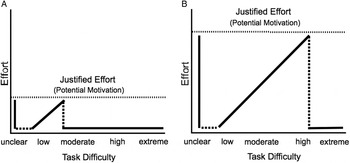
Figure 1. Effort mobilization according to motivational intensity theory (Brehm & Self 1989). Panel A shows predictions for effort mobilization when only low effort is justified (i.e., low potential motivation). Panel B shows predictions for the condition when high effort is justified (i.e., high potential motivation). (Adapted from Gendolla & Wright 2009, p. 134. Copyright: Oxford University Press, 2012)
Identifying the processes that determine the mobilization and experience of effort is important for understanding human motivation and performance. Given that theoretical models on this topic are rare, we highly welcome the formulation of a new model on effort and task performance that challenges existing ideas. However, we think that the current version of Kurzban et al.'s opportunity cost model suffers from a major shortcoming: It does not consider that task choice and task execution are influenced by different variables, and it neglects the considerable amount of research that has examined and demonstrated the significant role of task demand in effort and resource allocation, respectively.
The core idea of the opportunity cost model is that mental effort is a function of the relative utility of action alternatives, determined in an opportunity cost analysis. Surprisingly, Kurzban and colleagues do not consider findings and models that draw on the idea that the motivation to conserve resources governs effort mobilization, as stated in the principles of “least effort” or “least work” (e.g., Hull Reference Hull1943; Kool et al. Reference Kool, McGuire, Rosen and Botvinick2010; Tolman Reference Tolman1932; Zipf Reference Zipf1949). More than a hundred years ago, William R. B. Gibson highlighted the crucial role of task demand for resource investment. He discussed the role of the “principle of least action” in psychology (Gibson Reference Gibson1900), postulating that individuals invest only the effort that is minimally required to perform a task. Likewise, it was postulated in the “difficulty law of motivation” that effort is mobilized proportionally to the magnitude of obstacles in goal pursuit, once a goal is set (e.g., Ach Reference Ach1935; Hillgruber Reference Hillgruber1912). Consequently, the allocation of computational resources should be primarily driven by task demand, and not by the relative utility of task alternatives as suggested by Kurzban et al. We agree that utility may play a major role for task choice. But effort refers to task execution, and for this process other variables are relevant than the ones for task choice, as identified in research on action phases of goal pursuit (e.g., Gollwitzer Reference Gollwitzer, Higgins and Sorrentino1990; Heckhausen & Gollwitzer Reference Heckhausen and Gollwitzer1987). Kurzban et al. make no explicit distinction between task choice and task execution, which may explain why they neglect the role of task demand in their analysis.
Focusing exclusively on task execution, particularly motivational intensity theory (Brehm et al. Reference Brehm, Wright, Solomon, Silka and Greenberg1983; Brehm & Self Reference Brehm and Self1989) has elaborated the resource conservation principle by considering the role of utility, or success importance, and by specifying when and how utility determines effort in interaction with task demand. This theory posits that effort is mobilized proportionally to experienced task demand as long as (1) success is possible and (2) the amount of effort that is necessary to succeed is justified. If one of these limits is reached, people disengage, because effort investment would not bring return, meaning a waste of resources. Thus, effort should vary non-monotonically with the perceived difficulty of instrumental behavior, as depicted in Figure 1.
Effort mobilization according to motivational intensity theory (Brehm & Self Reference Brehm and Self1989). Panel A shows predictions for effort mobilization when only low effort is justified (i.e., low potential motivation). Panel B shows predictions for the condition when high effort is justified (i.e., high potential motivation). (Adapted from Gendolla & Wright Reference Gendolla, Wright, Sander and Scherer2009, p. 134. Copyright: Oxford University Press, 2012)
The theory posits that utility – which may be the result of an opportunity cost analysis – has only an indirect impact on effort in most situations: It defines the maximal effort people are willing to invest (i.e., potential motivation; see Wright Reference Wright2008 for a discussion). Most relevant for the model of Kurzban et al., unclear difficulty is the only condition under which justified effort directly determines actual effort. Only if people have no idea about the extent of task demand, can they not calibrate effort to the level of task demand (e.g., Richter & Gendolla Reference Richter and Gendolla2006; Reference Richter and Gendolla2009). Consequently, referring to task execution, we regard the opportunity cost model as valid only for this one performance condition: If task demand is unknown.
Nevertheless, we think that the opportunity cost model may be compatible with the resource conservation principle if one considers that organisms seem to prefer low opportunity costs, especially in task choice situations (as already identified by the behaviorists in the principles of least effort and least work: Hull Reference Hull1943; Tolman Reference Tolman1932). However, the logic consequence of the energy conservation principle is that organisms do not invest more resources than necessary for an action. Consequently, motivational intensity theory posits that effort rises with subjective demand as long as success is possible and justified. We agree that justified effort can be determined by an opportunity cost analysis, making this a central variable for task choice. However, in contrast to Kurzban et al.'s analysis, it is task demand that should primarily determine mobilized and experienced effort. Supporting this idea, numerous studies have shown that effort is low when demand is low, even when justified effort (i.e., task utility) is high (for overviews, see Gendolla & Richter Reference Gendolla and Richter2010; Gendolla et al. Reference Gendolla, Wright, Richter and Ryan2012; Wright & Kirby Reference Wright, Kirby and Zanna2001). Only if subjective demand is unclear does justified effort directly determine actual effort (e.g., Richter & Gendolla Reference Richter and Gendolla2006; Reference Richter and Gendolla2009).
In summary, we regard Kurzban et al.'s analysis as suitable for predicting task choices. However, concerning effort mobilization and experience, which refers to task execution, their arguments are valid only for one specific condition – if task demand is unclear. If demand is known, effort is determined by experienced difficulty up to the level of maximally justified effort, which may be the outcome of a cost-benefit analysis in terms of the opportunity cost model.