






No CrossRef data available.
Article contents
Novel epigenetic, quantitative, and qualitative insights on the socialness of autism
Published online by Cambridge University Press: 23 July 2019
Abstract
Three complementary points to Jaswal & Akhtar are raised: (1) As a person with autism, I desire sociality despite vulnerability to others’ antisocial behaviour; (2) Asperger's conflation of autism with psychopathy (Czech 2018) likely caused clinicians to disregard social motivation among those with autism; and (3) adverse experiences cause social-engagement diversity to develop in all people, not just those on the spectrum.
Information
- Type
- Open Peer Commentary
- Information
- Copyright
- Copyright © Cambridge University Press 2019
References
Batson, C. D. & Ahmad, N. (2001) Empathy-induced altruism in a prisoner's dilemma II: What if the target of empathy has defected? European Journal of Social Psychology 31(1):25–36. doi:10.1002/ejsp.26.Google Scholar
Bernal, A. J., Dolinoy, D.C., Huang, D., Skaar, D. A., Weinhouse, C. & Jirtle, R. L. (2013) Adaptive radiation-induced epigenetic alterations mitigated by antioxidants. FASEB Journal 27(2):665–71.Google Scholar
Berryessa, C. M. (2014) Judicial perceptions of media portrayals of offenders with high functioning autistic spectrum disorders. International Journal of Criminology and Sociology 3:46–60. doi:10.6000/1929-4409.2014.03.04.Google Scholar
Bethlehem, R. A. I., Allison, C., van Andel, E., Coles, A. I., Neil, K. & Baron-Cohen, S. (2016) Does empathy predict altruism in the wild? Social Neuroscience 12:743–50.Google Scholar
Boka, Z. & Leibman, F. H. (2015) Autism spectrum disorders and psychopathy: Clinical and criminal justice considerations. Journal of Cognitive Science 16(1):16–39.Google Scholar
Brown, L. X. (2012, January 21) Having loud hands. [web blog post]. Autistic hoya blog. Available at: https://www.autistichoya.com/2012/01/having-loud-hands.html.Google Scholar
Brown, W. M. (2015) Exercise-associated DNA methylation change in skeletal muscle and the importance of imprinted genes: A bioinformatics meta-analysis. British Journal of Sports Medicine 49(24):1567–78. doi:10.1136/bjsports-2014-094073.Google Scholar
Conn, C. (2015) “Sensory highs,” “vivid rememberings” and “interactive stimming”: Children's play cultures and experiences of friendship in autistic autobiographies. Disability & Society 30(8):1192–206. doi:10.1080/09687599.2015.1081094.Google Scholar
Czech, H. (2018) Hans Asperger, National Socialism, and “race hygiene” in Nazi-era Vienna. Molecular Autism 9(1):29. DOI: 10.1186/s13229-018-0208-6.Google Scholar
Dziobek, I., Rogers, K., Fleck, S., Bahnemann, M., Heekeren, H. R., Wolf, O. T. & Convit, A. (2008) Dissociation of cognitive and emotional empathy in adults with Asperger Syndrome using the Multifaceted Empathy Test (MET). Journal of Autism and Developmental Disorders 38:464–73.Google Scholar
Eshraghi, A. A., Liu, G., Kay, S. S., Eshraghi, R. S., Mittal, J., Moshiree, B. & Mittal, R. (2018) Epigenetics and autism spectrum disorder: Is there a correlation? Frontiers in Cellular Neuroscience 12. doi:10.3389/fncel.2018.00078.Google Scholar
Jones, N. D. & Paulhus, L. D. (2013) Introducing the short dark triad (SD3): A brief measure of dark personality traits. Assessment 21(1):28–41. Available at: https://doi.org/10.1177%2F1073191113514105.Google Scholar
Kelley, L. (2014, February 11) Advocating: Love not fear! [web blog post]. Thirty Days of Autism blog. Available at: https://30daysofautism.blog/2014/02/11/advocating-love-not-fear/.Google Scholar
Lockwood, P. L., Bird, G., Bridge, M. & Viding, E. (2013) Dissecting empathy: High levels of psychopathic and autistic traits are characterized by difficulties in different social information processing domains. Frontiers in Human Neuroscience 7:760. doi:10.3389/fnhum.2013.00760.Google Scholar
Park, S. S., Skaar, D. A., Jirtle, R. L. & Hoyo, C. (2017) Epigenetics, obesity and early-life cadmium or lead exposure. Epigenomics 9(1):57–75.Google Scholar
Roekel, E. V., Scholte, R. H. & Didden, R. (2009) Bullying among adolescents with autism spectrum disorders: Prevalence and perception. Journal of Autism and Developmental Disorders 40(1):63–73. doi:10.1007/s10803-009-0832-2.Google Scholar
Swartz, J. R., Hariri, A. R. & Williamson, D. E. (2017) An epigenetic mechanism links socioeconomic status to changes in depression-related brain function in high-risk adolescents. Molecular Psychiatry 22:209–14.Google Scholar
Why I left ABA [web blog post]. (2015, May 22) Socially anxious advocate blog. Available at: https://sociallyanxiousadvocate.wordpress.com/2015/05/22/why-i-left-aba/.Google Scholar
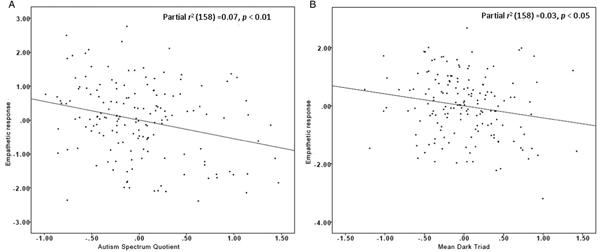
Figure 1. Partial regression plots from significant multiple regression model (adjusted R2 = .08, F (2,158) = 8.26, p < 0.01) demonstrating the independent negative partial associations while the other predictor (i.e., the dark triad or autism spectrum quotient) was held constant (all variables are residuals).
Target article
Related commentaries (32)
Beyond autism: Challenging unexamined assumptions about social motivation in typical development
Compensation in autism is not consistent with social motivation theory
Social motivation in autism: Gaps and directions for measurement of a putative core construct
We strongly endorse Jaswal & Akhtar's (J&A's) suggestion that it is empirically and ethically unwise to minimise the existence of social motivation among individuals on the autism spectrum. Further, we are pleased that J&A encouraged the sharing of qualitative accounts from people on the spectrum. Our commentary raises three points we believe the target article authors and field more generally will welcome. First, the communicating author of this commentary is autistic and would like to share his desires to be social despite its perceived costs (e.g., feelings of vulnerability from others’ antisocial behaviour). Second, Hans Asperger's dark legacy of what he labelled “autistic psychopathy” due to non-conformity to Nazi ideology (Czech Reference Czech2018) may have caused some theoreticians, therapists, or laypeople to disregard social motivation among people on the autism spectrum by conflating autism with psychopathy (e.g., lack of social conscience). Indeed, some researchers still dangerously conflate autism with psychopathy (Boka & Leibman Reference Boka and Leibman2015) despite evidence to the contrary. It is important to note that autistic and psychopathic-like traits are uncorrelated in the general population and share non-overlapping variance with empathetic responses. Third, our proposed commentary will point out that epigenetic changes over the course of socially adverse life experiences are likely responsible for social-engagement diversity among all people, not just those on spectrum. We propose that different life pathways contribute to epigenetic differences underlying the social aversion continuum.
The first author, despite being autistic, has long been interested in human kindness and how more altruistic individuals can be vulnerable to deceit by psychopathic individuals. This special interest stems from his difficulty in accurately reading others’ facial expressions and ultimately their intentions. Unlike his late father, a police officer who distrusted most people, he opted to trust others, despite the costs of exploitation. Interestingly, even though there is evidence that people on the autism spectrum are vulnerable to bullying and antisocial actions of others (Roekel et al. Reference Roekel, Scholte and Didden2009), there continues to be a misleading conflation between autism and antisocial traits, such as psychopathy (Boka & Leibman Reference Boka and Leibman2015). Qualitative analyses show that conflating autism with criminal behaviour is rampant in the media, potentially biasing judicial perceptions (Berryessa Reference Berryessa2014). However, empirical work is clear that affective empathy or indeed altruistic helping is not necessarily reduced among people on the autism spectrum (Bethlehem et al. Reference Bethlehem, Allison, van Andel, Coles, Neil and Baron-Cohen2016; Dziobek et al. Reference Dziobek, Rogers, Fleck, Bahnemann, Heekeren, Wolf and Convit2008). Furthermore, Lockwood et al. (Reference Lockwood, Bird, Bridge and Viding2013) have shown in a community sample that psychopathy predicts cognitive, but not emotional, empathy. However, the opposite pattern was found for people on the autism spectrum. Likewise, in a non-clinical sample of 161 people (63 of which were males) aged 18–74, we have found that a degree of the dark triad (i.e., a constellation of narcissism, Machiavellianism, and psychopathy; see Jones & Paulhus Reference Jones and Paulhus2013) and autistic-like traits are orthogonal: r (159) = .06, p = .43, despite being statistically significant negative predictors of emotional empathy using Batson and Ahmad's (Reference Batson and Ahmad2001) empathy induction task (Fig. 1).
Partial regression plots from significant multiple regression model (adjusted R 2 = .08, F (2,158) = 8.26, p < 0.01) demonstrating the independent negative partial associations while the other predictor (i.e., the dark triad or autism spectrum quotient) was held constant (all variables are residuals).
Interestingly, we also found that narcissism and autistic-like traits were negatively correlated: r (159) = −.26, p <.01. The pattern of findings is consistent with J&A. Specifically, people with autistic-like traits can be prosocial (Bethlehem et al. Reference Bethlehem, Allison, van Andel, Coles, Neil and Baron-Cohen2016), and psychopathy or socially aversive traits such as increased scores on the dark triad do not characterise people on the autism spectrum.
Researchers and laypersons alike may ask “why is there social-engagement diversity among those on the autism spectrum?” This is a reasonable question, as just like all people, some on the autism spectrum may be fearful or avoid social interactions. The reason for social motivation diversity is likely due to experiences during development changing the epigenome. Epigenetics is defined as “above the genome” and constitutes molecular marks placed on DNA modulating gene expression and transmitted cross-generationally without changing the underlying DNA sequence (Brown Reference Brown2015). Epigenetic regulation is a fine-grained barometer of stress and a diversity of epigenetic mechanisms have been linked to autism (Eshraghi et al. Reference Eshraghi, Liu, Kay, Eshraghi, Mittal, Moshiree and Mittal2018). Importantly, however, unlike the genome, the epigenome is more amiable to change. Our argument is that autistic people are not more vulnerable to the epigenetic effects of stress than non-autistic people. Specifically, all stress (including social stress) reconfigures epigenomes (Bernal et al. Reference Bernal, Dolinoy, Huang, Skaar, Weinhouse and Jirtle2013; Park et al. Reference Park, Skaar, Jirtle and Hoyo2017; Swartz, et al. Reference Swartz, Hariri and Williamson2017) causing social aversions among all people, not just those on the autism spectrum.
So rather than lack of social motivation being a defining characteristic of someone with autism, lack of social motivation should be viewed as an individual difference variable caused by adaptive responses to lived experiences. Negative social experiences can cause withdrawal in all people. For example, some social reactions to those on the spectrum could cause distress to people with autism. Positive reactions to autistic behaviours can help facilitate well-being. Research has demonstrated that the act of stimming within play and embracement of cognition typical of autistic individuals are critical components of socialisation and friendship for autistic children (Conn Reference Conn2015). Interventions designed to shame people with autism who engage in stimming have clearly caused harm (for moving personal accounts, see Brown Reference Brown2012; Kelley Reference Kelley2014; “Why I left ABA” 2015). Therefore the quashing of what seems to be a critical social and coping skill for autistic individuals in their formative years could impede their social motivation.
In conclusion, we agree with J&A that lack of social motivation is not a defining characteristic of people on the autism spectrum. Indeed, people with autism can be prosocial, despite having difficulties with aspects of cognitive empathy (e.g., mind reading). Furthermore, our commentary suggests social interest heterogeneity among people on the spectrum may reflect their lived experiences in the social realm as opposed to their underlying condition. We argue that, in some cases of social stress, all people, regardless of their placement on an autism spectrum, may become distrustful of others.