Jaswal & Akhtar (J&A) bring important and under-represented voices of autistic individuals into conversation with the social motivation hypothesis of autism. However, we challenge their argument that reports of autistic individuals who feel socially motivated are incongruous with neuroimaging evidence for the social motivation hypothesis. J&A cite neuroimaging studies showing decreased reward processing in autistic individuals as the purported neurobiological evidence for the social motivation hypothesis, then argue, “The problem with this line of reasoning is that, as we have noted, many autistic people claim to be very interested in other people” (sect. 6, para. 6). We argue that self-reported claims of social interest are not necessarily at odds with diminished neural social reward responsiveness for four reasons.
First, the human brain performs a range of processes unconsciously. Neuroimaging methodologies are commonly used to assay subtle processes unavailable for conscious reporting. For example, study participants will deny seeing a quickly flashed image despite visual cortex activation (Yuval-Greenberg & Heeger Reference Yuval-Greenberg and Heeger2013). We do not doubt the veracity of these participants’ reports – we believe that they did not experience seeing the image. At the same time, we accept the evidence that at an unconscious level, their brains processed this image. The value of functional neuroimaging lies in its ability to detect processes underlying cognition and behavior that are difficult to access by direct report or behavioral experiments. Autistic people can both report accurately that they feel socially motivated and demonstrate altered motivational processing at the neural level.
Second, our recent meta-analysis of reward-processing neuroimaging studies in autism (Clements et al. Reference Clements, Zoltowski, Yankowitz, Yerys, Schultz and Herrington2018) found reliable but small group differences (Cohen's d values of approximately 0.25), indicating that the autism group shows diminished activity in reward circuitry in response to social reward. This small effect may be imperceptible to an individual. These effects do not indicate that autistic participants were not at all motivated by social reward or that they did not experience being motivated by social reward. Rather, they indicate that to a small degree, their neurobiology processed reward differently. Specifically, autistic participants showed a slightly smaller increase in activity when viewing social rewards relative to viewing no reward, as compared to the increase shown by non-autistic participants. These group differences reflect one specific process within the broader, multifaceted process that produces the mental state we call “motivation.”
Third, like autism itself, social motivation exists on a spectrum, with a large range in social motivation among both autistic and non-autistic individuals. However, studies are conducted at the group level. When neuroimaging studies report that a group of autistic individuals shows lower social motivation than a group of non-autistic individuals, these effects are averaged across each group; both groups include individuals with higher and lower social motivation than the average. In study samples and in the general population, the distributions of social motivation within each group overlap, with some autistic people showing high social motivation and some non-autistic people showing low motivation. In fact, assuming normal distribution, an effect of d = 0.25 means that only 60% of autistic individuals show lower social motivation than the average non-autistic individual. Analogously, people with attention-deficit/hyperactivity disorder (ADHD) fidget more than people without ADHD on average, but some people with ADHD do not fidget at all, and some people without ADHD fall in the 99th percentile of fidgeting. The same is likely true of social motivation. The 16 anecdotes selected for the appendix show high social motivation in some autistic individuals, but in the absence of a randomly selected sample, such reports do not disprove an average group difference in social motivation. Given the massive heterogeneity of autism, it is unlikely that any one model will fit every autistic individual. As long as the social motivation hypothesis is supported on average for groups of autistic people, it can be a productive model for generating hypotheses about interventions and developing future models.
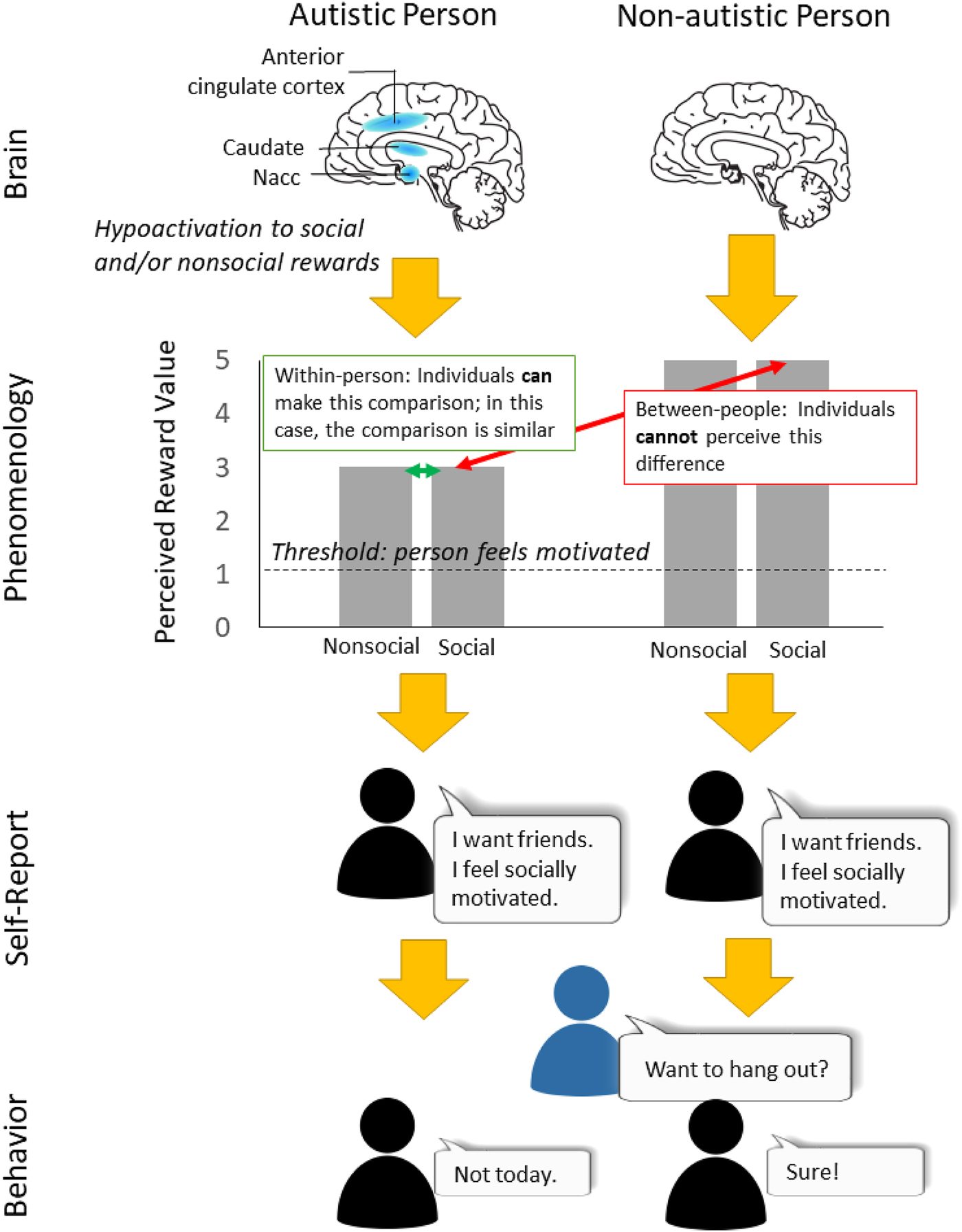
Fourth, our meta-analysis (Clements et al. Reference Clements, Zoltowski, Yankowitz, Yerys, Schultz and Herrington2018) and a recent systematic review (Bottini Reference Bottini2018) both converged on a similar conclusion: social and non-social reward processing are broadly diminished in autism. This bears directly on self-report. Individuals reporting their experience have a limited comparison sample of only their own experiences (see Fig. 1). An autistic person cannot say whether she feels more or less motivated by social interaction than a non-autistic person; she can, at best, compare her own social motivation with her own non-social motivation. Non-social motivation deficits in autism may affect self-report, in that persons comparing lower social motivation with lower non-social motivation will report that their social motivation is intact. This does not mean that we should discount the self-report of an autistic person who is socially motivated, but that such report does not necessarily reflect underlying typical levels of social motivation. We also note the emerging evidence that autistic people show increased activation to restricted interests; thus, autistic individuals’ evaluation of their own social motivation occurs in the context of more broadly altered reward processing, not simply diminished reward processing overall.
Figure 1.Autistic people show small, reliable hypoactivation in reward circuitry in response to social and non-social rewards. At the phenomenological level, an individual can only compare his own level of perceived social motivation to his own level of perceived non-social motivation (see green; both diminished in ASD); an individual cannot compare his perceived level of motivation to someone else's (see red). Here, we depict social and non-social as equal in each group for simplicity. In reality, many studies report differences between social and non-social reward value that depend upon the specific stimuli and experimental paradigms used. With regard to self-report and behavior, an individual's perceived level of motivation may be sufficient to foster a self-reported desire to establish friendships, but nonetheless lead to subtle or substantial differences in behavior, including reduced initiating and joining conversations, eye contact, and others.
In sum, we agree with J&A that some autistic individuals, such as those quoted in the appendix, experience social motivation. In fact, some of these individuals could even experience greater social motivation than non-autistic individuals. However, this does not contradict findings from the neuroimaging literature that autistic people, on average, process rewards differently. Although information about the experience of social motivation can be gleaned from self-report, information about between-person differences in processing social reward cannot. We argue that self-reported motivation from any individual cannot negate results from neuroimaging studies of groups, because neuroimaging evidence speaks to unconscious processes and group-level differences. Furthermore, the self-reports of autistic people likely reflect relative comparisons of motivation toward different types of stimuli, and accumulating evidence indicates that autism affects motivation broadly. The testimony of individuals in J&A serves as an important reminder of the limits of neuroimaging – specifically that group findings with small effects cannot be generalized to every individual – but does not inherently contradict the evidence that, on average, autistic individuals show diminished social motivation at the neural level.







Jaswal & Akhtar (J&A) bring important and under-represented voices of autistic individuals into conversation with the social motivation hypothesis of autism. However, we challenge their argument that reports of autistic individuals who feel socially motivated are incongruous with neuroimaging evidence for the social motivation hypothesis. J&A cite neuroimaging studies showing decreased reward processing in autistic individuals as the purported neurobiological evidence for the social motivation hypothesis, then argue, “The problem with this line of reasoning is that, as we have noted, many autistic people claim to be very interested in other people” (sect. 6, para. 6). We argue that self-reported claims of social interest are not necessarily at odds with diminished neural social reward responsiveness for four reasons.
First, the human brain performs a range of processes unconsciously. Neuroimaging methodologies are commonly used to assay subtle processes unavailable for conscious reporting. For example, study participants will deny seeing a quickly flashed image despite visual cortex activation (Yuval-Greenberg & Heeger Reference Yuval-Greenberg and Heeger2013). We do not doubt the veracity of these participants’ reports – we believe that they did not experience seeing the image. At the same time, we accept the evidence that at an unconscious level, their brains processed this image. The value of functional neuroimaging lies in its ability to detect processes underlying cognition and behavior that are difficult to access by direct report or behavioral experiments. Autistic people can both report accurately that they feel socially motivated and demonstrate altered motivational processing at the neural level.
Second, our recent meta-analysis of reward-processing neuroimaging studies in autism (Clements et al. Reference Clements, Zoltowski, Yankowitz, Yerys, Schultz and Herrington2018) found reliable but small group differences (Cohen's d values of approximately 0.25), indicating that the autism group shows diminished activity in reward circuitry in response to social reward. This small effect may be imperceptible to an individual. These effects do not indicate that autistic participants were not at all motivated by social reward or that they did not experience being motivated by social reward. Rather, they indicate that to a small degree, their neurobiology processed reward differently. Specifically, autistic participants showed a slightly smaller increase in activity when viewing social rewards relative to viewing no reward, as compared to the increase shown by non-autistic participants. These group differences reflect one specific process within the broader, multifaceted process that produces the mental state we call “motivation.”
Third, like autism itself, social motivation exists on a spectrum, with a large range in social motivation among both autistic and non-autistic individuals. However, studies are conducted at the group level. When neuroimaging studies report that a group of autistic individuals shows lower social motivation than a group of non-autistic individuals, these effects are averaged across each group; both groups include individuals with higher and lower social motivation than the average. In study samples and in the general population, the distributions of social motivation within each group overlap, with some autistic people showing high social motivation and some non-autistic people showing low motivation. In fact, assuming normal distribution, an effect of d = 0.25 means that only 60% of autistic individuals show lower social motivation than the average non-autistic individual. Analogously, people with attention-deficit/hyperactivity disorder (ADHD) fidget more than people without ADHD on average, but some people with ADHD do not fidget at all, and some people without ADHD fall in the 99th percentile of fidgeting. The same is likely true of social motivation. The 16 anecdotes selected for the appendix show high social motivation in some autistic individuals, but in the absence of a randomly selected sample, such reports do not disprove an average group difference in social motivation. Given the massive heterogeneity of autism, it is unlikely that any one model will fit every autistic individual. As long as the social motivation hypothesis is supported on average for groups of autistic people, it can be a productive model for generating hypotheses about interventions and developing future models.
Fourth, our meta-analysis (Clements et al. Reference Clements, Zoltowski, Yankowitz, Yerys, Schultz and Herrington2018) and a recent systematic review (Bottini Reference Bottini2018) both converged on a similar conclusion: social and non-social reward processing are broadly diminished in autism. This bears directly on self-report. Individuals reporting their experience have a limited comparison sample of only their own experiences (see Fig. 1). An autistic person cannot say whether she feels more or less motivated by social interaction than a non-autistic person; she can, at best, compare her own social motivation with her own non-social motivation. Non-social motivation deficits in autism may affect self-report, in that persons comparing lower social motivation with lower non-social motivation will report that their social motivation is intact. This does not mean that we should discount the self-report of an autistic person who is socially motivated, but that such report does not necessarily reflect underlying typical levels of social motivation. We also note the emerging evidence that autistic people show increased activation to restricted interests; thus, autistic individuals’ evaluation of their own social motivation occurs in the context of more broadly altered reward processing, not simply diminished reward processing overall.
Autistic people show small, reliable hypoactivation in reward circuitry in response to social and non-social rewards. At the phenomenological level, an individual can only compare his own level of perceived social motivation to his own level of perceived non-social motivation (see green; both diminished in ASD); an individual cannot compare his perceived level of motivation to someone else's (see red). Here, we depict social and non-social as equal in each group for simplicity. In reality, many studies report differences between social and non-social reward value that depend upon the specific stimuli and experimental paradigms used. With regard to self-report and behavior, an individual's perceived level of motivation may be sufficient to foster a self-reported desire to establish friendships, but nonetheless lead to subtle or substantial differences in behavior, including reduced initiating and joining conversations, eye contact, and others.
In sum, we agree with J&A that some autistic individuals, such as those quoted in the appendix, experience social motivation. In fact, some of these individuals could even experience greater social motivation than non-autistic individuals. However, this does not contradict findings from the neuroimaging literature that autistic people, on average, process rewards differently. Although information about the experience of social motivation can be gleaned from self-report, information about between-person differences in processing social reward cannot. We argue that self-reported motivation from any individual cannot negate results from neuroimaging studies of groups, because neuroimaging evidence speaks to unconscious processes and group-level differences. Furthermore, the self-reports of autistic people likely reflect relative comparisons of motivation toward different types of stimuli, and accumulating evidence indicates that autism affects motivation broadly. The testimony of individuals in J&A serves as an important reminder of the limits of neuroimaging – specifically that group findings with small effects cannot be generalized to every individual – but does not inherently contradict the evidence that, on average, autistic individuals show diminished social motivation at the neural level.