






No CrossRef data available.
Article contents
The evolution of music: One trait, many ultimate-level explanations
Published online by Cambridge University Press: 30 September 2021
Abstract
We propose an approach reconciling the ultimate-level explanations proposed by Savage et al. and Mehr et al. as to why music evolved. We also question the current adaptationist view of culture, which too often fails to disentangle distinct fitness benefits.
Information
- Type
- Open Peer Commentary
- Information
- Copyright
- Copyright © The Author(s), 2021. Published by Cambridge University Press
References
André, J.-B., Baumard, N., & Boyer, P. (2020). The Mystery of Symbolic Culture: What fitness costs? What fitness benefits? 18. https://osf.io/kdh7t/download?format=pdf.Google Scholar
Bourdieu, P. (1979). La distinction: Critique sociale du jugement. Éditions de Minuit.Google Scholar
Hamilton, W. (1964). The genetical evolution of social behaviour. I. Journal of Theoretical Biology, 7(1), 1–16.Google Scholar
Krebs, J. R., & Dawkins, R. (1978). Animal signals: Mind reading and manipulation. In J. R. Krebs & N. B. Davies (Eds.), Behavioral ecology: An evolutionary approach (pp. 282–309), Blackwell Scientific Publications.Google Scholar
Lorenz, K. Z. (1966). Evolution of ritualization in the biological and cultural spheres. Philosophical Transactions of the Royal Society of London. Series B, Biological Sciences, 251(772), 273–284.Google Scholar
Miller, G. (2011). The mating mind: How sexual choice shaped the evolution of human nature. Anchor.Google Scholar
Petrie, M. (1994). Improved growth and survival of offspring of peacocks with more elaborate trains. Nature, 371(6498), 598–599. https://doi.org/10.1038/371598a0.CrossRefGoogle Scholar
Petrie, M., Tim, H., & Carolyn, S. (1991). Peahens prefer peacocks with elaborate trains. Animal Behaviour, 41(2), 323–331. https://doi.org/10.1016/S0003-3472(05)80484-1.CrossRefGoogle Scholar
Ryan, M. J., Fox, J. H., Wilczynski, W., & Rand, A. S. (1990). Sexual selection for sensory exploitation in the frog Physalaemus pustulosus. Nature, 343(6253), 66–67. https://doi.org/10.1038/343066a0.CrossRefGoogle ScholarPubMed
Veblen, T. (1899). Theory of the leisure class: An Economic Study of Institutions. Macmillan.Google Scholar
Zahavi, A. (1975). Mate selection – A selection for a handicap. Journal of Theoretical Biology, 53(1), 205–214. https://doi.org/10.1016/0022-5193(75)90111-3.CrossRefGoogle ScholarPubMed
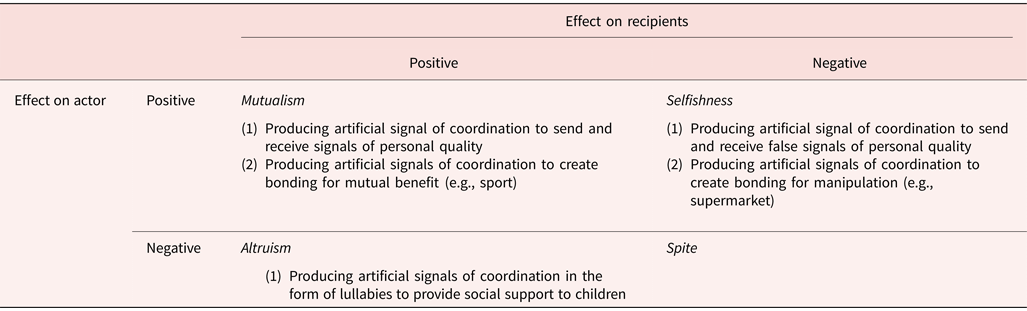
Table 1. Fitness costs and benefits of music-related behavior on both producers and consumers of music, with the framework from social evolution theory (André et al., 2020; Hamilton, 1964)
Target article
Related commentaries (60)
A boldly comparative approach will strengthen co-evolutionary accounts of musicality's origins
A neurodevelopmental disorders perspective into music, social attention, and social bonding
An evolutionary theory of music needs to care about developmental timing
Credible signalling and social bonds: Ultimately drawing on the same idea
Functional and evolutionary parallels between birdsong and human musicality
Is neural entrainment to rhythms the basis of social bonding through music?
Music as a trait in evolutionary theory: A musicological perspective
Not by signalling alone: Music's mosaicism undermines the search for a proper function
Oxytocin as an allostatic agent in the social bonding effects of music
Sound sleep: Lullabies as a test case for the neurobiological effects of music
The music and social bonding hypothesis does require multilevel selection
Savage et al. focus on the social functions of music-related behaviors, but they don't explain why musicality, and not music, is often preferred to other things such as food, perfume, and painting, to increase social bonding in humans. Similarly, Mehr et al.'s article focuses on the adaptive nature of musicality, which might well be rooted in credible signaling for coalition strength, but they don't expand on how and why music develops new social functions beyond coalition signaling. We argue that both hypotheses need each other to provide a comprehensive and consistent evolutionary understanding of music. We aim at showing why this is the case by disentangling three evolutionary steps.
The first step should account for the fitness benefits of producing music-like sounds in the first place. Mehr et al. provide evidence that contact calls and territorial advertisements may have been the evolutionary precursors of music-related cognitive processes and behavior in humans. Coordinated rhythm, according to Mehr et al., enhanced fitness in local environments when humans evolved because it credibly signaled high level of interindividual coordination. Their hypothesis is seducing because it explains both how music could emerge by natural selection (because it provides a unique way to signal coalition that food or smell cannot provide) and the cognitive constraints such an evolution would have put on all future music-related inventions (they need a least some rhythm). This hypothesis explains why humans evolved cognitive mechanisms to detect and enjoy music-like inputs, at the proximate level. However, it doesn't explain why music evolved culturally with much variability and extend beyond situations of coalitional signaling.
This is the second step. In many species, once a behavioral or phenotypic trait has emerged, it can be co-opted for new adaptive functions. This is very often the case, in particular for traits involved in signaling, as signaling evolves by recycling traits that have first evolved for other functions (Krebs & Dawkins, Reference Krebs and Dawkins1978; Lorenz, Reference Lorenz1966). For instance, the female frog Physalaemus pustulosus had pre-existing preferences for lower-frequency chuck sounds, and then males evolved the ability to produce such sounds to exploit this sensory preference (Ryan, Fox, Wilczynski, & Rand, Reference Ryan, Fox, Wilczynski and Rand1990). In nonhuman animals, this recycling usually emerges by natural selection.
But, it can also emerge by cultural evolution. Humans are very plastic. Thanks to their cognitive flexibility, they can recycle existing behaviors and preferences and use evolved preferences (e.g., for sugar, sex, social information, and musicality) to shape sophisticated cultural things (e.g., cheesecakes, pornography, stories, and music) that other people enjoy consuming. As many have noted, musicians, singers, and dancers honestly signal skills and qualities through their performances and this leads to sexual, reputational, or material benefits (André, Baumard, & Boyer, Reference André, Baumard and Boyer2020; Miller, Reference Miller2001). Even in modern industrialized societies, musicians and singers take advantage of their productions with economic benefits. We suggest this underlies the producers' motivation to craft such cultural items in the first place.
This second step crucially explains why music appeared in human culture: because (1) humans had evolved with a preference for music-like sounds and (2) people adaptively used this preference to do other things. However, it does not explain why, according to many empirical studies reported by Savage et al., music promotes social bonding.
The third step implies that signaling is not necessarily selfish. At least in small-scale societies, consumers should have fitness benefits too. The most obvious one is the acquisition of the information about the musicians, inferred from their music. A similar phenomenon is well described in the nonhuman animal literature: Peacocks impress peahens with their large and beautiful tails, but the peahens are adaptively drawn to them because the size of the tails honestly signal the genetic quality of the peacocks, leading to a more informative sexual partner choice (Petrie, Reference Petrie1994; Petrie, Tim, & Carolyn, Reference Petrie, Tim and Carolyn1991; Zahavi, Reference Zahavi1975). Similarly, in small-scale societies, consumers know how skilled producers of music are merely by listening to their music, and they can arguably better choose skilled cooperative agents or mating partners. In large-scale societies, consumers can take advantage of the fact that other people are also attracted by music to signal preferences, skills, and qualities of their own to other people (Bourdieu, Reference Bourdieu1979; Veblen, Reference Veblen1899).
But. there is another social use of music that relates to the first adaptive function of musicality. Coordinated rhythm evolved to be perceived as a credible signal of coalitional bond. Thus, when we listen to coordinated rhythm outside an agonistic context, we cannot help but analyze this signal as a cue that, somehow, we are part of a well-coordinated coalition. Hence, we feel the pleasure of having social support. This would explain why, by default, music makes people cheerful: it mimics the signal that we have coalitional allies (exactly like pornography is arousing because it mimics the signal that we have an opportunity to reproduce). Humans will thus use music in all cases when they need to artificially create social bonding, with actual fitness consequences (Table 1). We propose that most of the findings reported by Savage et al. are best understood in light of this adaptive recycling.
Fitness costs and benefits of music-related behavior on both producers and consumers of music, with the framework from social evolution theory (André et al., Reference André, Baumard and Boyer2020; Hamilton, Reference Hamilton1964)
In sum, we believe evolutionary approaches of cultural items such as music should carefully distinguish fitness costs and benefits from separate evolutionary steps. In that sense, we believe that the publication of these two articles as a pair is an exciting event in the field, if we prevent ourselves from setting them against each other.
Financial support
This study is supported by FrontCog ANR-17-EURE-0017.
Conflict of interest
None.