






No CrossRef data available.
Article contents
Neuropeptide-like signaling in the microbiota-gut-brain axis
Published online by Cambridge University Press: 15 July 2019
Abstract
For gut microbiota to influence behavior, microorganisms should be able to interfere with specific brain neurochemical circuitries. Understanding these molecular mechanisms is a key task in the new microbiota-gut-brain field. Recent studies have revealed that one major mechanistic link is the modulation of neuropeptide signaling by homologous bacterial proteins acting both directly and indirectly via production of neuropeptide-reactive immunoglobulins.
Information
- Type
- Open Peer Commentary
- Information
- Copyright
- Copyright © Cambridge University Press 2019
Footnotes
1.
The author is a founder and scientific advisor of TargEDys SA.
References
Breton, J., Legrand, R., Akkermann, K., Järv, A., Harro, J., Déchelotte, P. & Fetissov, S. O. (2016a) Elevated plasma concentrations of bacterial ClpB protein in patients with eating disorders. International Journal of Eating Disorders 49(8):805–808. Available at: https://www.doi.org/10.1002/eat.22531.Google Scholar
Breton, J., Tennoune, N., Lucas, N., François, M., Legrand, R., Jacquemot, J., Goichon, A., Guérin, C., Peltier, J., Pestel-Caron, M., Chan, P., Vaudry, D., do Rego, J. C., Liénard, F., Pénicaud, J., Fioramonti, X., Ebenezer, I. S, Hökfelt, T., Déchelotte, P. & Fetissov, S. O. (2016b) Gut commensal E. coli proteins activate host satiety pathways following nutrient-induced bacterial growth. Cell Metabolism 23:324–34. Available at: http://dx.doi.org/10.1016/j.cmet.2015.10.017.Google Scholar
Ericson, M. D., Schnell, S. M., Freeman, K. T. & Haskell-Luevano, C. (2015) A fragment of the Escherichia coli ClpB heat-shock protein is a micromolar melanocortin 1 receptor agonist. Bioorganic & Medicinal Chemistry Letters 25(22):5306–308. Available at: http://dx.doi.org/10.1016/j.bmcl.2015.09.046.Google Scholar
Fetissov, S. O., Hamze Sinno, M., Coëffier, M., Bole-Feysot, C., Ducrotté, P., Hökfelt, T. & Déchelotte, P. (2008) Autoantibodies against appetite-regulating peptide hormones and neuropeptides: Putative modulation by gut microflora. Nutrition 24(4):348–59. Available at: http://www.sciencedirect.com/science/article/B6TB0-4RSRR1P-1/2/e54c334156f121b0ec526a69b603506f.Google Scholar
Fetissov, S. O., Harro, J., Jaanisk, M., Järv, A., Podar, I., Allik, J., Nilsson, I., Sakthivel, P., Lefvert, A. K. & Hökfelt, T. (2005) Autoantibodies against neuropeptides are associated with psychological traits in eating disorders. Proceedings of the National Academy of Sciences USA 102(41):14865–70.Google Scholar
Fetissov, S. O., Legrand, R. & Lucas, N. (2019) Bacterial protein mimetic of peptide hormone as a new class of protein-based drugs. Current Medicinal Chemistry 26(3):546–53. Available at: https://doi.org/10.2174/0929867324666171005110620.Google Scholar
François, M., Schaefer, J. M., Bole-Feysot, C., Déchelotte, P., Verhulst, F. C. & Fetissov, S. O. (2015) Ghrelin-reactive immunoglobulins and anxiety, depression and stress-induced cortisol response in adolescents. The TRAILS study. Progress in Neuro-Psychopharmacology 59:1–7. Available at: http://dx.doi.org/10.1016/j.pnpbp.2014.12.011.Google Scholar
Garcia, F. D., Coquerel, Q., do Rego, J.-C., Cravezic, A., Bole-Feysot, C., Kiive, E., Déchelotte, P., Harro, J. & Fetissov, S. O. (2012) Anti-neuropeptide Y plasma immunoglobulins in relation to mood and appetite in depressive disorder. Psychoneuroendocrinology 37:1457–67. Available at: http://www.sciencedirect.com/science/article/pii/S0306453012000522.Google Scholar
Garcia, F. D., Coquerel, Q., Kiive, E., Déchelotte, P., Harro, J. & Fetissov, S. O. (2011) Autoantibodies reacting with vasopressin and oxytocin in relation to cortisol secretion in mild and moderate depression. Progress in Neuro-Psychopharmacology and Biological Psychiatry 35(1):118–25. Available at: http://www.sciencedirect.com/science/article/B6TBR-515SRKJ-1/2/799ec6a29b3a8757aa79b210e93426f0.Google Scholar
Hökfelt, T., Bartfai, T. & Bloom, F. (2003) Neuropeptides: Opportunities for drug discovery. Lancet Neurology 2(8):463–72. Available at: http://www.ncbi.nlm.nih.gov/entrez/query.fcgi?cmd=Retrieve&db=PubMed&dopt=Citation&list_uids=12878434.Google Scholar
Karaiskos, D., Mavragani, C. P., Sinno, M. H., Déchelotte, P., Zintzaras, E., Skopouli, F. N., Fetissov, S. O. & Moutsopoulos, H. M. (2010) Psychopathological and personality features in primary Sjogren's syndrome – Associations with autoantibodies to neuropeptides. Rheumatology 49(9):1762–69. Available at: http://rheumatology.oxfordjournals.org/cgi/content/abstract/keq158v1.Google Scholar
Lucas, N., Legrand, R., Bôle-Feysot, C., Breton, J., Coëffier, M., Akkermann, K., Järv, A., Harro, J., Déchelotte, P. & Fetissov, S. O. (2019) Immunoglobulin G modulation of the melanocortin 4 receptor signaling in obesity and eating disorders. Translational Psychiatry 9(1): Article number 87. Available at: https://doi.org/10.1038/s41398-019-0422-9.Google Scholar
Mogk, A., Deuerling, E., Vorderwulbecke, S., Vierling, E. & Bukau, B. (2003) Small heat shock proteins, ClpB and the DnaK system form a functional triade in reversing protein aggregation. Molecular Microbiology 50(2):585–95. Available at: http://www.ncbi.nlm.nih.gov/pubmed/14617181.Google Scholar
Takagi, K., Legrand, R., Asakawa, A., Amitani, H., François, M., Tennoune, N., Coëffier, M., Claeyssens, S., do Rego, J.-C., Déchelotte, P., Inui, A. & Fetissov, S. O. (2013) Anti-ghrelin immunoglobulins modulate ghrelin stability and its orexigenic effect in obese mice and humans. Nature Communications 4:2685.Google Scholar
Tennoune, N., Chan, P., Breton, J., Legrand, R., Chabane, Y. N., Akkermann, K., Jarv, A., Ouelaa, W., Takagi, K., Ghouzali, I., François, M., Lucas, N., Bole-Feysot, C., Pestel-Caron, M., do Rego, J.C., Vaudry, D., Harro, J., Dé, E., Déchelotte, P. & Fetissov, S. O. (2014) Bacterial ClpB heat-shock protein, an antigen-mimetic of the anorexigenic peptide [alpha]-MSH, at the origin of eating disorders. Translational Psychiatry 4:e458. Available at: https://doi.org/10.1038/tp.2014.98.Google Scholar
Værøy, H., Adori, C., Legrand, R., Lucas, N., Breton, J., Cottard, C., do Rego, J.-C., Duparc, C., Louiset, E., Lefebvre, H., Déchelotte, P., Western, E., Andersson, S., Hökfelt, T. & Fetissov, S. O. (2018) Autoantibodies reactive to adrenocorticotropic hormone can alter cortisol secretion in both aggressive and nonaggressive humans. Proceedings of the National Academy of Sciences USA 115(28):E6576–84. Available at: https://doi.org/10.1073/pnas.1720008115.Google Scholar
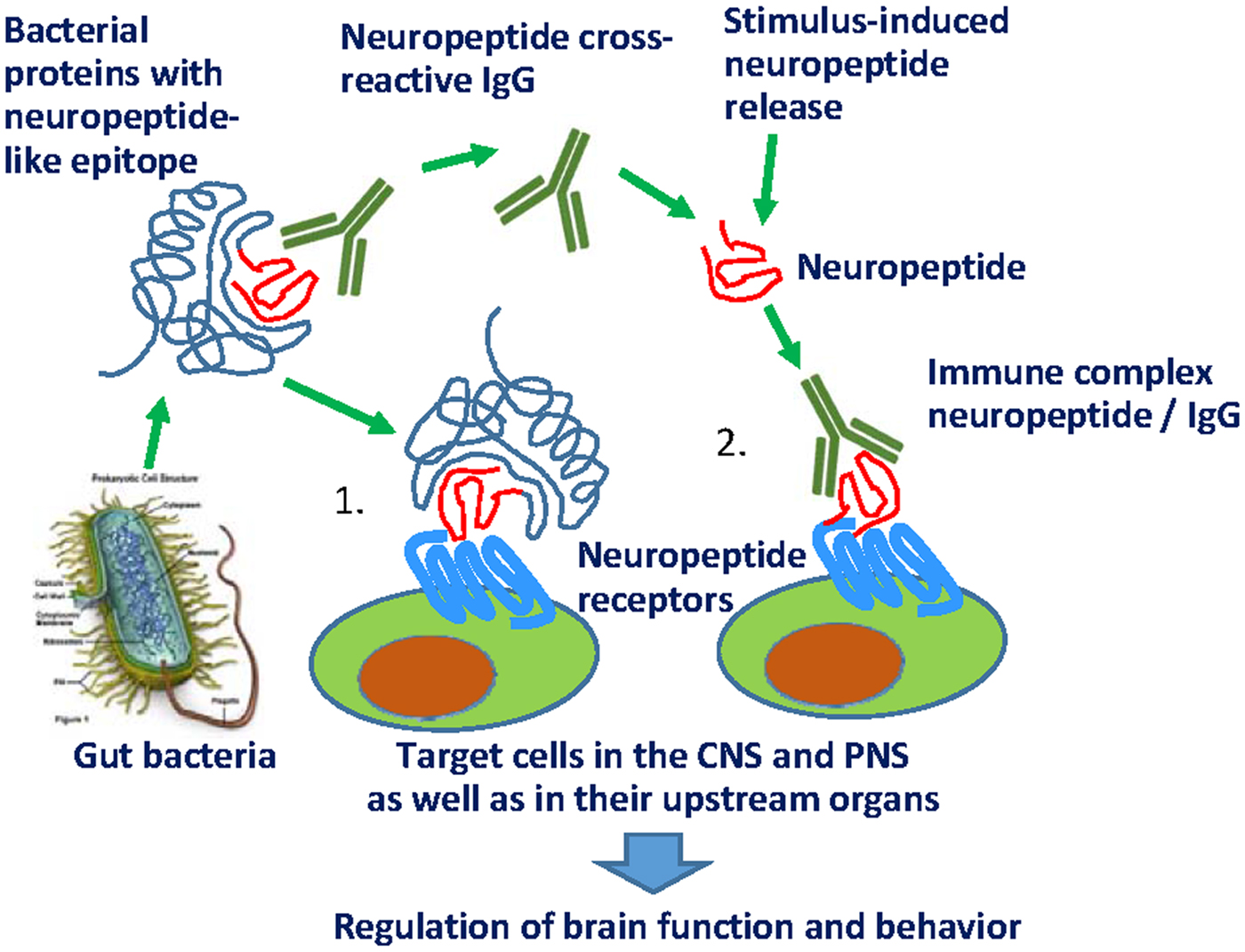
Figure 1. Simplified model illustrating the concept of microbiota influence of peptidergic signaling in MGB axis: (1) Binding of bacterial mimetic proteins to neuropeptide receptors may directly modify peptidergic signaling. (2) Bacterial mimetic proteins may trigger production of neuropeptide cross-reactive IgG forming functional immune complexes with neuropeptides providing an indirect mechanism of microbiota influence on peptidergic signaling. This model supposes either stimulation or inhibition of neuropeptide signaling in central and peripheral nervous systems (CNS and PNS) depending on the molecular properties of bacterial mimetic proteins and immune complexes, effectively linking microbiota composition with neuropeptidergic regulation of brain function and behavior.
Target article
Related commentaries (19)
A call for mapping the development of the microbiota-gut-brain axis during human infancy
Beyond a gut feeling: How the immune system impacts the effect of gut microbiota in neurodevelopment
Nourishing the gut microbiota: The potential of prebiotics in microbiota-gut-brain axis research
Practical guidelines for gut microbiome analysis in microbiota-gut-brain axis research
The parent-offspring microbiome and neurobehavioral development
The associations between dysbiotic microbiota and various physiological and pathological brain states and behavior have been reported, including some most highly cited papers selected for critical analysis by Hooks et al. Multiple problems of the new field of microbiota-gut-brain (MGB) have been rightly highlighted including the current lack of causality between dysbiosis and behavior. As the solution to this problem and for future directions the authors suggest focusing on “more connected research … in multipathway systems” (sect. 9, para. 1). I find this suggestion too vague and would instead propose to focus the MGB research on determining the possible role of specific bacteria in modulating brain function and behavior. Moreover, because the MGB research is connecting with the mature scientific fields of neuroscience, neuroendocrinology, and neuroimmunology, it could be more constructive to design new MGB studies that target the well-known neurochemical systems. The ultimate goal of such studies would be identification of molecular tools used by specific gut bacteria to influence the specific brain pathways including molecular and cellular targets. Classic neurotransmitters, such as GABA, dopamine, and so forth, and neuropeptides may be among the primary targets of microbiota interference. My further comment gives an example of experimental and conceptual approaches to promote the specificity in MGB research.
Neuropeptides and peptide hormones may participate in the MGB signaling because of their specific roles in the regulation of various brain functions and behavior (Hökfelt et al. Reference Hökfelt, Bartfai and Bloom2003). The specificity of each neuropeptide is determined by its unique amino acid sequence binding with a nanomolar affinity to neuropeptide receptors. These properties of neuropeptides make them perfect targets for microbiota-derived homologous proteins. Indeed, this type of MGB mechanism of communication was recently described for α-melanocyte-stimulating hormone (α-MSH), a neuropeptide of the melanocortin (MC) family involved in regulation of energy metabolism, memory, and emotion. A heat shock protein, ClpB, which plays a key role in protein disaggregation in bacteria (Mogk Reference Mogk, Deuerling, Vorderwulbecke, Vierling and Bukau2003), was found to contain an α-MSH-like motif (Tennoune et al. Reference Tennoune, Chan, Breton, Legrand, Chabane, Akkermann, Jarv, Ouelaa, Takagi, Ghouzali, François, Lucas, Bole-Feysot, Pestel-Caron, do Rego, Vaudry, Harro, Dé, Déchelotte and Fetissov2014). A complementarity of this motif towards the MC receptors was then demonstrated (Ericson et al. Reference Ericson, Schnell, Freeman and Haskell-Luevano2015) providing the mechanistic background for a direct α-MSH-like effect of ClpB. In support of such molecular mimicry, mice receiving native Escherichia coli, but not ClpB-deficient bacteria, displayed reduced food intake and body weight (i.e., demonstrating an α-MSH-like anorexigenic effect of ClpB [Tennoune et al. Reference Tennoune, Chan, Breton, Legrand, Chabane, Akkermann, Jarv, Ouelaa, Takagi, Ghouzali, François, Lucas, Bole-Feysot, Pestel-Caron, do Rego, Vaudry, Harro, Dé, Déchelotte and Fetissov2014]). Moreover, ClpB activated the arcuate nucleus proopiomelanocortin neurons, a key structure in the brain anorexigenic pathway (Breton et al. Reference Breton, Tennoune, Lucas, François, Legrand, Jacquemot, Goichon, Guérin, Peltier, Pestel-Caron, Chan, Vaudry, do Rego, Liénard, Pénicaud, Fioramonti, Ebenezer, Hökfelt, Déchelotte and Fetissov2016b). Finally, to reach the brain ClpB should be present in blood, and in fact, it was detected in plasma of healthy humans (Breton et al. Reference Breton, Legrand, Akkermann, Järv, Harro, Déchelotte and Fetissov2016a), while its plasma concentration in rats was proportional to the ClpB DNA expression in feces (Breton Reference Breton, Tennoune, Lucas, François, Legrand, Jacquemot, Goichon, Guérin, Peltier, Pestel-Caron, Chan, Vaudry, do Rego, Liénard, Pénicaud, Fioramonti, Ebenezer, Hökfelt, Déchelotte and Fetissov2016b). It is also of importance for the concept of MGB signaling to mention that the α-MSH-like motif of ClpB was specific to the ClpB protein expressed by the family of Enterobacteriaceae (Fetissov et al. Reference Fetissov, Legrand and Lucas2019). Hence, the ClpB protein appears as an endocrine neuropeptide-like factor, whose production is regulated by gut bacteria (i.e., dependent on gut microbiota composition).
This discovery of the α-MSH-like properties of ClpB was initially triggered by the observation of α-MSH-reactive autoantibodies in humans and rodents. Subsequently, ClpB has been found to act as an antigen mimetic of α-MSH – that is, active immunization or per os provision of ClpB-expressing E.coli bacteria leads to increased plasma level of anti-ClpB α-MSH cross-reactive immunoglobulins (Ig's) (Tennoune et al. Reference Tennoune, Chan, Breton, Legrand, Chabane, Akkermann, Jarv, Ouelaa, Takagi, Ghouzali, François, Lucas, Bole-Feysot, Pestel-Caron, do Rego, Vaudry, Harro, Dé, Déchelotte and Fetissov2014). The relevance of such α-MSH-reactive IgG and IgM to brain function and behavior was shown by significant correlations of their plasma levels with psychopathological scores in patients with psychiatric disorders including anorexia nervosa and bulimia (Fetissov et al. Reference Fetissov, Harro, Jaanisk, Järv, Podar, Allik, Nilsson, Sakthivel, Lefvert and Hökfelt2005), as well as with depression and anxiety scores in healthy subjects (Karaiskos et al. Reference Karaiskos, Mavragani, Sinno, Déchelotte, Zintzaras, Skopouli, Fetissov and Moutsopoulos2010). Further molecular insight comes from the finding that α-MSH in the circulation forms immune complexes with IgG that activate the MC4 receptors with a lower threshold than α-MSH alone. Importantly, different IgG α-MSH binding epitopes in patients with obesity and anorexia nervosa were accompanied by altered kinetics of immune complex formation and MC4 receptor binding and activation. Such modulation of MC4 receptor signaling may contribute to altered regulation of appetite and energy metabolism in patients (Lucas et al. Reference Lucas, Legrand, Bôle-Feysot, Breton, Coëffier, Akkermann, Järv, Harro, Déchelotte and Fetissov2019). Considering the causal role of specific bacterial antigens in production of α-MSH-reactive IgG, it is likely that the altered levels and binding properties of α-MSH-reactive IgG in patients with obesity and eating disorders may result from altered antigenic composition of their gut microbiota.
Taken together, the ClpB/α-MSH homology provides an example of a specific molecular link between gut bacteria of the Enterobacteriaceae family and the MC system regulating feeding behavior. Such data are valuable for the interpretation of the potential impact of gut microbiota composition on the MGB axis. For example, when increased abundance of Enterobacteriaceae is detected, over-activation of the MC system, including low appetite, can be expected. This example can also be generalized as a concept for neuropeptide-like signaling in the MGB axis applicable to other neuropeptides and peptide hormones (Fig. 1). In fact, healthy humans possess plasmatic immunoglobulins reactive with several key regulatory peptides displaying sequence homology with proteins derived from gut microbiota (Fetissov et al. Reference Fetissov, Hamze Sinno, Coëffier, Bole-Feysot, Ducrotté, Hökfelt and Déchelotte2008). For example, natural IgGs reactive with corticotropin were shown to interfere with cortisol secretion and aggressive behavior (Værøy et al. Reference Værøy, Adori, Legrand, Lucas, Breton, Cottard, do Rego, Duparc, Louiset, Lefebvre, Déchelotte, Western, Andersson, Hökfelt and Fetissov2018), ghrelin-reactive IgGs were found to improve ghrelin stability and to enhance feeding behavior (Takagi et al. Reference Takagi, Legrand, Asakawa, Amitani, François, Tennoune, Coëffier, Claeyssens, do Rego, Déchelotte, Inui and Fetissov2013), whereas oxytocin-, vasopressin-, ghrelin-, and neuropeptide Y (NPY)-reactive natural IgGs were associated with anxiety and depression (François et al. Reference François, Schaefer, Bole-Feysot, Déchelotte, Verhulst and Fetissov2015; Garcia et al. Reference Garcia, Coquerel, Kiive, Déchelotte, Harro and Fetissov2011; Reference Garcia, Coquerel, do Rego, Cravezic, Bole-Feysot, Kiive, Déchelotte, Harro and Fetissov2012). It is, hence, likely that the production of such neuropeptide- and peptide hormone-reactive IgG may be directly linked to the homologous antigenic stimulation from gut microbiota. Discovery of neuropeptide-like antigenic bacterial proteins should represent then one of the main tasks for improving our understanding of the functionality of the MGB axis at least as it concerns the specific peptidergic systems regulating brain functions and behavior.
Simplified model illustrating the concept of microbiota influence of peptidergic signaling in MGB axis: (1) Binding of bacterial mimetic proteins to neuropeptide receptors may directly modify peptidergic signaling. (2) Bacterial mimetic proteins may trigger production of neuropeptide cross-reactive IgG forming functional immune complexes with neuropeptides providing an indirect mechanism of microbiota influence on peptidergic signaling. This model supposes either stimulation or inhibition of neuropeptide signaling in central and peripheral nervous systems (CNS and PNS) depending on the molecular properties of bacterial mimetic proteins and immune complexes, effectively linking microbiota composition with neuropeptidergic regulation of brain function and behavior.
Acknowledgment
The author is supported by the Transversal Microbiota Program of Inserm, France.