



R1. Introduction
Human microbiome research has captured the imagination of scientists, clinicians, research funders, health providers, and the public. There are many good reasons for such enthusiastic responses to the early insights generated from closer scrutiny of our microbial residents. Not only has a great deal been learned about these multitudinous occupants of human bodies, but there are also anticipations of new explanations and treatments for a vast range of diseases and disorders. Although little of this promise has been precisely actualized yet, extensive efforts are underway to bring microbiomes into deeper and sharper focus. This “second phase” of research in the emerging microbiome arena is now occurring in one of its newer sub-fields: microbiota-gut-brain (MGB) research.
The broad scope and interdisciplinary appeal of MGB research are evident in the commentaries on our target article. Our aim in that paper was to raise issues of importance for anyone interested in this area of scientific research, with the expectation that further cross-disciplinary dialogue will contribute to problem solving and future advances. The commentaries bear out this aim: Each of them constructively suggests ways in which MGB research can avoid existing pitfalls and explore new areas of investigation.
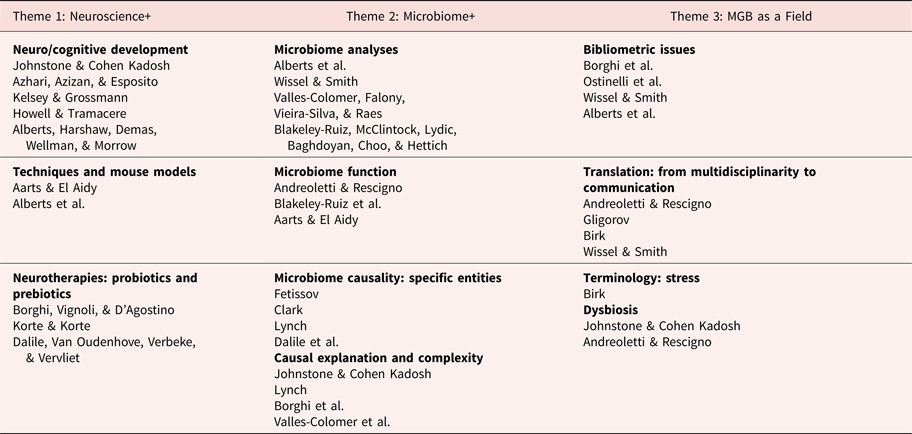
We see three main themes in these commentaries, with several papers contributing to more than one of them (Table 1). Theme 1 is “expanding the neuroscience of MGB research,” particularly to investigate relationships between microbiomes and brain development and increase insight into potential treatments. Theme 2 is concerned with “expanding the microbiome analyses of MGB research” by developing additional bioinformatic, experimental, and explanatory tools. Theme 3 focuses on “understanding MGB as a field” from bibliometric, translational, and terminological angles.
Three general themes categorizing the commentaries on the target article “Microbiota-Gut-Brain Research: A Critical Analysis” by Hooks et al.

Theme 1: Expanding the neuroscience of MGB research
One of the strongest areas of advocacy in the commentaries is for closer attention to brain development in MGB research. Johnstone & Cohen Kadosh, for example, propose that developmental cognitive neuroscience can make MGB research sounder and stronger. Howell & Tramacere also call for more attention to behavioural development in relation to MGB research, especially with regard to longitudinal investigations in human subjects. They believe that microbiomes and brain development are linked to breast milk and are very enthusiastic about recent findings in Carlson et al. (Reference Carlson, Xia, Azcarate-Peril, Goldman, Ahn, Styner, Thompson, Geng, Gilmore and Knickmeyer2018), as are Kelsey & Grossmann. Kelsey & Grossmann go on to urge “mapping [of] the development of the microbiota-gut-brain axis during human infancy.” They criticize us for having “overlooked” the role of the human microbiome in brain and cognitive development, although they are blaming the messenger here. As Alberts, Harshaw, Demas, Wellman, & Morrow (Alberts et al.) observe, it is the 25 most cited MGB articles that have given cognitive development little attention. Our target article did in fact address some conflicting claims in those 25 papers about critical neurodevelopmental periods.
Azhari, Azizan, & Esposito (Azhari et al.) start out somewhat differently, by saying that our target article proposes that “the mere presence” (para. 1) of gut microbiota should be considered developmental signals and not specific causal agents (although we do not say exactly this, we are happy to listen to evidence and reasons for this position). Azhari et al. go on to argue that although the fetus does not have a gut microbiota (despite some artefactual findings), maternal inflammatory responses to bacterial or viral infection need prime consideration with regard to their impact on prenatal neurodevelopment. Azhari et al. are thus urging us (and MGB researchers) to consider the microbiota as an “intermediary system,” rather than a “direct causative agent” in the case of neurodevelopmental disorders such as autism.
Fetal responses to maternal inflammation may indeed be one avenue of insight into cognitive neurodevelopment. Earlier fields, such as psychoneuroimmunology, successfully showed how maternal infection-induced inflammation alters offspring behaviour. However, many MGB researchers might worry that Azhari et al.’s focus on maternal inflammatory products puts the microbiota at a causal remove. In other words, the microbiota, or specific components of it, become not the most proximate causes of particular phenotypes but more distal causal contributors. Not everyone will see this as the right way to understand microbiome causality, which is a topic we discuss at length in Theme 2. Moreover, we are not as sure as Azhari et al. that “specific species of microbes” are not key parts of these causal chains. Although an increasing amount of MGB research refers to neuroimmune interactions, a pressing question is whether and how the experimental investigation of inflammation can be integrated with broader microbiome surveys. As we discuss in Theme 2, homing in on testable causal factors is not so easy when the microbiota is seen as an aggregated mass of potential causality that is embedded in diverse systems of causal interaction.
Assessing causal contributions from microbiomes is crucial whatever the phenomena being explained. MGB and other microbiome research is concerned not only with disease, but also with “normal” human features. An impressive number of our commentators are keen that our reflections on MGB research include additional attention to the relationship of microbiota to cognitive development (see Table 1). We are happy to oblige by focusing on a paper acclaimed by two commentaries as exemplary: Carlson et al. (Reference Carlson, Xia, Azcarate-Peril, Goldman, Ahn, Styner, Thompson, Geng, Gilmore and Knickmeyer2018). This paper examines the microbiomes of 1-year-olds. It finds there are different “types” of microbiome composition (similar to adults), and that breastfed children have lower-diversity microbiomes that also correlate with greater language development at 2 years old. Although this study certainly has some promising elements, we are not sure it will push MGB onto a better track in the ways Howell & Tramacere and Kelsey & Grossmann believe it will. Let us outline briefly why.
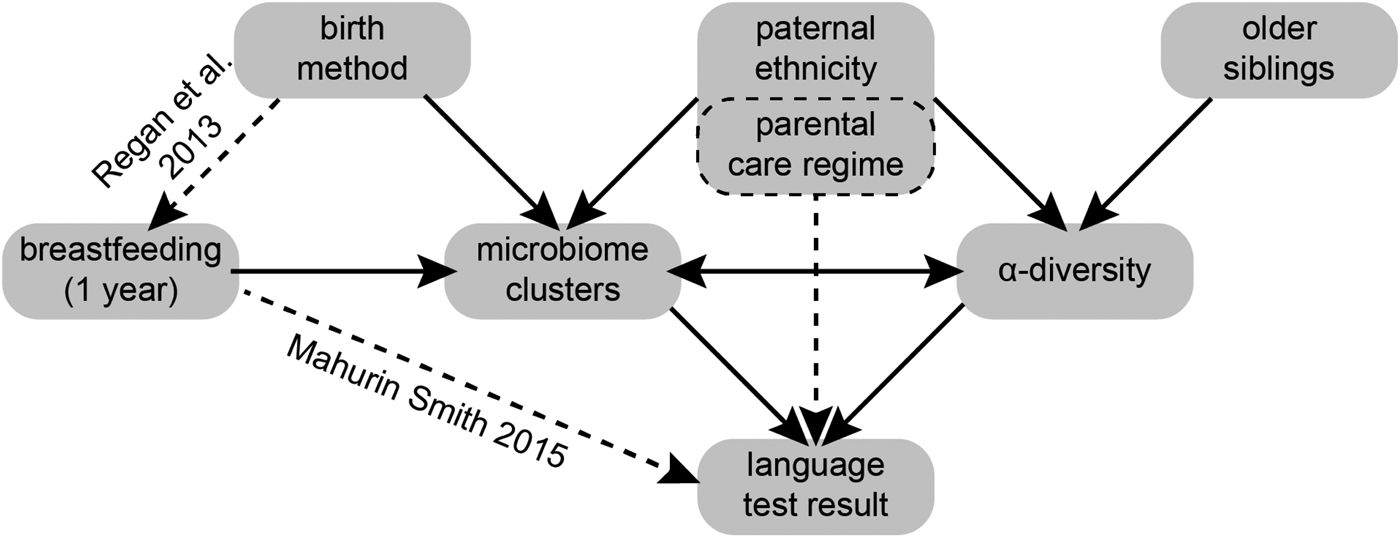
First off, Carlson et al. (Reference Carlson, Xia, Azcarate-Peril, Goldman, Ahn, Styner, Thompson, Geng, Gilmore and Knickmeyer2018) are focused on correlations, in this case primarily between microbiome diversity and cognitive markers (language). The study explicitly denies positing a causal relationship but uses other terminology to hint at such connections (e.g., “the development of the gut microbiome … support[s] cognitive development” [p. 157]; “gut microbiota influences brain development during a critical period” [p. 154]). But, in fact, all these correlations could also be explained by other variables measured in the study, particularly the nutritional benefits of breast milk and – more implicitly – parental care regimes (see our Fig. 1). It is not clear why microbiota were not sampled at 2 years (when language development was assessed), especially when the authors push hard on a stage-like model of microbiome development (e.g., “delayed maturation of the microbiome” [p. 154]).
Correlations revealed in Carlson et al. (Reference Carlson, Xia, Azcarate-Peril, Goldman, Ahn, Styner, Thompson, Geng, Gilmore and Knickmeyer2018) are represented by solid lines, and those previously reported in the literature are represented by dashed lines (e.g., Mahurin Smith Reference Mahurin Smith2015; Regan et al. Reference Regan, Thompson and DeFranco2013). Arrows indicate the most likely directions of influence (positive and negative). The double arrow between “microbiome clusters” and “α-diversity” indicates that although the paper finds these measures to be “independent,” the relationship between the two is necessarily mutual. Carlson et al. mention parental care regimes only implicitly (i.e., “environmental factors associated with this sociocultural construct” of ethnicity [p. 154]). We take this to mean that different ethnic backgrounds can impact key variables such as how parents support infant learning and how they follow nutritional and medical guidelines.

We agree that it is interesting to find less diverse microbiomes correlating with the desirable host state (more language), but this is simply because it inverts the often fallacious assumption that less diverse microbiomes correlate with disease (see, e.g., Johnstone & Cohen Kadosh; for why this is a fallacy, see Shade Reference Shade2017). Making lower diversity “positive” probably does not avoid the shallowness of diversity correlations with host states. A potential treatment suggested by Carlson et al.’s findings is that the repeated administration of antibiotic treatments could deplete the infant's microbiota and raise cognitive attainments. The authors do not state this explicitly, but they discuss how antibiotics “delay microbiota maturation,” that “immature” microbiota are less diverse, and that less diverse microbiota associate with higher cognitive outcomes. The final inference is easy to make. Fortunately, nobody is yet proposing this therapy, which indicates to us that the study's findings are recognized as missing crucial variables and pathways. In short, although we feel sure that attention to cognitive development is a good aspect to elaborate further in the MGB literature, study designs of this sort are more likely to add to the litany of problems outlined in our target article rather than solve them.
R2.1. Techniques and mouse models
Other commentaries focus more closely on specific neuroscientific techniques that could potentially contribute to MGB insights. Aarts & El Aidy suggest that brain imaging in the form of functional magnetic resonance imaging (fMRI) may increase the depth of neuroscientific knowledge in microbiome-related investigations. They cite a handful of studies that have done just that. Even though there are limitations to what fMRIs reveal (Klein Reference Klein2010; Logothetis Reference Logothetis2008), we agree that brain-imaging methods have the potential to provide more detail about the activation of brain structures in relationship to microbiome conditions. Other visualization techniques (not just fMRIs) might also reveal associations between visualized brain states and microbiome composition; again, they may not (e.g., Carlson et al. Reference Carlson, Xia, Azcarate-Peril, Goldman, Ahn, Styner, Thompson, Geng, Gilmore and Knickmeyer2018). Although everyone has his or her favourite technique, it is not always the case when a field is new and still developing that “more is better” all the time. Moreover, it is not at all clear that additional types of data are what are needed to push microbiome-brain findings over the causal threshold.
Alberts et al. emphasize the developmental importance of parent-offspring interactions for gut microbiome colonization and make a plea for more careful behavioural approaches. They are disappointed that we believe there are limits to mouse models of human disorders, which they think is not justified because of the “evolutionary conservation of core mechanisms” (para. 7). The problem we see is that there is little evidence that these claims are true for many aspects of behaviour. Assuming shared evolved mechanisms for human and rodent behaviour is part of the methodological and translational problem indicated by our target article. Alberts et al. go on to argue that “sophisticated experimental” use of germ-free animals will advance the field and allow mechanisms to be postulated and therapies to be discovered. They suggest the answers lie in “methods that are sensitive, objective, and sufficiently nuanced to capture social behaviour” (para. 3).
In contrast, we believe that even optimal methods for measuring social behaviour in mice are just as likely to provide evidence for species-specific behavioural patterns, rather than conserved core behaviours relevant to all mammals. These species-specific behaviours will probably be much harder to compare to human behaviour in general, let alone mental disorders, than the study of one or two parameters in rodents that are supposed to reflect one symptom of a human condition. In addressing this issue of human-mice comparability, Kelsey & Grossmann argue that we should have paid more attention to “humanized mouse models” (para. 4), in which human microbiota are transferred into mice. Possibly, but there are also well-known problems in transplanting human microbiota into mice (see Arrieta et al. Reference Arrieta, Walter and Finlay2016; Nguyen et al. Reference Nguyen, Vieira-Silva, Liston and Raes2015). These problems greatly exacerbate the basic translational obstacles we noted in our target article; Birk also points to these challenges. Mouse-human translation becomes even more troublesome when treatments derived from mice studies are applied to humans. A recent study (also noted by Korte & Korte) demonstrates how probiotics often fail to colonize mice intestines, whereas humans may have far more individualized colonization responses and hence different modes of potential host impact (Zmora et al. Reference Zmora, Zilberman-Schapira, Suez, Mor, Dori-Bachash, Bashiardes, Kotler, Zur, Regev-Lehavi, Brik, Federici, Cohen, Linevsky, Rothschild, Moor, Ben-Moshe, Harmelin, Itzkovitz, Maharshak, Shibolet, Shapiro, Pevsner-Fischer, Sharon, Halpern, Segal and Elinav2018).
R2.2. Therapies
The greatest treatment hopes of MGB and some broader microbiome research are probiotics and dietary interventions. Kelsey & Grossmann think the probiotic aspect of MGB research is “somewhat overemphasized” (para. 5). We concur, on the grounds that these are not straightforward therapies, as our target article discussed. Korte & Korte agree and go on to urge more careful hypotheses about how probiotics might affect host physiology. They encourage attention to new research that reveals a “personalized” response to probiotic therapy (Zmora et al. Reference Zmora, Zilberman-Schapira, Suez, Mor, Dori-Bachash, Bashiardes, Kotler, Zur, Regev-Lehavi, Brik, Federici, Cohen, Linevsky, Rothschild, Moor, Ben-Moshe, Harmelin, Itzkovitz, Maharshak, Shibolet, Shapiro, Pevsner-Fischer, Sharon, Halpern, Segal and Elinav2018). Therapeutically, this means that different strains of probiotic bacteria (i.e., below the species level) may have to be used on very specific populations of people. A personalized approach also means that different probiotic organisms may help different conditions, and that detailed diagnosis and treatment plans would have to accompany any therapy. Doing so would undermine expectations of generic probiotics able to provide a fast universal fix of conditions ranging from anxiety and Alzheimer's to schizophrenia and Tourette's syndrome. The scientific detail required for personalized probiotics undermines the DIY appeal of such therapies. More personalized probiotic treatments might also not be so attractive to commercialization (see the Supplementary Material that accompanies our target article) because of decreased consumer bases.
Expanding the treatment theme further, Dalile, Van Oudenhove, Verbeke, & Vervliet (Dalile et al.) note that our target article ignored research on prebiotics, which are foods believed to favour “good” microbes in the gut; prebiotics may also refer to any dietary fibres that are primarily broken down by microorganisms. It is true we do not even mention prebiotics in our target article, but that is simply because the 25 most cited MGB articles paid them no attention. Dalile et al. argue that prebiotics are therapeutically better than probiotics, and to substantiate their claim, they discuss a systematic review of prebiotic-microbiome studies. Although it is always useful to draw on comprehensive analyses of a topic, we are concerned that many of the problems present in probiotic research would manifest themselves in prebiotic and other food-based studies. Dalile et al. suggest that prebiotics are good therapy because they increase the numbers of certain bacteria (or their fermentation products) that correlate with neurobehavioral benefits. However, it is not obvious to us how universally “good” any strain of bacteria can be for mental health; plus, dietary confounding is a recognized problem in microbiome research. In a nutshell, we do not think there is sufficient evidence of sufficient quality to warrant Dalile et al.’s conclusion that “prebiotics have a higher potential than probiotics [for] causal claims” (para. 6) about microbiomes, brains, and behaviours.
To add to the complications of microbiome-oriented therapies, Borghi, Vignoli, & D'Agostino (Borghi et al.) note that poor nutritional and feeding habits are common in patients with mental illness. Their commentary then provides more data showing correlations between diet and mental health disorders. We think they may be implying that altered diet can be a common cause that leads both to host disorders and “reduced diversity microbiota.” This is by no means the same as saying the microbiota is the causal agent; instead, it could be merely a causally unrelated correlate of disease. We address the issue of causality in more detail in Theme 2 but agree that however microbiome causation of disease is understood, it must be investigated in the context of diet. Most human microbiome research does this already but does not always carefully analyse the causal structure of the relationships between diet, microbiome composition, and health (Lynch et al. Reference Lynch, Parke and O'Malley2019). Other commentators (Valles-Colomer, Falony, Vieira-Silva, & Raes [Valles-Colomer et al.]; Aarts & El Aidy) also point to additional confounders in microbiome studies such as intestinal transit time, inflammation, and medication. More attention to causal structure (i.e., common causes, confounders, causal order, and causal interactions) would certainly help with the evaluation of causal hypotheses in MGB and other microbiome research.
R3. Theme 2: Expanding the microbiome analyses of MGB research
We are fully aware that microbiome research is by no means standing still and it is good to hear more about improvements. Several commentaries elaborated on how methods of microbiome analysis have advanced, even in the last year or two. Valles-Colomer et al. outline evolving methods and standards for microbiome data generation and analysis, and so do Blakeley-Ruiz, McClintock, Lydic, Baghdoyan, Choo, & Hettich (Blakeley-Ruiz et al.). Echoing them, Alberts et al. suggest that Knight et al. (Reference Knight, Vrbanac, Taylor, Aksenov, Callewaert, Debelius, Gonzalez, Kosciolek, McCall, McDonald, Melnik, Morton, Navas, Quinn, Sanders, Swafford, Thompson, Tripathi, Xu, Zaneveld, Zhu, Caporaso and Dorrestein2018) point the way toward better microbiome methods. We also cited this paper in our target article as one of several recent reviews that discuss progress in the context of problems that remain to be solved.
A major methodological issue has to do with the quantification of microbiota and microbiomes. Both Borghi et al. and Valles-Colomer et al. mention that the density of intestinal microbiota (“microbial load”) varies substantially among healthy people and is consistently lower when hosts have disorders such as anorexia nervosa or inflammatory bowel disease. Standard sequencing analyses do not take such quantitative characteristics into account. More generally, because microbiome sequence data are usually expressed as ratios, even the overgrowth of one bacterial species can bias reported proportions of taxa and thus increase false discovery rates of patterns associated with diseases. Although there are now statistical tools that can deal with such issues (see Knight et al. Reference Knight, Vrbanac, Taylor, Aksenov, Callewaert, Debelius, Gonzalez, Kosciolek, McCall, McDonald, Melnik, Morton, Navas, Quinn, Sanders, Swafford, Thompson, Tripathi, Xu, Zaneveld, Zhu, Caporaso and Dorrestein2018), Valles-Colomer et al. discuss the advantages of absolute quantifications of bacterial taxa. These quantifications can be achieved by supplementing sequence data with direct cell counts. Not only does this method overcome proportionality biases, but it also adds information on the quantity of bacteria present, which may indeed be relevant to disease outcomes in the host.
Wissel & Smith focus on a different problem of relative differences in microbiota. They claim that our “article suggests inter-individual variability is a weakness of microbiota-gut-brain (MGB) research” (abstract). To clarify this point, we believe person-to-person variation in microbiome composition is an inevitability that is difficult to deal with and is seldom dealt with adequately. Wissel & Smith report that some MGB research does indeed engage with the inter-individual variation of microbiome composition, but all their examples are class based rather than individual based (e.g., fairly coarse microbiota differences classified by host sex or host “mood”). We think these commentators are using the term “inter-individual variability” in a different sense than is usually the case in microbiome research. It is an important topic: on that we agree.
What is standardly meant by inter-individual variability is that each person possesses a unique and fairly stable gut microbiome. The taxonomic composition of microbiomes in the intestines of any two human hosts may look quite different from each another, which means it is difficult if not impossible to find clear microbiota “types” that are reliably associated with general host states (Gilbert et al. Reference Gilbert, Blaser, Caporaso, Jansson, Lynch and Knight2018; Human Microbiome Project Consortium 2012). Implying there is a generally “optimal” microbiome for a particular phase of life (as Howell & Tramacere suggest) is quite problematic in light of this variability. At present, there is no real consensus on how to deal with the inter-individual variability of the microbiota. Taking a very coarse-grained taxonomic approach in order to find more similarities between individuals leads to coarse-grained findings, some of which are cited by Wissel & Smith. The most successful approaches so far have focused on specific bacterial taxa within each microbiota, or they have attempted to analyse bacterial function.
Function refers to the ways in which microbiota can interact with and affect the physiology of the host, immunologically and metabolically. Andreoletti & Rescigno believe that a taxonomy-based approach “has been abandoned already in favor of a functional account” (para. 5). However, it is well-known that a large amount of microbiome research continues to use biomarkers for taxa, as, for example, Valles-Colomer et al. observe. Even when microbiome analyses are concerned with function, the situation is not straightforward. Currently, the functions of sequenced genes in the microbiome are predicted by comparing those sequences to similar ones that have a known function (i.e., from earlier experimental evidence or bioinformatic predictions). However, many microbial genes have not been studied in sufficient detail and so are designated “unknown” and excluded from the analysis. In other words, much functional information is still missing.
Recently, researchers have begun to investigate not only the simple presence of genes in microbiomes, but also the completeness of the functional pathways in which they act (Franzosa et al. Reference Franzosa, McIver, Rahnavard, Thompson, Schirmer, Weingart, Lipson, Knight, Caporaso, Segata and Huttenhower2018). Doing so changes the focus from reporting the presence of one or two genes in the same pathway to evaluating whether the right genes in sufficient numbers are present in the microbiome for various multistep functions to be actualized. However, this approach raises yet another issue of treating the microbiome as a “soup,” in which each microorganism, gene, or metabolite is free to interact with all the other components. This is not the case in the mammalian gut, which is compartmentalized by the epithelial gut barrier and different layers of mucus.
Most importantly, the mere presence of a gene in a microbiome is no indication that it is functional within the gut. A better focus is gene expression, which if it occurs suggests function, especially when expression profiles are coupled with presence of either proteins or metabolites that are linked to gene action. Blakeley-Ruiz et al. advocate more attention to the “active” aspects of the microbiome as divulged by methods called metatranscriptomics (analysis of all the transcription products of microbiome genes), metaproteomics (analysis of all the expressed proteins of microbiome genes), and metametabolomics (analysis of all the metabolic products of microbiome reactions). These newer techniques are indeed promising, but each of them in turn has inherent issues to do with data collection and interpretation (Knight et al. Reference Knight, Vrbanac, Taylor, Aksenov, Callewaert, Debelius, Gonzalez, Kosciolek, McCall, McDonald, Melnik, Morton, Navas, Quinn, Sanders, Swafford, Thompson, Tripathi, Xu, Zaneveld, Zhu, Caporaso and Dorrestein2018). Most problematically, these data-intensive methods increase the scale and complexity of data gathering and analysis, which is already a challenge just for gene sequences (see Aarts & El Aidy for a discussion).
Much microbiome research outside MGB can be thought of as “data driven” rather than experimentally driven. Large-scale molecular studies (such as metatranscriptomics, etc.) can be complementary to hypothesis-driven research, meaning the two can work in tandem: The former can describe the state of the system and generate possible hypotheses for further examination, whereas the latter can answer very precise questions about that system (Kell & Oliver Reference Kell and Oliver2004). But large data-driven studies are sometimes dressed up in the literature as hypothesis driven when in fact they are merely fishing around for hypotheses. Aarts & El Aidy mention how hypotheses can be formulated post hoc and then presented as if they drove the study in the first place. In addition, say Aarts & El Aidy, only some significant results from a variety of statistical tests may be presented and the non-significant findings not even mentioned. “Hypothesis-driven intervention” is Blakeley-Ruiz et al.’s more general suggestion for the future of microbiome research (para. 8), but this oft-preferred view of scientific practice is not so easy to implement when large-scale data sets and hundreds of variables are involved, as Borghi et al. point out.
R3.1. Causal explanation
As we emphasized in our target article, a major issue in all microbiome research, and particularly MGB research, is how to detect and evaluate causal relationships. When seeking ways forward, it can be useful to turn to philosophy of science and see what it has to say. Korte & Korte suggest that “the field of MGB research would greatly improve when more attempts are made to falsify the hypothesis (Popper Reference Popper and Popper1963)” (para. 1). A flood of philosophical ink has been spilled over the last few decades on examining Popper's rather appealing characterization of good science. The general conclusion of this massive literature is that Popper's abstract methodology of falsification is an ideal of good science that simply does not really reflect how science works; even Popper eventually reached this conclusion (Thornton Reference Thornton and Zalta.2018). This is especially the case in today's life sciences, which value positive findings and may not always be driven by hypotheses at every stage of inquiry. Nevertheless, without worrying too much about the truth or falsity of “falsificationism,” it is good general practice to try to formulate and test hypotheses about causal processes. For us, the question is whether broad reference to “microbiomes” (compositional or functional) will really allow causal hypotheses to be tested and clear conclusions drawn.
This key topic emerges in a subset of commentaries that examine whether microbiomes as a whole are the causal agents of brain-behavioural disease and health states, or whether specific components of the microbiome are what should be understood causally. In tackling this topic, Lynch addresses whether whole microbiome explanations will succeed, or whether explanations involving particular microbes (or small groups of different microbes) are more likely to be successful in accounting for host phenomena. Using the criterion of “proportionality” (found in explanations in which causes are proportionate to the effect), she suggests smaller-scale causality is the way forward for MGB. However, Lynch also notes how microbiome research (or its media uptake) is particularly attached to much broader and vaguer “microbiome” explanations. This is rather odd in light of a historical view of genomics, she observes, which has always sought proportionate gene-based explanations rather than disproportionate whole-genome ones. Some sociology of science may eventually illuminate this curious trend in microbiome research.
Clark largely echoes Lynch’s advice, pointing specifically to neurotropic enterovirus research as “demonstrating causal relationships between gut-brain-axis status and infected host health, development, behavior, and mind” (para. 2). Microbiome researchers used once to focus exclusively on the bacterial components of gut microbiota, but these days, they are increasingly concerned with the viral components (or “virome”) of gut microbial communities. A “virome” focus seeks to understand not only all of the viral groups in the gut, but also their interactions with prokaryotic and eukaryotic microbes in relation to host health (Pfeiffer & Virgin Reference Pfeiffer and Virgin2016). These interactions are barely understood at present, largely because experimental exploration of the virome is limited. Although work on neurotropic enteroviruses precedes microbiome research by many years and is limited to a very specific range of viruses, it is an example of how insights into causal relationships are facilitated by having a more specific experimental focus, be that organismal, viral, or molecular.
Fetissov too argues along these lines when he proposes that microbiota effects on behaviour are potentially related to the generation of antibodies against gut microbial components, which then recognize mammalian peptide signalling molecules. Although any particular claims about causal entities and mechanistic pathways might be questioned, homing in on specific relationships such as a recognized group of organisms, molecules, or viruses is likely to be more experimentally tractable and generate more precise findings. Conversely, after proposing neurotropic viruses as causal agents of disease, Clark dwells on “cosmopolitan virus-microbe relations” (para. 2), which are again broad and unclear. We suggest that as soon as the research focus moves to this more general and unspecified level, problems with attributing causality are likely. Alberts et al. think researchers can have it both ways: They can consider “the microbial community in its entirety” even while looking for “missing or over-represented” microorganisms that just might be implicated in host phenotypes (para. 5). This is reasonable advice, but being able to do the latter already relies on decomposing the “entire community” and knowing what each individual microbe does to the host. MGB and other microbiome research is not able to do this yet except for a small selection of microorganisms.
In a similar vein, Johnstone & Cohen Kadosh believe that developmental cognitive neuroscience (DCN) is well equipped for “establishing causal relationships between dysbiosis and mental health problems” (para. 5). They see DCN as multilevel and multifactorial in its explanations, and argue that this allows the specification of mechanisms and the identification of causal relationships from correlational ones. Although strategies to improve the scientific understanding of complex phenomena are essential, DCN is probably not alone in having the potential to provide a helpful perspective. Psychoneuroimmunology, for example, is another field that may be operating in a similar spirit (e.g., Konsman et al. Reference Konsman, Parnet and Dantzer2002). Although Johnstone & Cohen Kadosh's short commentary is not detailed enough to lay out how such causal explanations have been achieved in DCN, we doubt that any of its putative explanatory success depends on positing large-scale complex entities without decomposing them and experimenting with individual components one by one. After that, of course, these components can be recomposed into larger networks of causal influence, but the initial breakdown is crucial for detecting experimental effects. We fully acknowledge Borghi et al.’s emphasis on the complexity of interactions between the gut, brain, and microbiota but think that a more traditional emphasis on the experimental targeting of proportionate and specific causes will make steps in the right direction.
R4. Theme 3: Understanding MGB as a field
As we noted several times in our target article, MGB is still an emerging field of research. That means snapshots taken now of its achievements will not necessarily match what it becomes tomorrow – in particular, it means that current failings do not necessarily dictate the future of MGB research. Our commentators address several aspects of how a new field such as MGB can be understood and elaborate on the problems that plague this formation process.
R4.1. Bibliometric issues
Ostinelli, Gambini, & D'Agostino (Ostinelli et al.) find that our bibliometric methods are deficient, particularly because at least one highly cited MGB paper was missed in our original analysis. To them, this indicates “cherry-picking.” Moreover, they argue, high citations are not good sources of evidence because the former can occur for bad reasons (provocation, etc.). They believe we did not distinguish adequately between article types or citation sources. They also suggest we should have included “systematic reviews” and not excluded the large numbers of MGB reviews our literature analysis found.
Borghi et al. also say that a focus on top-cited papers is bad methodology. Moreover, recent MGB literature has better microbiome analyses. They say generally that MGB is a new field and that it is just a matter of time before the research situation improves. Wissel & Smith echo this position when they say that looking at top-cited papers is biased in favour of outdated ones. Clark also notes that our perspective is based on “25 narrowly chosen literature examples” (para. 2), and he prefers to pay attention to some less cited material that is able to demonstrate causal relationships (see Theme 2).
These comments require us to reiterate the “snapshot” methodology of our target article. As we stated in our target article, we selected these 25 papers because of their centrality to the established experimental core of MGB. Their “most cited” status indicates these papers have influenced the field, in terms of their findings, methodologies, and conceptual machinery. By focusing on them, we hoped to delve more deeply into an influential corpus of work than we could have if we had conducted only a shallow survey of the entire body of literature. It did not escape our attention that a focus on “top-cited” papers would mean leaving aside more recent and potentially improved work in the field. We do not believe that citations are the apotheosis of bibliometric analysis, but citations do mean researchers are paying attention and often gaining inspiration and structure from these influential papers.
We also made very clear that we were not carrying out a systematic review, and even that we thought it was probably too early to do this for MGB, which is not only fairly youthful in its career, but also quite diverse. It will be difficult to compare effectively its different methods, data, and hypotheses not only now, but also for the field as a whole in the future. However, we take this opportunity to remind readers of systematic reviews and meta-analyses of microbiome and obesity correlations and experiments, which showed that accumulated findings were inconsistent, whether concerned with bioinformatic patterns or experimental effects (Duvallet et al. Reference Duvallet, Gibbons, Gurry, Irizarry and Alm2017; Sze & Schloss Reference Sze and Schloss2016). MGB research is concerned with many more host phenomena than obesity, but we suspect that sub-categories of research (e.g., depression-related MGB) might find themselves in the same position as obesity when systematic reviews and meta-analyses are eventually conducted.
We further note that the highly cited paper Ostinelli et al. say our methodology missed (Berer et al. Reference Berer, Mues, Koutrolos, Rasbi, Boziki, Johner, Wekerle and Krishnamoorthy2011) did not fit our specifications. We searched for highly cited articles linking microbiota/microbiomes and brain-behaviour phenomena. The “missed” article is about connections between the microbiota and multiple sclerosis, which is a neurological disorder rather than a behavioural or mental state. From our perspective, it is therefore not fully relevant to the body of work we loosely refer to as MGB. In other words, although we do not claim that our bibliometric exploration of the field is perfect, this single example of an important but omitted article is not compelling. However, perhaps this means that Ostinelli et al. have a different conception of what counts as MGB and think it should include basic neurological disorders. We agree we did not make this exclusion as clear as it should have been in the target article.
Clark makes a general point about whether top-cited articles can accurately depict trends in a field. His solution is to turn to meta-analyses, particularly to capture less cited but more robust findings. As we said in our target article and again in this response, there are major issues of when it is timely in the emergence of a field to do such studies. One consequence of thinking it is too early for systematic reviews and meta-analyses might be that MGB research is not yet a fully formed field. There are no universal definitions of what constitutes fields of research, but it is probably unobjectionable to describe them as loose collective research endeavours that use different tools to illuminate shared but fairly general research questions. Most clearly, perhaps, a research field tends not to be described as an established discipline and hence is free to draw on many different disciplinary tools and perspectives. This proclivity is both a strength and (sometimes) a weakness of MGB research.
R4.2. Translation
Translational issues abound in MGB research, where they range from mouse-human translation problems to how scientific findings are translated across disciplines and then into media reports, everyday talk, and health regimes (all discussed in our target article). Issues of multidisciplinarity lie on the “inward-facing” end of translation, which is concerned with overcoming internal barriers to scientific success. Put another way, translation needs to occur between disciplines for MGB to work. Andreoletti & Rescigno raise the possibility that the issues discussed in our target article are “typical of an emerging multidisciplinary field” (para. 1). They recommend seeking advice from experts to improve matters. To us, this recommendation falls a bit short with regard to the practical demands and everyday difficulties of multidisciplinary research. Aarts & El Aidy have narrower but more concrete suggestions that revolve around trial registration and preregistration. They believe that having formal requirements for clear hypotheses in advance of inquiry will help the field develop more rigorously as disciplines continue to interact and make potential MGB findings.
On the outward-facing (or publicly oriented) end of the translation spectrum, Gligorov speculates as to whether or not commonsense conceptions of health are revised by scientific discoveries. She distinguishes between easily revised common sense (beliefs that share similarities with scientific findings) and more intransigent common sense (beliefs that are in opposition to scientific findings). We are sure it will be worth doing some solid research on this topic but want to go back to the single mention of common sense in our target article. There, we discussed the advantage sometimes taken by scientists of commonsense beliefs.
Numerous MGB articles, reviews, and popular press pieces (as well as one of our commentaries) play on the phrase “gut feelings.” Some elaborate why using this phrase is an appropriate vindication of ordinary thinking. For example, one MGB review suggests that “in daily life, we use common phrases such as ‘butterflies in my stomach’ or ‘I have a gut feeling’ to articulate our intuitions, the first warning signs when something is wrong. This concept that the gut can reveal, or even predict, our thoughts and feelings is one that is ingrained in our psyche and is now gaining the attention it deserves in the scientific literature” (Cowan et al. Reference Cowan, Hoban, Ventura-Silva, Dinan, Clarke and Cryan2018, p. 1). They go on to say that such intuitions have something to do with the gut-brain-axis, which now includes the microbiota (hence MGB).
We fully understand how tempting catchphrases can be and why connections between “folk” uses of language might be made in scientific research areas. But there is seldom any straightforward relationship between folk use and scientific terminology, as detailed investigations of folk and scientific concepts such as “species,” “innateness,” “free will,” and “causation” have shown (e.g., Griffiths Reference Griffiths2002; Hunn Reference Hunn1976; Nichols Reference Nichols2004; Norton Reference Norton2003). Even without thinking too hard, it should be obvious that whatever microorganisms are doing in our gut, these activities simply will not translate into “thoughts and feelings” in any comprehensible sense. Our main reason for urging caution with such appeals to commonsense terminology is because of the tendency to “oversell” microbiome research in general (Eisen Reference Eisen2017) and MGB in particular (as outlined in our target article). One of the temptations to oversell can come from appeals to commonsense notions, when these verbal vehicles may already come with strong and potentially incompatible perspectives and may simply not capture at all the phenomena the science is investigating.
For example, Wissel & Smith mention findings about “the microbiome of romantic couples” (para. 3) when they cite a recently published study (Dill-McFarland et al. Reference Dill-McFarland, Tang, Kemis, Kerby, Chen, Palloni, Sorenson, Rey and Herd2019). It finds that married couples reporting “closeness” have more similar microbiomes than less close spouses, non-spouses, and even siblings. This article explains these correlations as attributable to sustained marital intimacies that presumably transfer microbes from one spouse to the other. Caregiving relationships that involve personal hygiene probably achieve similar effects. But by reporting this study with the label “romantic” (never mentioned in the cited paper), and then immediately invoking a microbiome-neurotransmitter correlation from another paper, Wissel & Smith might be thought to offer up these findings to the very sensationalism they criticize. We expect to read headlines any day now saying, “Microbiomes responsible for romance!”Footnote 1 One of the points in our target article was that scientists too have to take responsibility for their language and interpretations, and talking about “romance” rather than close cohabitation effects on microbiome composition is not going to help the field's relationship with media.
Clark partly defends the use of some catchy phrases saying that “many playful, flashy, even personifying interpretations and labels, now common to modern-day multimedia presentation styles, enrich the public's imagery of difficult-to-learn science concepts” (para. 3). Although we think this can be justified in appropriate contexts, there is also a very fine line between finding good metaphors to communicate science to non-specialists and over-simplification accompanied by false promises. Borghi et al. notice “pressure towards public engagement for professionals without specific training in science communication” (para. 1). There is a whole academic discipline of science communication out there – in most universities, in fact – and working with this discipline might be valuable for MGB research, scientific groups in general, and the future of science.
R4.3. Terminology
Being careful with language is not just about wording, but also conceptualization and operationalization. Birk urges MGB and other researchers to be more precise about the use of the term stress. He locates several definitions in our sample of highly cited MGB papers and finds “no coherent theoretical paradigm and … very different methods of inducing ‘stress’” (para. 2). Our target article noted efforts to avoid anthropomorphizing of anxiety and depression, yet this does not happen with “stress,” observes Birk. He gives very good examples of problems with the unqualified use of this term, which occurs well beyond the MGB area of research. We greatly appreciated his concluding salvo: that rather than grand discussions of microbiomes and their impact on the human self (as is done in Rees et al. Reference Rees, Bosch and Douglas2018), the field needs to deflate itself to deal with basic operationalization of terms.
Birk also shows that “social” is another inconsistently deployed concept in rodent behavioural tests. He goes on to argue more generally that all scientific terms and concepts need careful operationalization. We agree wholeheartedly. Our pet peeve in MGB research and beyond is the term “dysbiosis.” Johnstone & Cohen Kadosh, for example, take the term to be part of established microbiome explanations. For them, “dysbiosis has been shown to be related to symptoms of anxiety and depression,” and that there are “consequences of dysbiosis [that are] particularly critical during development” (para. 3). They suggest that improved MGB research can be achieved simply by taking into account “the timing of dysbiosis” (para. 3). Andreoletti & Rescigno likewise believe that dysbiosis contributes to disease, and that it is a generic phenomenon untroubled by the inter-individual variability of microbiomes.
As we outlined in our target article and have addressed in earlier work (Hooks & O'Malley Reference Hooks and O'Malley2017), the term dysbiosis suffers from loose and messily overlapping definitions that often tie disease diagnosis and explanation together in a vicious explanatory circle. By throwing the term around so liberally (in the broader microbiome field, as well as MGB), causality is further obscured. Rather than talking about mere “changes” or “reduced diversity” in microbiomes as drivers of disease (e.g., Johnstone & Cohen Kadosh), researchers would be considerably better off specifying which fine-grained taxa are increasing or decreasing, their potential or actual roles in the causal pathways that lead to disease outcomes, and whether many of the microbes might simply be along for the causal ride when the host is diseased. All of these aspects of host-microbiome relationships are beginning to be addressed in broader microbiome research but have some way to go.
Alberts et al. try to avoid the conceptual issues of dysbiosis by referring to microbiomes as “dysregulated” instead of “dysbiotic.” Borghi et al. refer coyly to “unbalanced ratios” of microbiota composition. Do these rewordings avoid the problem? We do not think so. First, there is no evidence that the microbiome should be treated by the host as a unitary entity that can be regulated to achieve a definitive desirable state rather than less desirable ones. Microbes come and go and compete furiously among themselves and with the host (Foster et al. Reference Foster, Schluter, Coyte and Rakoff-Nahoum2017). Discussing stable states as “homeostasis” (the supposed opposite of dysbiosis) misleads about the dynamics producing such states. Although there may be microbiome states that have specific pathogens that affect host health, it is simpler and more accurate to refer to those taxa. If the microbiota is influenced by diet, and the diet seems to have effects on both host and microbiome composition, it is more straightforward to say just that. As for balance, this is the revival of an antiquated notion of thinking about health, and there is neither evidence nor theory to warrant claims about microbiome imbalance as a mechanism for disease (Olesen & Alm Reference Olesen and Alm2016).
When referring to “dysbiotic microbiota,” Fetissov argues for a focus on “specific bacteria in modulating brain function and behaviour” (para. 1). This, we suggest, identifies very nicely where the true problems of the term dysbiosis are located along with their potential solutions. Although attempts have been made to identify “dysbiotic” signatures of whole microbiomes, ultimately, very particular groups of microbes are probably producing the harmful effects on the host (as Lynch notes, this is a more “proportionate” causal explanation than the whole microbiome). In such a situation, there is no need to mention “dysbiosis.” Instead, it will be sufficient to specify which organisms are doing what and how these relationships hold under distinct (experimental) conditions. Ultimately, the issues to do with dysbiosis come back to the causal uncertainty of microbiome research, which has come up repeatedly in these three themes and the commentaries grouped under them.
R5. Core conclusions
We identified three major themes in the commentaries on our target article (Table 1). However, another way to categorize them is by dimensionality of the field and the causal nature of its findings.
Dimensionality refers to the calls made in multiple commentaries for more depth and scope of methods, so that MGB (and probably microbiome research more broadly) can understand microbiota across different populations, circumstances, and timescales. Although sometimes adding extra dimensions can simply look like throwing more methods or data at a problem, if we interpret this advice in the constructive sense it is offered, these commentaries have the much more justifiable aim of trying to gain closer insights into microbiome diversity in order to explain their effects on brain and behaviour more precisely.
But to explain any phenomenon is ultimately to achieve causal insight into it, and this is the second core demand of the commentaries. They suggest how to address causality: from specific angles (e.g., particular causal entities; function-based accounts) and within broader frameworks (e.g., complex causal networks; criteria of causal explanation). Most of our commentators see more robust causal attributions as the mandatory next step forward for MGB and microbiome research in general.
We noted in our target article how MGB is salutary in its focus on gaining experimental insights into connections between the microbiome and the brain rather than accumulating yet more high-throughput data. We applauded how these insights may eventually lend themselves to causal interpretations. What we questioned, and many of our commentators have now echoed and elaborated, is how justified many current causal interpretations are. We are delighted to see such a strong consensus on this core issue and look forward to seeing the different ways in which stronger causal explanations are realized in MGB research and microbiome studies more broadly.
Acknowledgments
KBH and MAO acknowledge support from the French government via the “Investments for the Future” Programme, IdEx Bordeaux (ANR-10-IDEX-03-02). JPK was financially supported in 2018 by the CNRS as part of its “Osez l'interdisciplinarité!” programme.



Target article
Microbiota-gut-brain research: A critical analysis
Related commentaries (19)
A call for mapping the development of the microbiota-gut-brain axis during human infancy
Beyond a gut feeling: How the immune system impacts the effect of gut microbiota in neurodevelopment
Combining integrated systems-biology approaches with intervention-based experimental design provides a higher-resolution path forward for microbiome research
Increasing reproducibility and interpretability of microbiota-gut-brain studies on human neurocognition and intermediary microbial metabolites
Inter-individual variation shapes the human microbiome
Microbiota-gut-brain research: A plea for an interdisciplinary approach and standardization
Neuropeptide-like signaling in the microbiota-gut-brain axis
Neurotropic enteroviruses co-opt “fair-weather-friend” commensal gut microbiota to drive host infection and central nervous system disturbances
Nourishing the gut microbiota: The potential of prebiotics in microbiota-gut-brain axis research
On the potential distortions of highly cited papers in emerging research fields: A critical appraisal
Practical guidelines for gut microbiome analysis in microbiota-gut-brain axis research
Putting microbiota-gut-brain research in a systemic developmental context: Focus on breast milk
Scientific claims are constitutive of common sense about health
Stress and microbiota: Between biology and psychology
The contribution of microbiology to neuroscience: More complex than it seems?
The parent-offspring microbiome and neurobehavioral development
Why a developmental cognitive neuroscience approach may be key for future-proofing microbiota-gut-brain research
Why don't probiotics work?
Why microbes, not microbiomes, are better causal explanations in gut-brain research
Author response
Causal clarity and deeper dimensions in microbiota-gut-brain research