Published on behalf of Australian Mathematical Society
We partner with a secure submission system to handle manuscript submissions.
Please note:
Click Proceed to submission system to continue to our partner's website.
We continue our investigation of the fractal uncertainty principle (FUP) for random fractal sets. In the prequel Eswarathasan and Han [‘Fractal uncertainty principle for discrete Cantor sets with random alphabet’, Math. Res. Lett. 30(6) (2023), 1657–1679], we considered the Cantor sets in the discrete setting with alphabets randomly chosen from a base of digits so the dimension $\delta \in (0,\frac 23)$ . We proved that, with overwhelming probability, the FUP with an exponent $\ge \frac 12-\frac 34\delta -\varepsilon $
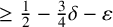 holds for these discrete Cantor sets with random alphabets. In this paper, we construct random Cantor sets with dimension $\delta \in (0,\frac 23)$
 in $\mathbb {R}$
 via a different random procedure from the previous one used in Eswarathasan and Han [‘Fractal uncertainty principle for discrete Cantor sets with random alphabet’, Math. Res. Lett. 30(6) (2023), 1657–1679]. We prove that, with overwhelming probability, the FUP with an exponent $\ge \frac 12-\frac 34\delta -\varepsilon $
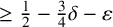 holds. The proof follows from establishing a Fourier decay estimate of the corresponding random Cantor measures, which is in turn based on a concentration of measure phenomenon in an appropriate probability space for the random Cantor sets.
 -SUPERSINGULAR ABELIAN VARIETIES OF $\textbf {GL}_{\textbf {2}}$
 -TYPE OVER $\boldsymbol {\mathbb {Z}}_{\boldsymbol {p}}$
 -EXTENSIONS OF NUMBER FIELDS
We study the boundedness of the Mordell–Weil rank and the growth of the v-primary part of the Tate–Shafarevich group of p-supersingular abelian varieties of $\mathrm {GL}_2$ -type with real multiplication over $\mathbb Z_p$
 -extensions of number fields, where v is a prime lying above p. Building on the work of Iovita and Pollack in the case of elliptic curves, under precise ramification and splitting conditions on p, we construct explicit systems of local points using the theory of Lubin–Tate formal groups. We then define signed Coleman maps, which in turn allow us to formulate and analyse signed Selmer groups. Assuming these Selmer groups are cotorsion, we prove that the Mordell–Weil groups are bounded over any subextensions of the ${\mathbb Z}_p$
 -extension and provide an asymptotic formula for the growth of the v-primary part of the Tate–Shafarevich groups. Our results extend those of Kobayashi, Pollack, and Sprung on p-supersingular elliptic curves.
In this article, we study questions pertaining to ramified $\mathbb {Z}_p^d$ -extensions of a finite connected graph $X$
 . Let $X_\infty $
 denote a $\mathbb {Z}_p^d$
 ramified derived graph of $X$
 (with $d\geq 1$
 ) and $\Lambda $
 denote the associated Iwasawa algebra. We first prove an asymptotic growth formula in this general setting and show that it is possible to interpret the characteristic ideal of $\mathrm {Pic}_{\Lambda }(X_\infty )$
 as an abstract determinant of an operator on $\mathrm {Div}_{\Lambda }(X_\infty ^{\mathrm {unr}})$
 . We also introduce the study of the Iwasawa theory of dual graphs.
For $h>1,$ we consider the reaction-diffusion equation: $$ \begin{align*} \Delta_\infty^hu(x)=f(x,u(x),Du(x)),\quad x\in\Omega, \end{align*} $$where $\Delta _\infty ^h$

 denotes the h-degree infinity Laplacian, $f\in C(\Omega \times \mathbb {R}\times \mathbb {R}^n)$
 satisfies $ 0\leq f(x,\delta t,p)\leq \Lambda (x)\delta ^{\gamma }f(x,t,p),$
 a positive function $\Lambda (x)\in C(\overline {\Omega }), \, \gamma \in [0,h), \,t>0$
 , and $\delta>0 $
 is small enough. Such an equation may cause a dead-core region, that is, an unknown region where the nonnegative solution vanishes completely. We establish a flattening estimate for the viscosity solution and obtain sharp $C^{({h+1})/({h-\gamma })}$
 -regularity along the free boundary $\partial \{u>0\}\cap \Omega .$
 Using the sharp regularity, we prove Liouville-type theorems for the global solution and give the porosity of the free boundary. In the end, for the limit case $\gamma =h,$
 we show that if the viscosity solution vanishes at a point, then the dead-core region must vanish.