


R1. Individual-level and social-level approaches: Friends, not foes
We begin this response as we ended our target article, by confirming again that we do not at all deny the important influence of social factors, namely of social support, in the protection against stress-related mental dysfunctions, and that we see great potential in interventions that target social and environmental variables (Janicki-Deverts & Cohen Reference Janicki-Deverts, Cohen, Southwick, Litz, Charney and Friedman2011; Reissman et al. Reference Reissman, Kowalski-Trakofler, Katz, Southwick, Litz, Charney and Friedman2011; Southwick et al. Reference Southwick, Pietrzak, White, Southwick, Litz, Charney and Friedman2011; Zautra Reference Zautra, Kent, Davis and Reich2014). We merely dare conjecture that the unquestionable effects of social support and other nonindividual resources on mental health, emphasized in the commentaries by Bennett & Windle; Chang, Reddan, Ashar, Eisenbarth, & Wager (Chang et al.); IJzerman & Lindenberg; Kimbrel & Beckham; Southwick, Pietrzak, Charney, & Krystal (Southwick et al.); Ungar; and Washington, can be explained by how they shape stressor appraisal and how they affect stressor exposure. If this turned out to be true, what would be the consequences for the development of resilience-promoting interventions? And could these consequences be unethical, as Ungar and Washington imply?
First of all, we think that discovering new ways to promote mental health, including ways that involve directly changing appraisals or underlying neural processes, or both, can only be highly desirable in a field where scientifically grounded and empirically tested effective and efficient intervention programs are still scarce. We cannot choose from a rich basket of resilience interventions, and therefore, basically any new possibility to improve mental health should be welcome, regardless of what route is taken to achieve the effect. This pragmatic stance, and the sobering experiences we have had over the years working as psychiatrists and neuroscientists of how difficult it is to change appraisals and brain functions, includes the realistic prediction that it is highly unlikely that cognitive-neuroscientific resilience research ever will discover the “magic pill” that produces resilient robots that can be used and exploited for any kind of stressful activity. Positive appraisals may be protective but, as Washington notes, “regardless of how resilient an individual might be, it is possible that resilience mechanisms inevitably will collapse in certain environments.”
That implies that new intervention methods that might be developed from the kind of research that our target article tries to promote will almost certainly never replace the need to work also at the socioenvironmental level. Rather, individual-level interventions will complement social-level approaches. So, taking into account individual factors and better understanding the relationship between socioenvironmental and individual factors might have the advantage that we can better tailor socioenvironmental interventions to individual needs. For example, if the effect of social support on resilience indeed were mediated by appraisal, it would make much sense to provide social support–enhancing interventions specifically to those individuals who perceive their social support as low and suffer from this perception. By contrast, individuals who already feel well supported (regardless of whether this appraisal is correct or not), as well as those who do not value social support much and feel strong enough to cope without, would most likely not benefit from such an intervention.
Also, socioenvironmental interventions, even if well-tailored, may be limited in their efficacy and efficiency, for example, because they do not manage to change everyone's appraisals to the better (the skeptic or misanthropist might not be impressed by offers of better social integration) and hence do not achieve optimized stress responding in every participant. In these cases, socioenvironmental interventions might profit from augmentation by adjunctive enhancements through psychological or neurobiological routes of the positive appraisals they are intended to generate. Those enhancements might include pharmacological strengthening of positive memories of social support, similar to current attempts to augment psychotherapy with drugs that improve the formation of safety memories made during exposure-based treatments (Graham et al. Reference Graham, Callaghan and Richardson2014).
Positive appraisals might also be generated or enhanced independent from the intended effects of a socioenvironmental intervention, simply as an add-on, to improve overall outcome. For example, a socioenvironmental intervention that increases perceived social support could be supplemented with a cognitive-neuroscientific intervention that improves the ability to discriminate safety from threat.
Hence, individual tailoring, augmentation, and supplementation are possible clinical benefits of an individual-level approach to resilience. Let us also not forget that, in many cases, socioenvironmental factors simply will be out of the hands of the clinician, educator, or counselor working with at-risk individuals, and therefore, exclusively betting on socioenvironmental interventions is certainly not an option for resilience research. In this last scenario, indeed, replacement of socioenvironmental action is a fourth possible benefit of individual-level action.
There is even a wider political implication to an approach that involves strengthening individuals. One could argue that individual-level methods will increase the pressure on people to function in adverse environments and will allow those in power more easily to exploit those who are not. We believe that this risk needs to be weighed against the chances that an individual-level approach bears for helping individuals stay healthy, and in this cost-benefit analysis, we estimate the benefits to weigh more than the costs. Further, there is a paternalistic notion in seeing people as weak and dependent on help from more powerful others who might have the capacity to change the world for them.
We know that this is not a standpoint taken by any of our commentators, and we apologize in advance to those readers who might find the following political “manifesto” ill-suited for a biobehavioral research article. But we would like to take this opportunity to emphasize that we believe that individual-level resilience research has a potential to empower individuals to lead freer and more autonomous lives and also to be more resistant to economic or political pressures, simply because they need less time and energy to stay healthy despite those pressures. Ultimately, resilient individuals will have a higher capacity to involve themselves in a constructive fashion in economic or political decision-making processes and to participate socially. This can only be beneficial for the flourishing of democratic societies, in particular when the stability of these societies is challenged by natural or man-made threats. We would thus make a bold claim (to be empirically evaluated by a different discipline of science than ours) that resilient individuals make resilient countries.
R2. Explaining the influence of social factors and of coping behaviors on mental health
In section 3.1 of our target article, we define the degree of resilience R someone exhibits at some timepoint T2 during or after stressor exposure by normalizing mental health changes ΔΣP occurring between baseline (T1) and T2 to the stressor load incurred in between, as expressed in the equation: RT2 = 1/(ΔΣP/ΣS) = ΣS/ΔΣP, P signifying mental problems. (See also Fig. 1 in that section.) Normalization of mental health changes ΔΣP to stressor load ΣS has practical and conceptual importance. This can be illustrated by assuming a case where stressor load ΣS between T1 and T2 is low in a subject (compared with other subjects or with other measurement intervals in the same subject). Here, a maintenance of mental health or even a decrease in mental problems over that interval (i.e., a small, range-corrected ΔΣP value) would be a trivial effect that should not be considered a case of resilience. (Remember that resilience is not just mental health but mental health in the face of adversity.) Accordingly, in the equation, the subject's relatively small ΣS value would result in smaller RT2 scores than in subjects with higher stressor load ΣS but similarly stable mental health (who could rightly claim to be more resilient). When compared with subjects with higher stressor load and increased mental health problems, our subject would have a comparable RT2 score, provided comparable ratios of ΣS and ΔΣP. (This means that two subjects with different mental health trajectories would still be classified as similarly resilient.) Hence, to sum up this first point, our formalization avoids simply equating resilience with mental health, and thereby preserves the original meaning of the term resilience.
The subject in the example also could have a higher RT2 score than other subjects; for example, when another subject had a higher stressor load and the concomitant increase in mental problems in that subject outweighed the higher stressor load, or when another subject showed increased mental problems despite low stressor load. Another point to note about our formalization, therefore, is the relativity of the R score in terms of the stressor exposure and the mental stability of the sample. This certainly precludes comparing R scores between individuals from different types of samples (e.g., a soldier in combat versus a physician in internship), but it allows for comparing R scores between individuals from similar samples, which can be very practical for multicenter or replication studies.
A third point is that our formalization permits a conceptualization of how social factors (and also coping behaviors; see further below) affect mental health and of how this relates to resilience. As explained in detail in section 4.2.4.1, section 4.2.4.2, and Figure 4 of the target article, we hypothesize that the influence of social factors can be explained by their influence on appraisals, while considering that they also affect stressor load ΣS. Hence, in our framework, social support (if perceived) can improve one's perceived coping potential, making a threat appear less threatening and thereby reducing the likelihood of exaggerated, inappropriately costly stress responses and ultimately of mental problems P. This happens without effects on stressor exposure ΣS. Therefore, compared with a subject with identical stressor load (!) but lower perceived social support, a subject with higher perceived social support is less likely to develop mental problems and will be classified as more resilient. Further, social support (if received) can factually reduce stressors S, likewise reducing the likelihood of costly stress responses and ensuing mental problems P. Better mental health, however, does not necessarily count as better resilience, as long as the mental health effect simply (trivially) reflects reduced stressor load, as discussed above.
Ungar rejects our hypothesis, arguing that we neglect the role of opportunities for adaptive coping offered, or not, by the environment. We would counter that coping opportunities do enter into our equation, namely by determining one's perceived coping potential and by additionally defining stressor load. So, when the stressed employee that we used as an illustrative example at several instances throughout the target article (starting in sect. 1.3) has the opportunity to cope with an externally caused increase in performance pressure (a stressor, S) by working harder – for example, because his family will take over some of his domestic obligations for a while – this will both increase his perceived coping potential and reduce stressor load (by avoiding excessive demands). This is another example where we do not deny the influence of social factors on mental health or resilience, but simply split that influence into those effect paths going via stressor appraisal, thus acting distally on resilience, and those going via stressor exposure.
IJzerman & Lindenberg argue that a secure, complex, and flexible self, shaped in early development by social thermoregulation and operationalized (in approximation) by a secure attachment style, among others makes people cope more constructively, that is, behave in a way that strengthens social bonds and activates social support. They propose that securely attached individuals spontaneously produce prosocial emotional responses that function to assure their social partners that they are understood and supported (such as when they respond to their partner's anger with a spontaneous smile rather than with retaliation, or when they display understanding and encouragement of their partner's goals). We have no objections against the idea that behaviors that promote perceived and received social support eventually promote resilience and mental health (see above). We merely want to point out again that our model deals with variables such as a secure attachment style, the associated adaptive coping behaviors, and the resulting social support as, one, reducing stressor load ΣS and as, two, promoting resilience indirectly, by providing positive appraisals.
The examples of adaptive coping brought by IJzerman & Lindenberg are helpful in allowing us to clarify better than we may have in our target article the role of behavior, which we let affect mental health outcomes by bearing on stressor load ΣS (similar to received social support). In the target article's section 2 we defined stress (threat, aversive, fear) responses as adaptive reactions that serve to assure survival and reproduction by avoiding, removing, or minimizing threats. In our preceding phenomenological definition in its section 1.3, we included overt behavior – primary (defensive) or secondary (compensatory and recuperative) coping responses such as flight or fight, avoidance, impact preparation, support seeking, resource building, and so forth – among the many components of the stress response.
One such primarily adaptive behavioral stress response (best classified as defensive coping) is the increase in work efforts produced by the employee in the example in that same section 1.3. The response is adaptive because it minimizes chances of failure and of being exposed to additional and potentially more severe stressors such as being criticized, downgraded, or sacked. Hence, adaptive behavioral coping limits increases in ΣS and thereby promotes mental health. Adaptive coping behavior may be promoted by knowledge about how to achieve goals and by metacognitive insight into one's weaknesses and strengths and one's motivators – faculties that also may help avoid stressor exposure in the first place (Lau).
R3. On the adaptive nature of stress and on optimal stressor appraisal (specification of PASTOR)
This is also our response to several commentators who blame us for not acknowledging the adaptive nature of stress responses, and in particular the active behavioral coping aspect of stress responses (Bennett & Windle; Egloff; Freund & Staudinger; Juslin; Mancini; Southwick et al.; Troy). We think this is a misrepresentation of our theory, but we realize that we also may have invited this misrepresentation by imprecise wording, namely in the first paragraph of section 4.2.5 on reappraisal. We therefore emphasize here that because of the primarily adaptive nature of stress responses (pointed out in sects. 1.3, 2, and 4.2.4.1), we do not propose that stress responses should be avoided at any costs. What we say is that “although primarily adaptive, stress responses can become deleterious if they are very intense, prolonged, or chronic – by exhausting internal, but also social or monetary resources and interfering with the pursuit of other important goals, as summarized in the concept of allostatic load (McEwen & Stellar Reference McEwen and Stellar1993)” (sect. 1.3, para. 3). We go on to argue that
as a consequence, any mechanism that helps the organism fine-tune stress responses to optimal levels, to terminate them if no longer necessary, and to remain flexible enough to switch to possible alternative coping strategies, thereby facilitating efficient deployment of resources, is likely to protect all or most of the systems involved in the stress response and therefore to prevent a large range of stress-related dysfunctions. (sect. 1.3, para. 3)
We illustrate the importance of “optimized aversion,” “optimizing stressor-induced aversion,” “optimally regulat[ing] stress responses,” and “react[ing] to…stressors with optimized aversion” (sect. 1.3); “flexibly adjust[ing] aversive motivation to appropriate levels” and “optimization of aversion” (sects. 2 and 4.2.8); and “limitation of…aversion” (sect. 4.2) by taking the example of the stressed employee to the point where he fails despite increased work efforts, and perseverance is not an option anymore. The employee develops “dislike for the job, decreased efforts or even avoidance of work, and diminished job-related self-efficacy perceptions” (sect. 1.3). These, too, are adaptive stress responses, precisely because they help preventing “pointless perseverance and [the resulting] exhaustion” (i.e., the costs of a more inflexible and unnecessarily prolonged stress response). If he is smart, the pitiable employee now will “search for alternative coping strategies, such as reducing ambitions and redefining work objectives or looking for another job.” Looking for a better job therefore is another example of what may be considered an adaptive coping behavior (see sect. R2), which functions to contain stressor load S (e.g., unemployment).
The more important point to make here, however, is that an aversive over-reaction potentially can be harmful at two stages: It can make the employee persevere unnecessarily, until the point of exhaustion; or later, provided he earlier has chosen to give up, it can prevent the employee from looking for a smarter solution, and instead induce “a generalized amotivational, lethargic state” (sect. 1.3). Both exhaustion and lethargy would figure as increases in mental problems (ΔΣP) in our model. What could cause the harmful over-reaction? Or better, what could prevent it? The “dislike for the job” and the “diminished job-related self-efficacy perceptions” that stop perseverance are realistic appraisals that are neither negative (in the sense that they do not exaggerate the aversive consequences of failure) nor too positive (incorrectly appetitive). (Here, Beer & Flagan; Crespi; Freund & Staudinger; Juslin; Koole, Schwager, & Rothermund (Koole et al.); Lau; Mancini; Sachser & Richter; Southwick et al.; and Ungar have a point in insisting that unrealistically appetitive or delusional appraisals are likely to be harmful, which not to have mentioned is clearly a weakness of our target article.) Similarly, to prevent generalized lethargy, the employee must “not extend [his] aversion and reduced self-efficacy perceptions to work life generally or even to any kind of challenging situation” (sect. 1.3). That is, he must avoid unrealistically aversive appraisals (as well as unrealistically appetitive appraisals). Avoiding such appraisals is key for producing adaptive stress responses, including at the level of behavioral coping. Such stress responses will come with costs, but these costs will be appropriate in relation to the costs of not responding.
From the comments, we realize that we have not adequately defined what we consider as “negative” and “positive.” So what is an optimal appraisal style that assures adaptive stress responding? If we understand “negative” as any appraisal that exaggerates the aversive consequences of a threatening situation, in the sense of pessimism or catastrophization, then seeing a threat as what it is does not count as negative. Responding to a barking mastiff with staying still and keeping away is an adaptive stress response that is caused by a realistic appraisal of the threatening nature of the dog. This appraisal is not negative in our terminology. Responding to the mastiff with panic and running away is the result of an exaggerated, that is, negative or pessimistic appraisal that an attack is unavoidable and imminent and escape is the only, though small, chance to stay alive. It is the equivalent of an employee who has once failed on the job and now believes that he is unable to achieve anything, whether on the job or in any other difficult situation.
So the art is to avoid unnecessarily aversive motivational states because these cause unnecessary costs, including the costs of stupid decisions. According to this definition of the term negative, we have defined a negative appraisal style as might be found in a patient who “consistently overestimate[s] the aversive consequences of challenging situations (outcome magnitude dimension) or the probability of such aversive consequences (outcome probability dimension), or both; he may also consistently underestimate his ability to cope (coping dimension)” (sect. 4.2.2). To summarize this, we clarify here that “non-negative” in PASTOR claim 1 signifies a realistic threat appraisal. We thank the commentators for their scrutiny.
Nevertheless, we have not termed our theory “non-negative” or “non-pessimistic” or “realistic” appraisal style theory, but positive appraisal style theory. This was done only partly for simplicity. In part, also, we intended to take into account that the inherent unpredictability of life always limits the certainty with which we can estimate outcome magnitudes, outcome probabilities, and our coping potential. The realism of appraisal is an ideal that can only be approximated. Ultimately, appraisal must remain subjective and uncertain (sects. 4.2.1 and 4.2.5). (See also the argument that it is difficult to find an objective standard for realism in the criticism of depressive realism [Moore & Fresco Reference Moore and Fresco2012].) Further, the different appraisal dimensions are not independent, and any final appraisal outcome is always the result of a complex interplay of different appraisals along different appraisal dimensions (see our exemplary discussion in sect. 4.2.1). Therefore, especially in complex situations, “individuals [have] many degrees of freedom in evaluating” the situation (sect. 4.2.5). Unless the outcome of such a complex (often social) situation is potentially highly dramatic and irreversible (e.g., death), it may therefore be well adaptive to choose a more optimistic scenario among the many possible outcomes, simply because this reduces or avoids the costs of mounting anticipatory aversive behaviors. This might even be done knowingly, and it might be done also when a grimmer scenario appears slightly more likely but still within some confidence interval of the likelihood of the more optimistic scenario. Surely, clearly unrealistic positive appraisal choices are maladaptive (Crespi; Freund & Staudinger; Koole et al.; Lau; Mancini; Sachser & Richter; Southwick et al.; and Ungar).
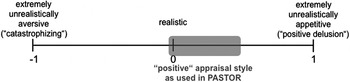
Figure R1 tries to illustrate the optimal range of appraisals on a dimension of realism where an ideal, completely realistic appraisal has a value of 0, an extremely unrealistically aversive appraisal has a value of −1, and an extremely unrealistically appetitive (“delusional”) appraisal has a value of 1. It can be seen that the bulk of the appraisals considered optimal live on the positively signed side of the axis, which is why we think that positive is a suitable term to describe the type of appraisals we believe are protective. Disease-oriented, pathophysiological research traditionally is concerned with appraisals on the negatively signed side of the axis.
Range of appraisals considered protective by positive appraisal style theory of resilience (PASTOR) in relation to the realism of the appraisal. Realistic appraisals attach a correct emotional-motivational value to a situation, whether that value is aversive or appetitive. Unrealistic appraisals consist of seeing a situation as either worse than it is (negative sign on the realism axis) or better than it is (positive sign). For simplicity, the term positive is used for appraisals that are either completely realistic (both non-negative and non-positive, i.e., 0) or mildly unrealistically appetitive (moderate positive values). The adaptive nature of mildly positive appraisals results from the inherent unpredictability of the world, making realistic judgments difficult and conferring an advantage to optimistic, stress-reducing judgments.

There is another reason why we think that positive is the best term for describing optimal appraisals. The inherent complexity of the world also implies that is it difficult to predict not only what is going to happen and how we are going to be able to cope with it, but also what this means for us. In order to choose his most adaptive response, not only is the pressured employee going to calculate the probability of failure and the probability and magnitude of the sanction that might follow failure, but he also will take into consideration the further consequences of a possible sanction. At first sight, being sacked appears clearly bad, but it also might be taken as a welcome opportunity for exploring a new career path (Troy) or making a more fundamental change to one's life, as a test of morale or faith, as a possibility to mature and grow personally, as an opportunity for chance entering one's life, and so forth. Although evolution has surely equipped us with mechanisms that make us avoid social exclusion, it is not objectively possible to determine the absolute value of a social-exclusion event such as being sacked. Again, “individuals [have] many degrees of freedom in evaluating” a situation (sect. 4.2.5).
So the employee may consider his chances to avoid sanction by increasing his work efforts as high, and he may be sure he will be sacked if he does not, but he still may choose not to work more, because he does not find being sacked particularly terrible. This might apply even if he does not appraise his financial or social resources to cope with unemployment as sufficient from a material point of view. And it is not guaranteed that this ostensibly maladaptive behavior will lead to mental dysfunction. A poor man can be healthy. (And is that not what resilience is about?)
Brummelman & Walton make a similar argument in their description of a girl performing poorly at school but not appraising that as a threat. The point here is that a narrow evolutionary perspective, which we basically endorse as extremely useful for behavioral analysis, comes to its limits, by leaving out the essentially constructivist nature of human world interpretation (Raskin Reference Raskin2002) and the subjective importance of associated attitudes and value systems. Hence, if we define protective, resilience-promoting appraisals functionally as those that generate optimized stress responses, then this leads us not only to the conclusion that they range from realistic (non-negative, non-pessimistic) to mildly positively unrealistic (see above and Fig. R1). In addition, we have to acknowledge that some people do well (mentally) with what might appear irrational choices, perhaps because they confer a sense of comprehensibility or meaningfulness of life and the world, of authenticity, creativity, or transcendence (Antonovsky Reference Antonovsky1987; Frankl Reference Frankl2004; Maslow Reference Maslow1971; Seligman et al. Reference Seligman, Rashid and Parks2006), “meta-needs” (Maslow Reference Maslow1971), or values that are not readily integrable into an evolutionary-biological perspective and originate from worldviews or personal philosophies that transcend a merely hedonistic perspective. And we also have to acknowledge that these people probably do well because of – and not in spite of – their choices. (Credit to Quirin, Kent, Boksem, & Tops [Quirin et al.] and Vázquez for highlighting these aspects.) Nonsatisfaction of meta-needs is aversive and can cause stress, and enduring the stresses of physical hardships or social conflicts can, in sum, even reduce stress if it leads to meta-need satisfaction. In other words, we appraise situations not only with respect to their (un)pleasantness and compatibility with or conduciveness to hedonic needs and goals, but also with respect to what they mean for our meta-needs and goals. Both can be subjectively relevant outcomes. And positive appraisal therefore can involve giving the pursuit of meta-goals more weight than the pursuit of hedonic goals, with a potential to reduce stress and its long-term costs for mental health specifically in situations where hedonic need satisfaction is difficult or impossible.
The advantage of cultivating a meta-hedonistic worldview, then, is that it offers additional needs and goals against which the meaning of an anticipated outcome can be evaluated (for the importance of relative goal valuation, see also sect. 4.2.5). This wider range of criteria can be exploited to appraise ostensibly aversive or “anti-hedonistic” outcomes as appetitive, to “find the good in the bad.” If an individual has a repertoire of such “positive” appraisal contents at her disposal and is used to employing them, the process of finding the good in the bad may be relatively effortless and automatic (positive situation classification; see PASTOR claim 2 and sect. 4.2.5). In many cases, especially under massive stressor exposure, however, it will be necessary to enforce these alternative, appetitive appraisals against the strong opposition of the aversive appraisals generated more or less spontaneously by vestigial appraisal systems that have been fashioned by evolution to assure hedonic need satisfaction. In this (but not only in this) reappraisal process (PASTOR claim 2, sect. 4.2.5), interference inhibition (PASTOR claim 3, sect. 4.2.7) is likely to be an important mental faculty. It remains to be mentioned that this “non-hedonistic” facet of positive appraisal can be assumed to be restricted to humans.
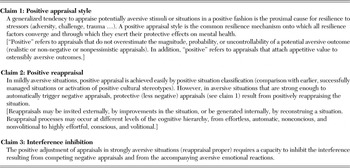
We were reluctant to discuss these definitional issues in so much detail in the target article for reasons of space, but also because we are more interested in the neurocognitive processes that bring about positive appraisals than in actual appraisal contents (see sects. 4.2.6, 4.2.8, and 6), and because we prefer to study appraisal style experimentally, by observing emotional reactions, rather than by employing questionnaires that ask about specific appraisal contents (sect. 4.3). We nevertheless now feel obliged to spell out more clearly our definition of positive appraisal style. We therefore supplement PASTOR claim 1, as in Table R1, with an explanatory parenthesis. (Note also the explanatory parenthesis in claim 2, necessitated by a frequent misconception of reappraisal processes as being solely volitional and conscious; cf. sects. R4 and R5.)
Positive appraisal style theory of resilience (PASTOR)

The text in square brackets provides precise definitions of key terms in order to prevent possible misinterpretations (cf. Table 1).
Refer to the following sections from the target article for more details: 4.2.1 and 4.2.2. (for claim 1), 4.2.5 (for claim 2), and 4.2.7 (for claim 3).
With respect to the appraisal style (AS) score proposed as a self-report measure for assessing appraisal contents in section 4.2.8 and Figure 5 in the target article, we specify that it should index not the magnitude of the positivity of appraisals (which would lead to a curvilinear relationship between AS and R; Southwick et al.) but to what extent positive appraisals generalize across stimuli and situations.
R4. Comparison of positive appraisal style with other constructs or models
One demarcation to make is that positive appraisal style as defined in the target article and specified in the previous section is not merely optimism (Carver & Scheier; Sachser & Richter) but a broader construct. Most notably, it also includes seeing things as positive that are not (or do not seem to be; see above). But even when comparing positive appraisal style and optimism only on the realism dimension (Fig. R1), two additional differences must be noted. Given the many formulations of a definition of optimism that can be found in the literature, it seems wisest to rely on the accepted and widely used instrument for measuring optimism, the Life Orientation Test, or LOT-R (Scheier et al. Reference Scheier, Carver and Bridges1994), when trying to understand the construct. The operationalization of optimism in the form of the LOT-R does not include the realistic (both non-negative and non-positive) estimates that are part of a positive appraisal style. And it does not include estimates of coping potential. (The LOT-R effectively invites people to think about the probability and magnitude of possible outcomes, although Scheier and Carver [Reference Scheier and Carver1985] theoretically consider optimistic coping potential estimates as one attribute of the optimistic personality.)
This demarcation of positive appraisal style from optimism does not imply that behavioral paradigms measuring optimistic decision biases in animals (Mendl et al. Reference Mendl, Brooks, Basse, Burman, Blackwell and Casey2010), as proposed by Sachser & Richter, cannot be a highly useful source of information on some of the neurobiological substrates of positive appraisal. But to more broadly study positive appraisal style in animals, paradigms such as discrimination, unconditioned stimulus (UCS) deflation, counter-conditioning, or extinction (which involve a realistic analysis of a nonreinforced stimulus as safe, or safer, than it used to be; see 4.3.3) or the study of response termination after stressor exposure also may be necessary.
We only briefly mention in this context that many or all of our appraisal systems presumably have evolved in more hostile environments than those provided by contemporaneous industrialized societies. In more hostile environments, where vital threats are frequent, it may be more adaptive to be negative by default (left side of the axis in Fig. R1). This has been expressed in the motto “better safe than sorry,” which well characterizes the workings especially of our evolutionarily oldest appraisal systems, responsible for generating low-threshold defense responses (see sect. 4.2.5). It is therefore not surprising that natural selection has not eliminated non-positive versions of appraisal, as Sachser & Richter rightly note (though not denying that positive appraisals also may have survival value). Our theory, however, tries to explain resilience in today's comparatively safe, developed societies, in accordance with our goal, formulated in the introductory paragraph of the target article, to promote mental health in the industrialized world.Footnote 1
Koole et al., in their “counter-regulation” model, emphasize the potential dangers of intense and persistent positive emotional states and the corresponding importance of maintaining a steady emotional balance. Hence, it is adaptive to limit not only negative emotional states but also positive states. Positive emotional states can be limited by directing attention to negative information and activating negative appraisals. We find this idea very interesting and worth testing in an outcome-based study framework (sect. 3 of the target article; see also sect. R6 of this response). We nevertheless would like to remark that we do not recommend generation of “intense positive emotional states” (Koole et al.) as a way to resilience, and that we do not think that the type of cautiously optimistic appraisal style that we have defined as positive here (Fig. R1) is conducive to such states.
Soenke, O'Connor, & Greenberg (Soenke et al.), on the other hand, emphasize the resilience-promoting function of positive emotion. Importantly, in their model, the value of appetitive motivational states not only lies in their not being unnecessarily aversive (as in PASTOR, where avoiding negative appraisals will in many cases effectively lead to mildly appetitive states) or in inhibiting the aversive system via neural opponency mechanisms (see sect. 4.2.7, including Note 2). Rather, positive emotions have a series of adaptive consequences, such as broadening attention and allowing creative thinking and a more broad-minded perspective. Thereby, appetitive motivational states constitute an independent, second way to resilience in addition to positive appraisal style, mediating the effects of a range of upstream resilience factors. But appetitive motivation also can result in poorer mental health outcomes, for instance, when they conflict with reality or keep people from disengaging from sources of distress. We think that a model, such as PASTOR, that focuses on avoiding the costs of unnecessary aversive responses is more parsimonious, and that effects of positive emotion can be understood as distal factors that work by facilitating positive appraisal (and thereby reducing unnecessary aversion). We nevertheless think that, as in the case of Koole et al.'s ideas, ultimately this has to be tested empirically.
Koole et al.'s and Soenke et al.'s models are two in a series of proposals that invoke a wider range of emotion generation and regulation processes as potential resilience mechanisms, including deployment of attention (i.e., distraction from negative information; see also Luyten, Boddez, & Hermans (Luyten et al.); Egloff; Troy; and Vázquez) and suppression of emotional expression (Egloff). Many of these models (see also Boden et al. Reference Boden, Kulkarni, Shurick, Bonn-Miller, Gross, Kent, Davis and Reich2014; Bonanno & Burton Reference Bonanno and Burton2013; Cheng Reference Cheng2001; Kashdan & Rottenberg Reference Kashdan and Rottenberg2010; Opitz et al. Reference Opitz, Gross and Urry2012; Troy et al. Reference Troy, Shallcross and Mauss2013) stress the importance of flexibly using different strategies, depending on situational demands or personal characteristics (Egloff; Troy).
One argument to support the adaptive value of distraction is work by Sheppes et al. (Reference Sheppes, Scheibe, Suri, Radu, Blechert and Gross2014), who show that distress ratings in response to high-intensity negative stimuli are more easily attenuated by volitional distraction than by volitional reappraisal (Egloff; Grecucci & Job; Troy). We note that these commentators mistakenly reduce the notion of reappraisal in PASTOR to volitional (“cognitive,” conscious, higher-level) forms of reappraisal, despite the explicit statement in PASTOR claim 2 that reappraisal also can occur at lower levels of the cognitive hierarchy (see also sect. R5 and the explicit explanatory parenthesis added to PASTOR claim 2 in Table R1). Leaving aside this misrepresentation, the commentators fail to appreciate that Sheppes and colleagues' studies investigate the down-regulation of acute aversive states. It remains unclear from these studies whether distraction is also better than volitional reappraisal is in attenuating the aftereffects of stressor exposure (e.g., traumatization) or in dealing with repeated exposures to the same or similar stressors. Both effects are likely to be much more important for long-term outcome than acute regulation success. Interestingly, Sheppes et al. make the argument that
the major cost of distraction is that motivationally it does not allow processing, evaluating, and remembering emotional information, which are crucial for one's long-term goals and adaptation…. Specifically, distraction is not conducive to emotional events being repeatedly attended to and provided with adequate explanation, a requirement that is at the heart of many long-term goals where an individual has to face difficulties and of adaptation. (Sheppes et al. Reference Sheppes, Scheibe, Suri, Radu, Blechert and Gross2014, p. 165)
In support, they cite evidence that distraction can produce rebound effects when stressor exposure is repeated (Thiruchselvam et al. Reference Thiruchselvam, Blechert, Sheppes, Rydstrom and Gross2011) and is maladaptive when long-term adjustment is required (Kross & Ayduk Reference Kross and Ayduk2008), whereas repeated reappraisal efforts can gradually change stimulus evaluation (Blechert et al. Reference Blechert, Sheppes, Di Tella, Williams and Gross2012).
We do not want to exclude that distraction (or also expressive suppression) can be adaptive, in particular, by counteracting tendencies of perseveration or rumination. Hence, distraction and expressive suppression may be strategies that protect specifically against depressive-type dysfunctions (Joormann et al. Reference Joormann, Siemer and Gotlib2007; Nolen-Hoeksema et al. Reference Nolen-Hoeksema, Wisco and Lyubomirsky2008; see also Sheppes et al. Reference Sheppes, Scheibe, Suri, Radu, Blechert and Gross2014). However, they also may be maladaptive in other individuals or situations, especially when used frequently. As Sheppes et al. note:
Common to several anxiety disorders is a tendency to overgeneralize a disengagement or avoidance regulatory response (see Campbell-Sills & Barlow Reference Campbell-Sills, Barlow and Gross2007; Foa & Kozak Reference Foa and Kozak1986, for reviews). Avoidance usually starts in response to high-intensity emotional stimuli, but over time, it ends up spilling over to seemingly low-intensity stimuli … although disengagement strategies are helpful in providing short-term relief, they are maladaptive in the long run and can perpetuate anxiety and fears. (Sheppes et al. Reference Sheppes, Scheibe, Suri, Radu, Blechert and Gross2014, p. 177)
Hence, distraction and expressive suppression may be dysfunction-specific but not general resilience mechanisms in our terminology introduced in section 1.3, which is why we do not include them in our model. Whether flexibility in the use of different strategies (Egloff; Troy) is a better explanation than positive appraisal style is for resilient outcomes is yet another question. We would invite proponents of the idea to operationalize this construct and to make it amenable to empirical testing (Bonanno & Burton Reference Bonanno and Burton2013).
The crucial question of the long-term effects of stressor exposure can be understood best within the global framework of allostatic plasticity (McEwen & Stellar Reference McEwen and Stellar1993), that is, the cerebral and bodily adaptations that help the organism deal with future exposures to identical or similar stressors (sect. 1.3). Whenever an individual's appraisals are lastingly changed during or in the aftermath of a stressful situation (such as when an initially neutral stimulus becomes feared due to an aversive experience, or when one's perceived coping potential increases as the result of a successfully mastered challenging situation), this constitutes a case of allostatic plasticity (sect. 4.2.4.3). The latter example is an instance of positive reappraisal (sect. 4.2.5; process class 2, PC2, in sect. 4.2.8 and Fig. 5) – that is, the appraisal value attached to the coping potential dimension of the situation increases. This increase will make coping easier the next time one encounters the situation (unless one has developed a delusional power perception; see section R3). In the best case, the increase in perceived coping potential is so profound and long-lasting that retrieving the new appraisal content is entirely automatic and effortless at the next situation encounter. In this case, reappraisal processes are no longer necessary, and the situation will be positively evaluated as a result of spontaneous positive situation classification (sect. 4.2.5; process class 1, PC1). This makes the question of how new appraisal contents are written into memory, consolidated, and later retrieved particularly interesting, as exemplified in section 4.3.3 for the safety memories generated during the reappraisal process of fear extinction (which changes the value attached to the outcome probability dimension of a conditioned stimulus).
Discussing the important role of developmental factors in resilience (see also IJzerman & Lindenberg; Sachser & Richter), Nederhof reminds us that allostatic plasticity is particularly prominent during early childhood, and in particular during certain sensitive time windows and in individuals with high programming sensitivity (Belsky et al. Reference Belsky, Bakermans-Kranenburg and van IJzendoorn2007). She argues that individuals lastingly adjust their appraisal styles during these developmental periods to meet predicted future environmental demands. In the terms of PASTOR, then, appraisal style could be a mediator of the effects of early-life history (a resilience factor) on resilience. Perhaps, better understanding how appraisal contents are transformed into strong and stable memories in sensitive periods of life (or also in sensitive individuals) could help find ways to make appraisal styles more positive in vulnerable people, too.
Relatedly, Luyten et al. and Vázquez make the valuable comment that reappraisal also may occur after the event (such as in “retrospective revaluation”; Boddez et al. Reference Boddez, Baeyens, Hermans, Van der Oord and Beckers2013a). This ties in with the idea by Quirin et al. that new experiences have to be integrated in a meaningful and coherent way into internal self-models, which sometimes is easier in the absence of acute threat (Quirin et al.'s “predictive control” mode). In a similar vein, Murray, Gerrans, Brosch, & Sander (Murray et al.) propose that event-free resting states provide an opportunity for updating implicit self-models via reappraisals (in particular, of one's coping potential) – in other words, for reorganizing one's appraisal style. Where self-model integration is successful to the extent that new appraisals become implicit and unconscious, this will result in spontaneous and effortless positive situation classification. Murray et al. invoke Bayesian learning principles to explain this integration process. We think these are excellent ideas that have the potential to advance importantly our mechanistic understanding of the allostatic plasticity of appraisal.
Finally, Crespi conceptualizes resilience as a trait (including “resilient genotypes”), which we explicitly do not (see our outcome-based definition of resilience in sects. 1.1, 2, and 3.1). Hence, we cannot endorse his juxtaposition of sensitivity (a personality marked by strong responses to both aversive and appetitive events; Pluess & Belsky Reference Pluess and Belsky2013) and resilience. We do not want to exclude, however, the possibility that a positive appraisal style may be negatively associated with a tendency not only for overly aversive responses, but also for overly appetitive responses (see our reply to Koole et al. above). In other words, positive appraisers might be comparatively less-sensitive people in the terms of Crespi. This quality may keep positive appraisers as we define them from maximally exploiting the benefits of good environments, which, however, is a different story.
R5. Value of an appraisal-based theory for translational, neurobiological resilience research
Resilience research in animals has made tremendous progress in the past few years, including the identification of entirely novel molecular or cellular mechanisms that shape resistance to chronic social stress (e.g., Agudelo et al. Reference Agudelo, Femenía, Orhan, Porsmyr-Palmertz, Goiny, Martinez-Redondo, Correia, Izadi, Bhat, Schuppe-Koistinen, Pettersson, Ferreira, Krook, Barres, Zierath, Erhardt, Lindskog and Ruas2014; Chaudhury et al. Reference Chaudhury, Walsh, Friedman, Juarez, Ku, Koo, Ferguson, Tsai, Pomeranz, Christoffel, Nectow, Ekstrand, Domingos, Mazei-Robison, Mouzon, Lobo, Neve, Friedman, Russo, Deisseroth, Nestler and Han2013; Dias et al. Reference Dias, Feng, Sun, Shao, Mazei-Robison, Damez-Werno, Scobie, Bagot, LaBonté, Ribeiro, Liu, Kennedy, Vialou, Ferguson, Peña, Calipari, Koo, Mouzon, Ghose, Tamminga, Neve, Shen and Nestler2014; Friedman et al. Reference Friedman, Walsh, Juarez, Ku, Chaudhury, Wang, Li, Dietz, Pan, Vialou, Neve, Yue and Han2014; Issler et al. Reference Issler, Haramati, Paul, Maeno, Navon, Zwang, Gil, Mayberg, Dunlop, Menke, Awatramani, Binder, Deneris, Lowry and Chen2014). With new findings arriving at a fast pace, animal research runs the same risk as human resilience research of losing itself in vast amounts of data. Already, neurobiological review papers on resilience are starting to enumerate long lists of molecules, physiological mechanisms, or brain systems (from glutamate receptors in the hippocampus, brain-derived neurotrophic factor [BDNF] or serotonin, over neurogenesis or prefrontal inhibition, to the hypothalamus-pituitary-adrenal gland [HPA] axis or the reward system, and so forth) (Feder et al. Reference Feder, Charney, Abe, Southwick, Litz, Charney and Friedman2011; Franklin et al. Reference Franklin, Saab and Mansuy2012; Russo et al. Reference Russo, Murrough, Han, Charney and Nestler2012). (Compare our criticism of the human resilience literature in sect. 3.5). However, if this disparate knowledge is to contribute to the understanding of human resilience, it must be organized in a meaningful way and be related to human cognition and behavior. Clearly, BDNF or glutamate or any other molecule is involved in so many different functions that it can hardly be considered a “resilience molecule” in any narrow sense, and the same applies to any neurophysiological process or brain region or brain circuit. In the same vein, no molecular or neurophysiological manipulation will just make people resilient, if not appropriately designed and contextualized.
Understanding human resilience can succeed only if one acknowledges the brain's orchestrating role as an information processing machine whose job it is to find and organize appropriate responses to changes in the external and internal environment, as emphasized in more elegant language by Silbersweig. Hence, neurobiological or neurophysiological experiments in mouse or rat models can provide important insights if – and only if – they elucidate the inner workings of an information processing procedure that also exists in a homologous fashion in humans and plays a role there in supporting resilience to stressors. It is therefore of utmost importance to identify what those critical information processing procedures are and in which context they are used. And the process of identifying critical procedures should start at the functional level, asking on what type of information they work and what type of behavioral change they produce; in other words, what are they good for? Only after such fundamental clarification can one meaningfully analyze the identified procedures at the levels of their algorithmic and neural implementation (Marr Reference Marr1982).
It is for this reason that we have proposed the concept of appraisal as a possible guiding principle for resilience research. Appraisal is functionally defined as the information processing procedure that translates a stimulus or situation into an emotional reaction. This definition derives from the empirical observation from both animal and human behavioral research that emotional reactions are not simply determined by stimulus input, and therefore cannot be conceived as mere stimulus-response phenomena (sect. 4.2.2; Moors Reference Moors2009). Appraisal theory very plainly argues that one must assume a step (or steps) of evaluation between the stimulus and the response, in order to explain that the same stimulus can induce very different reactions in different individuals or at different time points or in different contexts in the same individual (e.g., Arnold Reference Arnold1969; Moors Reference Moors2009; Scherer Reference Scherer, Scherer, Schorr and Johnstone2001; see sect. 4.2.2 for more references). This functional definition is entirely agnostic as to the nature of the evaluation process (its algorithmic or neural implementation) and it applies both to how humans and to how non-human animals “make” emotions.
If one accepts that appraisal, by explaining the generation and manifestation of stress responses, is the key information processing procedure for resilience, then it becomes relevant what type of appraisals there are (algorithmic level) and how they are implemented in the brain (neural level). We emphasize in various places in our target article that current knowledge strongly indicates that there is not just one appraisal process, but many, and that these different types of appraisal processes can be found at different levels of the cognitive hierarchy, from very effortless, automatic, nonconscious, and nonvolitional processes to those highly effortful, controlled, and conscious processes that presumably exist only in humans (cf. sects. 4.2.2, 4.2.5, and 5.1 and Leventhal & Scherer Reference Leventhal and Scherer1987; Moors Reference Moors2009; Robinson Reference Robinson1998). (To Lau, this description is reminiscent of Kahnemann's [Reference Kahnemann2011] dual-process model, with its fast intuitive system 1 and an analytic and deliberate system 2, although we should say that we do not make a claim that appraisals in humans are organized in this simple dichotomic fashion. Some commentators [Egloff; Grecucci & Job; Washington] incorrectly assume we consider appraisal to involve only high-level, conscious [“cognitive”] processes. Others [Beer & Flagan] incorrectly assume the contrary.) Animal research is valuable in elucidating the neural bases of the more lower-level appraisal processes that can be assumed to be highly homologous between humans and, for example, rodents.Footnote 2 Exactly defining those processes and creating the best-suited behavioral paradigms to study them requires the careful ethological-analytic approach described by Sachser & Richter.
If used in this way, animal research can be a valuable tool in resilience research. Nevertheless, animal models can never free the human resilience researcher from the obligation to ask which role an appraisal process, defined ethologically and studied neurally in animals, plays in humans and how it is complemented (or sometimes antagonized) by higher-order appraisal processes that are reserved to the human species. A good example is provided by Vázquez, who reminds us that the principle of learned helplessness (in human, psychological terms: diminished perceived self-efficacy) was highly successful in explaining certain depression-like behaviors in rodent models but was insufficient to deal with the complexities of the human disorder (Abramson et al. Reference Abramson, Seligman and Teasdale1978). In such cases, an appraisal-based analysis can be a useful guide, allowing researchers to ask which other appraisal dimensions on top of coping potential are relevant in determining which types of emotional reaction (lethargy, sadness, anxiety, and so forth), how these dimensions interact, and which human-specific neurocognitive processes are involved in producing these appraisal contents, on top of conserved, vestigial processes. Our much-used example of the stressed employee served to demonstrate the value of such an appraisal-based analysis for enlightening human resilience research, too.
To our great pleasure, many commentators have made a variety of specific suggestions about potential (neuro)biological resilience mechanisms – the effects of cortisol on neural function (Hermans & Fernández; Schutter, Wischnewski, & Bekkering [Schutter et al.]); cortical excitability and its regulation through (cortisol-sensitive) homeostatic plasticity mechanisms (Schutter et al.; see also Silbersweig); neural network properties (Levit-Binnun & Golland); neural reorganization during resting state (Murray et al.); neural mechanisms of stress response termination (Walter, Erk, & Veer [Walter et al.]); lateralizations in prefrontal function (Quirin et al.); and orbitofrontal-striatal functional connectivity (Beer & Flagan). It was beyond the scope of our target article to flesh out PASTOR in any neurobiological detail. (Beginning in section 4.3.2, we briefly mention some brain regions or circuits that we think are likely to be relevant, based on their association with some of the process classes posited by PASTOR, but without attempting to be exhaustive or formally integrating neural elements into the theory.) Similarly, here, for reasons of space and focus, we will not exhaustively discuss these many fascinating ideas. We will limit ourselves to commenting in a few cases where we think the authors have underestimated the value of our appraisal-theoretic approach for informing and organizing (neuro)biological resilience research.
The case of amygdala “reactivity” or “responsiveness” or “activation” to threat (Hermans & Fernández; Shumyatsky, Jovanovic, & Handler [Shumyatsky et al.]; Walter et al.) is a good opportunity to apply an appraisal-based analysis in order to make sense of an empirically observed neural phenomenon. Within the appraisal framework, amygdala reactivity no longer comes out of the blue but is either part of the appraisal process or its result (i.e., part of the subsequent execution of the emotional response). On this basis, one can ask further questions, such as to which appraisal dimensions amygdala activity is sensitive (e.g., outcome magnitude? probability? coping potential?); at which processing level (nonconscious? conscious?) these dimensions are determined; how, neurobiologically speaking, the amygdala constructs appraisals and response execution; and which other neural systems cooperate or compete with the amygdala in the emotion generation process. Hence, a theory-guided analysis is able to confer meaning to observations of amygdala reactivity (or other neural phenomena) in specific experimental settings and specific groups of subjects and to inspire further experiments. In a second step, it then permits one to formulate reasonable hypotheses about what amygdala reactivity under defined experimental circumstances implies for an individual's resilience. For example, if the amygdala is found to be sensitive to changes in outcome probability as implemented in a fear conditioning and extinction experiment, and if resilience theory posits extinction learning ability as a potentially critical reappraisal faculty (sect. 4.2.7), then it is promising to ask whether changes in amygdala activity during extinction predict resilience; whether they mediate life-history effects on resilience (e.g., because stressor exposure during critical ontogenetic time windows shapes amygdala function; Hartley & Lee Reference Hartley and Lee2015); or how molecular or cellular features of amygdala function during extinction contribute to resilience.
Another change in stimulus input inviting an adjustment of responding is when a stressor ceases to exist, and being able to terminate stress responses after stressor termination is likely to be adaptive. PASTOR explains such response adjustment as an adjustment of outcome appraisals, allowing for using response termination as another way to assess (re)appraisal style (sect. 4.3.3). Walter et al. assign a particularly prominent role in resilience to these recovery processes, both in the short term (acute stress response) and in the long term (aftereffects of stress; cf. the themes of allostatic plasticity and appraisal memories discussed in sect. R4). Interestingly, to advance this important topic, they recommend a more atheoretical, primarily neurophysiological analysis of recovery phenomena in the different systems that participate in stress responses (autonomic nervous system, HPA axis, brain circuits, etc.), including also amygdala response recovery.
On a general note, first, we would reply that there is nothing like atheoretical neuroscience. Every neuroscientific experiment is by necessity based on a large number of, often implicit, theoretical assumptions. For example, to choose only the threat stimulus used in a stress experiment to evoke amygdala activation (or heart-rate increases or cortisol release) requires a conceptualization of the model organism's goals and its needs, and of how the experimental stimulus might interfere with them. In the same vein, focusing on certain readouts (amygdala activity, heart rate, cortisol) always implies assumptions about the functions of the systems that produce the readouts. Inevitably, these considerations will have to be made when trying to establish a recovery measure that could serve as a “biomarker that will be predictive of resilience in the long run” (Walter et al.). More specifically, then, one could easily think of an example where quickly recovering is not adaptive at all, for instance, because the environment is highly unpredictable and stressor termination cannot be trusted (unclear outcome probability), or because the consequences of outcome occurrence could be disastrous (high outcome magnitude), or because one has no ways of managing the occurrence of the feared outcome (low coping potential). Here, benignly but not unrealistically optimistic appraisals in the sense of PASTOR's positive appraisal style (sect. R3, Fig. R1) preclude quick recovery, which would have to be considered in the planning of a recovery experiment. Hence, making underlying assumptions explicit and designing and interpreting experiments based on a theoretical framework are likely to improve neurobiological investigation.
Another very good example, we found, of how an appraisal framework can organize the interpretation of biological data was Hermans & Fernández's analysis of the (presumed) effects of cortisol release during acute stress on resilience. They suggest that cortisol modulates the function of neural appraisal systems, notably by affecting the balance between subcortical (including amygdala) and prefrontal processing, and thereby may determine resilience. Although Hermans & Fernández seem to consider this biological explanation as competing with PASTOR, we note that they reserve a proximal place in the causal chain toward resilience to appraisal and that it is by cortisol's effects on appraisal that cortisol's (presumed) effects on resilience are understood. Providing a conceptual link between biological determinants of appraisal and of individual differences in appraisal, on the one hand, and resilience, on the other, exactly is one of the intentions of PASTOR.
We are therefore confident that combining a functional analysis based on an appraisal framework with cognitive-algorithmic and neural-level analysis will much advance resilience research. It will be exciting in the coming years to explore the appraisal functions and resilience effects of cortical excitability and homeostatic plasticity mechanisms (Schutter et al.), of features of neural network architecture (Levit-Binnun & Golland), of their experience-dependent shaping and reorganization during resting states (Murray et al.), of the relation of these processes to stress aftereffects (Walter et al.), and of the interplay of limbic and prefrontal functions (Beer & Flagan; Hermans & Fernández; Quirin et al.; Walter et al.).
R6. Need for empirical research based on an atheoretical definition of resilience
Our discussion in section R1– about whether the positive effects that a reduced stressor exposure has on mental health can truly count as effects on resilience R, or whether, alternatively, an increase in resilience should be stated only if good mental health outcomes cannot merely be explained by reduced stressor exposure – may appear unnecessarily academic, given the unquestionable link between stressor exposure and mental health. There is, however, an important practical advantage in providing a comparatively clear and unambiguous mathematical formalization of the construct one tries to measure (such as in our equation in sect. 3.1 of the target article), and in sticking to it. The advantage is that it enormously facilitates empirical research: For the individual researcher, it can provide guidance on how to analyze data and report results; and for the research community, it permits easier comparison of findings and reduces discursive ambiguity.
Ambiguity is an issue when one researcher defines resilience based on the Connor-Davidson Resilience Scale (CD-RISC; Connor & Davidson Reference Connor and Davidson2003; see Kimbrel & Beckham), one based on the ego resiliency scale (ER 89; Block & Kremen Reference Block and Kremen1996), another one based on the Resilience Scale for Adults (RSA; Friborg et al. Reference Friborg, Hjemdal, Rosenvinge and Martinussen2003), and so forth. (See Windle et al. [2011] for a summary of the 15 most used questionnaires in the field.) Ambiguity also is not resolved by general definitions that do not include guides toward operationalization. Examples of such definitions provided by the commentators include
-
“the process of effectively negotiating, adapting to, or managing significant sources of stress or trauma” (Windle Reference Windle2011, in Kimbrel & Beckham);
-
“the ability to bounce back from negative emotional experiences by flexible adaptation to the changing demands of stressful experiences” (Tugade & Fredrickson Reference Tugade and Frederickson2004, in Soenke et al.), a definition that includes “mechanisms such as the experience of positive affect, nurturing social interactions, creativity, a focus on positive memories, and even physical health,” according to these commentators, for whom resilient individuals are those “who are flourishing rather than struggling”;
-
or “the capacity to absorb disturbance; to undergo change and still retain essentially the same function, structure and feedbacks, without crossing a threshold to a different system regime” (Walker & Salt Reference Walker and Salt2006, in Southwick et al.).
Even if the community could agree on just one of these scales or definitions, an additional and perhaps even more serious problem would be that they all include implicit or explicit theoretical assumptions on how good mental health outcomes are achieved, whether through a combination of five specific factors (personal competence, trust/tolerance/strengthening effects of stress, acceptance of change and secure relationships, control, spiritual influences), as in the CD-RISC; through a specific personality construct, as in the ER 89; through a series of intrapersonal and interpersonal protective factors (family support and cohesion, external support systems, dispositional attitudes and behaviors), as in the RSA (descriptions as in Windle et al. Reference Windle, Bennett and Noyes2011); or through any of the abilities or mechanisms in the above general definitions. Hence, all of these approaches to resilience already anticipate resilience factors and mechanisms, the identification of which should be the goal of empirical resilience research. By contrast, an explicitly atheoretical definition of resilience that is based purely on mental health status and stressor exposure is agnostic as to what a study might find and can therefore be used by researchers from different theoretical backgrounds to test their predictions.
In our ambition to propose a pragmatic operationalization of resilience that constitutes some sort of lowest common denominator and could find acceptance across schools of thinking as a common ground for model testing and comparison, we also have based our definition of resilience exclusively on the presence of mental problems or dysfunctions (as rightly noted by Kimbrel & Beckham). By contrast, we have refrained from including in our definition aspects of positive psychology such as “life-insight” (in Freund & Staudinger); “appreciation of life,” “more intimate social relationships,” “personal strength,” “engagement,” or “wisdom” (in Jayawickreme, Forgeard, & Blackie [Jayawickreme et al.]); “positive affect,” “creativity,” “well-being,” or “flourishing” (in Soenke et al.); or “capacities,” “benefits,” “autonomy,” “self-acceptance,” or “sense of control” (in Vázquez).
We completely agree with the commentators that those are highly interesting topics and worthy of investigation. Also, as we noted in section R3, we believe that non-hedonistic valuations contribute to a positive appraisal style and thereby benefit mental health. So, wisdom or self-acceptance, or being engaged in meaningful activities, may increase resilience through the proximal mechanism of positive appraisal. Nevertheless, basing a definition of resilience on any of these terms simply would overburden resilience research with complex semantic debates about the nature of these constructs and enormous problems of operationalization. In this context, it also may be worth remembering that Foucault's (Reference Foucault2006) criticism of how psychiatry defines mental illness already is difficult enough to counter. Defining what is wisdom, well-being, or strength, or even happiness or fulfilment (Seligman et al. Reference Seligman, Rashid and Parks2006) and making them goals for mental health research is not only ambitious but also associated with significant ethical and political implications (e.g., Antonovsky Reference Antonovsky1995).
An exception may be the concept of growth (or “posttraumatic growth”; see Freund & Staudinger; Jayawickreme et al.; Vázquez), which refers to the observation that some people appear to develop a more mature or positive personality when experiencing hard times (Joseph & Linley Reference Joseph and Linley2006; Tedeschi & Calhoun Reference Tedeschi and Calhoun2004). In our framework, psychological growth could be framed atheoretically and without reference to constructs from positive psychology simply as a decrease in mental problems during/after adversity (negative ΔΣP; see the lowest of the three mental-problem trajectories in Figure 1 of the target article). Growth then would be a highly resilient outcome (high R). From Jayawickreme et al. we learn that there is an ongoing debate as to the exact nature of posttraumatic growth, and perhaps investigating what brings about improvements in mental health could contribute to clarifying the construct.
To sum up this discussion, our focus is entirely on making empirical research on resilience possible, not excluding that this research also may yield results that are of relevance to other, related research fields. In the same vein, we have proposed PASTOR only to generate testable experimental hypotheses. If empirical resilience research were to result in falsification of PASTOR and to find better explanations in Ungar's social ecological model, or Carver & Scheier's and Sachser & Richter's optimism-based accounts, or models that invoke a wider range of emotion generation and regulation processes (Egloff; Juslin; Koole et al.; Luyten et al.; Quirin et al.; Troy; Vázquez), or pronounced (neuro)biological formulations (e.g., Hermans & Fernández; Levit-Binnun & Golland; Schutter et al.; Walter et al.) – to name but a few proposals made by the commentators – then our initiative would have served its purpose.
R7. Toward a concerted international research effort
In our attempt to advance empirical resilience research, we felt very much encouraged by Chang et al. and Kleim & Galatzer-Levy, whose commentaries we understand as calls for a concerted international and interdisciplinary research effort that must aim at conducting extensive large-scale longitudinal studies in humans. We wholeheartedly agree with these commentators when they point out that resilience research needs large sample sizes and high sampling frequencies for stressor events and resilience outcomes in order to be able to address problems such as a low base rate of stressor events, a low rate of nonresilient outcomes (see also Boden & McLeod), heterogeneous distributions, and variable temporal outcome trajectories, all of which are inherent to resilience research and make studying resilience particularly challenging. We also agree that recent advances in data collection and data analysis should be exploited for this purpose.
These and other commentators have made a range of suggestions about what an optimal study design and a data-analytical strategy should look like. Suggestions include also taking into account vulnerability factors (Boden & McLeod; Luyten et al.), which precisely may put people at risk for psychopathology because they compromise the working of resilience mechanisms (Boden & McLeod); incorporating self-report measures into laboratory paradigms in order to get access to subjects' experience (Luyten et al.); analyzing also factors or mechanisms that protect against specific dysfunctions, instead of exclusively focusing on general resilience mechanisms (Luyten et al.; Southwick et al.); assessing outcome (mental health ΣP) not just at two, but at several time points TX (Chang et al.; Vázquez) (a clear methodological desideratum only briefly mentioned in sects. 4.2.4.3, 4.3.5, and 5.2); and employing functional methods (Chang et al.) or latent-growth mixture modeling and machine learning approaches for data analysis (Kleim & Galatzer-Levy). Naturally, there is also variation in how our commentators appraise the value of laboratory experiments (our sect. 4.3), some of them arguing that these experiments are unlikely to achieve stress levels that would engage resilience processes in normal, healthy individuals (Boden & McLeod), others that they may not tell us much about non-hedonic needs or goals or the underlying value systems (Vázquez).
It is beyond the scope of this paper to address all these points in detail. We believe that the wide interest our target article has aroused and the many valuable and constructive suggestions made by the commentators show that this is a good time to act and to forge a global alliance for large-scale multicenter longitudinal studies that take human resilience research to the same level as contemporaneous pathophysiological research. These studies could provide an opportunity for evaluating different resilience theories and for better elucidating how socioenvironmental (Bennett & Windle; Chang et al.; IJzerman & Lindenberg; Kimbrel & Beckham; Southwick et al.; Ungar; Washington) or developmental (IJzerman & Lindenberg; Nederhof; Sachser & Richter) factors shape resilience. They could allow for comparing resilience factors and mechanisms in different age groups (Bennett & Windle). They could help the community develop better tools for measuring stressor exposure (Kimbrel & Beckham). They could be a basis for designing dedicated experimental interventions that test the causality of an identified mechanism (Brummelman & Walton; Jayawickreme et al.; Southwick et al.). We would hope they would lead to new prevention programs (whether these consist of social-psychological interventions, as in the elegant examples provided by Brummelman & Walton, or in cognitive-skills trainings or in neuroscientific interventions). Human research must be closely interlinked with animal research (Sachser & Richter; Shumyatsky et al.) in the elucidation of mechanisms and development of interventions. Such a resilience research initiative would not replace, but complement, psychopathological research initiatives.
By providing a “mathematical formulation of the resilience phenomenology” (Shumyatsky et al.) and attempting to find a possible mechanistic explanation for the many disparate findings in the literature, it was our intention to offer the community “a guiding framework in which to organize the variables used in the study of resilience” (Shumyatsky et al.). Regardless of whether our ideas survive the test of time, we think that common action is urgently needed to advance mental health research in the twenty-first century.



Target article
A conceptual framework for the neurobiological study of resilience
Related commentaries (35)
Adding network approaches to a neurobiological framework of resilience
Animals can tell us more
Appreciating methodological complexity and integrating neurobiological perspectives to advance the science of resilience
Are positive appraisals always adaptive?
Beyond resilience: Positive mental health and the nature of cognitive processes involved in positive appraisals
Broadening the definition of resilience and “reappraising” the use of appetitive motivation
Careful operationalization and assessment are critical for advancing the study of the neurobiology of resilience1
Cognitive trade-offs and the costs of resilience
Do we know how stressed we are?
Does a positive appraisal style work in all stressful situations and for all individuals?
Heterogeneity of cognitive-neurobiological determinants of resilience
Integration of negative experiences: A neuropsychological framework for human resilience
Knowledge and resilience
Personality science, resilience, and posttraumatic growth
Phenotypic programming as a distal cause of resilience
Positive appraisal style: The mental immune system?1
Quantifying resilience: Theoretical or pragmatic for translational research?
Reappraisal and resilience to stress: Context must be considered
Rediscovering confidence as a mechanism and optimism as a construct
Resilience and psychiatric epidemiology: Implications for a conceptual framework
Resilience is more about being flexible than about staying positive
Resilience: Mediated by not one but many appraisal mechanisms
Resilience: The role of accurate appraisal, thresholds, and socioenvironmental factors1
Rethinking reappraisal: Insights from affective neuroscience
Social ecological complexity and resilience processes
Stability through variability: Homeostatic plasticity and psychological resilience
The challenges of forecasting resilience
The importance of not only individual, but also community and society factors in resilience in later life
The self in its social context: Why resilience needs company
The temporal dynamics of resilience: Neural recovery as a biomarker
The value of “negative” appraisals for resilience. Is positive (re)appraisal always good and negative always bad?
Toward a translational neuropsychiatry of resilience
What do we know about positive appraisals? Low cognitive cost, orbitofrontal-striatal connectivity, and only short-term bolstering of resilience
When at rest: “Event-free” active inference may give rise to implicit self-models of coping potential
“If you want to understand something, try to change it”: Social-psychological interventions to cultivate resilience
Author response
Advancing empirical resilience research