




No CrossRef data available.
Article contents
Integration of negative experiences: A neuropsychological framework for human resilience
Published online by Cambridge University Press: 02 September 2015
Abstract
We propose that the fundamental mechanism underlying resilience is the integration of novel or negative experiences into internal schemata. This process requires a switch from reactive to predictive control modes, from the brain's salience network to the default mode network. Reappraisal, among other mechanisms, is suggested to facilitate this process.
Information
- Type
- Open Peer Commentary
- Information
- Copyright
- Copyright © Cambridge University Press 2015
References
Andrews, P. W. & Thomson, J. A. Jr. (2009) The bright side of being blue: Depression as an adaptation for analyzing complex problems. Psychological Review
116:620–54. doi: 10.1037/a0016242.CrossRefGoogle ScholarPubMed
Antonovsky, A. (1987) Unraveling the mystery of health: How people manage stress and stay well. Jossey-Bass.Google Scholar
Bach, D. R., Grandjean, D., Sander, D., Herdener, M., Strik, W. K. & Seifritz, E. (2008) The effect of appraisal level on processing of emotional prosody in meaningless speech. NeuroImage
42(2):919–27. doi: 10.1016/j.neuroimage.2008.05.034.Google Scholar
Bandura, A. (1977) Self-efficacy: Toward a unifying theory of behavioral change. Psychological Review
84:191–215.Google Scholar
Buckner, R. L. & Carroll, D. C. (2007) Self-projection and the brain. Trends in Cognitive Sciences
11:49–57.CrossRefGoogle ScholarPubMed
Burklund, L. J., Creswell, J. D., Irwin, M. R. & Lieberman, M. D. (2014) The common and distinct neural bases of affect labeling and reappraisal in healthy adults. Frontiers in Psychology
5:221.CrossRefGoogle ScholarPubMed
Creswell, J. D., Way, B. M., Eisenberger, N. I. & Lieberman, M. D. (2007) Neural correlates of dispositional mindfulness during affect labeling. Psychosomatic Medicine
69:560–65.Google Scholar
Deci, E. L. & Ryan, R. M. (1980) Self-determination theory: When mind mediates behavior. Journal of Mind and Behavior
1:33–43.Google Scholar
Downar, J., Crawley, A. P., Mikulis, D. J. & Davis, K. D. (2002) A cortical network sensitive to stimulus salience in a neutral behavioral context across multiple sensory modalities. Journal of Neurophysiology
87(1):615–20.CrossRefGoogle Scholar
Frankl, V. E. (2004) Man's search for meaning. An introduction to logotherapy. Simon & Schuster.Google Scholar
Frühholz, S., Ceravolo, L. & Grandjean, D. (2012) Specific brain networks during explicit and implicit decoding of emotional prosody. Cerebral Cortex
22(5):1107–17. doi: 10.1093/cercor/bhr184.CrossRefGoogle ScholarPubMed
Hayes, J. P., Morey, R. A., Petty, C. M., Seth, S., Smoski, M. J., McCarthy, G. & LaBar, K. S. (2010) Staying cool when things get hot: Emotion regulation modulates neural mechanisms of memory encoding. Frontiers of Human Neuroscience
4:230.CrossRefGoogle ScholarPubMed
Herwig, U., Kaffenberger, T., Jäncke, L. & Brühl, A. B. (2010) Self-related awareness and emotion regulation. NeuroImage
50(2):734–41.Google Scholar
Kent, M. (2012) From neuron to social context: Restoring resilience as a capacity for good survival. In: The social ecology of resilience: A handbook of theory and practice, ed. Ungar, M., pp. 111–25. Springer.Google Scholar
Kent, M. (2013) Approach/engagement and withdrawal/defense as basic biobehavioral adaptations: Resilient transcendence of a popular duality. In: The resilience handbook: Approaches to stress and trauma, ed. Kent, M., Davis, M. C. & Reich, J. W., pp. 33–43. Routledge.Google Scholar
Koole, S. L. & Jostmann, N. B. (2004) Getting a grip on your feelings: Effects of action orientation and external demands on intuitive affect regulation. Journal of Personality and Social Psychology
87:974–90.CrossRefGoogle ScholarPubMed
Kuhl, J. (2000) A functional-design approach to motivation and self-regulation: The dynamics of personality systems and interactions. In: Handbook of self-regulation, ed. Boekaerts, M. & Pintrich, P. R., pp. 111–69. Academic Press.Google Scholar
Kuhl, J. (2011) Adaptive and maladaptive pathways of self-development: Mental health and interactions among personality systems. Psychologia Rozwojowa (Polish Journal of Developmental Psychology)
16:9–31.Google Scholar
Kuhl, J., Quirin, M., & Koole, S. L. (2015) Being someone: The integrated self as a neuropsychological system. Social and Personality Psychology Compass
9:115–32.CrossRefGoogle Scholar
Pennebaker, J. W. (1993) Putting stress into words: Health, linguistic, and therapeutic implications. Behaviour Research and Therapy
31:539–48.Google Scholar
Quirin, M., Bode, R. C. & Kuhl, J. (2011) Recovering from negative events by boosting implicit positive affect. Cognition and Emotion
25(3):559–70.CrossRefGoogle ScholarPubMed
Rimé, B. (2009) Emotion elicits the social sharing of emotion: Theory and empirical review. Emotion Review
1(1):60–85.Google Scholar
Salomons, T. V., Johnstone, T., Backonja, M. M., Shackman, A. J. & Davidson, R. J. (2007) Individual differences in the effects of perceived controllability on pain perception: Critical role of the prefrontal cortex. Journal of Cognitive Neuroscience
19(6):993–1003.Google Scholar
Seligman, M. E. P., Railton, P., Baumeister, R. & Sripada, C. (2013) Navigating into the future or driven by the past. Perspectives on Psychological Science
8(2):119–41.Google Scholar
Spreng, R. N., Mar, R. A. & Kim, A. S. (2009) The common neural basis of autobiographical memory, prospection, navigation, theory of mind, and the default mode: A quantitative meta-analysis. Journal of Cognitive Neuroscience
21:489–510.Google Scholar
Thompson, R. W., Arnkoff, D. B. & Glass, C. R. (2011) Conceptualizing mindfulness and acceptance as components of psychological resilience to trauma. Trauma Violence Abuse
12(4):220–35.Google Scholar
Tops, M. (2014) Slow life history strategies and slow updating of internal models: The examples of conscientiousness and obsessive-compulsive disorder. Psychological Inquiry
25(3–4):376–84.Google Scholar
Tops, M., Boksem, M. A. S., Quirin, M. & Koole, S. L. (2014a) Internally directed cognition and mindfulness: An integrative perspective derived from predictive and reactive control systems theory. Frontiers in Psychology
5:429.Google Scholar
Tops, M., Buisman-Pijlman, F. T. A. & Carter, C. S. (2013a) Oxytocin and attachment facilitate a shift from seeking novelty to recognizing and preferring familiarity: The key to increasing resilience? In: The resilience handbook: Approaches to stress and trauma, ed. Kent, M., Davis, M. C. & Reich, J. W., pp. 115–30. Routledge.Google Scholar
Tops, M., Koole, S. L., IJzerman, H. & Buisman-Pijlman, F. T. A. (2014b) Why social attachment and oxytocin protect against addiction and stress: Insights from the dynamics between ventral and dorsal corticostriatal systems. Pharmacology, Biochemistry and Behavior
119:39–48.Google Scholar
Tops, M., Luu, P., Boksem, M. A. S. & Tucker, D. M. (2013b) The roles of reactive and predictive behavioral/physiological programs in resilience. In: The resilience handbook: Approaches to stress and trauma, ed. Kent, M., Davis, M. C. & Reich, J. W., pp. 15–32. Routledge.Google Scholar
Torrisi, S. J., Lieberman, M. D., Bookheimer, S. Y. & Altshuler, L. L. (2013) Advancing understanding of affect labeling with dynamic causal modeling. NeuroImage
82: 481–88. doi: 10.1016/j.neuroimage.2013.06.025.Google Scholar
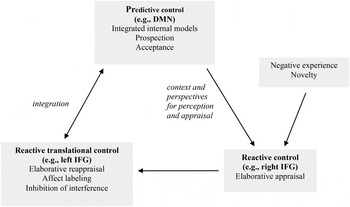
Figure 1. A neurobiological model of resilience based on the integration of negative experiences, derived from predictive and reactive control systems theory. DMN=default mode network; IFG=inferior frontal gyrus.
Although we agree with Kalisch and colleagues that positive appraisal is an important mechanism of facilitating resilience, we propose a more fundamental mechanism underlying resilience. Specifically, based on a neurobehavioral framework (predictive and reactive control systems theory; cf. Tops Reference Tops2014; Tops et al. Reference Tops, Buisman-Pijlman, Carter, Kent, Davis and Reich2013a; Reference Tops, Luu, Boksem, Tucker, Kent, Davis and Reich2013b; Reference Tops, Boksem, Quirin and Koole2014a; Reference Tops, Koole, IJzerman and Buisman-Pijlman2014b), we propose that integration of novel and negative experiences into coherent internal models (or “schemata”) of already integrated experiences is central to resilience (see also Kent Reference Kent and Ungar2012; Kuhl Reference Kuhl, Boekaerts and Pintrich2000; Reference Kuhl2011; Kuhl et al. Reference Kuhl, Quirin and Koole2015), with positive (re)appraisal and other mechanisms facilitating such integration (cf. Fig. 1).
A neurobiological model of resilience based on the integration of negative experiences, derived from predictive and reactive control systems theory. DMN=default mode network; IFG=inferior frontal gyrus.
According to this framework, two control systems in the brain can be distinguished: reactive versus predictive networks. Reactive control appraises novel (schema-incongruent), salient, and degraded stimuli and guides attention, emotions, and behavior in immediate and continuous response to such stimuli. Reactive control is typically accompanied by tense arousal and negative affect, particularly when the stimulus is assessed as a potential threat. This system includes brain areas overlapping with the “salience network” (cf. Downar et al. Reference Downar, Crawley, Mikulis and Davis2002). By contrast, predictive control is typically activated in the relative absence of threats, or when the individual perceives the threat as predictable and manageable. This system includes brain areas overlapping with the “default mode network” (DMN; cf. Buckner & Carroll Reference Buckner and Carroll2007).
During predictive but not reactive control, negative experiences can be readily integrated into internal models representing relationships between entities, motivations, actions, and outcomes (also referred to as “the self-system”; e.g., Kuhl Reference Kuhl, Boekaerts and Pintrich2000; Kuhl et al. Reference Kuhl, Quirin and Koole2015; see also Koole & Jostmann Reference Koole and Jostmann2004; Quirin et al. Reference Quirin, Bode and Kuhl2011). This integration process puts negative experiences and concomitant emotions in perspective, and it provides the individual with a sense of coherence (Antonovsky Reference Antonovsky1987), controllability (Bandura Reference Bandura1977; Deci & Ryan Reference Deci and Ryan1980; Rotter Reference Rotter1954), and meaning (Frankl Reference Frankl2004). When the individual is confronted with similar situations in the future, integrated experiences can be recalled and will provide context and perspectives for perception and appraisal of the situation. Individuals can thus more readily and flexibly switch from stressful reactive control, with its narrow focus on the salient stimulus, to more relaxed predictive control, with its prudent, mindful, attentional mode, in order to “keep their heads” (Kuhl Reference Kuhl, Boekaerts and Pintrich2000; Tops et al. Reference Tops, Luu, Boksem, Tucker, Kent, Davis and Reich2013b). In the end, this results in affective relief and thereby facilitates resilience.
Consequently, individual tendencies to accept and integrate negative experiences (rather than to deny, repress, sensitize to, or avoid them) constitute the basis for a continuous formation of extended, integrated, and differentiated internal models and, therefore, for personal growth and sustained resilience throughout life (Kuhl Reference Kuhl, Boekaerts and Pintrich2000; Reference Kuhl2011). Indeed, acceptance of negative experiences has been related to physiological indicators of health and has been shown to foster resilience following exposure to trauma (Thompson et al. Reference Thompson, Arnkoff and Glass2011).
Although the availability of well-integrated internal models may be a prerequisite for resilience, highly incongruent emotional or traumatic information may challenge internal models and resist immediate integration. We suggest that in such situations, adaptive switches from reactive to predictive control and concomitant integration can be facilitated by reappraisal, and by other subsidiary mechanisms such as prospection or labeling of emotions, as those involve effortful elaboration and semantization necessary for incongruent experiences to become integrated. Prospection refers to the mental representation and evaluation of possible futures, often including planning, prediction, or construction of hypothetical scenarios. Indeed, prospection yields physical and psychological benefits in daily life and in resilience treatment approaches (Kent Reference Kent, Kent, Davis and Reich2013; Seligman et al. Reference Seligman, Railton, Baumeister and Sripada2013). Finally, labeling emotions verbally (Burklund et al. Reference Burklund, Creswell, Irwin and Lieberman2014; Pennebaker Reference Pennebaker1993) or sharing them with others (Rimé Reference Rimé2009) alleviates stress and facilitates integration, much like reappraisal does. For example, when incongruent or unfamiliar experiences challenge collective knowledge and elicit negative emotions, affective sharing can accommodate and absorb these experiences into socially shared internal models, thus reducing their negative valence and concomitant negative emotions (Rimé Reference Rimé2009) by facilitating predictive control.
In terms of the neural underpinnings of the capacity to shift from reactive to predictive control modes and to integrate negative experiences, the inferior frontal gyrus (IFG) plays a key role, with partly different functions for left and right IFGs. The right IFG is implicated in elaborative appraisal of novel (emotional) stimuli and is more strongly interconnected with limbic (emotional) areas such as the amygdala and the striatum. The left IFG is implicated in translation of novel emotional experiences into semantic information that later can be integrated into existing internal models of the predictive control system (as supported by DMN areas such as posterior cingulate and medial prefrontal cortex, precuneus, and posterior hippocampus; Tops et al. Reference Tops, Koole, IJzerman and Buisman-Pijlman2014b).
There is indeed evidence that the resilience mechanisms considered subsidiary in the present framework also may be facilitated by the left IFG. For example, this area often coactivates with areas of the DMN during prospection (Spreng et al. Reference Spreng, Mar and Kim2009). Also the left IFG has been implicated in successful encoding of negative memories during reappraisal (Hayes et al. Reference Hayes, Morey, Petty, Seth, Smoski, McCarthy and LaBar2010) and in the inhibition of interfering appraisals or other distractors (Andrews & Thomson Reference Andrews and Thomson2009), a process that contributes to reappraisal. Further, individuals who accept negative experiences, but not those who deny them, show left IFG activation in anticipation of uncontrollable pain (Salomons et al. Reference Salomons, Johnstone, Backonja, Shackman and Davidson2007). Finally, similar to what is found in studies of reappraisal, during verbal labeling of unpleasant emotions, activation of the left IFG (including Broca's area) increases, whereas amygdala activity and bodily arousal decrease (Torrisi et al. Reference Torrisi, Lieberman, Bookheimer and Altshuler2013; cf. Bach et al. Reference Bach, Grandjean, Sander, Herdener, Strik and Seifritz2008; Creswell et al. Reference Creswell, Way, Eisenberger and Lieberman2007; Frühholz et al. Reference Frühholz, Ceravolo and Grandjean2012; Herwig et al. Reference Herwig, Kaffenberger, Jäncke and Brühl2010). Hence, particularly the left IFG appears to have an intermediate status between reactive and predictive control, allowing for important switches between modes of control, which in turn promote resilience.
In sum, our neurobehavioral framework emphasizes integration of negative experiences as a fundamental neurocognitive mechanism underlying sustainable resilience, while not ignoring the relevance of (re)appraisal or other resilience mechanisms. Although this framework is functional in nature, it is nonreductionistic, because it considers a broad array of psychological processes. Consequently, our framework has the potential to integrate psychologically and biologically oriented approaches toward resilience.