






No CrossRef data available.
Article contents
Oxytocin as an allostatic agent in the social bonding effects of music
Published online by Cambridge University Press: 30 September 2021
Abstract
Despite acknowledging that musicality evolved to serve multiple adaptive functions in human evolution, Savage et al. promote social bonding to an overarching super-function. Yet, no unifying neurobiological framework is offered. We propose that oxytocin constitutes a socio-allostatic agent whose modulation of sensing, learning, prediction, and behavioral responses with reference to the physical and social environment facilitates music's social bonding effects.
Information
- Type
- Open Peer Commentary
- Information
- Copyright
- Copyright © The Author(s), 2021. Published by Cambridge University Press
References
Alley, J. C., & Diamond, L. M. (2020). Oxytocin and human sexuality: Recent developments. Current Sexual Health Reports, 12, 182–185. doi: 10.1007/s11930-020-00274-4.CrossRefGoogle Scholar
Bartz, J. A., Zaki, J., Bolger, N., & Ochsner, K. N. (2011). Social effects of oxytocin in humans: Context and person matter. Trends in Cognitive Sciences, 15(7), 301–309. doi: 10.1016/j.tics.2011.05.002.Google ScholarPubMed
Baskerville, T. A., & Douglas, A. J. (2010). Dopamine and oxytocin interactions underlying behaviors: Potential contributions to behavioral disorders. CNS Neuroscience & Therapeutics, 16(3), e92–e123. doi: 10.1111/j.1755-5949.2010.00154.x.CrossRefGoogle ScholarPubMed
Carter, C. S. (2014). Oxytocin pathways and the evolution of human behavior. Annual Review of Psychology, 65, 17–39. doi: 10.1146/annurev-psych-010213-115110.CrossRefGoogle ScholarPubMed
Carter, C. S. (2017). The role of oxytocin and vasopressin in attachment. Psychodynamic Psychiatry, 45(4), 499–517. doi: 10.1521/pdps.2017.45.4.499.CrossRefGoogle ScholarPubMed
Chini, B., Leonzino, M., Braida, D., & Sala, M. (2014). Learning about oxytocin: Pharmacologic and behavioral issues. Biological Psychiatry, 76(5), 360–366. doi: 10.1016/j.biopsych.2013.08.029.CrossRefGoogle ScholarPubMed
D'Ausilio, A., Novembre, G., Fadiga, L., & Keller, P. E. (2015). What can music tell us about social interaction? Trends in Cognitive Sciences, 19(3), 111–114. doi: 10.1016/j.tics.2015.01.005.CrossRefGoogle ScholarPubMed
De Dreu, C. K., Greer, L. L., Van Kleef, G. A., Shalvi, S., & Handgraaf, M. J. (2011). Oxytocin promotes human ethnocentrism. Proceedings of the National Academy of Sciences, 108(4), 1262–1266. doi: 10.1073/pnas.1015316108.CrossRefGoogle ScholarPubMed
Declerck, C. H., Boone, C., Pauwels, L., Vogt, B., & Fehr, E. (2020). A registered replication study on oxytocin and trust. Nature Human Behaviour, 4, 646–655. doi: 10.1038/s41562-020-0878-x.CrossRefGoogle Scholar
Eckstein, M., Bamert, V., Stephens, S., Wallen, K., Young, L. J., Ehlert, U., & Ditzen, B. (2019). Oxytocin increases eye-gaze towards novel social and non-social stimuli. Social Neuroscience, 14(5), 594–607. doi: 10.1080/17470919.2018.1542341.CrossRefGoogle ScholarPubMed
Egito, J. H., Nevat, M., Shamay-Tsoory, S. G., & Osório, A. A. C. (2020). Oxytocin increases the social salience of the outgroup in potential threat contexts. Hormones and Behavior, 122, 104733. doi: 10.1016/j.yhbeh.2020.104733.CrossRefGoogle ScholarPubMed
Gebauer, L., Witek, M. A., Hansen, N. C., Thomas, J., Konvalinka, I., & Vuust, P. (2016). Oxytocin improves synchronisation in leader-follower interaction. Scientific Reports, 6, 38416. doi: 10.1038/srep38416.CrossRefGoogle ScholarPubMed
González-Hernández, A., Rojas-Piloni, G., & Condés-Lara, M. (2014). Oxytocin and analgesia: Future trends. Trends in Pharmacological Sciences, 35(11), 549–551. doi: 10.1016/j.tips.2014.09.004.CrossRefGoogle ScholarPubMed
Grape, C., Sandgren, M., Hansson, L. O., Ericson, M., & Theorell, T. (2002). Does singing promote well-being? An empirical study of professional and amateur singers during a singing lesson. Integrative Physiological & Behavioral Science, 38(1), 65–74. doi: 10.1007/BF02734261.CrossRefGoogle Scholar
Graustella, A. J., & MacLeod, C. (2012). A critical review of the influence of oxytocin nasal spray on social cognition in humans: Evidence and future directions. Hormones and Behavior, 61(3), 410–418. doi: 10.1016/j.yhbeh.2012.01.002.CrossRefGoogle Scholar
Grippo, A. J., Pournajafi-Nazarloo, H., Sanzenbacher, L., Trahanas, D. M., McNeal, N., Clarke, D. A., … Sue Carter, C. (2012). Peripheral oxytocin administration buffers autonomic but not behavioral responses to environmental stressors in isolated prairie voles. Stress, 15(2), 149–161. doi: 10.3109/10253890.2011.605486.CrossRefGoogle Scholar
Josef, L., Goldstein, P., Mayseless, N., Ayalon, L., & Shamay-Tsoory, S. G. (2019). The oxytocinergic system mediates synchronized interpersonal movement during dance. Scientific Reports, 9(1), 1–8. doi: 10.1038/s41598-018-37141-1.CrossRefGoogle ScholarPubMed
Keeler, J. R., Roth, E. A., Neuser, B. L., Spitsbergen, J. M., Waters, D. J. M., & Vianney, J. M. (2015). The neurochemistry and social flow of singing: Bonding and oxytocin. Frontiers in Human Neuroscience, 9, 518. doi: 10.3389/fnhum.2015.00518.CrossRefGoogle ScholarPubMed
Kosfeld, M., Heinrichs, M., Zak, P. J., Fischbacher, U., & Fehr, E. (2005). Oxytocin increases trust in humans. Nature, 435(7042), 673–676. doi: 10.1038/nature03701.CrossRefGoogle ScholarPubMed
Kovatsi, L., & Nikolaou, K. (2019). Opioids and the hormone oxytocin. Vitamins and Hormones, 111, 195–225. doi: 10.1016/bs.vh.2019.05.003.CrossRefGoogle ScholarPubMed
Lancaster, K., Goldbeck, L., Pournajafi-Nazarloo, H., Connelly, J. J., Carter, C. S., & Morris, J. P. (2018). The role of endogenous oxytocin in anxiolysis: Structural and functional correlates. Biological Psychiatry, 3(7), 618–625. doi: 10.1016/j.bpsc.2017.10.003.Google ScholarPubMed
Leng, G., & Ludwig, M. (2016). Intranasal oxytocin: Myths and delusions. Biological Psychiatry, 79(3), 243–250. doi: 10.1016/j.biopsych.2015.05.003.CrossRefGoogle ScholarPubMed
Love, T. M. (2014). Oxytocin, motivation and the role of dopamine. Pharmacology Biochemistry and Behavior, 119, 49–60. doi: 10.1016/j.pbb.2013.06.011.CrossRefGoogle ScholarPubMed
Marsh, N., Marsh, A. A., Lee, M. R., & Hurlemann, R. (2020). Oxytocin and the neurobiology of prosocial behavior. The Neuroscientist 15(2), 469–482. doi: 10.1177/1745691619876528.Google Scholar
McCullough, M. E., Churchland, P. S., & Mendez, A. J. (2013). Problems with measuring peripheral oxytocin: Can the data on oxytocin and human behavior be trusted? Neuroscience & Biobehavioral Reviews, 37(8), 1485–1492. doi: 10.1016/j.neubiorev.2013.04.018.CrossRefGoogle ScholarPubMed
Podlipniak, P. (2017). The role of the Baldwin effect in the evolution of human musicality. Frontiers in Neuroscience, 11, 542. doi: 10.3389/fnins.2017.00542.CrossRefGoogle ScholarPubMed
Quintana, D. S., & Guastella, A. J. (2020). An allostatic theory of oxytocin. Trends in Cognitive Sciences, 24(7), 515–528. doi: 10.1016/j.tics.2020.03.008.CrossRefGoogle ScholarPubMed
Saxbe, D. E., Beckes, L., Stoycos, S. A., & Coan, J. A. (2020). Social allostasis and social allostatic load: A new model for research in social dynamics, stress, and health. Perspectives on Psychological Science, 15(2), 469–482. doi: 10.1177/1745691619876528.CrossRefGoogle ScholarPubMed
Schladt, T. M., Nordmann, G. C., Emilius, R., Kudielka, B. M., de Jong, T. R., & Neumann, I. D. (2017). Choir versus solo singing: Effects on mood, and salivary oxytocin and cortisol concentrations. Frontiers in Human Neuroscience, 11, 430. doi: 10.3389/fnhum.2017.00430.CrossRefGoogle ScholarPubMed
Schulkin, J. (2011). Social allostasis: Anticipatory regulation of the internal milieu. Frontiers in Evolutionary Neuroscience, 2, 111. doi: 10.3389/fnevo.2010.00111.CrossRefGoogle ScholarPubMed
Shahrestani, S., Kemp, A. H., & Guastella, A. J. (2013). The impact of a single administration of intranasal oxytocin on the recognition of basic emotions in humans: A meta-analysis. Neuropsychopharmacology, 38(10), 1929–1936. doi: 10.1038/npp.2013.86.CrossRefGoogle ScholarPubMed
Shamay-Tsoory, S. G., Fischer, M., Dvash, J., Harari, H., Perach-Bloom, N., & Levkovitz, Y. (2009). Intranasal administration of oxytocin increases envy and schadenfreude (gloating). Biological Psychiatry, 66(9), 864–870. doi: 10.1016/j.biopsych.2009.06.009.CrossRefGoogle Scholar
Szymanska, M., Schneider, M., Chateau-Smith, C., Nezelof, S., & Vulliez-Coady, L. (2017). Psychophysiological effects of oxytocin on parent-child interactions: A literature review on oxytocin and parent–child interactions. Psychiatry and Clinical Neurosciences, 71(10), 690–705. doi: 10.1111/pcn.12544.CrossRefGoogle ScholarPubMed
Theofanopoulou, C., Boeckx, C., & Jarvis, E. D. (2017). A hypothesis on a role of oxytocin in the social mechanisms of speech and vocal learning. Proceedings of the Royal Society B: Biological Sciences, 284(1861), 20170988. doi: 10.1098/rspb.2017.0988.CrossRefGoogle ScholarPubMed
van der Schyff, D., & Schiavio, A. (2017). Evolutionary musicology meets embodied cognition: Biocultural coevolution and the enactive origins of human musicality. Frontiers in Neuroscience, 11, 519. doi: 0.3389/fnins.2017.00519.CrossRefGoogle ScholarPubMed
Walum, H., Waldman, I. D., & Young, L. J. (2016). Statistical and methodological considerations for the interpretation of intranasal oxytocin studies. Biological Psychiatry, 79(3), 251–257. doi: 10.1016/j.biopsych.2015.06.016.CrossRefGoogle ScholarPubMed
Wu, N., Li, Z., & Su, Y. (2012). The association between oxytocin receptor gene polymorphism (OXTR) and trait empathy. Journal of Affective Disorders, 138(3), 468–472. doi: 10.1016/j.jad.2012.01.009.CrossRefGoogle ScholarPubMed
Zak, P. J., Stanton, A. A., & Ahmadi, S. (2007). Oxytocin increases generosity in humans. PLoS ONE, 2(11), e1128. doi: 10.1371/journal.pone.0001128.CrossRefGoogle ScholarPubMed
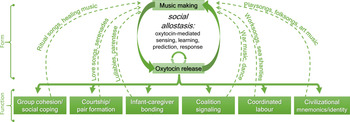
Figure 1. Overview of how the socio-allostatic effects of oxytocin may contribute to a unifying neurobiological framework for music's adaptive functions. Specifically, music making – which often occurs in social contexts – may lead to oxytocin release that promotes internal adjustment of sensing and response set-points as well as assists learning and prediction processes with reference to the external physical and social environment. These allostatic optimizations may, in turn, increase the efficacy of music's adaptive functions as a facilitator of social cohesion, pair formation, parental bonding, coalition signaling, group coordination, and preservation of communal knowledge and identity. These adaptive functions of music are each associated with specific musical forms employing distinct acoustic features. Such function-to-form associations are, however, statistical (rather than deterministic) as well as highly interconnected in that dance, for example, can contribute to multiple adaptive functions such as cohesion, courtship, coalition, and coordination, depending on the context in which it appears.
Target article
Related commentaries (60)
A boldly comparative approach will strengthen co-evolutionary accounts of musicality's origins
A neurodevelopmental disorders perspective into music, social attention, and social bonding
An evolutionary theory of music needs to care about developmental timing
Credible signalling and social bonds: Ultimately drawing on the same idea
Functional and evolutionary parallels between birdsong and human musicality
Is neural entrainment to rhythms the basis of social bonding through music?
Music as a trait in evolutionary theory: A musicological perspective
Not by signalling alone: Music's mosaicism undermines the search for a proper function
Oxytocin as an allostatic agent in the social bonding effects of music
Sound sleep: Lullabies as a test case for the neurobiological effects of music
The music and social bonding hypothesis does require multilevel selection
Both target articles acknowledge that human musicality evolved to serve more than one adaptive function. Although Mehr, Krasnow, Bryant, and Hagen exalt credible signaling to a unitary mechanism, they eventually promote two ultimate-level explanations in terms of credible signaling of coalition strength and parental attention, manifesting in divergent forms of music (i.e., loud drumming/chanting vs. lullabies). In this way, one of their arguments opposing Savage et al.'s music and social bonding (MSB) hypothesis – namely that (some types of) musics are poorly designed to coordinate groups – can be turned against themselves in that lullabies are poorly designed to signal coalition strength and war chants are poorly designed to signal parental attention. This functional multiplicity leads Savage and colleagues to search for an overarching super-function through synthesis and extension of previous proposals.
Savage et al.'s MSB account is convincing in many aspects. Yet, their overview of candidate neurobiological mechanisms exposes the somewhat rudimentary state of research in this area. For example, their Figure 3 treats the oxytocinergic and endogenous opioid systems under the same umbrella despite comprising distinct – albeit interconnected (Kovatsi & Nikolaou, Reference Kovatsi and Nikolaou2019) – systems. In light of oxytocin's well-established role in social learning and memory (Chini, Leonzino, Braida, & Sala, Reference Chini, Leonzino, Braida and Sala2014), direct links of oxytocin to learning/knowledge (e.g., through laryngeal motor cortex, ventral tegmental area, or Broca's area; Theofanopoulou, Boeckx, & Jarvis, Reference Theofanopoulou, Boeckx and Jarvis2017) could also be considered in addition to indirect links via the dopaminergic system (Baskerville & Douglas, Reference Baskerville and Douglas2010; Love, Reference Love2014). Although the detailed interactions of these three systems lie beyond the scope of a brief commentary, it suffices to say that the overarching super-function envisioned by the target authors indeed requires a unifying neurobiological framework.
Given its manifold roles in a multitude of peripheral and central nervous processes with direct relevance for the proposed adaptive functions of music (as depicted in Fig. 1), we suggest that the nonapeptide oxytocin may contribute crucially to such a unifying neurobiological framework. Specifically, oxytocin-mediated increases in generosity (Zak, Stanton, & Ahmadi, Reference Zak, Stanton and Ahmadi2007), emotional face recognition (Shahrestani, Kemp, & Guastella, Reference Shahrestani, Kemp and Guastella2013), and (potentially) trust (Kosfeld, Heinrichs, Zak, Fischbacher, & Fehr, Reference Kosfeld, Heinrichs, Zak, Fischbacher and Fehr2005; but see Declerck, Boone, Pauwels, Vogt, & Fehr, Reference Declerck, Boone, Pauwels, Vogt and Fehr2020) may increase music's effects on group cohesion resulting in social coping benefits. Changes in eye gaze (Eckstein et al., Reference Eckstein, Bamert, Stephens, Wallen, Young, Ehlert and Ditzen2019), selective sociality (Carter, Reference Carter2017), and sexual arousal and orgasm (Alley & Diamond, Reference Alley and Diamond2020) mediated by oxytocin may enhance musical effects on courtship behavior and exclusionary pair formation. Oxytocin-mediated empathy (Wu, Li, & Su, Reference Wu, Li and Su2012), playful behavior (Szymanska, Schneider, Chateau-Smith, Nezelof, & Vulliez-Coady, Reference Szymanska, Schneider, Chateau-Smith, Nezelof and Vulliez-Coady2017), and peripheral effects on parturition and lactation (Carter, Reference Carter2014) could underlie musical infant–caregiver bonding. Moreover, oxytocin-related increases in synchrony (Gebauer et al., Reference Gebauer, Witek, Hansen, Thomas, Konvalinka and Vuust2016; Josef, Goldstein, Mayseless, Ayalon, & Shamay-Tsoory, Reference Josef, Goldstein, Mayseless, Ayalon and Shamay-Tsoory2019) along with out-group gloating (Shamay-Tsoory et al., Reference Shamay-Tsoory, Fischer, Dvash, Harari, Perach-Bloom and Levkovitz2009), derogation (De Dreu, Greer, Van Kleef, Shalvi, & Handgraaf, Reference De Dreu, Greer, Van Kleef, Shalvi and Handgraaf2011), and threat perception (Egito, Nevat, Shamay-Tsoory, & Osório, Reference Egito, Nevat, Shamay-Tsoory and Osório2020) may promote competitive musical coalition signaling. Oxytocin's analgesic (González-Hernández, Rojas-Piloni, & Condés-Lara, Reference González-Hernández, Rojas-Piloni and Condés-Lara2014) and anxiolytic (Lancaster et al., Reference Lancaster, Goldbeck, Pournajafi-Nazarloo, Connelly, Carter and Morris2018) effects may, in turn, enhance music's facilitation of coordinated physical labor. Finally, oxytocin-enhanced social learning and memory (Graustella & MacLeod, Reference Graustella and MacLeod2012) could increase music's capacity for preserving civilizational knowledge and forming shared cultural identities.
Overview of how the socio-allostatic effects of oxytocin may contribute to a unifying neurobiological framework for music's adaptive functions. Specifically, music making – which often occurs in social contexts – may lead to oxytocin release that promotes internal adjustment of sensing and response set-points as well as assists learning and prediction processes with reference to the external physical and social environment. These allostatic optimizations may, in turn, increase the efficacy of music's adaptive functions as a facilitator of social cohesion, pair formation, parental bonding, coalition signaling, group coordination, and preservation of communal knowledge and identity. These adaptive functions of music are each associated with specific musical forms employing distinct acoustic features. Such function-to-form associations are, however, statistical (rather than deterministic) as well as highly interconnected in that dance, for example, can contribute to multiple adaptive functions such as cohesion, courtship, coalition, and coordination, depending on the context in which it appears.
Importantly, the two target theories propose opposite causal relationships between oxytocin and musical synchronization. Although MSB predicts that joint music making would increase oxytocin levels, the credible signaling theory predicts that higher oxytocin levels achieved through pre-existing social cohesion would increase musical synchronization. Burgeoning evidence for both of these effects (former: Grape, Sandgren, Hansson, Ericson, & Theorell, Reference Grape, Sandgren, Hansson, Ericson and Theorell2002; Keeler et al., Reference Keeler, Roth, Neuser, Spitsbergen, Waters and Vianney2015; latter: Gebauer et al., Reference Gebauer, Witek, Hansen, Thomas, Konvalinka and Vuust2016; Josef et al., Reference Josef, Goldstein, Mayseless, Ayalon and Shamay-Tsoory2019) suggests that both hypotheses may ultimately be viable. Yet, findings are sometimes contradictory (e.g., Schladt et al., Reference Schladt, Nordmann, Emilius, Kudielka, de Jong and Neumann2017), sample sizes are typically low (Walum, Waldman, & Young, Reference Walum, Waldman and Young2016), and intranasal administration and salivary assays of oxytocin have faced methodological criticisms (Leng & Ludwig, Reference Leng and Ludwig2016; McCullough, Churchland, & Mendez, Reference McCullough, Churchland and Mendez2013). Theorizing, therefore, converges on oxytocin effects being highly individualistic/context-dependent (Bartz, Zaki, Bolger, & Ochsner, Reference Bartz, Zaki, Bolger and Ochsner2011) and modulatory/interactive rather than primary (Marsh, Marsh, Lee, & Hurlemann, Reference Marsh, Marsh, Lee and Hurlemann2020).
Consistent with this view, an allostatic theory of oxytocin has recently gained traction (Quintana & Guastella, Reference Quintana and Guastella2020). This theory posits that oxytocin facilitates the adjustment of sensing and response set-points and assists learning and prediction in ways that proactively optimize systemic adaptation with reference to a constantly changing environment. The resulting criticality in brain states and behavioral flexibility are beneficial under many circumstances – but perhaps especially so in complex social interactions such as music and dance where ongoing anticipation of environmental consequences is essential (D'Ausilio, Novembre, Fadiga, & Keller, Reference D'Ausilio, Novembre, Fadiga and Keller2015). Beyond the individual level, oxytocin's allostatic effects may further extend to social allostasis in that behavioral flexibility can resolve vicious circles of rigid interaction patterns and inflexible group dynamics (Saxbe, Beckes, Stoycos, & Coan, Reference Saxbe, Beckes, Stoycos and Coan2020; Schulkin, Reference Schulkin2011). A socio-allostatic view of oxytocin, moreover, connects well with intellectual currents such as enactive cognition and biocultural evolution where biological and cultural dimensions constitute factors in the same evolving system of living agents embedded in an environment (van der Schyff & Schiavio, Reference van der Schyff and Schiavio2017).
Savage et al. (2020) propose that music and musicality coevolved through an iterated Baldwin process whereby musical behaviors were culturally invented to tackle the environmental challenges of social living which gradually manifested as adaptive musicality traits (Podlipniak, Reference Podlipniak2017). The neurochemical feedback loop depicted in Figure 1 is consistent with such a process of gene-culture coevolution in that genetic mutations leading to tighter connections between music making and oxytocin release would accelerate the extent to which the adaptive functions of music can capitalize upon oxytocin-mediated sensing, learning, prediction, and response processes. The proposed feedback mechanism whereby oxytocin in itself stimulates more oxytocin release (Grippo et al., Reference Grippo, Pournajafi-Nazarloo, Sanzenbacher, Trahanas, McNeal, Clarke and Sue Carter2012) may further accelerate this process.
When oxytocin-mediated sensing, learning, prediction, and response capacities are sharpened in the encounter with the in-group, phenomena such as social cohesion arise, which in turn promote coordinated labor as well as civilizational mnemonics and identity formation (Fig. 1). When faced with an out-group, heightened social allostasis may manifest in coalition signaling. Finally, when presented with offspring or potential mates, infant–caregiver bonding and dyadic courtship result, respectively. These effects could be mediated by the manifold empirically substantiated effects of oxytocin on human behavior summarized above.
Financial support
NCH received funding from the European Union's Horizon 2020 research and innovation program under the Marie Skłodowska-Curie grant agreement (No. 754513), The Aarhus University Research Foundation, Carlsberg Foundation (CF18-0668), and Lundbeck Foundation (R266-2017-3339).
Conflict of interest
None.