In developing the music and social bonding (MSB) hypothesis, Savage and colleagues have created a highly valuable synthesis spanning disciplines and levels of analysis that surely represents a much needed clarification on a line of thinking well over a century old. We agree with them in their approach and argumentation in nearly all respects; however, we suggest that their contextualization of the MSB hypothesis within the multilevel selection debates could benefit from further conceptual exposition. We argue that, in fact, multilevel selection is required to make MSB coherent, and embedding the hypothesis within this theoretical framework will extend the explanatory power of the model as a whole.
In section 6.2 on group selection, the authors briefly summarize a slice of the long-standing debates over group selection and multilevel selection, both in biological and cultural evolution, and suggest that group selection is not needed because “the key fitness advantages accrue to individuals.”
The invocation of individual level fitness benefits is a common strategy to argue against the need for multilevel selection theory, yet it is a claim that can obscure the explanatory potential of multilevel selection if not carefully unpacked.
First, as Eldakar and Wilson (Reference Eldakar and Wilson2011) make clear, it is key to specify if the fitness advantages accrued for individuals are being framed in relative or absolute terms. This is not made clear by the authors with regard to their framing of MSB. Given that the focus of the hypothesis is on group level social bonding functions, one would be hard pressed to argue that such functions of musicality increase the relative fitness of individuals compared to their (presumably equally socially bonding) group members. As Eldakar and Wilson describe, the invocation of absolute fitness advantages for individuals is no argument against the value of multilevel selection.
Second, to reject group selection in favor of individual selection, it would have to be shown, or at least argued, that individual level selection (i.e., relative fitness differentials) within groups has been stronger than between group selection pressures. Given that the foundational claim of the MSB hypothesis is the social bonding function of musicality, this is a theoretical impossibility. Functions such as improved group coordination, by definition, cannot be achieved by selection acting on competing individuals.
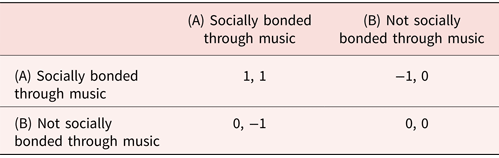
We offer a simple payoff matrix (Table 1) to illustrate these points. We imagine groups of interacting individuals in which two phenotypes A and B exist, where A represents individuals with the kinds of neurobiological and psychological mechanisms that Savage et al. describe and that lead to increased social bonding, prosociality, helping behavior, and so forth in response to participatory music making.
Table 1.Payoff matrix for musicality and social bonding
Individuals with phenotype A who benefit from the social-bonding functions of musicality will only benefit within the context of structured groups of likewise socially-bonded musical individuals. Furthermore, it is thinkable that individuals with phenotype A who are in groups of predominantly phenotypes B might, in fact, have a relative fitness disadvantage because the social bonding mechanism is costly or might make the individual vulnerable to exploitation by non-reciprocating others in the group. Musicality and the social bonding effects could, therefore, not evolve through selection acting on competing individuals. However, it could evolve through multilevel selection if different groups with different compositions of phenotypes A and B exist in a population. In groups of more socially-bonded musical individuals, individuals will have a fitness advantage relative to individuals in other groups with less socially-bonded musical individuals. This payoff dynamic makes the situation one that requisitely invokes multilevel selection on a group-structured population in evolutionary game theory (e.g., Bowles & Gintis, Reference Bowles and Gintis2011).
We can take this analysis a step further and use the analytic framework for cultural multilevel selection developed by Kline, Waring, and Salerno (Reference Kline, Waring and Salerno2018) to determine if a trait can be said to be a group level cultural adaptation (i.e., emergent from group-level cultural selection pressures). This framework requires addressing five core criteria, and we argue that musicality, as framed within the MSB hypothesis, very likely does meet all of these requirements:
(1) Indicators of group adaptation: MSB suggests group-level adaptive functions of musicality including enhanced within group bonds, improved group coordination, and group membership cues.
(2) Group structure: participatory music making is likely a group structured trait, and the social bonding functions are definitionally group structured outcomes.
(3) Selection mechanism: the social bonding functions of musicality would plausibly facilitate survival and expansion of groups, as well as cultural transmission and trait-based migration between groups.
(4) Group-level cultural selection: because of the plausible probability of cultural selection mechanisms occurring at the group level, group-level cultural selection can be said to be occurring.
(5) Group-level cultural adaptation: given the group structured fitness benefits and selection processes resulting from the social-bonding outcomes of participatory music making, it can be seen as a group-level cultural adaptation.
Even in recent years, many leading scholars in the evolutionary social sciences have framed their hypotheses as not requiring group selection, perhaps because of perceptions of persistent controversy, only to be shown the conceptual issues that emerge from this lack of embrace (see discussions of Michael Tomasello's study in Wilson, Reference Wilson2018; and Richard Wrangham's study in Wilson, Reference Wilson2019). Given that the core criticism of group selection offered in the target article is a 2012 popular press piece from Steven Pinker that has since been well refuted (see Richerson, Reference Richerson2012), with no known formal response from Pinker himself, and given the theoretical value offered by multilevel selection theory in providing a framework for understanding the complex of socially structured fitness benefits likely emergent from evolving musicality, we suggest the authors and future scholars would benefit from re-thinking this aversion to group selection. Situating the MSB hypothesis within cultural multilevel selection theory can allow the hypothesis to achieve the full explanatory power the authors rightly ascribe its potential to be.







In developing the music and social bonding (MSB) hypothesis, Savage and colleagues have created a highly valuable synthesis spanning disciplines and levels of analysis that surely represents a much needed clarification on a line of thinking well over a century old. We agree with them in their approach and argumentation in nearly all respects; however, we suggest that their contextualization of the MSB hypothesis within the multilevel selection debates could benefit from further conceptual exposition. We argue that, in fact, multilevel selection is required to make MSB coherent, and embedding the hypothesis within this theoretical framework will extend the explanatory power of the model as a whole.
In section 6.2 on group selection, the authors briefly summarize a slice of the long-standing debates over group selection and multilevel selection, both in biological and cultural evolution, and suggest that group selection is not needed because “the key fitness advantages accrue to individuals.”
The invocation of individual level fitness benefits is a common strategy to argue against the need for multilevel selection theory, yet it is a claim that can obscure the explanatory potential of multilevel selection if not carefully unpacked.
First, as Eldakar and Wilson (Reference Eldakar and Wilson2011) make clear, it is key to specify if the fitness advantages accrued for individuals are being framed in relative or absolute terms. This is not made clear by the authors with regard to their framing of MSB. Given that the focus of the hypothesis is on group level social bonding functions, one would be hard pressed to argue that such functions of musicality increase the relative fitness of individuals compared to their (presumably equally socially bonding) group members. As Eldakar and Wilson describe, the invocation of absolute fitness advantages for individuals is no argument against the value of multilevel selection.
Second, to reject group selection in favor of individual selection, it would have to be shown, or at least argued, that individual level selection (i.e., relative fitness differentials) within groups has been stronger than between group selection pressures. Given that the foundational claim of the MSB hypothesis is the social bonding function of musicality, this is a theoretical impossibility. Functions such as improved group coordination, by definition, cannot be achieved by selection acting on competing individuals.
We offer a simple payoff matrix (Table 1) to illustrate these points. We imagine groups of interacting individuals in which two phenotypes A and B exist, where A represents individuals with the kinds of neurobiological and psychological mechanisms that Savage et al. describe and that lead to increased social bonding, prosociality, helping behavior, and so forth in response to participatory music making.
Payoff matrix for musicality and social bonding
Individuals with phenotype A who benefit from the social-bonding functions of musicality will only benefit within the context of structured groups of likewise socially-bonded musical individuals. Furthermore, it is thinkable that individuals with phenotype A who are in groups of predominantly phenotypes B might, in fact, have a relative fitness disadvantage because the social bonding mechanism is costly or might make the individual vulnerable to exploitation by non-reciprocating others in the group. Musicality and the social bonding effects could, therefore, not evolve through selection acting on competing individuals. However, it could evolve through multilevel selection if different groups with different compositions of phenotypes A and B exist in a population. In groups of more socially-bonded musical individuals, individuals will have a fitness advantage relative to individuals in other groups with less socially-bonded musical individuals. This payoff dynamic makes the situation one that requisitely invokes multilevel selection on a group-structured population in evolutionary game theory (e.g., Bowles & Gintis, Reference Bowles and Gintis2011).
We can take this analysis a step further and use the analytic framework for cultural multilevel selection developed by Kline, Waring, and Salerno (Reference Kline, Waring and Salerno2018) to determine if a trait can be said to be a group level cultural adaptation (i.e., emergent from group-level cultural selection pressures). This framework requires addressing five core criteria, and we argue that musicality, as framed within the MSB hypothesis, very likely does meet all of these requirements:
(1) Indicators of group adaptation: MSB suggests group-level adaptive functions of musicality including enhanced within group bonds, improved group coordination, and group membership cues.
(2) Group structure: participatory music making is likely a group structured trait, and the social bonding functions are definitionally group structured outcomes.
(3) Selection mechanism: the social bonding functions of musicality would plausibly facilitate survival and expansion of groups, as well as cultural transmission and trait-based migration between groups.
(4) Group-level cultural selection: because of the plausible probability of cultural selection mechanisms occurring at the group level, group-level cultural selection can be said to be occurring.
(5) Group-level cultural adaptation: given the group structured fitness benefits and selection processes resulting from the social-bonding outcomes of participatory music making, it can be seen as a group-level cultural adaptation.
Even in recent years, many leading scholars in the evolutionary social sciences have framed their hypotheses as not requiring group selection, perhaps because of perceptions of persistent controversy, only to be shown the conceptual issues that emerge from this lack of embrace (see discussions of Michael Tomasello's study in Wilson, Reference Wilson2018; and Richard Wrangham's study in Wilson, Reference Wilson2019). Given that the core criticism of group selection offered in the target article is a 2012 popular press piece from Steven Pinker that has since been well refuted (see Richerson, Reference Richerson2012), with no known formal response from Pinker himself, and given the theoretical value offered by multilevel selection theory in providing a framework for understanding the complex of socially structured fitness benefits likely emergent from evolving musicality, we suggest the authors and future scholars would benefit from re-thinking this aversion to group selection. Situating the MSB hypothesis within cultural multilevel selection theory can allow the hypothesis to achieve the full explanatory power the authors rightly ascribe its potential to be.
Financial support
This research received no specific grant from any funding agency, commercial, or not-for-profit sectors.
Conflict of interest
None.