Refine search
Actions for selected content:
174 results
Subgroup mixing in Baumslag–Solitar groups
- Part of
-
- Journal:
- Ergodic Theory and Dynamical Systems , First View
- Published online by Cambridge University Press:
- 05 November 2026, pp. 1-31
-
- Article
-
- You have access
- Open access
- HTML
- Export citation
-
In this article, we contribute to the study of the dynamics by conjugation on the space of subgroups of Baumslag–Solitar groups $\mathrm {BS}(m,n)$
 via the mixing properties of elements asymptotically produced by suitable random walks on the group. In an acylindrically hyperbolic context, Hull, Minasyan and Osin [Subgroup mixing and random walks in groups acting on hyperbolic spaces. Ergod. Th. & Dynam. Sys. 46(10) (2026), 2505–2541] demonstrated strong mixing situations, namely topological $\mu $
 -mixing, a strengthening of high topological transitivity. Regarding non-metabelian $\mathrm {BS}(m,n)$
 with $|m|\neq |n|$
 , we exhibit here a radically different situation on each of the pieces except one of the partition introduced by Carderi, Gaboriau, Le Maître and Stalder [On the space of subgroups of Baumslag–Solitar groups I: perfect kernel and phenotype. Rev. Mat. Iberoam. 41(5) (2025), 1711–1758] (although it is highly topologically transitive on each piece). However, when $|m|= |n|$
 , we demonstrate the topological $\mu $
 -mixing character of the action on each of the pieces.


On the moments of the Ulam–Kac adder
- Part of
-
- Journal:
- Journal of Applied Probability , First View
- Published online by Cambridge University Press:
- 04 November 2026, pp. 1-20
-
- Article
-
- You have access
- HTML
- Export citation
-
Let
 $\{U(n)\}_{n \geq 0}$ be a sequence of independent random variables such that U(n) is distributed uniformly on
 $\{0, 1, 2, \dots, n\}$. The Ulam–Kac adder is the history-dependent random sequence defined by
 $X_{n + 1} = X_{n} + X_{U(n)}$ with the initial condition
 $X_0 = 1$. We show that for each
 $m \geq 1$,
 $\log \mathbb{E}[X_n^m]/\sqrt{n}$ approaches a constant
 $c_m$ as
 $n \to \infty$. For a given m, a method is provided which allows the high-accuracy numerical computation of
 $c_m$. For arbitrary m, loose bounds are provided.


ON PÓLYA’S 4D RANDOM WALK CONSTANT
- Part of
-
- Journal:
- Bulletin of the Australian Mathematical Society , First View
- Published online by Cambridge University Press:
- 21 October 2026, pp. 1-6
-
- Article
-
- You have access
- Open access
- HTML
- Export citation
-
The return probability in the simple symmetric random walk on the four-dimensional lattice $\mathbb {Z}^4$
 is evaluated in closed form in terms of the generalised hypergeometric function.

Stable limit theorems for unbalanced step-reinforced random walks
- Part of
-
- Journal:
- Advances in Applied Probability , First View
- Published online by Cambridge University Press:
- 30 September 2026, pp. 1-30
-
- Article
-
- You have access
- HTML
- Export citation
Aggregating heavy-tailed random vectors: from finite sums to lévy processes
- Part of
-
- Journal:
- Advances in Applied Probability , First View
- Published online by Cambridge University Press:
- 18 June 2026, pp. 1-44
-
- Article
-
- You have access
- Open access
- HTML
- Export citation
-
The tail behavior of aggregates of heavy-tailed random vectors is known to be determined by the so-called principle of ‘one large jump’, be it for finite sums, random sums, or Lévy processes. We establish that, in fact, a more general principle is at play. Assuming that the random vectors are multivariate regularly varying on various subcones of the positive orthant
 $[0,\infty)^d$, first we show that their aggregates are also multivariate regularly varying on these subcones. This allows us to approximate certain tail probabilities rendered asymptotically negligible under classical regular variation. Second, we discover that depending on the structure of a particular tail event, the tail behavior of the aggregates may be characterized by more than a single large jump. Finally, we illustrate a similar phenomenon for regularly varying multivariate Lévy processes, establishing as well a relationship between regular variation of a multivariate Lévy process and multivariate regular variation of its Lévy measure on different subcones. The applicability of these results in financial and insurance risk management is discussed.

Random walks in a time-inhomogeneous random environment conditioned to stay positive
- Part of
-
- Journal:
- Journal of Applied Probability / Volume 63 / Issue 3 / September 2026
- Published online by Cambridge University Press:
- 24 February 2026, pp. 1082-1094
- Print publication:
- September 2026
-
- Article
-
- You have access
- HTML
- Export citation
Fluid limit of a distributed ledger model with random delay
- Part of
-
- Journal:
- Advances in Applied Probability , First View
- Published online by Cambridge University Press:
- 13 February 2026, pp. 1-41
-
- Article
-
- You have access
- Open access
- HTML
- Export citation
Graphical sequences and plane trees
- Part of
-
- Journal:
- Combinatorics, Probability and Computing / Volume 35 / Issue 3 / May 2026
- Published online by Cambridge University Press:
- 05 February 2026, pp. 316-328
-
- Article
-
- You have access
- Open access
- HTML
- Export citation
-
Balister, the second author, Groenland, Johnston, and Scott recently showed that there are asymptotically
 $C4^n/n^{3/4}$ many unordered sequences that occur as degree sequences of graphs with
 $n$ vertices. Combining limit theory for infinitely divisible distributions with a new connection between a class of random walk trajectories and a subset counting formula from additive number theory, we describe
 $C$ in terms of Walkup’s number of rooted plane trees. The bijection is related to an instance of the Lévy–Khintchine formula. Our main result complements a result of Stanley, that ordered graphical sequences are related to quasi-forests.


Extremes for systemic expected shortfall and marginal expected shortfall in a multivariate continuous-time risk model
- Part of
-
- Journal:
- Probability in the Engineering and Informational Sciences / Volume 40 / Issue 1 / January 2026
- Published online by Cambridge University Press:
- 22 July 2025, pp. 30-62
-
- Article
-
- You have access
- Open access
- HTML
- Export citation
Random walks and contracting elements I: deviation inequality and limit laws
- Part of
-
- Journal:
- Compositio Mathematica / Volume 161 / Issue 7 / July 2025
- Published online by Cambridge University Press:
- 17 September 2025, pp. 1512-1575
- Print publication:
- July 2025
-
- Article
-
- You have access
- Open access
- HTML
- Export citation
Exact solution to the Chow–Robbins game for almost all n, by using a catalan triangle
- Part of
-
- Journal:
- Advances in Applied Probability / Volume 57 / Issue 4 / December 2025
- Published online by Cambridge University Press:
- 16 May 2025, pp. 1206-1241
- Print publication:
- December 2025
-
- Article
-
- You have access
- Open access
- HTML
- Export citation
-
The payoff in the Chow–Robbins coin-tossing game is the proportion of heads when you stop. Stopping to maximize expectation was addressed by Chow and Robbins (1965), who proved there exist integers
 ${k_n}$ such that it is optimal to stop at n tosses when heads minus tails is
 ${k_n}$. Finding
 ${k_n}$ was unsolved except for finitely many cases by computer. We prove an
 $o(n^{-1/4})$ estimate of the stopping boundary of Dvoretsky (1967), which then proves
 ${k_n} = \left\lceil {\alpha \sqrt n \,\, - 1/2\,\, + \,\,\frac{{\left( { - 2\zeta (\! -1/2)} \right)\sqrt \alpha }}{{\sqrt \pi }}{n^{ - 1/4}}} \right\rceil $ except for n in a set of density asymptotic to 0, at a power law rate. Here,
 $\alpha$ is the Shepp–Walker constant from the Brownian motion analog, and
 $\zeta$ is Riemann’s zeta function. An
 $n^{ - 1/4}$ dependence was conjectured by Christensen and Fischer (2022). Our proof uses moments involving Catalan and Shapiro Catalan triangle numbers which appear in a tree resulting from backward induction, and a generalized backward induction principle. It was motivated by an idea of Häggström and Wästlund (2013) to use backward induction of upper and lower Value bounds from a horizon, which they used numerically to settle a few cases. Christensen and Fischer, with much better bounds, settled many more cases. We use Skorohod’s embedding to get simple upper and lower bounds from the Brownian analog; our upper bound is the one found by Christensen and Fischer in another way. We use them first for yet many more examples and a conjecture, then algebraically in the tree, with feedback to get much sharper Value bounds near the border, and analytic results. Also, we give a formula that gives the exact optimal stop rule for all n up to about a third of a billion; it uses the analytic result plus terms arrived at empirically.


The spread of an epidemic: a game-theoretic approach
- Part of
-
- Journal:
- Advances in Applied Probability / Volume 57 / Issue 3 / September 2025
- Published online by Cambridge University Press:
- 31 January 2025, pp. 749-810
- Print publication:
- September 2025
-
- Article
-
- You have access
- HTML
- Export citation
QUENCHED CENTRAL LIMIT THEOREM FOR DVORETZKY COVERING
- Part of
-
- Journal:
- Bulletin of the Australian Mathematical Society / Volume 111 / Issue 2 / April 2025
- Published online by Cambridge University Press:
- 28 January 2025, pp. 368-378
- Print publication:
- April 2025
-
- Article
-
- You have access
- HTML
- Export citation
-
Let
 $\{\omega _n\}_{n\geq 1}$ be a sequence of independent and identically distributed random variables on a probability space
 $(\Omega , \mathcal {F}, \mathbb {P})$, each uniformly distributed on the unit circle
 $\mathbb {T}$, and let
 $\ell _n=cn^{-\tau }$ for some
 $c>0$ and
 $0<\tau <1$. Let
 $I_{n}=(\omega _n,\omega _n+\ell _n)$ be the random interval with left endpoint
 $\omega _n$ and length
 $\ell _n$. We study the asymptotic property of the covering time
 $N_n(x)=\sharp \{1\leq k\leq n: x\in I_k\}$ for each
 $x\in \mathbb {T}$. We prove the quenched central limit theorem for the covering time, that is,
 $\mathbb {P}$-almost surely,
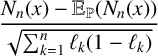 $$ \begin{align*}\frac{N_n(x)-\mathbb{E}_{\mathbb{P}}(N_n(x))}{\sqrt{\sum_{k=1}^n \ell_k(1-\ell_k)}}\end{align*} $$
converges in law to the standard normal distribution.


Optimal linear sofic approximations of countable groups
- Part of
-
- Journal:
- Glasgow Mathematical Journal / Volume 67 / Issue 2 / May 2025
- Published online by Cambridge University Press:
- 24 January 2025, pp. 245-268
-
- Article
-
- You have access
- HTML
- Export citation
-
Let
 $G$ be a group. The notion of linear sofic approximations of
 $G$ over an arbitrary field
 $F$ was introduced and systematically studied by Arzhantseva and Păunescu [3]. Inspired by one of the results of [3], we introduce and study the invariant
 $\kappa _F(G)$ that captures the quality of linear sofic approximations of
 $G$ over
 $F$. In this work, we show that when
 $F$ has characteristic zero and
 $G$ is linear sofic over
 $F$, then
 $\kappa _F(G)$ takes values in the interval
 $[1/2,1]$ and
 $1/2$ cannot be replaced by any larger value. Further, we show that under the same conditions,
 $\kappa _F(G)=1$ when
 $G$ is torsion-free. These results answer a question posed by Arzhantseva and Păunescu [3] for fields of characteristic zero. One of the new ingredients of our proofs is an effective non-concentration estimates for random walks on finitely generated abelian groups, which may be of independent interest.


First-passage time for Sinai’s random walk in a random environment
- Part of
-
- Journal:
- Journal of Applied Probability / Volume 62 / Issue 2 / June 2025
- Published online by Cambridge University Press:
- 29 November 2024, pp. 756-774
- Print publication:
- June 2025
-
- Article
-
- You have access
- HTML
- Export citation
Random walks on groups and superlinear-divergent geodesics
- Part of
-
- Journal:
- Ergodic Theory and Dynamical Systems / Volume 45 / Issue 5 / May 2025
- Published online by Cambridge University Press:
- 21 November 2024, pp. 1403-1443
- Print publication:
- May 2025
-
- Article
-
- You have access
- Open access
- HTML
- Export citation
Transience of continuous-time conservative random walks
- Part of
-
- Journal:
- Journal of Applied Probability / Volume 62 / Issue 1 / March 2025
- Published online by Cambridge University Press:
- 18 September 2024, pp. 153-171
- Print publication:
- March 2025
-
- Article
-
- You have access
- Open access
- HTML
- Export citation
-
We consider two continuous-time generalizations of conservative random walks introduced in Englander and Volkov (2022), an orthogonal and a spherically symmetrical one; the latter model is also known as random flights. For both models, we show the transience of the walks when
 $d\ge 2$ and that the rate of direction changing follows a power law
 $t^{-\alpha}$,
 $0<\alpha\le 1$, or the law
 $(\!\ln t)^{-\beta}$ where
 $\beta>2$.


Multidimensional random motions with a natural number of finite velocities
- Part of
-
- Journal:
- Advances in Applied Probability / Volume 56 / Issue 3 / September 2024
- Published online by Cambridge University Press:
- 22 March 2024, pp. 1033-1063
- Print publication:
- September 2024
-
- Article
-
- You have access
- Open access
- HTML
- Export citation
Scaling limit of the local time of random walks conditioned to stay positive
- Part of
-
- Journal:
- Journal of Applied Probability / Volume 61 / Issue 3 / September 2024
- Published online by Cambridge University Press:
- 13 February 2024, pp. 1060-1074
- Print publication:
- September 2024
-
- Article
-
- You have access
- HTML
- Export citation
LINEAR GROWTH OF TRANSLATION LENGTHS OF RANDOM ISOMETRIES ON GROMOV HYPERBOLIC SPACES AND TEICHMÜLLER SPACES
- Part of
-
- Journal:
- Journal of the Institute of Mathematics of Jussieu / Volume 23 / Issue 4 / July 2024
- Published online by Cambridge University Press:
- 06 November 2023, pp. 1751-1795
- Print publication:
- July 2024
-
- Article
-
- You have access
- Open access
- HTML
- Export citation
-
We investigate the translation lengths of group elements that arise in random walks on the isometry groups of Gromov hyperbolic spaces. In particular, without any moment condition, we prove that non-elementary random walks exhibit at least linear growth of translation lengths. As a corollary, almost every random walk on mapping class groups eventually becomes pseudo-Anosov, and almost every random walk on
 $\mathrm {Out}(F_n)$ eventually becomes fully irreducible. If the underlying measure further has finite first moment, then the growth rate of translation lengths is equal to the drift, the escape rate of the random walk.
We then apply our technique to investigate the random walks induced by the action of mapping class groups on Teichmüller spaces. In particular, we prove the spectral theorem under finite first moment condition, generalizing a result of Dahmani and Horbez.

