To save content items to your account,
please confirm that you agree to abide by our usage policies.
If this is the first time you use this feature, you will be asked to authorise Cambridge Core to connect with your account.
Find out more about saving content to .
To save content items to your Kindle, first ensure no-reply@cambridge.org
is added to your Approved Personal Document E-mail List under your Personal Document Settings
on the Manage Your Content and Devices page of your Amazon account. Then enter the ‘name’ part
of your Kindle email address below.
Find out more about saving to your Kindle.
Note you can select to save to either the @free.kindle.com or @kindle.com variations.
‘@free.kindle.com’ emails are free but can only be saved to your device when it is connected to wi-fi.
‘@kindle.com’ emails can be delivered even when you are not connected to wi-fi, but note that service fees apply.
Chapter 6 investigates the ways in which new approaches to parish church design augmented the spatial, visual, and aural experience of their resident communities—with special attention to the roles of boundary-marking installations such as screens, seats, and stained-glass windows. Items of special interest include screens at Woodbridge (Suffolk) and Totnes (Devon); seats at King’s Lynn (Norfolk) and Altarnun (Cornwall); stained glass in various locations across Norfolk, Suffolk, and Cornwall; and the spectacular suite of timber furnishings preserved at Southwold (Suffolk).
‘John Banville, Art and Genre’ traces the work of one of Ireland’s most significant novelists since the early 1970s, John Banville. It reads backwards from the point at which Banville, a determinedly literary writer, began writing genre fiction under the pseudonym Benjamin Black in 2006, with his novel Christine Falls. However, Banville’s works, from early novels such as Nightspawn (1971), were from the beginning concerned with the exhaustion of literary form, and this can be traced through the science tetralogy, the art trilogy (beginning with the Book of Evidence, 1989), and the Cleave trilogy in the early 2000s. Hence, when Banville declared his 2022 novel, The Singularities, to be his last (even though it has since been followed by more genre fiction), it could be argued that this statement of finality is really only a continuation of a sense of fallibility and inevitable failure present in all his fiction.
Applying a Science and Technology Studies (STS) lens and building on Rancièrian philosophy and the aesthetic turn in International Relations (IR), the article explores the possibilities that the mobilisation of knowledge from the artistic field holds for the pluralisation of expert knowledge-making in the global governance of sustainable development. Is the use of aesthetic knowledge production yet another effort to ‘art-wash’ a global governance agenda? Or does the opening of such new spaces of political exchange create the opportunity for collective knowledge production and political transformation? Moving beyond examining art as an instrument of science communication, the article discusses artworks as boundary objects, facilitating multivocality, interpretative flexibility, inclusivity, timeliness, and virtual reality, all achieved within the technocratic environment of a governing agenda where datafied expertise continues to dominate. Following such ‘new modalities of reflection’,1 the article applies case study analysis of artworks exhibited at UN COP meetings in order to explore the dynamic interdependence of policy and art as spaces of expert knowledge production and democratic politics.
Chapter 6 reiterates the responsibility of designers to account for legal aspects in their work and explores the need for better support to create more Accountable Designers. A research agenda for doing Accountable Design is presented through proposing eleven principles and a six-stage process. The process and principles foreground key questions, provide methods, and identify future research priorities for doing Accountable Design. This chapter then introduces specific tools and design methods that support doing Accountable Design in practice. There is discussion of the development and empirical evaluation of tools that translate between law, ethics and design such as ideation cards, board games, and design fictions. There is then an overall summary of the book.
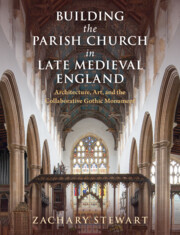
Building the Parish Church in Late Medieval England investigates the architectural, artistic, and cultural significance of local places of worship between the Black Death and the Reformation. Zachary Stewart provides the first systematic account of an exceptional type of parish church distinguished by the absence of any structural division between nave and chancel. Tracking its development across time, place, and setting, he explores how the type's integrated format not only expressed but also reinforced and reproduced collective processes related to the conception, construction, and customization of parochial space. The result, he argues, was nothing less than a new kind of public monument to collaborative action. Informed by a wealth of archival, archaeological, and architectural research, with special attention to East Anglia, Stewart's study demonstrates the importance of the parish church as a center for innovative material production in late medieval England. It also reveals how non-elite social arrangements shaped local life on the eve of the modern era.
This chapter takes up Jabrā Ibrāhīm Jabrā’s first published novel, Ṣurākh fī layl ṭawīl (Cry in a Long Night, 1955), arguing that it integrates modernist elements and themes into Arabic prose. Jabrā’s prose experiments derived from a literary-intellectual posture that he fully articulated in his 1958 essay al-Ḥurriyyah wa-l-ṭūfān (Freedom and the Flood). This posture, which Jabrā framed through the term al-qalaq (anxiety), was the basis of his adamant rejection of iltizām (political/social commitment) in literature. Jabrā’s experiences as a student in the UK and Harvard, his embrace of literary formalism modeled after New Criticism, and his investment in the project of cultural renewal (tajdīd) in Arabic art and literature, guided his approach to translating modernist form into Arabic. The chapter argues that Jabrā’s adaptation of the late modernist discourse of aesthetic autonomy into Arabic, which he articulated through the language of individual freedom, was positioned against discourses of commitment in an Arab intellectual tradition that viewed the relationship of aesthetics to politics as irrevocably tied to the questions of class and colonialism.
This chapter addresses the second main challenge to Kant’s conception of autonomy: the sense that the opposition between nature and freedom renders the actuality of freedom unintelligible. Turning to the Inaugural Dissertation and the three critiques, the second chapter shows that tackling the problem requires us to first overcome a widespread misunderstanding of Kant’s notion of the intelligible world. The intelligible world is not a given world available to theoretical cognition but initially accessible only through practical cognition as a world that ought to be. The chapter develops a new interpretation of Kant’s use of the principle “ought implies can” to show how the moral self-consciousness of the ought provides the realm of freedom with a first degree of actuality that, however, remains insufficient on its own. For freedom to be truly realized, we have to realize our freedom in the natural world by endowing it with a different purposive form. The third Critique offers unrecognized resources to explain how such a realization may be possible. By means of its account of natural purposiveness and the feeling of life, it redescribes external and subjective nature in such a manner that we can see how freedom may take root in them. By means of its account of fine, Kant specifies the general form of processes through which we can transform given nature and produce a second nature expressive of ideas. The chapter closes by considering why Kant did not fully develop these resources and why freedom remains ultimately unreal in his own account, something especially obvious in his discussion of the highest good.
Chapter 4 analyzes the concept of the unnameable or ineffable in ritual and art. The ineffable refers to the difficulty of comprehending specific contexts of intense individual and collective experience that frequently arise during the ritual process. The ensuing totality or emptiness of meaning emerges as a challenge to account for that which eludes logical representation within the social order. The chapter also explores how the experience of the ineffable manifests in the realm of art and aesthetic experience, investigating how this problem has been addressed within continental philosophy, particularly within phenomenology and poststructuralism. Finally, the chapter analyzes poetry’s role as a privileged means of accounting for that which lacks a name and apparent meaning, and of presenting itself to consciousness’s immediacy. Through poetry, it becomes possible to preserve the transient process of the experience of the hidden and unnameable in its existential and anthropological dimensions.
The Introduction presents the book’s general argument. It describes the main objectives and central themes related to the conceptualization of not-knowing. It argues for an anthropology of that which remains nameless in anthropology, lost in the gaps between culture, structure, and process. Not-knowing refers to the difficulty of accounting for certain intense individual and collective experiences that often arise in ritual, spiritual, and religious contexts and, in many ways, defy any attempt at complete rationalization. It deals with situations in which meaning is broken, forcing anthropologists to think beyond reason. It describes how an otherness of a radical nature unfolds before the anthropologist’s gaze, both in its experiential dimension and ethnographic and argumentative construction, as well as the discipline´s blind spots. The Introduction also describes the book’s structure, the organization of each chapter, and its contribution to anthropology.
Chapter 9 moves the discussion from not-knowing to not-doing in the acts of everyday life. Here, the focus is on people’s willingness and purpose to stop knowing, to pause, or to put a stop to the meaning of the world by engaging in subversive acts of not-doing. This concept is derived from the work of the controversial anthropologist and ethnographic fiction writer, Carlos Castaneda. This chapter centers on various forms of deliberate immersion and transportation of subjects into the negative and enigmatic realm of not-knowing. Therefore, we perceive not-doing as purposely creative, devising practices with the intention of altering consciousness in order to introduce individuals to experiences commonly referred to as paranormal, esoteric, mystical, divine, artistic, and subjunctive.
The material and visual culture of late precolonial Andean societies-especially the Inka Empire-looked radically different from their predecessors. For millennia, the iconography of the ancient Andes was dominated by warriors, sacrificial rites, apex predators and chimerical beings whose bodies were amalgamations of multiple human and animal species. Yet by AD 1000, these images had almost entirely vanished. This study offers the first ever analysis of these dramatic transformations. Far more than simply a change of aesthetic preferences, or even a shift in ideology, it posits a series of metaphysical revolutions in which Andean sociality was fundamentally altered. The basis of personhood, the creation of value and the nature of political power itself all came to be refigured in far-reaching ways. Specifically, a once-dominant metaphysics focused on the predatory extraction of vitality from enemies disappeared, to be replaced by one grounded in reciprocal exchanges between human and nonhuman beings.
How can we reconfigure our way of understanding all that is, what Heidegger calls 'being' – so that we can live differently and more fittingly, together? How can we get a sense of different possibilities for being and doing, that allow for hope and change? How can things show themselves so that we heed them and feel a kind of grateful receptivity to them? To all of these questions, Heidegger's answer is 'art.' This Element aims to make sense of the incredible importance Heidegger affords art, on the one hand, and his pessimistic reflections on the possibilities for both art and life in late modernity, on the other. The author proposes that thinking of the artwork as a measure – opaque, basic, and with a regulative normative force – helps make sense of Heidegger's thinking and the promise and peril of art.
This chapter examines a remarkable effort to memorialize ‘Alamgir in the decades after his death. This enterprise is noteworthy because it was unprecedented in Mughal history: no other emperor, not even ‘Alamgir’s much-admired great-grandfather Akbar (r. 1556–1605), was eulogized with the same intensity and for so many decades after his death. In its early stages this project was led by a small group of noble ‘Alamgir loyalists. In time, however, the effort extended to other parts of the rapidly disintegrating empire as well as, unexpectedly, to groups that had either been only nominally under Mughal rule or had actively opposed it. The end product was a trove of histories, administrative manuals, collections of orders and correspondence, and miniatures depicting ‘Alamgir. Although the participants’ motivations for eulogizing ‘Alamgir varied, the results point to a broad consensus about his greatness, among both Muslims and Hindus, across much of northern and central India that lasted until the late eighteenth century and the onset of British colonial rule.
Georges Didi-Huberman asks, “How can we ask ethical questions through aesthetic problems?”. In a world shaped by visual material and human rights struggles, art history is uniquely positioned to explore this question. Beyond thematic connections between art and human rights, art history examines the power of the aesthetic experience to unsettle conventional thought and foster critical engagement. As a discipline, art history investigates this transformative capacity through aesthetic form and material conditions. It draws on aesthetic theories from Kant and Schiller to Hegel and Adorno, to explore art’s role in constructing democracy and a culture of human rights. Social art history, meanwhile, examines art’s connection to social contexts and ideology, analysing how aesthetics can interrogate human rights violations and envision justice. Engaging theorists from philosophy of aesthetics and social art history, along with cases from Latin America, this chapter explores how the aesthetic experience and its analysis support human rights principles and norms. It further proposes pedagogical models for innovative learning possibilities around art history and human rights.
Extreme weather events caused by human created climate change not only cause catastrophic impact on human and the more-than-human populations but can also trigger permanent changes to place. With these changes, stories shift, in turn influencing knowledge and cultural systems. This article is a dialogue between Natalie Davey and Renée Newman, about the role of art, story, mapping and “jarriny” (translating to totem) as a tool for education on extreme weather events and climate crisis. We also consider the vital role custodianship plays in response to and recovery from an extreme weather event, as was the case for Natalie Davey during, and in the aftermath, of the Fitzroy River floods in Western Australia, 2023.
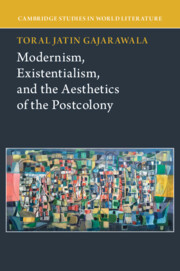
How did writers reimagine self and nation in the postcolonial moment? After the brutalities of partition and the triumph of Independence, decolonization in South Asia unfolded in a dramatic sense of disillusion and alienation. In this transnational study, Toral Gajarawala explores the cultural afterlife of decolonization in India, Pakistan and Bangladesh and its profound moment of existential reckoning. In new genres and forms, artists registered a growing sense of estrangement from nation and nationalism, and crafted a new aesthetic landscape. This book reconsiders modernism in the subcontinent, charting the unlikely affiliations and aesthetic experiments it generated. Each chapter discusses a distinct artistic experiment- Hindi novels set in snow and ice, and a Pakistani painter's Paris moment; the existential novel of Bengal, and absurdist plays on famine and extinction- in light of key philosophical concepts of the moment: askesis, responsibility, commitment. The result is an illuminating microanalysis of the 1960s that reshapes our understanding of postcolonial aesthetics.
The Prologue gives examples of various kinds of hiddenness, focusing especially on the way the artist or the author is both indicated by and hidden behind a work.
During the 1990s and early 2000s, artists of color began to gain prominence and squarely address the burden of recognition and the politics of representation over race and Britishness. Chapter 3 focuses on Maud Sulter and David Dabydeen, who highlight the Black presence in European and British art through the poetic genre of ekphrasis, or poems on visual art. In Sulter’s case, the Scottish Ghanaian lesbian artist conducts a series of “queer reframings” through her career-long preoccupation with Jeanne Duval, the common-law wife, “Black Venus,” and muse to Charles Baudelaire. In contrast, David Dabydeen takes on one of the most revered English artists in his long poem, Turner (Peepal Tree, 1995), which enters into conversation with Turner’s Slavers Throwing Overboard the Dead and the Dying – Typhon Coming On, commonly known as The Slave Ship (1840). Their ekphrastic experimentations pattern forms of Blackness and racialized being whose radical alterity become “beyond recognition,” to the point of becoming nearly inscrutable and unknown in aesthetic form.