To save content items to your account,
please confirm that you agree to abide by our usage policies.
If this is the first time you use this feature, you will be asked to authorise Cambridge Core to connect with your account.
Find out more about saving content to .
To save content items to your Kindle, first ensure no-reply@cambridge.org
is added to your Approved Personal Document E-mail List under your Personal Document Settings
on the Manage Your Content and Devices page of your Amazon account. Then enter the ‘name’ part
of your Kindle email address below.
Find out more about saving to your Kindle.
Note you can select to save to either the @free.kindle.com or @kindle.com variations.
‘@free.kindle.com’ emails are free but can only be saved to your device when it is connected to wi-fi.
‘@kindle.com’ emails can be delivered even when you are not connected to wi-fi, but note that service fees apply.
Chapter 3 examines how the open-plan type was adopted in and adapted to the increasingly prosperous (and sometimes increasingly populous) parish churches of larger communities across fifteenth- and sixteenth-century England. Examples include a tightly connected group of churches in the city of Norwich as well as clusters of related buildings in York and London.
Chapter 2 investigates how, beginning in the fourteenth century, the emergence of the open-plan parish church afforded residents of rapidly expanding municipalities the means to build ostentatious places of worship that maximized space, minimized cost, and expressed their ambitions as emerging social agents. Case-study locales include Gorleston-on-Sea (Norfolk), North Walsham (Norfolk), Beccles (Suffolk), King’s Lynn (Norfolk), Dartmouth (Devon), St Ives (Cornwall), and Oldham (Lancashire).
Chapter 1 surveys scholarly approaches to the development of the parish church as a spatial/social phenomenon in medieval England. It introduces the example of the “open-plan parish church,” a distinctive architectural type defined by the absence of any structural division between nave and chancel, as a powerful mechanism for analyzing the dynamics of architectural form, architectural function, and architectural facture in late medieval society.
Chapter 5 moves from the municipality to the manor to explore how the open-plan parish church format expedited the exercise of lordly provision, piety, and power in an era of political tumult. Case-study locales include Scottow (Norfolk), Nayland (Suffolk), Long Melford (Suffolk), Denston (Suffolk), Loddon (Norfolk), Shelton (Norfolk), Salthouse (Norfolk), Middleton (Lancashire), Sefton (Lancashire), and a collection of manors associated with the Stanley family in northeastern Wales.
Chapter 4 examines how the open-plan type was adopted in and adapted to the increasingly populous (and sometimes increasingly prosperous) parish churches of smaller communities across fifteenth- and sixteenth-century England. Examples include a tightly connected group of churches in the county of Suffolk as well as clusters of related buildings in Cheshire, Lancashire, Devon, and Cornwall.
The conclusion argues, on the basis of the evidence presented throughout the book, that the open-plan parish church represents a special achievement in several respects: spatially (qua the English parish church), socially (qua the English parish church), and architecturally (as a manifestation of collaborative Gothic). It closes with a survey of the legacy of the type in the anglophone world.
In the first two years of his reign, the thirty-year-old Philip had to mobilize as much cash as possible to fight the war declared by France and to refinance the debts of his father into long-term term juros. He did this while in Flanders and while dealing with a reluctant administration in Castile. The procedure for the refinancing was laid down in a letter of April 1557 to the Council of Finance in Madrid. The chapter shows that it was not a default but the first step of a sound policy that would be completed with the Cortes of 1560, when he had returned after the triumph of San Quentin.
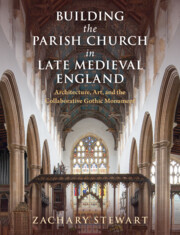
Building the Parish Church in Late Medieval England investigates the architectural, artistic, and cultural significance of local places of worship between the Black Death and the Reformation. Zachary Stewart provides the first systematic account of an exceptional type of parish church distinguished by the absence of any structural division between nave and chancel. Tracking its development across time, place, and setting, he explores how the type's integrated format not only expressed but also reinforced and reproduced collective processes related to the conception, construction, and customization of parochial space. The result, he argues, was nothing less than a new kind of public monument to collaborative action. Informed by a wealth of archival, archaeological, and architectural research, with special attention to East Anglia, Stewart's study demonstrates the importance of the parish church as a center for innovative material production in late medieval England. It also reveals how non-elite social arrangements shaped local life on the eve of the modern era.
This article examines how encounters with South Asian religious diversity shaped the English East India Company’s systems of knowledge, governance, and authority between 1601 and 1700. Moving beyond interpretations that emphasise commerce or geopolitics, it argues that religion was central to the company’s early development as a governing institution. Drawing on company correspondence, travel accounts, administrative records, and the writings of figures such as Streynsham Master, the study demonstrates how concerns about conversion, loyalty, and moral discipline informed corporate policy and administrative practice. The company’s responses to religious plurality were profoundly shaped by engagement with Mughal and regional traditions of governance, which employed forms of religious accommodation to maintain political stability within diverse populations. Rather than imposing a purely English model, company officials adapted existing South Asian practices of sufferance, communal representation, and negotiated authority. The article also explores the role of brokers and intermediaries, whose fluid religious identities complicated European confessional categories while facilitating commercial and political relationships. Simultaneously, the company developed classificatory forms of knowledge that rendered religious communities increasingly legible and governable. By tracing the intersections of religion, knowledge production, and administration, the article shows how the company’s management of plurality laid important foundations for later British imperial governance in India.
This chapter uses the examples of marriages by deaf people in this period to examine how ideas about deafness operated in practice. Records show that most prelingually deaf people were able to marry using signs, and that clergy generally accepted signed vows as evidence of intention and consent. Some of these cases, however, reveal points of vulnerability: signed communication could be misread, manipulated, or deliberately reinterpreted by those with an interest in challenging a marriage’s validity. The chapter also considers how wealthy families responded when a deaf person was an heir. Rather than inventing new legal mechanisms, families relied on the well-established device of the strict settlement to secure property, guide inheritance, and provide structured support for the deaf heir. Together, these practices show that while prejudice and misinterpretation persisted, deaf people were able to marry and inherit within familiar legal frameworks, revealing a more flexible and inclusive system than has often been assumed.
Martin Amis twice used the title ‘State of England’. This chapter considers his fiction as a series of reports on this subject. Despite a few intriguing and exceptional ventures into pastoral territory, most of Amis’s work is set in and around London, especially West London. From The Rachel Papers’s world of youth, the urban vision darkens into a dirty and dangerous city in which ‘the yobs are winning’. This social change is explored through Success, Money, London Fields, and Lionel Asbo. From Money on, Amis depicts an England influenced by the United States, yet which also retains its seemingly imperishable culture of pub and tabloid. Amis’s treatment of England is grim and biting, but Lionel Asbo allows a last hint of optimism.
This chapter sets out the book’s central claim, namely that deafness offers a new perspective on early modern England. It does this by revealing both the diversity of deaf experiences and the cultural weight attached to speech and hearing. Drawing on extensive archival research, it recovers the lives of deaf and deafened people across the social spectrum, showing how prelingually deaf individuals using sign language to work, marry and participate in religious life. Their stories challenge long-standing assumptions that a primarily oral society excluded them. Instead, deaf people were more integrated than printed sources or legal guides suggest, even as prejudice about speech and rationality persisted. The chapter also introduces the methodological challenges of writing deaf history, foregrounding the rarity of first-person accounts and the importance of interpreters, family networks and teachers. By combining insights from medical, theological, legal and cultural models of disability, the chapter reframes deafness as a historically situated experience that illuminates broader questions of knowledge, communication and what it meant to be human in early modern England.
Early modern England was a primarily oral culture, in which deafness and hearing loss could be particularly devastating. Yet, deaf people were a considerable minority in the early modern British Isles, and deafness did not discriminate by sex, wealth or status. By placing deaf people at the centre of the story, Silent Histories transforms our understanding of early modern England. Using newly discovered archival sources, including diaries, court records, wills and personal correspondence, Rosamund Oates uncovers a world in which deaf people used sign language in court cases, in worship and in daily life. Rather than treating deafness as a medical or linguistic problem, this book offers a holistic account of deafness or disability in this period. Oates uncovers the untold stories of deaf people, often in their own words, showing how they worshipped, worked and forged relationships within their communities. Accessible and richly detailed, Silent Histories invites a fresh understanding of the past – one that is more inclusive, more surprising and far more human.
This paper examines what happens to performance when public services transition to social enterprises that combine a public social value focus with private commercial revenue generation. We focus on England’s health and social care sector, which has seen the transition or ‘spin-out’ of some government-run services into social enterprises with the goal of combining high-quality services with a business focus that would allow them to be more efficient, flexible and innovative. Drawing on 2017 English Care Quality Commission (CQC) data, we use ordered logit multi-variate regression to compare quality ratings of government-run providers and social enterprise Community Interest Companies (CICs) while differentiating spin-out and non-spin-out CICs. Our study shows that services spun out into social enterprise CICs did better overall across all CQC quality ratings than government-run services; however, they did not perform as well as independently established CICs. We draw on and contribute to publicness theory to explain divergent performance across these organisational models and provide important information for policymakers deciding where to direct limited public funds for health and social care.
I examine Anglo-Russian relations during the early Cold War (1941–1947), focusing on the evolution of British estimates of Stalin’s intentions and their policy consequences. I contribute to the historiography by highlighting the critical role of Anthony Eden’s 1941 visit to Moscow and demonstrating that a single, dominant assessment framework shaped British estimates during this period. In 1941, British leaders were uncertain about Stalin’s motivations and speculated about many possible principles underlying Soviet foreign policy. They believed that a clear private statement from Stalin was key to understanding Soviet strategic intentions. Following Eden’s visit, during which Stalin articulated his motivation as securing Soviet borders from external threats, British analysts developed a framework for interpreting Soviet actions relative to Stalin’s declared principle. Over the next several years, British elites interpreted Stalin’s actions through this lens, maintaining optimism even as Stalin orchestrated a coup in Romania and installed a communist government in Poland. British optimism shifted after the Iran Crisis, when elites struggled to reconcile Stalin’s push for control over Iran with the principle of Soviet security, leading them to recognize the vastness of Stalin’s ambitions.
This chapter constructs the study’s conceptual framework, focusing first and foremost on detailing demobilisation. In particular, it clarifies that the outcome of interest is ‘negative demobilisation’, when collective action does not achieve its objective(s) but instead is compelled by internal and/or external factors to cease their activities. By drawing from extant research on demobilisation and on social control, the chapter formulates a typology of demobilising factors. Moreover, identifying several key causal characteristics of demobilisation processes relates to the methodological choices described in the following chapters. The second half of the chapter presents the rationale for studying demonstration campaigns in Germany, Austria, and England, most especially that the contextual variation helps ensure diversity in the demobilising factors present in cases and guards against the particularism of studying cases from only one country. The chapter explains the nature of that contextual variation by providing an overview of the relevant background to far-right activity in the three countries. Crucially, this background knowledge provides the basis for interpreting case evidence and building inferences in the case-study chapters.
This chapter draws together the findings from the connected analytical pieces and relates them to other cases and research from the fields of social movements studies and scholarship on the far right. As borne out by the case studies as well as by most of the cases covered in the qualitative comparative analysis (QCA), far-right demonstration campaigns are not typically mobilised around short-term rationales but instead are intended to endure. Since modes of institutionalisation are less open to far-right, particularly extreme-right movements, regular demonstrations are a convenient tool to maintain mobilisation and movement cohesion. The chapter highlights key findings of the study, including that counter-mobilisation by anti-far-right social actors is typically an indispensable factor in bringing about the demobilisation of far-right collective action.
Football broke down barriers as well as generating hatred during the Cold War. When communist Kim il-Sung’s North Korea arrived in England to play in the 1966 World Cup they were greeted with suspicion and derision. By the time they left three weeks later, the Koreans had set the tournament alight and formed a bond with the people of Middlesbrough, where they trained, that lasts to the present day. This chapter traces North Korea’s astonishing progress at the 1966 World Cup, before focusing on the team’s 5–3 quarter-final defeat to Portugal. It shows how Portugal’s right-wing dictator António Salazar used players from Portugal’s African colonies, like the great Eusébio, to fight the Cold War in the developing world and to cling on to his country’s crumbling imperial authority. By the mid-1970s, Salazar, Portugal’s empire and the golden age of Eusébio were all in the history books. In contrast, North Korea survives. Today, British newspapers still tell stories of Kim il-Sung’s abuse of the players who lost to Portugal, testifying to the game’s resonance and to its role in the ongoing propaganda conflict between the Hermit Kingdom and the West.
This chapter traces the demobilisation process of the British National Party’s Red, White, and Blue festival campaign. The party had mobilised this campaign in attempts to reform its image and boost its electoral prospects, wanting to be known as family-friendly rather than fascist. The qualitative comparative analysis (QCA) locates it in the anti-far-right militancy pattern of demobilisation. By tracing the case, the chapter confirms the causation implied by the QCA pattern: militant counter-mobilisation drove a diminishing returns mechanism whereby increased costs of maintaining the campaign combined with decreased benefits, both directly resulting from private coercion, caused demobilisation.
This chapter introduces the book’s examination of the dynamics of far-right demonstration campaigns and their demobilisation. The chapter summarises the importance of these campaigns within the broader context of far-right movements and why they are illuminating cases for the study of demobilisation. It previews the book’s conceptual framework for understanding demobilisation, providing a theoretical basis for subsequent analysis. The chapter provides an overview of the empirical context for the study, drawing cases from Germany, Austria, and England between 1990 and 2020. Then, the chapter introduces the mixed-methods research design that is employed, combining both qualitative comparative analysis and process tracing to investigate these cases. The chapter concludes with the plan for the book, summarising the different chapters.