To save content items to your account,
please confirm that you agree to abide by our usage policies.
If this is the first time you use this feature, you will be asked to authorise Cambridge Core to connect with your account.
Find out more about saving content to .
To save content items to your Kindle, first ensure no-reply@cambridge.org
is added to your Approved Personal Document E-mail List under your Personal Document Settings
on the Manage Your Content and Devices page of your Amazon account. Then enter the ‘name’ part
of your Kindle email address below.
Find out more about saving to your Kindle.
Note you can select to save to either the @free.kindle.com or @kindle.com variations.
‘@free.kindle.com’ emails are free but can only be saved to your device when it is connected to wi-fi.
‘@kindle.com’ emails can be delivered even when you are not connected to wi-fi, but note that service fees apply.
Thucydides, early in his account of the war between the Peloponnesians and the Athenians, expresses his intention to write a book that will reveal the truth about “that which is human” and then remarks that his book will therefore be “a possession for all time.”1 Thucydides’ explicitly philosophic intention in writing this book in order to convey lasting truths about the character and condition of human beings suggests that his book is better understood as a work of philosophy than as a work of history. Yet, while the end of his book is philosophic–to teach the permanent and universal truth about human nature–the means is historical–to give an account of a particular conflict between the alliance of the Peloponnesians, led by the city of Sparta, and the city of Athens.
This chapter details Herodotus’ Egyptian narrative, which has long been a topic of scholarly controversy. I argue that Herodotus presents Egypt as living culture dedicated to the active preservation of the past, in line with Egyptian self-presentation. This real cultural difference furthers Herodotus’ comparative political theory; the Hellenes appear jejune and conceited in comparison. The culturally mediated conception of the past cultivated by Egyptian conventions also offers a foil to Herodotus’ own historical inquiry. Through tracing the way that the Egyptians actively archive and reenact a hallowed past, Herodotus traces the way that attitudes toward the status of the past affect human flourishing in the present. The Egyptian narrative thus furthers his philosophical inquiry into the relationship between nature and convention.
Greek literature contains an archive of ritual forms, both dynamic and stable, in which the creative appropriation of changing tradition played a crucial role over the centuries. Grounded in the ritual archive, Greek sacrificial self-referentiality massively and recurrently returned to Homer. Although sacrifice was the dominant ritual tradition of Greek culture, and the poems of Homer had the ultimate authority of the canon, passive models of reproduction and transmission fail to answer for the transformations of the relevant material. Interrelated notions of appropriation, competence and normativity can help us better understand the long process of accommodation at play. One example of direct engagement with the sacrificial models of Homer, Dionysius of Halicarnassus, Roman Antiquities 7.70–73, is used to open some windows on this process of accommodation.
Chapter 3 examines the problem of Homer and the making of the epics. It surveys ancient traditions about Homer, the realities of oral composition, and the long processes by which Iliads and Odysseys took shape. It considers standardization, the transition from voice to page, and the role of epic as public memory, explaining why an ‘author’ figure became necessary.
The prologue frames the Iliad and the Odyssey as poems that speak to the aftermath of violence. Rather than treating war as an episode that ends when fighting stops, it introduces the book’s central claim: Homeric epic preserves the textures of lived experience, including silence, grief, and the long work of rebuilding. It also explains the book’s approach, combining archaeology and close reading for general readers and students.
This article reports on Singing Homer, a two-year cultural project (2021–2023) in a Greek lower-secondary school that engaged students with the Iliad and the Odyssey through modern Greek songs. The project addressed persistent challenges in teaching Homer – linguistic difficulty, cultural distance, and questions of curricular relevance – by introducing music as a medium of reception and reinterpretation, through which students connected modern musical narratives with Homeric figures and themes. Students researched songs, transcribed lyrics, juxtaposed them with epic passages, and produced digital presentations and videos. Their artefacts, together with questionnaire responses, show how music mediated Homeric figures and motifs, encouraging affective engagement, critical comparison, and collaborative creativity. Findings indicate three main outcomes. First, music provided an emotional gateway: students consistently reported joy, pride, and surprise, which sustained motivation and opened interpretive depth. Second, participants articulated clear rationales for the modern value of Ancient Greek texts, linking Homer to cultural roots, ethical reflection, and adolescent identity. Third, the integration of digital tools and public presentation fostered twenty-first-century competences, including creativity, collaboration, communication, and digital literacy. The study theorises experiential reception as a pedagogical approach where students actively reinterpret classical texts through culturally familiar media. It offers a transferable model for re-energising Homer in today’s classrooms, demonstrating that epic can function simultaneously as cultural heritage and as a living pedagogical resource.
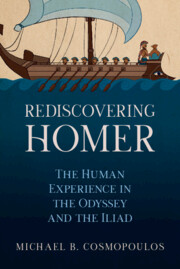
A timeless tale of a heroic character's journey through life, Homer's Odyssey has captured the imagination of readers from antiquity to the present day. Michael Cosmopoulos approaches this epic, together with the Iliad, not as remote works of literature, but as a living record of human experience shaped by war, loss, memory, and survival. He offers a poignant exploration of the aspects and consequences of war as captured in the Odyssey, including trauma, leadership and politics, human relations, religion and fate, and the struggle to return home and rebuild after upheaval. Cosmopoulos also situates both the Iliad and the Odyssey within the social conditions and the material realities of Greek society during the Aegean Bronze Age. Based on decades of archaeological field work and study of classical antiquity, and written in an accessible style, his book powerfully demonstrates how the poetry of ancient Greece preserves collective memory across the generations – and why these poems still speak to modern readers.
This paper explores the implications for classics teaching of our experiments at Sing O Muse, an OpenAI workspace created to emulate the voices of ancient writers. To address difficulties noted by earlier researchers in digital-classics pedagogy, we decoupled from the prevailing use of Large Language Models (LLMs) in favour of a Restricted Language Model (RLM). After explaining how we used this model to reconstruct scenes from the lost epic, Cypria, we explore other uses of RLMs for learning about the ancient world, such as using Aristotle’s Rhetoric to help first-generation college applicants outline admissions essays. We caution, however, that creating RLMs of reliable fidelity requires subject-knowledge more characteristic of graduate than of undergraduate or secondary students. We find, further, that optimal RLM-use involves a feel for the seam between automation and artistry, presuming a more-than-casual erudition. We conclude that RLMs in and beyond the classroom are most promising as tools not to reduce but rather to enhance labour. In this respect, for users who invest the energies, one transformational use of RLMs may be reenactment of the performance-within-a-tradition characteristic of ancient literature itself.
This article aims to elucidate the oblique insight that the Arabic translation can offer on Aristotle. In the case of Poetics 1461a29–30, the Arabic evidence supports a variant rightly disregarded as corrupt by modern editors. The Arabic rendering of the erroneous variant, however, simultaneously misquotes the Homeric verse and syntactically acknowledges its status as a direct quotation, a status neglected by modern critical editions of the Poetics. Surveying the Aristotelian evidence in light of the Arabic translation reveals the need for an analytical approach to Aristotle that fully takes into account the testimonies of the witnesses even when—or rather, especially when—they disagree.
Aristotle’s ethical works mention or quote passages from literary sources to illustrate points of ethical doctrine. Some of these illustrations may be purely decorative. Some may be proverbial, cited without reference to their sources. But in some cases a quotation from, or allusion to, a well-known source may convey to the audience or reader more than is actually said. In some cases Aristotle’s point is intelligible only to an audience who know the context. In other cases he conveys something that he does not say; the context is relevant to the doctrinal point. Either the relevance is a mere coincidence or it is probably intended by Aristotle and probably recognized by the audience. If the context is often relevant, the relevance is probably not a mere coincidence.
The Introduction presents the main themes of the book. Against the view that Homer’s epic poem is episodic or incoherent, the book reads the poem as a structured narrative driven by intention, miscommunication, and moral reversal. The book encourages the reader to pay close attention to textual details to ‘read the minds’ and understand the motivations of the characters – a methodology aligned with cognitive studies. It argues that the cognitive approach of ‘mind-reading’ is practised by all interpreters of fictional texts, including ancient commentators. The Introduction ends with an overview of the content of the book.
There is a recent scholarly consensus on the nature of Hipponax’s interaction with Homer, especially with the figure of Odysseus in the Odyssey. According to this picture, the iambist is an early precursor to the Hellenistic poets – alluding, combining and recombining different Homeric passages in a manner we would routinely associate with Callimachus or Apollonius. Yet this picture is entirely anachronistic, divorced from the evidentiary and methodological difficulties we encounter in thinking about textual dynamics in the Archaic world, and the apparent cases of Homeric interaction are overplayed and misidentified. This chapter surveys the evidence and its scholarship with a sceptical eye, and comes to a sceptical conclusion: not only is it unjustified to relate Hipponax directly with Homer, but it also closes our eyes to the flexibility with which, and the variety of ways in which, Hipponax attempted to invoke the heroic world and its medium for his own poetry.
Introduction: In this book, we evaluate the ancient testimonia; investigate production materials from Greek and Roman casting debris; look at bronzes inside and out; apply modern technology to reconstructing the ancient industry; and assess the impact of technique on the way in which we understand classical bronze statuary. Furthermore, recognizing post-antique features in restoration, patina, and display can help to correct long-held misconceptions.
Chapter 1: Notes from the Field. Homer and Hesiod describe how Hephaistos worked in his fabled smithy. Later texts from Athens to Rome to Byzantion cover myth, history, and technology and introduce Pliny, Pausanias, Christodoros, and many other writers. We shall consider how they responded to bronze statues from what was to them ancient Greece, and their interest in lifelikeness, alongside their fascination with production – from wax to alloy to surface detail – and the effects of corrosion. Authors faced the conundrum of statues that looked alive because they were made of bronze or that were prevented from living for the same reason. Some statues were protectors, others were threatening enough to be punished, and a few were even destroyed so as to remove their evil influence.
In this book, Luigi Battezzato argues that Homer's poem is a tightly woven narrative of motives, misreadings, and reversals. Bringing cognitive 'mind-reading' into dialogue with ancient scholia and close attention to the text, he shows how Achilles, Hector, and Zeus pursue honour and care – yet, through failures of communication, achieve the opposite. The book reframes Zeus's 'plan', the Embassy to Achilles, and Hector's fatal choices as examples of Aristotelian peripeteia, or reversal, grounded in human (and divine) fallibility rather than simple fate. Two chapters examine anger and gender, tracing how the poem stages women's constrained speech and how ancient critics policed it, while one of the appendices dismantles the modern myth of a Homeric 'heroic code'. Clear, compact, and argumentative, the book offers students, scholars, and curious readers a new way to follow the plot and to hear Homer's characters think. In order to ensure a wide readership, all Greek texts have been translated.
Bronze was a prized medium for sculpture in the classical world, as reflected by the remnants of the thousands of bronze statues of gods, dignitaries, and intellectuals that once filled its cities and sanctuaries. Today, only a few hundred statues are preserved, counting heads without bodies and bodies missing heads and limbs. Fortunately, the few survivors – pieces of bronze statues, scraps dumped by ancient bronze foundries, ancient texts, and occasional new finds – offer invaluable insights into the ancient bronze statuary industry. In this magisterial work, Carol Mattusch brings her deep knowledge of ancient technology to the study of bronze sculpture from multiple perspectives. Analyzing ancient literary testimonia together with the material evidence, she charts the production process from start to finished statues and to modern workshop analogies. Exploring standards for size, appearance, and placement of classical public statuary, her volume also considers issues related to Roman private collections of bronzes, including taste, production, means of acquisition, display, and loss or occasional survival of ancient bronzes.
This chapter offers an interpretation of early Greek conceptions of divine and human as a coherent constellation of ideas organised around the core notions of human vulnerability, short-sightedness and mutability. Beginning with Achilles’ speech to Priam in Iliad 24, I discuss these key principles and their expressions in genres including epic, elegy, choral lyric, philosophy and historiography. I analyse some of their specific formulations and inflections, with a particular focus on perceptions of the unpredictable and unstable nature of human affairs, the conception of human beings as ephēmeroi (‘creatures of the day’), ideas of divine retribution and the ‘archaic chain’ linking prosperity, greed, arrogance, delusion and disaster. In a second step, I examine the relationship between these ideas and the narratives in which they are embedded, mainly using the examples of the Iliad and Solon’s Elegy to the Muses (fr. 13W).
The epilogue explores how later Greeks understood the notable Mycenaean remains from the regions under study and probes why, during the post-Bronze Age, Tiryns was much celebrated while Mycenae’s reputation was deliberately suppressed.
This broad survey of select Aegean islands and the Greek-speaking coast of western Anatolia reviews the revival of settlements in these areas, after the collapse of Bronze Age civilization. Opening and closing with the imagined vision of this world in Homeric epic, the survey traces the evolution of regional styles in art and architecture, linked to independent polities that developed patterns in self-government that became the Greek polis. Early Iron Age sites, tombs, and artifacts from Euboea, the Cyclades, East Greek islands, the Dodecanese and the mainland areas of Aeolis, Ionia, and Caria are examined against the mythological paradigms of migration and Greek colonization; these regions demonstrate widespread continuity behind the later legends of a wave of Hellenism, and enjoyed close and fertile contacts with neighboring Anatolian cultures such as Phrygia and Lydia. Such relationships fostered innovations in the Archaic period such as the first monumental temples and sculptures in marble, and the evolution of poetic genres, among island and coastal entrepreneurs in collaboration (as well as conflict) with a succession of inland empires, until the Ionian revolt against Achaemenid Persia.
This chapter introduces the book’s two major claims: that learning to read and write fiction was integral to literate education in the Roman world, and that Imperial prose fiction emerged in response to this pedagogy. Drawing on a wide range of literary, philosophical, and educational sources, it argues that the acquisition of “fiction competence” – the trained ability to identify, interpret, and evaluate fictional narratives – was central to the curriculum from early childhood through rhetorical education. It then proposes an “institutional theory of fiction” for classical antiquity, arguing that ancient fictionality be defined not by genre or authorial intent but by culturally embedded conventions taught through schooling. Tracing the roots of these conventions to Greek philosophical and sophistic traditions, the chapter reconstructs four pedagogical principles that structured how students learned to engage with fiction. These principles centered on deception (apate), enigmatic speech (ainigma), and evaluative criticism. The chapter demonstrates that educational texts and practices shaped ancient readers’ expectations of fiction and that literary fiction, in turn, reflected and contested its institutional training. Fiction in antiquity, the chapter contends, must be understood as a socially regulated practice, embedded in and shaped by systems of education.