To save content items to your account,
please confirm that you agree to abide by our usage policies.
If this is the first time you use this feature, you will be asked to authorise Cambridge Core to connect with your account.
Find out more about saving content to .
To save content items to your Kindle, first ensure no-reply@cambridge.org
is added to your Approved Personal Document E-mail List under your Personal Document Settings
on the Manage Your Content and Devices page of your Amazon account. Then enter the ‘name’ part
of your Kindle email address below.
Find out more about saving to your Kindle.
Note you can select to save to either the @free.kindle.com or @kindle.com variations.
‘@free.kindle.com’ emails are free but can only be saved to your device when it is connected to wi-fi.
‘@kindle.com’ emails can be delivered even when you are not connected to wi-fi, but note that service fees apply.
Religion made the theatre modern. Since the late nineteenth century, theatre theorists have asserted that drama's origins lie in religious ritual. In this ambitious study, Rebecca Kastleman traces the surprising effects of that claim for the modern and contemporary stage. Across lucidly written chapters, she tracks the 'modern drama of religion,' a movement rooted in both the many modern plays that engage directly with religion and the dramatic debut of new religious practices in the modern theatre. Such works serve as crucibles for catalyzing skepticism, dissolving some religious attachments and strengthening others. Modern playwrights' fascination with religion expanded the frontiers of theatrical experimentation, such that in modernity, the purported origin of theatre in religious ritual came to signify the cutting edge of artistic invention. Spanning drama, performance, modernism, and religious studies, this study powerfully reconfigures the relations between all these fields.
Comparisons of German National Socialism and Italian Fascism reveal that the two movements bore more similarities than differences and often emulated each other. In their cultural policies, both embraced corporatism in organizing their cultural workforce, both invested heavily in cultural institutions and high-profile events, and, despite their authoritarian and racist practices, both exercised considerable caution in implementing censorship, contrary to postwar assumptions. Following a comparative overview of Nazi and Fascist approaches to architecture, visual art, film and theater, this chapter explores the challenges both systems faced in censoring music. Practiced in a wide range of amateur and professional performance experiences, music was by its very nature extremely difficult to control. Strong rhetoric denouncing ‘alien’ musical forces was far more pronounced in Germany than in Italy, but both countries needed to hold back on aggressive censorship practices that might risk alienating the public. The only arena in which censorship could be effectively imposed was upon Germany’s oppressed Jewish community.
The complex relationships between Indigenous groups in the area that became New Orleans undergird the ceremony by which Bienville founded the city in 1718, a ceremony that, in turn, presages the first theatrical production in the city in the early nineteenth century. Despite the massive die-off of the Indigenous, especially in the eighteenth century, as European diseases decimated their numbers, they remained visible in the city all the way into the early twentieth century, particularly through the spectacles of sports and craft-marketing and their close association with the well-known Creole missionary and poet, Father Adrien Rouquette.
Chapter 4 examines how absurdism becomes a postcolonial aesthetic. Beginning with The Thing (1960), likely the first absurdist play in the subcontinent, the chapter focuses on the East Pakistani playwrights Sayeed Ahmad and Syed Waliullah and their dramaturgical experiments, read as reflective of a widespread engagement with absurdism in almost all of the languages of the subcontinent. Beyond encounters with Samuel Beckett (and Ahmad’s writings on not only Albert Camus, Harold Pinter, and Eugene Ionesco but everything from Ousmane Sembène to Zen Buddhism and Kabuki theater), I argue that for Ahmad and Waliullah, the absurdist register makes available a new kind of political critique and, in its abstract, decoded language, creates space for the postcolonial moral inventory. The wild heteroaesthetica of these plays (itinerant flute players, clowns, stick games, decimation) mark a departure from available dramatic modes during a period of interregnum: after the Independence of Pakistan (1947) and before the Independence of Bangladesh (1971), the absurd suggests confusion, drowsiness, and waiting as forms of postcolonial being.
If the same in-game events are arrayed in different sequences, players may find some sequences to be more attractive, exciting, engaging, or intriguing than others. But how can such sequences be explained, understood, planned, compared, or rated? Do models exist that analytically describe various sequences? To address this question, this study seeks to identify conceptual models for the strategic ordering of game play events. Such models can describe, for instance, a pattern of increasing difficulty, a mix of positive and negative events, or phases of intense action broken up by pauses. The study identifies relevant exemplary contributions in the discourses of game design, design patterns, Dynamic Difficulty Adjustment, tabletop roleplay, literary drama, Flow theory, and Operant Conditioning theory. It is found that surprisingly few models exist. The predominant model appears to be repeated variations of rather simple experiential sequences of tension and relaxation on an overall increasing level, similar to the dramatic arc. The study’s main contribution to the narratology discourse is to show how the dramatic arc as a powerful conceptual model can inform the understanding of the strategic ordering of game play events.
Hollywood’s overseas expansion during the 1920s–1930s resulted from interwoven economic, political, and industrial changes. Although European agents rented Hollywood movies prior to 1914, World War I destroyed European film industry infrastructures, thus allowing American companies to flood markets with their products. Simultaneously, US domestic growth resulted in vertically integrated companies whose international revenues facilitated greater quality and quantity of production. This achievement fostered by Jewish immigrant studio moguls repackaged the very utopian promise that had brought them to the United States. They accomplished what the US government could not – global advertisement for an American way of life and consumerism. Even though some nations attempted building robust film industries, boycotting American theatres and products, or legislating restrictions, the rise of Nazism and World War II prevented effective national cinemas. Hollywood’s global ascendancy is not simply about American domination but about how a national cinema became a global one.
Key to popular theatre were animal performances that provided amusement when mechanical power was eclipsing animal power and that illustrated science’s new hierarchies of human and animal bodies. Hybrid theatre-circus presentations regularly included horseback riding and display as well as dangerous animal stunts. For example, Mazeppa (1831) highlighted the lead character tied bareback to a horse that stampeded across the stage. The best-known Mazeppa (1861–1868) starred Adah Isaacs Menken who sensationalized the role by cross-dressing and carrying out the dangerous bareback ride. Menken became a star – a striking counterexample to Victorian femininity. After the Civil War, the transcontinental railroad expanded touring possibilities for these large-scale shows while Manhattan theatres built larger venues and more elaborate productions. The 1905 opening of Times Square’s Hippodrome was unparalleled for audience capacity (5,200), underground facilities for housing animals, and stage apparatus for supporting an entire circus and special effects.
Barred from many employments, Jewish artists entered the music industry and produced a twentieth-century canon of Tin Pan Alley hits, show tunes, and jazz standards combining light opera, sophistication, and Black music. Jerome Kern and Oscar Hammerstein’s musical Show Boat (1936) set a new paradigm: its “Ol’ Man River” blends minstrelsy, classical music, and spirituals. George Gershwin’s Rhapsody in Blue (1924) and An American in Paris (1928) fused European influences with blues, foxtrot, ragtime, and jazz. His “I Got Rhythm” (1930) is among history’s most influential jazz compositions, and his jazz opera Porgy and Bess (1935) boldly depicts Black experience. Gershwin’s union of lowbrow-highbrow, Jewish and African American music created a radical multicultural art. Although recent scholars accuse Gershwin, Kern, and others of cultural exploitation, many Black jazz artists embraced their music. Even Duke Ellington, who denounced Porgy and Bess, eventually recorded it and imitated Gershwin’s chord progressions and rhythms.
Although musical theatre originally mixed theatrical and musical styles and genres – from minstrel shows and burlesque to ballet and opera – it only developed a cohesive form that told a story through speech, song, and dance in the 1920s. Musicals quickly became America’s most popular theatrical entertainment. They continued to evolve, even incorporating social topics and aesthetic elements emerging more organically as part of the story. Many recent hits have been jukebox musicals (relying on hit pop songs) and film-to-stage adaptations. There is a commercial rationale for this proliferation: whether it is name recognition of the sources or nostalgia for their original releases, they help box office success. Recently, even Disney has made repurposing its movie catalog into musicals a continuous, profitable operation. Musicals have also become a vehicle for satire and parody, resulting in memorable television and YouTube musical sketches. Broadway’s engagement with popular culture has become a symbiotic one.
Calvin and Perception in Early Modern Visual Culture is the first monograph to return John Calvin's Institutes of the Christian Religion (1559) to its original visual culture. AnnMarie Bridges draws on early modern optics, art theory, rhetoric, psychology, and religion to reconstruct the perceptual assumptions of Calvin's earliest readers. Her study reveals the Institutes' unrecognized concern with 'perception'-pre-conscious processing believed to occur in the imagination, capable of distorting sense experience before conscious thought could even occur. Illuminating Calvin's most striking visual metaphors-from the spectacles of scripture to the factory of idols-and through close readings of topics like accommodation, idolatry, faith, and Calvin's Latin prose, Bridges advocates a paradigm shift in how we read Calvin's most cited work, displacing 'knowledge' in favor of 'perception versus delusion.' In so doing, her study invites reflection on perceptual instability in our own cultural moment, where the challenge is not only to know what is true, but even to perceive what is real.
Ignatius Sancho had a rich artistic life, from music to literary criticism to engagement with the theater. Unfortunately, little is known about the latter – Joseph Jekyll’s 1782 short biography of Sancho offers only a few sentences about what appears to have been a failed attempt at playing the titular leads of William Shakespeare’s Othello and Thomas Southerne’s Oroonoko. However, Jekyll’s biography offers an important window into eighteenth-century thinking about race and performance, in spite of (and, in part, because of) its limited and compromised nature. Crucial to Jekyll’s explanation for Sancho’s theatrical failure is a supposedly “defective and incorrigible articulation,” most often read along the lines of disability. This chapter examines how vocal and linguistic performance in the eighteenth-century created and disrupted popular narratives about race.
In the years 1803–1807, a dramatic triple murder case in Shouzhou, Anhui, convulsed officialdom in the Jiangnan region and drove the Jiaqing emperor to exasperation. At a time when many in power felt a sense of crisis as “High Qing” imperial ambitions receded, each stone turned over in this meandering investigation revealed another source of anxiety fitted to the age: incest, poisoning, negligent and corrupt officials, amoral and abusive local gentry, misbehaving yamen runners, pettifogging litigators, and, to top it all off, deadly serious rumors of a subversive opera. This article traces the investigations into both the murders and the theater rumor. What made the former so convoluted and vexing, while the latter was alarming yet easier to resolve? Surprisingly, the Imperial Household’s carefully cultivated relationship with the theater world of Jiangnan realized, in miniature, a level of state–society coordination Qing rulers wished for but which often escaped them elsewhere.
The words 'all rise' announce the appearance of the judge in the thespian space of the courtroom and trigger the beginning of that play we call a trial. The symbolically staged enactment of conflict in the form of litigation is exemplary of legal action, its liturgical and real effects. It establishes the roles and discourses, hierarchy and deference, atmospheres and affects that are to be taken up in the more general social stage of public life. Leading international scholars drawn from performance studies, theatre history, aesthetics, dance, film, history, and law provide critical analyses of the sites, dramas and stage directions to be found in the orchestration of the tragedies and comedies acted out in multiple forums of contemporary legality. This title is also available as open access on Cambridge Core.
This paper presents the theory of improvisational emergence, an account of how social phenomena emerge from improvisational processes. I build outward from the small-group improvisational encounter to provide an account of the relationship between individuals, groups, and societies. Social entities, including groups and societies, emerge from people engaged in group improvisation. But even though social entities emerge from individuals in interaction, their study cannot be reduced to the study of individuals, because once having emerged, social entities have causal power over individuals. The theory of improvisational emergence addresses the structure-agency relationship and the micro-macro debate in sociological theory. It moves beyond practice and structuration theories in positing an ontological separation between people and society. Improvisational emergence allows us to explain the relationship between the improvisational creativity of each participating individual and the collective improvisationality of the group. A complete understanding of social phenomena, including social structures, norms, and cultures, must be grounded in the theoretical and empirical study of creative improvisation.
Cultural exchange was another critically important mechanism for influencing popular emotions. This chapter looks at Sino-North Korean exchanges in theater, film, and the arts. It argues that these exchanges reached large audiences in both countries while inculcating official emotions.
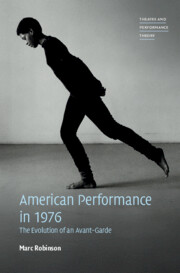
A survey of drama and performance in the period 1975-1980, with emphasis on the innovative plays and experimental productions that appeared in New York in 1976, along with consideration of surrounding developments in visual art, literature, film, and music, and attention to the politics of these transitional years.
1976 was a febrile, transitional year in cultural history, coming after Watergate and Vietnam and before the AIDS epidemic and the rise of the Conservative movement. Bicentennial triumphalism sounded dissonant against a violent past and uncertain future. Marc Robinson here explores how innovative artists across disciplines – drama, dance, music, film, visual art – responded to this period, before zeroing in on avant-garde theater. Over 1976, five landmark productions could be seen within months of one another: Cecil Taylor's A Rat's Mass / Procession in Shout, Meredith Monk's Quarry, the Robert Wilson / Philip Glass opera Einstein on the Beach, Joseph Chaikin's production of Adrienne Kennedy's A Movie Star Has to Star in Black and White, and, finally, the Wooster Group's first open rehearsal of Spalding Gray and Elizabeth LeCompte's Rumstick Road. In close readings of these five works, Robinson reveals the poetics of a transformative moment in American culture.
In many ways the American War of Independence failed to revolutionize American performance culture. After the wartime ban on theater, the resurrected theatrical repertoire quickly reverted to British classics, with a sprinkling of German and French dramas thrown in. Musical performances continued to evoke familiar British folk tunes, comic operettas, or tragic operas. Parade and holiday culture drew on longstanding European forms such as charivari or other genres to celebrate the “perpetual fetes” of the wartime and postwar period. What then would prove “revolutionary” about American performance culture after the war? What could the former colonists proclaim as their own unique and substantive contributions to the cultural life of the new nation?
The chapter probes the relationship between law and performance in the context of transitional justice. By analyzing cultural productions and public performances such as films and theater plays, the chapter examines the ways in which lustration has become dramatized through the themes of secrecy, deception, betrayal, and the desire to know and not to know. While these cultural practices offer insight into the public intimate life of lustration, they also show how they become a site and form of social opposition and critical engagement with the terms of lustration and moral autopsy. In particular, the chapter offers a detailed ethnographic study of the experimental theater play by Wojtek Ziemilski, Small Narration (Mala Narracja), which highlights the layered relationship between theater and law and shows the extent to which the judicial and moralized forms of examination and judgment might travel and be contested by alternative forms of knowing, not-knowing, and relating to life, history, and politics.
Edited by
Martin Nedbal, University of Kansas,Kelly St. Pierre, Wichita State University and Institute for Theoretical Studies, Prague,,Hana Vlhová-Wörner, University of Basel and Masaryk Institute, Prague
Throughout most of the seventeenth and eighteenth centuries, the Habsburg court resided predominantly in Vienna. Consequently, the Habsburg monarchs of Bohemia rarely visited Prague, and visits of the entire court were even rarer because they were expensive both for the monarch and the city. Therefore, each coronation of a Habsburg emperor as the Bohemian king was a significant event reflecting both the immediate political context and more general cultural and historical trends, such as the role of music in court ceremonies and the relationship between Bohemian and Viennese musical practices. This chapter sketches the relationship between coronation music and music and operatic developments in Prague in general, particularly in connection to the coronations of Charles VI (1723), Maria Theresa (1743), Leopold II (1791), and Francis II (1792).