To save content items to your account,
please confirm that you agree to abide by our usage policies.
If this is the first time you use this feature, you will be asked to authorise Cambridge Core to connect with your account.
Find out more about saving content to .
To save content items to your Kindle, first ensure no-reply@cambridge.org
is added to your Approved Personal Document E-mail List under your Personal Document Settings
on the Manage Your Content and Devices page of your Amazon account. Then enter the ‘name’ part
of your Kindle email address below.
Find out more about saving to your Kindle.
Note you can select to save to either the @free.kindle.com or @kindle.com variations.
‘@free.kindle.com’ emails are free but can only be saved to your device when it is connected to wi-fi.
‘@kindle.com’ emails can be delivered even when you are not connected to wi-fi, but note that service fees apply.
Chapter 3 focuses on a small number of letters from Keats to his poet-friend John Hamilton Reynolds written in the first few months of their friendship, in late 1817 and early 1818. As aspiring young poets, Reynolds and Keats developed a close, competitive-collaborative friendship in which the exchange of letters played an important part. The chapter examines the ways in which some of the main tenets of Keats’s conceptual or theoretical sense of both letter-writing and literary criticism arose out of the interchange of letters with a poet with whom he actively collaborated. Through a reading of Keats’s commentary on the power of Shakespeare’s poems and plays, the chapter argues that letter-writing is intrinsically collaborative, and that in his letters to Reynolds, Keats also emphasizes the collaborative or corresponding quality of both literature and literary criticism.
The epilogue provides a summary of the book’s main conclusions, followed by an overview of the key developments in the translation of the classics in the decades after 1580 and their continuities and discontinuities with the period covered by the book. It highlights the translation of more openly oppositional or subversive texts and the publication of complete translations of the major works of ancient Greek and Roman literature, often in folio format with extensive scholarly apparatus, in the later sixteenth and early seventeenth centuries. It argues that the vernacular literature of the later Elizabethan period drew on translations of the classics produced in the middle years of the sixteenth century not just as linguistic and literary models but also for their topical application of ancient texts to Tudor England and intervention in contemporary political debates that contributed to the development of the public sphere.
Chapter 2 examines the balance between praise, precept, and criticism in comparisons of the dedicatees of translations with exemplary figures from ancient history. It argues that Anthony Cope’s The History of Hannibal and Scipio (1544) and Gabriel Harvey’s marginalia similarly applied Livy’s History of Rome as a guide to military action in Tudor England, but Cope also made a principled attempt to influence the direction of religious and political policy. The five Plutarchan Lives presented in manuscript to Henry VIII by Henry Parker, Lord Morley during the 1530s and 1540s rebuked the increasingly tyrannical king. William Master’s manuscript Life of Scipio mined the text for military stratagems as well as moral and other lessons. Thomas North’s Lives of the Noble Grecians and Romans (1579) supported the religio-political agenda of forward Protestants under the leadership of Leicester and Shakespeare’s Roman plays responded to North’s application of the Lives to Elizabethan England in their exploration of masculine martial valour and heroism.
“The Fate of Ophelia,” the opening track on Taylor Swift’s album The Life of a Showgirl, includes an unsettling Shakespearean allusion. Ophelia was the jilted lover of the melancholy prince in Shakespeare’s Hamlet, a woman whose life ends in suicide. Swift’s song says her fiancé, Travis Kelce, saved her from the fate of Ophelia, positioning her previous boyfriends as moody philosophers and the fun-loving jock Kelce as the anti-Hamlet. This song also recuperates Swift as a reader of Shakespeare after the startingly bad account of Romeo and Juliet in “Love Story,” the song that started Swift’s career.
The chapter provides an overview situating the literatures produced or circulated in Britain and the racialized, classed, and gendered imaginaries of empire. English literature was informed by imperial concerns and anti-capitalist critique alike since the sixteenth century, even as England was a minor player among European imperial powers. Contemporary scholarship, while attending to marginalized authors, such as women, immigrants, minorities, and the working class, demonstrates that diverse literature, prose especially, but also drama and verse, were shaped by expanding trade, global markets, territorial appropriations, military conquests, human emigration, and cultural contact. A mix of ideologies spawned in the nineteenth century to rationalize British presence as not only inevitable but beneficial for the colonized; for colonized intellectuals, on the other hand, literature fostered alternative visions of resistance. Diasporic writers in twentieth-century Britain introduced readers to the vocabulary and memory of colonized lands. The chapter contends that many themes of contemporary culture are not unique to the present but variations of older, far-flung contests. Literature, in its ability to articulate shifts in perception, sensibilities, and relations before such changes are actualized, is an indispensable site of analysis and study.
Chapter 4 explores how fiscal policy and questions of national security play on stage. Fiscal concerns pervade Shakespeare’s history plays. All of his sovereigns wrestle with the need to fund security in the face of ongoing domestic and international threats, and all of them have to confront ongoing fiscal discontent. This chapter shows how security dilemmas are at the heart of controversies that drive English history as Shakespeare understands it. Rulers’ ongoing efforts to cover the expenses associated with implementing security coupled with subjects’ resentment at having to pay for their sovereign’s decisions opens up the terms of security and collective wellbeing for collective scrutiny. By depicting a multiplicity of voices and perspectives on collective existence, Shakespeare foregrounds fiscal controversies and the alternative visions of security and collective life such controversies prompt. These plays immerse theatergoers in an underdetermined world defined by antagonism, conflict, geopolitical struggle, and political inventiveness.
This chapter works backward from the glossary of terms in Joseph Moxon’s 1683 printer’s manual and a 1684 poem that uses those terms extensively to show how the less technical, more widespread set of terms collected in this book demonstrate considerable rhetorical and conceptual flexibility. Two key terms, “bookish” and “set forth,” begin an exploration of how the language of books gave people a way to describe their culture and situate themselves within it.
Human beings build their worlds using metaphors. Just as computer technology has inaugurated a massive metaphorical transformation in the present era, in which we can 'reboot' social causes or 'program' human behaviour, books spawned new metaphorical worlds in the newly print-savvy early modern England. Pamphleteers appealed to books to stage political attacks, preachers formulated theological claims using metaphors of page and binding, and scientists claimed to leaf through the 'Book of Nature'. Jonathan P. Lamb shows how, far from offering a mere a linguistic tool, this astonishingly broad lexicon did no less than teach entire cultures how to imagine, giving early modern writers – from Shakespeare to Cavendish, and from the famous to the anonymous – the language to describe and reshape the worlds around them. He reveals how, at a scale beyond anything scholars have imagined, bookish language shaped religious, political, racial, scientific, and literary questions that remain alive today.
This chapter examines some of the most important poetic influences on Shelley’s writing from the tradition of poetry in English published before his birth in 1792. In particular, it focuses on Shelley’s inheritance of works by Spenser, Milton, and Shakespeare while acknowledging the breadth of his reading and its influence on his own poetic practice (the chapter also acknowledges that Shelley’s inheritance from English poetry must be considered in the context of his inheritance of work in Greek, Latin, and a range of modern European languages, which is discussed elsewhere in this volume). The chapter attempts to tease out some of the ambivalences in Shelley’s relation to his poetic forebears, taking Spenser – royalist and imperial apologist, which Shelley emphatically was not – as a crucial example here.
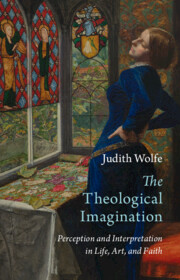
How can we live truthfully in a world riddled with ambiguity, contradiction, and clashing viewpoints? We make sense of the world imaginatively, resolving ambiguous and incomplete impressions into distinct forms and wholes. But the images, objects, words, and even lives of which we make sense in this way always have more or other possible meanings. Judith Wolfe argues that faith gives us courage both to shape our world creatively, and reverently to let things be more than we can imagine. Drawing on complementary materials from literature, psychology, art, and philosophy, her remarkable book demonstrates that Christian theology offers a potent way of imagining the world even as it brings us to the limits of our capacity to imagine. In revealing the significance of unseen depths – of what does not yet make sense to us, and the incomplete – Wolfe characterizes faith as trust in God that surpasses all imagination.
This chapter begins by interrogating the ideal of authenticity as a paradigmatic modern response to the crisis of master narratives. It critically examines practices of narrative selfhood, and discusses the ways in which social roles offer scaffolds for the development of a self without fully constituting such a self. Role-playing – the inhabitation of social and narrative roles – is an outstanding example of the exercise of imagination, its double function of finding and making, and its for-the-most-part inherited, moulded, and largely habituated practice. The chapter concludes with a theological discussion of the ways our habitual imagination of selfhood can be broken open without pretence that we might be able to find a fully realized authentic self beneath our narrative and social roles.
This chapter discusses the relationship of the imagination to Christian eschatology. It gives an account of the function of eschatological imagery in the Bible, discusses the changing ways in which art and literature have engaged Christian eschatology, and concludes with an account of a distinctly eschatological imagination.
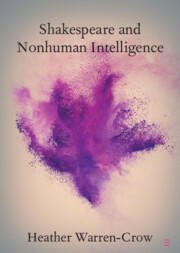
The Infinite Monkey Theorem is an idea frequently encountered in mass market science books, discourse on Intelligent Design, and debates on the merits of writing produced by chatbots. According to the Theorem, an infinite number of typing monkeys will eventually generate the works of Shakespeare. Shakespeare and Nonhuman Intelligence is a metaphysical analysis of the Bard's function in the Theorem in various contexts over the past century. Beginning with early-twentieth century astrophysics and ending with twenty-first century AI, it traces the emergence of Shakespeare as the embattled figure of writing in the age of machine learning, bioinformatics, and other alleged crimes against the human organism. In an argument that pays close attention to computer programs that instantiate the Theorem, including one by biologist Richard Dawkins, and to references in publications on Intelligent Design, it contends that Shakespeare performs as an interface between the human and our Others: animal, god, machine.
Wagner’s immersion in the literary culture of Spain is seldom examined. This chapter explores his fascination with Cervantes, Lope de Vega, and Calderón in particular, as borne out by his private correspondence, public essays and via Cosima’s diaries. Here, Wagner’s personal characterisation of their literary value bears scrutiny as a facet of his self-understanding of drama within Opera and Drama, even if the role of Spanish culture within Wagner’s works is paltry. Canonical works such as Don Quixote testify to a shattering of the hero myth, the decadence of the ‘Christian romance of chivalry’, while the auto sacramantales of Calderón served as a counterpart to Parsifal, reversing its path from art to religion.
What does it actually mean to read for justice and what might this entail? Yoking a wide range of theoretical and pedagogical perspectives and hard-won critical insights, this chapter argues that decolonizing the curriculum is not simply additive (”just add Achebe!”). Decolonization provides a vocabulary by which new knowledges of human development may help to reshape the literary curriculum in the direction of greater sensitivity to urgent racial and social justice issues in today’s world. The chapter examines pathways for this change through detailed readings of Conrad’s Heart of Darkness, Fitzgerald’s The Great Gatsby (and Baz Luhrmann’s cinematic adaptation), and an examination of the politics of comparison.
Created by Chicanx and Indigenous artists living and working in the US–Mexico Borderlands, Borderlands Shakespeare appropriations situate Shakespeare within the unique context of la frontera, engaging with its hybrid cultures, genres, and languages. These appropriations draw from Anglo, Spanish, and Indigenous traditions, and they confront Shakespeare’s colonial legacies, interrogating the complex layers of colonialism shaping the region and Shakespeare’s reception in it. To explore the decolonial vision of Borderlands Shakespeare, this essay focuses on Edit Villarreal’s The Language of Flowers (1991), an appropriation of Romeo and Juliet set in Los Angeles during Día de los Muertos, and Herbert Siguenza’s El Henry (2014), an appropriation of Henry IV, Part I set in post-apocalyptic San Diego. These plays engage with Shakespeare to critique imperialist policies that have resulted in the dispossession of Indigenous land, the criminalization of migration, and high levels of labor and environmental exploitation. In their use of multilingual Indigenous and Chicanx frameworks to imagine more just futures, Borderlands Shakespeare plays such as The Language of Flowers and El Henry offer valuable methodologies for decolonizing English literary studies and for approaching canonical Western texts in culturally sustaining ways.
Chapter 4 covers their final decade, during which the company underwent a series of changes to the core membership following two decades of stability. The company shifted around 1578 from supplementing personnel by hiring boy players to shoring up membership with an apprenticeship system. This enabled them to survive the departure of James Burbage by 1581 and the cull of members to help form the Queen’s Men in 1583. I identify evidence that several of the Queen’s Men not previously attached to any other company were likely members of Leicester’s Men, which also means the cull was greater than has been imagined in the past. A final crisis hit the company when five of their members were sent by Leicester into service in Europe for a year, but I show that Will Kempe’s development of the stage jig was ideally timed to enable the remaining few members to still tour widely with jigs as their primary play stocks. The final section explains reasons to doubt that Richard Burbage or Shakespeare were ever in Leicester’s Men, but did undoubtedly forge ties with this company’s members after Dudley died, ensuring the legacy of this company was carried forward to Shakespeare’s own career.
This chapter discusses Shakespeare’s Falstaff as an anti-martyr in the two parts of Henry IV. The character of Falstaff isloosely based on the fifteenth-century Lollard martyr John Oldcastle and was indeed once called Oldcastle in performance. Even though Shakespeare transforms the martyr into a cowardly dissembler, who has very little to do with the Lollard martyr, countless allusions to Oldcastle’s martyrdom provide a meaningful interpretative framework for Falstaff’s ‘better part of valour’. However, this does not mean that Shakespeare mocks the Proto-Protestant as part of a Catholic or anti-Puritan campaign. On the contrary, in contrast with the politically subversive martyr figure in 2 Henry IV, Archbishop Scrope, Shakespeare’s transformation of the Lollard martyr rather amounts to a defence of the Elizabethan ideal of outward conformity. Falstaff’s dissimulation, insofar as it can be read as a rejection of martyrdom, is a form of political obedience. Moreover, Falstaff’s dissimulation also entails a defence of theatrical dissimulation that aligns Shakespeare’s theatre closely with the religious policies of the Elizabethan government.
This chapter discusses the collaboratively written Sir Thomas More in the context of Catholic outrage over the breakdown of the Elizabethan policy of outward conformity in the 1580s and 1590s and the various means by which the Elizabethan regime made windows into men’s hearts in the late sixteenth century, including espionage, oaths, and torture. The play’s insistent Senecan intertext, which revolves around questions of silence and treason, thus becomes legible in relation to late Elizabethan legislative developments that served to penalise silence in matters of religion. As this chapter argues, the play’s biographical treatment of the famous Catholic martyr, who never specifies the convictions for which he is executed, thus reflects the predicament of Elizabethan Catholic loyalists, such as Anthony Browne, first Viscount of Montague, who were concerned with maintaining an increasingly untenable sphere of silence as a middle ground between truth and dissimulation.
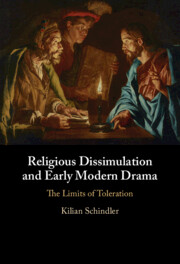
Kilian Schindler examines how playwrights such as William Shakespeare, Ben Jonson, and Christopher Marlowe represented religious dissimulation on stage and argues that debates about the legitimacy of dissembling one's faith were closely bound up with early modern conceptions of theatricality. Considering both Catholic and Protestant perspectives on religious dissimulation in the absence of full toleration, Schindler demonstrates its ubiquity and urgency in early modern culture. By reconstructing the ideological undercurrents that inform both religious dissimulation and theatricality as a form of dissimulation, this book makes a case for the centrality of dissimulation in the religious politics of early modern drama. Lucid and original, this study is an important contribution to the understanding of early modern religious and literary culture. This title is also available as Open Access on Cambridge Core.