To save content items to your account,
please confirm that you agree to abide by our usage policies.
If this is the first time you use this feature, you will be asked to authorise Cambridge Core to connect with your account.
Find out more about saving content to .
To save content items to your Kindle, first ensure no-reply@cambridge.org
is added to your Approved Personal Document E-mail List under your Personal Document Settings
on the Manage Your Content and Devices page of your Amazon account. Then enter the ‘name’ part
of your Kindle email address below.
Find out more about saving to your Kindle.
Note you can select to save to either the @free.kindle.com or @kindle.com variations.
‘@free.kindle.com’ emails are free but can only be saved to your device when it is connected to wi-fi.
‘@kindle.com’ emails can be delivered even when you are not connected to wi-fi, but note that service fees apply.
Chapter 5 investigates the networks of relationship that sustain individuals and communities in the poems. It addresses family, marriage, sexual desire and agency, male bonds and loyalty, and the expectations placed on women and men. It also considers childhood and old age, hospitality, and wider social connections, arguing that epic memory preserves not only heroic deeds but everyday forms of attachment and obligation.
This article re-examines the role of the ‘family’ in Italian mafias by challenging both organisational and culturalist interpretations. Drawing on long-term empirical research based on judicial documents, police records and interviews covering Italian mafias and Italo-American groups from the late nineteenth century to the present, the authors propose a re-conceptualisation of the mafia family. Rather than a natural or fixed organisational unit, the family is understood as a flexible social infrastructure embedded in civil society and strategically mobilised by criminal actors. Focusing on two historical case studies – the Morello family in New York and the Giuliano clan in Naples – the article shows how kinship networks function as resources for survival, alliance building, market control and the reproduction of criminal power. The analysis moves beyond the traditional paradigm of ‘familism’ and rejects ethnocultural explanations of ‘mafiosity’, concluding instead that family ties become criminal only when exploited as instruments of power, governance and economic co-ordination within illegal markets.
Relatives are often intimately involved in medical assistance in dying (MAID) on both psychiatric and somatic grounds. Greater insight into the extent to which certain experiences occur in practice will help physicians provide support.
Aims
To investigate how relatives of patients who received psychiatric versus somatic MAID scored on measures of opinions and emotions regarding the MAID trajectory; involvement in the trajectory; and judgement of the due care criteria.
Method
We included 616 Dutch relatives (18 years and over) of patients who received psychiatric or somatic MAID, recruited via an online cross-sectional survey conducted in the Netherlands between April 2023 and February 2025. Survey distribution occurred via social media, pamphlets, a patient federation and newspapers. In total, 110 participants had experienced psychiatric MAID and 506 somatic MAID. Outcomes included the following: opinions about the duration of the MAID trajectory; emotions due to MAID (five-point Likert scale); involvement in the MAID trajectory (five-point Likert scale); judgement of the due care criteria (five-point Likert scale); and total Empathy Questionnaire score (a validated scale).
Results
Following psychiatric MAID, gratitude, resignation, relief and sadness were most strongly felt (mean 3.5–4.2 on a scale from 1 to 5). More than 25% felt insufficiently involved in the MAID trajectory, and more than 80% positively judged the due care criteria, with no differences between psychiatric and somatic MAID. Respondents who experienced psychiatric MAID felt greater powerlessness (p = 0.026, 95% CI [−1.082, −0.069]) and guilt (p = 0.004, 95% CI [−0.833, −0.166]), and more often found the MAID trajectory too long (68.3 v. 21%, p < 0.001, U = 37 118, z = 9.19).
Conclusions
Relatives of people who received psychiatric MAID generally reported positive experiences that did not differ from those with somatic MAID. In regard to psychiatric MAID, relatives experienced greater powerlessness and guilt, emphasising the importance of relative involvement and support. Future research should investigate how this involvement can be optimised.
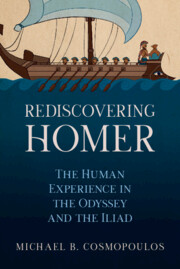
A timeless tale of a heroic character's journey through life, Homer's Odyssey has captured the imagination of readers from antiquity to the present day. Michael Cosmopoulos approaches this epic, together with the Iliad, not as remote works of literature, but as a living record of human experience shaped by war, loss, memory, and survival. He offers a poignant exploration of the aspects and consequences of war as captured in the Odyssey, including trauma, leadership and politics, human relations, religion and fate, and the struggle to return home and rebuild after upheaval. Cosmopoulos also situates both the Iliad and the Odyssey within the social conditions and the material realities of Greek society during the Aegean Bronze Age. Based on decades of archaeological field work and study of classical antiquity, and written in an accessible style, his book powerfully demonstrates how the poetry of ancient Greece preserves collective memory across the generations – and why these poems still speak to modern readers.
In late-nineteenth-century Canada, cases of incest were met with both outrage and doubt. To avoid questions of consent raised by long-term abuse, the Crown Attorney in Ontario’s Wentworth County experimented with a novel prosecutorial strategy between 1886 and 1890, trying three cases of incestuous abuse involving fifteen-year-old girls under the new criminal seduction law. Only one resulted in a conviction, and an examination of court records and contemporary commentary reveals how social taboos, discredited testimony, and requirements of corroboration rendered girls’ experiences of incest illegible to the court and community when viewed through the lens of seduction. Situating girlhood within discourses about protection, the family, and sexual morality, this study illuminates unexplored applications and limits of the seduction law, contemporary shifts in understandings of consent and coercion, and how victims serve as sites of socio-legal experimentation before being discarded once they have fulfilled that role.
The connection between Christianity and the development of Western welfare states is long-standing, albeit somewhat neglected by scholarship. Recent work has suggested the formative influence on the formation of different welfare "regimes" through different Christian ideas of work, need, poverty, and the family, as well as differnt ecclesiologies. The chapter outlines these and proceeds to examine the philsophical connection between social welfare and religion, through the work of Raymond Plant. Plant argues that welfare policy invariably draws on inherently "contestable" social concepts, such as ‘need’, ‘want’, ‘right’, ‘justice’, ‘equality’, and ‘community’. To know what kind of good social policy is pursuing, it is essential to clarify what meaning and weight we accord to such concepts. But doing this demands we have a clear idea of the kind of creatures whose goods we are pursuing. In essence, social welfare theory of this kind rests on anthropological commitments. The chapter illustrates this by reference to Richard Titmuss, Margaret Thatcher, and Frank Field, and in so doing, underlines how this entire debate is open to theological perspectives.
Although by no means uncompromising in his hostility to the “welfare” – or as he termed it the “social assistance” – state, Pope John Paul II was more critical of its legitimacy, processes and results than were William Temple, Jacques Maritain (or Rowan Williams). His antagonism was drawn, in part, from his formative experiences in Communist Poland, but it is the anthropological reasons for his more critical appreciation that are foundational. John Paul conceived of the human person as created and oriented to transcendence, as an effective moral agent, and with a clear capacity for reason and truth, as well as being relationally constituted and completed by ‘gift’. The consequence of this for his understanding of the welfare role of the state was a palpable reluctance to countenance social welfare structures that removed agency and responsibility from people. His resulting vision of welfare was not one in which the state had no direct role for welfare provision, but one in which work, family and the natural patterns of associational solidarity were the first and primary basis for welfare.
This book places the larger autobiographical projects of Art Spiegelman and Alison Bechdel alongside each other for the first time, drawing on a range of previously unanalyzed works. It argues that the structurally layered, word-and-image form of comics is particularly well-suited to negotiate complex filial inheritances and manage identity in the face of transgenerational trauma. Each chapter is organized around a different formal trope that highlights an aspect of the visual language of comics and its material processes: boxes, spirals, tic-tac-toe, mirrors, and webs. From Jewishness to gender, from high modernism to lesbian feminist communities, Filial Linesshows how the comics form is capacious enough to accommodate the push–pull of inheritance and invention, enabling both creators to negotiate their place in (or beyond) various lines of familial, cultural, and artistic descent. Integrating formalist and psychoanalytic frameworks, and parsing alignments and differences with different forms of practice, the book situates today’s graphic memoir canon as an unexpected outpost – and expansion – of avant-garde formalism long after the modernist moment of form.
Potential immigrants do not even apply for a visa because they also confront social forces from the community bearing on their families that deter them from leaving. Many young adults become deterred from migrating not merely from visa requirements, but also due to opposition and pressure from the family. Despite how most of China has a patrilocal kinship system and culture that more strongly sanctions men from marrying outside their bloodline, Chinese parents are much more likely to oppose women going abroad than men, even if this opposition decreases as they age. Aside from overt opposition children may face, many women specifically are discouraged from migrating abroad or even traveling abroad due to concerns about their daughter’s physical safety, socioeconomic dependence on their parents, and societal peer pressure. Such concerns are particularly strong in the patriarchal context of China as it is mediated by a traditional filial duty amongst the one-child-only generation toward their parents and the intense influence that parents exercise over the educational, career, and marital choices of their adult children – both of which have a stronger deterrent effect on daughters than on sons.
Deterrence also operates through a belief among potential immigrants that they need time to build sufficient socioeconomic status (SES) and social ties in their country of origin with which they can prove to foreign governments, family, and others in the country of origin they will return to their country when applying for an NIV and therefore enhance the opportunities they have to travel abroad. Many repeatedly defer migrating abroad because they devote time accumulating SES and social ties to meet several expectations of society, like the expectation that adult children complete a college education, obtain a “respectable” and stable job, purchase a home with a mortgage, marry, have and raise children, work enough to afford paying for the mortgage and sending their child to university, and increasingly take care of their parents as they age – all of which effectively tie up and therefore ground many individuals from going abroad. Others deterred from applying for a visa later often become especially eager to intentionally provide their children with preimmigration support to go abroad as what I conceptualize as second-generation emigrants.
This chapter turns to the forces of unity that drove patients’ publishing projects, focusing on the role of asylum periodicals in construing and maintaining real and imagined communities within and beyond the asylum. Producing and consuming periodicals brought together various actors with distinct skill sets, enabling, to a degree, transgression of the institutional boundaries that otherwise kept different groups of patients separated. This transgression fed into the representation of the asylum community as a family on the pages of asylum periodicals, reenforcing the institutionally imposed family model, according to which patients were ascribed the role of children under the care and protection of a father-like superintendent and a motherly matron. However, asylum periodicals show not only the manifestation of this framework’s application but patients’ active engagement with these symbols. Finally, the chapter explores former inmates’ continuous involvement in asylum periodicals, suggesting that some patients formed lasting and meaningful connections during their stay in mental institutions and relied on the asylum for support during their reintegration into society.
Based on ethnographic fieldwork in Uttar Pradesh and Haryana, this chapter explores how informal norms interact with formal justice. It recounts the challenges faced by complainants and female staff while working inside police stations.
You may have thought that as an early childhood education and care (ECEC) provider, your unifying focus will be centred around on the children in your setting. Supporting children’s learning and wellbeing may indeed be the priority, but this cannot be achieved without the positive involvement of children’s family members. Bronfenbrenner’s ecological systems model describes the layered systems of support that children can be influenced by, acknowledging that no individual child exists in a vacuum (See chapters 1 and 2 for further details). The resources and wellbeing of the family as a whole will have an impact on children’s development, behaviour and engagement in ECEC settings, as well as at home and other community settings.
This multi-method, multi-informant, three-wave longitudinal study sought to examine how maternal and paternal parenting entropy might operate as indirect factors in the link between interparental conflict and the development of child attention-deficit/hyperactivity disorder (ADHD) symptoms during early childhood. Participants were 235 families with a young child (Wave one: Mchild age = 2.97 years, Ngirls = 130, Child race/ethnicity: 56.2% White, 21.3% African American, 16.2% Mixed race) followed over three annual waves. We observed constructive and destructive interparental conflict during an interparental conflict discussion task and created parenting entropy based on multiple aspects of molar-rated parenting behavior during parent–child interaction. Child ADHD symptoms were reported by both parents over time. Findings indicated that only greater maternal parenting entropy operated as the indirect factor linking interparental conflict with elevated risks for child ADHD symptoms over time (Association with Maternal Parenting Entropy: Constructive conflict: β = −0.23, Destructive conflict: β = 0.17; Maternal parenting entropy in association with Child ADHD symptoms: βs range: [0.16, 0.17]). Follow-up tests comparing the role of constructive vs. destructive forms of interparental conflict highlighted the role of constructive interparental conflict. Findings highlighted potential targets to mitigate the risks associated with unpredictable parenting behavior.
The voyages of Columbus and his successors linked the two hemispheres, and this chapter surveys the positive and negative biological, cultural, and social consequences of this “Columbian Exchange.” Among these were the spread of disease and the transfer of plants, animals, and consumer goods, along with economic changes that led to social protests, revolts, warfare, and forced migrations in an increasingly interdependent world. Religious transformations, including the Protestant and Catholic Reformations and the creation of Sikhism, were interwoven with all of these developments, as religions, too, migrated and morphed. New urban social settings and cultural institutions, such as coffee and tea houses, theatres, and salons, offered men—and sometimes women—opportunities for entertainment, sociability, consumption, and the exchange of ideas, but the increasing contacts among peoples also resulted in more rigid notions of human difference.
This chapter traces the process by which villages became cities and city-states, which grew in some places into larger-scale states and empires, with a focus on the social institutions and cultural norms that facilitated these developments, including hereditary dynasties, hierarchical families, and notions of ethnicity. Writing and other means of recording information were invented to serve the needs of people who lived close to one another in cities and states. Oral rituals of worship, healing, and celebration in which everyone participated grew into religions, philosophies, and branches of knowledge presided over by specialists, including Judaism and Confucian thought. Social differences became formalized in systems that divided enslaved and free, or that grouped people into castes or orders, distinctions that were maintained through marriage and cultural ideologies. Hinduism, Buddhism, and Christianity were created and then expanded in the cosmopolitan worlds of classical empires, shaping family life and social practices.
This chapter discusses the Paleolithic and Neolithic, thus covering the vast majority of human history. It examines the more complex social structures and cultural forms that plant and animal domestication enabled, as the simple stone hand axes of the Paleolithic were replaced by more specialized tools, small kin groups gave way to ever larger villages, egalitarian foragers became stratified by gender distinctions and divisions of wealth and power, and spirits were transformed into hierarchies of divinities worshipped at permanent human-built structures. The basic social pattern set in early agricultural societies—with most people farming the land and a small elite who lived off their labor—was remarkably resilient, lasting well into the twentieth century for most of the world.
Lawyers instruct their clients to make performative and fleeting modifications in comportment to appease judges or officers. But how do they guide their clients to routinize everyday behaviors and lifestyles seen as desirable and respectable by the state? Expanding on theories of social control, nonstate governance, and lawyering, this paper considers the role of lawyers who guide mixed-status couples applying for marriage-based green card and naturalization petitions in the United States. Interviews with immigration attorneys, paralegals, and nonprofit advocates reveal their three-step strategy to shape intimate dimensions of mixed-status couples’ lives that connote marital legitimacy. First, lawyers translate immigration law into personalized checklists that function as the blueprint of marriage that couples must follow. Then, lawyers instruct and correct their clients’ family behaviors so that they are enacted and documented in compliance with vague immigration law as interpreted by the archetypal immigration officer. Crucially, lawyers help couples routinize and painstakingly archive these curated lifestyles for ongoing adjudication. Findings suggest that nonstate actors like immigration lawyers are more than intermediaries who broker and coach; they become domestic counselors who, as indirect agents of the state, coerce subjects toward acculturation.
When faced with a cancer diagnosis, navigating the maze of emotions and decisions can be overwhelming. In this inspiring and deeply personal memoir, Michael Handford – a professor of intercultural communication – shares his experience of a stage-4 throat cancer diagnosis at the age of 42 while living and working in Japan and the UK. Weaving together his professional insights and personal experiences, and through vivid storytelling, Handford examines how communication – whether with doctors, loved ones, or oneself – can shape the cancer experience. He shows that creating meaning and agency in the face of illness can provide a sense of control amidst the chaos. This book is not just about surviving cancer but about reframing it as part of a quest for connection, resilience, and understanding. Poignant, and at times brutally funny, Lump in My Throat offers guidance, hope, and tools to navigate the toughest of times with dignity and strength.
U.S. empire depends upon the logics of sexual normativity for their natural-seemingness. As an epistemological project, US empire shapes our understanding of what sexuality means. This chapter offers that the history of American literature and empire reveal how sexuality is inherently political, that desire is itself part of the political world; its contours are filtered through the relations of race and power that operate in the public sphere. There is a lot we don’t know about sexuality: it is too amorphous a collection of acts, desires, fantasies, and ideas to claim dominion over. What we know, however, is that US empire’s remapping of power relations, norms, identities, and territory operates with and through the desires we hold to be most intimate, and that American literary study is key to better understanding the sexual scope of empire’s reach.