The University of Rochester Press launched the Eastman Studies in Music series in May 1994 with the publication of its first title - a revised edition in hardback and paperback of <i>The Poetic Debussy: A Collection of His Song Texts and Selected Letters</i>, by Margaret G. Cobb. With over one hundred fifty titles in print and more new titles scheduled for publication in the coming year, Eastman Studies in Music is a well-established endeavor committed to publishing quality titles in music scholarship.
To save content items to your account,
please confirm that you agree to abide by our usage policies.
If this is the first time you use this feature, you will be asked to authorise Cambridge Core to connect with your account.
Find out more about saving content to .
To save content items to your Kindle, first ensure no-reply@cambridge.org
is added to your Approved Personal Document E-mail List under your Personal Document Settings
on the Manage Your Content and Devices page of your Amazon account. Then enter the ‘name’ part
of your Kindle email address below.
Find out more about saving to your Kindle.
Note you can select to save to either the @free.kindle.com or @kindle.com variations.
‘@free.kindle.com’ emails are free but can only be saved to your device when it is connected to wi-fi.
‘@kindle.com’ emails can be delivered even when you are not connected to wi-fi, but note that service fees apply.
This study represents the first substantial assessment of Italian comic operas composed during the central years of the Risorgimento -- the period during which upheavals, revolutions, and wars ultimately led to the liberation andunification of Italy. Music historians often view the period as one during which serious Romantic opera flourished in Italy while opera buffa inexorably declined. Laughter between Two Revolutions revises this widespread notion by viewing well-known masterpieces -- such as Donizetti's L'elisir d'amore (1832) and Don Pasquale (1843) -- as part of a still-thriving tradition. Also examined are opere buffe by Luigi Ricci,Lauro Rossi, Verdi (Un giorno di regno), and others, many of which circulated widely at the time. Francesco Izzo's pathbreaking study argues that in the "realm of seriousness" of mid-nineteenth-century Italy, comedy was not an anachronistic intruder, but a significant and vital cultural presence. Laughter between Revolutions: Opera Buffa in Italy, 1831-1848 offers new insights into opera history and theories of humor in the arts.It will be of interest to opera lovers everywhere and to students in such fields as music, philosophy, comparative literature, and Italian cultural studies. Francesco Izzo is Senior Lecturer in Music at the Universityof Southampton, and has also taught at New York University, East Carolina University, and the University of Chicago. He is the editor of Un giorno di regno for the Works of Giuseppe Verdi (forthcoming).
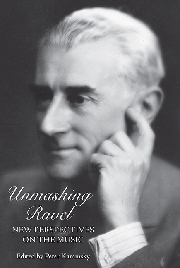
"Unmasking Ravel: New Perspectives on the Music" fills a unique place in Ravel studies by combining critical interpretation and analytical focus. From the premiere of his works up to the present, Ravel has been associated with masks and the related notions of artifice and imposture. This has led scholars to perceive a lack of depth in his music and, consequently, to discourage investigation of his musical language. This volume balances and interweaves these modes of inquiry. Part 1, "Orientations and Influences," illuminates the sometimes contradictory aesthetic, biographical, and literary strands comprising Ravel's artistry and our understanding of it. Part 2, "Analytical Case Studies," engages representative works from Ravel's major genres using a variety of methodologies, focusing on structural process and his complex relation to stylistic convention. Part 3, "Interdisciplinary Studies," integrates musical analysis and art criticism, semiotics, and psychoanalysis in creating novel methodologies. Contributors include prominent scholars of Ravel's and fin-de-siècle music: Elliott Antokoletz, Gurminder Bhogal, Sigrun B. Heinzelmann, Volker Helbing, Steven Huebner, Peter Kaminsky, Barbara Kelly, David Korevaar, Daphne Leong, Michael Puri, and Lauri Suurpää. Peter Kaminsky is Professor of Music at the University of Connecticut, Storrs.
Focusing on the operas of Wolfgang Amadeus Mozart, Christoph Willibald Gluck, and Jean-Phillipe Rameau, this book examines the essential role that eighteenth-century works played in the opera houses of Paris around the turn of the twentieth century. These works, most of which had been neglected during the nineteenth century, became the central exhibits in what William Gibbons calls the Operatic Museum-a simultaneously physical and conceptual space in which great masterworks from the past and present could, like works of visual art in the Louvre, entertain audiences while educating them in their own history and national identity. Drawing on the fields of musicology, museum studies, art history, and literature, 'Building the Operatic Museum' explores how this seemingly simple idea represented a fundamental shift in how French audiences, critics, and composers understood the nature and function of music history, as well as their own place in it. William Gibbons is assistant professor of musicology at Texas Christian iversity.
For over sixty years, the scholar and pianist John Kirkpatrick tirelessly promoted and championed the music of American composers. In this book, Drew Massey explores how Kirkpatrick's career as an editor of music shaped the music and legacies of American modernists including Aaron Copland, Ross Lee Finney, Roy Harris, Hunter Johnson, Charles Ives, Robert Palmer, and Carl Ruggles. By drawing on oral histories, interviews, and Kirkpatrick's own extensive archives, this book argues that Kirkpatrick's career invites a reconsideration of many of the most important debates in American modernism -- about young composers' self-fashioning during the 1940s; about the cherished myth of Ruggles as a composer in communion with the "timeless"; about Ives's status as a pioneer of modernist techniques. Drew Massey is an assistant professor of music at Binghamton University.
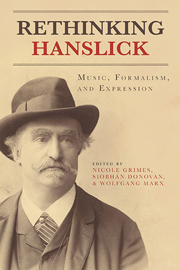
Rethinking Hanslick: Music, Formalism, and Expression' is the first extensive English-language study devoted to Eduard Hanslick--a seminal figure in nineteenth-century musical life. Bringing together eminent scholars from several disciplines, this volume examines Hanslick's contribution to the aesthetics and philosophy of music and looks anew at his literary interests. The essays embrace ways of thinking about Hanslick's writings that go beyond the polarities that have long marked discussion of his work such as form/expression, absolute/program music, objectivity/subjectivity, and formalist/hermeneutic criticism. This approach takes into consideration both Hanslick's important 'On the Musically Beautiful' and his critical and autobiographical writings, demonstrating Hanslick's rich insights into the context in which a musical work is composed, performed, and received. 'Rethinking Hanslick' serves as an invaluable companion to Hanslick's prodigious scholarship and criticism, deepening our understanding of the major themes and ideas of one of the most influential music critics of the nineteenth century. Dr Nicole Grimes is a Marie Curie Fellow at University College Dublin (UCD), and the University of California, Irvine. Dr Siobhán Donovan is a College Lecturer at the School of Languages and Literatures, UCD. Dr Wolfgang Marx is a Senior Lecturer at the School of Music, UCD.
This book is a philosophical tour through the experience of beauty: what it is, and how the composer, performer, and listener all contribute. It explores - with insight, patience, and humor - profound issues at the essence of our experience. A student performance of Beethoven's String Quartet No. 10 in E-Flat Major, known as the 'Harp,' serves as a point of departure and a recurring theme. For the layperson the core of the book is five dialogues between Icarus, an inquiring student intensely concerned with fulfilling his highest potential as a musician, and Daedalus, a curmudgeonly, iconoclastic teacher who guides Icarus's search. Three technical articles, geared to the music professional and academic, treat the issues in greater depth. Supplementary online audio files and musical examples. Markand Thakar is Charles A. & Carolyn M. Russell Music Director, Duluth Superior Symphony Orchestra; music director, Baltimore Chamber Orchestra; principal conductor, Duluth Festival Opera; and codirector of the graduate conducting program, Peabody Conservatory of the Johns Hopkins University.
Robert Schumann frequently expressed his deep admiration for the novels of Jean Paul Friedrich Richter, the late-eighteenth-century German novelist, essayist, and satirist. Schumann imitated Jean Paul's prose style in his own fiction and music criticism, and said once that he learned 'more counterpoint from Jean Paul than from my music teacher.' Drawing on the recent, groundbreaking work in musico-literary analysis of scholars such as Anthony Newcomb, John Daverio, and Lawrence Kramer, Erika Reiman embarks on a comparative study of Jean Paul's five major novels and Schumann's piano cycles of the 1830s, many of which are staples in the repertoire of concert pianists today. The present study begins with a thorough review of Jean Paul's literary style, emphasizing the digressions, intertextuality, self-reflexivity, and otherworldliness that distinguish it. The similarly digressive style that Schumann developed is then examined in his earliest works, including the enduring and highly original 'Carnaval' (1835), and in cycles of the later 1830s, notably 'Davidsbündlertänze' and 'Faschingsschwank aus Wien'. Finally, an analysis of three one-movement works from 1838-39 reveals links with Jean Paul's exploration of the idyll, an ancient genre that had experienced an eighteenth-century revival.Throughout, the author attempts to keep in mind the actual sound and performed experience of the works, and suggests ways in which an awareness of Jean Paul's style might change the performance and hearing of the cycles. Erika Reiman, received her Ph.D. in Musicology from the University of Toronto (1999) and has taught at Brock University, Wilfrid Laurier University, the University of Guelph, and the University of Toronto; she is also active as a pianist and chamber musician.