To save content items to your account,
please confirm that you agree to abide by our usage policies.
If this is the first time you use this feature, you will be asked to authorise Cambridge Core to connect with your account.
Find out more about saving content to .
To save content items to your Kindle, first ensure no-reply@cambridge.org
is added to your Approved Personal Document E-mail List under your Personal Document Settings
on the Manage Your Content and Devices page of your Amazon account. Then enter the ‘name’ part
of your Kindle email address below.
Find out more about saving to your Kindle.
Note you can select to save to either the @free.kindle.com or @kindle.com variations.
‘@free.kindle.com’ emails are free but can only be saved to your device when it is connected to wi-fi.
‘@kindle.com’ emails can be delivered even when you are not connected to wi-fi, but note that service fees apply.
This study presents the main motivation to investigate the COVID-19 pandemic, a major threat to the whole world from the day when it first emerged in China city of Wuhan. Predictions on the number of cases of COVID-19 are crucial in order to prevent and control the outbreak. In this research study, an artificial neural network with rectifying linear unit-based technique is implemented to predict the number of deaths, recovered and confirmed cases of COVID-19 in Pakistan by using previous data of 137 days of COVID-19 cases from the day 25 February 2020 when the first two cases were confirmed, until 10 July 2020. The collected data were divided into training and test data which were used to test the efficiency of the proposed technique. Furthermore, future predictions have been made by the proposed technique for the next 7 days while training the model on whole available data.
Coronavirus disease 2019 (COVID-19) has had a tremendous impact in China and abroad since its onset in December 2019 and poses a major threat to human health. Healthcare workers (HCWs) are at the forefront of the response to outbreaks. This study reviewed literature data and found that HCWs were at high risk of infection during the COVID-19 pandemic, especially at the early stage of the epidemic, and many factors greatly affected their occupational safety. Although SARS-CoV-2 transmission was controlled in China, the Chinese experience can help protect HCWs from COVID-19 and other respiratory diseases.
Due to the outbreak of the deadly coronavirus disease in 2019 (COVID-19), Wuhan was on lockdown for more than 60 days by the state government. This study investigated the perceptions and attitudes of the public on quarantine as a practical approach to halting the spread of COVID-19. An online survey was conducted via WeChat between 10 January 2020 and 10 March 2020 on the general population in Hubei province at the height of the COVID-19 outbreak. In total, 549 respondents participated in the survey. Results revealed that the public displayed significantly strong support towards quarantine throughout the outbreak period, apart from locking people up and using imprisonment legal sanctions against those who failed to comply with the stringent regulations. The support exerted by the public stemmed from the execution of authorised officers to protect the public interest and provision of psychosocial support for those affected. In situations where quarantine could not be imposed, public health policy-makers and government officials should implement an extensive system of psychosocial support to safeguard, instruct and inform frontline public health workers. The public should also be enlisted in an open conversation concerning the ethical utility of restrictive values during the COVID-19 outbreak.
In March 2020, China had periodically controlled the coronavirus disease-19 (COVID-19) epidemic. We reported the results of health screening for COVID-19 among returned staff of a hospital and conducted a summary analysis to provide valuable experience for curbing the COVID-19 epidemic and rebound. In total, 4729 returned staff from Zhongnan Hospital of Wuhan University, Wuhan, China were examined for COVID-19, and the basic information, radiology and laboratory test results were obtained and systematically analysed. Among the 4729 employees, medical staff (62.93%) and rear-service personnel (30.73%) were the majority. The results of the first physical examination showed that 4557 (96.36%) were normal, 172 (3.64%) had abnormal radiological or laboratory test results. After reexamination and evaluation, four were at high risk (asymptomatic infections) and were scheduled to transfer to a designated hospital, and three were at low risk (infectivity could not be determined) and were scheduled for home isolation observation. Close contacts were tracked and managed by the Center for Disease Control and Prevention (CDC) in China. Asymptomatic infections are a major risk factor for returning to work. Extensive health screening combined with multiple detection methods helps to identify asymptomatic infections early, which is an important guarantee in the process of returning to work.
Health-related fear is a normal and common response in the face of the global pandemic of COVID-19. Children and young people are frequently being exposed to messages about the threat to health, including from the media and authorities. Whilst for most, their anxiety will be proportionate to the threat, for some, existing pre-occupation with physical symptoms and illness will become more problematic. There is a growing body of evidence that health anxiety may occur in childhood, however much of the literature is taken from research using adult samples. This practitioner review aims to give an overview of the assessment and treatment of health-related worries in children and young people in the context of the COVID-19 pandemic. This review is based on the limited existing evidence in this population and the more substantial evidence base for treating health anxiety in adults. We consider the adaptations needed to ensure such interventions are developmentally appropriate.
This paper offers a perspective on nursing and lived experience responses to the COVID-19 pandemic. It charts health systems and mental health impacts with a particular focus on children and adolescents, older people and people availing of mental health services. Issues of moral distress and the nursing reaction are considered alongside psychological and social concerns which continue to rapidly evolve. The perspective of a person attending adult community mental health services and the experience of engaging with a mental health service remotely is provided. Matters of note for acute inpatient mental health nursing are highlighted and informed by the lived experience of a mental health nurse. The need for integrated health systems responses across nursing disciplines and the wider interdisciplinary team is elucidated.
The Philippines confirmed local transmission of COVID-19 on 7 March 2020. We described the characteristics and epidemiological time-to-event distributions for laboratory-confirmed cases in the Philippines recorded up to 29 April 2020 and followed until 22 May 2020. The median age of 8212 cases was 46 years (IQR 32–61), with 46.2% being female and 68.8% living in the National Capital Region. Health care workers represented 24.7% of all detected infections. Mean length of hospitalisation for those who were discharged or died were 16.00 days (95% CI 15.48–16.54) and 7.27 days (95% CI 6.59–8.24). Mean duration of illness was 26.66 days (95% CI 26.06–27.28) and 12.61 days (95% CI 11.88–13.37) for those who recovered or died. Mean serial interval was 6.90 days (95% CI 5.81–8.41). Epidemic doubling time prior to the enhanced community quarantine (ECQ; 11 February and 19 March) was 4.86 days (95% CI 4.67–5.07) and the reproductive number was 2.41 (95% CI 2.33–2.48). During the ECQ (20 March to 9 April), doubling time was 12.97 days (95% CI 12.57–13.39) and the reproductive number was 0.89 (95% CI 0.78–1.02).
To determine risk factors for mortality among COVID-19 patients admitted to a system of community hospitals in the United States.
Design:
Retrospective analysis of patient data collected from the routine care of COVID-19 patients.
Setting:
System of >180 acute-care facilities in the United States.
Participants:
All admitted patients with positive identification of COVID-19 and a documented discharge as of May 12, 2020.
Methods:
Determination of demographic characteristics, vital signs at admission, patient comorbidities and recorded discharge disposition in this population to construct a logistic regression estimating the odds of mortality, particular for those patients characterized as not being critically ill at admission.
Results:
In total, 6,180 COVID-19+ patients were identified as of May 12, 2020. Most COVID-19+ patients (4,808, 77.8%) were admitted directly to a medical-surgical unit with no documented critical care or mechanical ventilation within 8 hours of admission. After adjusting for demographic characteristics, comorbidities, and vital signs at admission in this subgroup, the largest driver of the odds of mortality was patient age (OR, 1.07; 95% CI, 1.06–1.08; P < .001). Decreased oxygen saturation at admission was associated with increased odds of mortality (OR, 1.09; 95% CI, 1.06–1.12; P < .001) as was diabetes (OR, 1.57; 95% CI, 1.21–2.03; P < .001).
Conclusions:
The identification of factors observable at admission that are associated with mortality in COVID-19 patients who are initially admitted to non-critical care units may help care providers, hospital epidemiologists, and hospital safety experts better plan for the care of these patients.
The pressures exerted by the coronavirus disease 2019 (COVID-19) pandemic pose an unprecedented demand on healthcare services. Hospitals become rapidly overwhelmed when patients requiring life-saving support outpace available capacities.
Objective:
We describe methods used by a university hospital to forecast case loads and time to peak incidence.
Methods:
We developed a set of models to forecast incidence among the hospital catchment population and to describe the COVID-19 patient hospital-care pathway. The first forecast utilized data from antecedent allopatric epidemics and parameterized the care-pathway model according to expert opinion (ie, the static model). Once sufficient local data were available, trends for the time-dependent effective reproduction number were fitted, and the care pathway was reparameterized using hazards for real patient admission, referrals, and discharge (ie, the dynamic model).
Results:
The static model, deployed before the epidemic, exaggerated the bed occupancy for general wards (116 forecasted vs 66 observed), ICUs (47 forecasted vs 34 observed), and predicted the peak too late: general ward forecast April 9 and observed April 8 and ICU forecast April 19 and observed April 8. After April 5, the dynamic model could be run daily, and its precision improved with increasing availability of empirical local data.
Conclusions:
The models provided data-based guidance for the preparation and allocation of critical resources of a university hospital well in advance of the epidemic surge, despite overestimating the service demand. Overestimates should resolve when the population contact pattern before and during restrictions can be taken into account, but for now they may provide an acceptable safety margin for preparing during times of uncertainty.
The current coronavirus (severe acute respiratory syndrome coronavirus 2 [SARS-CoV-2]) pandemic has resulted in severe shortages of personal protective equipment, including respiratory protective equipment, such as N95 respirators. This has led some government agencies to suggest the use of cloth face coverings (CFCs) by health-care providers and the general public as a last resort when standard respiratory protective equipment is unavailable. Although such coverings have been in use for over a century and have found widespread use during some previous pandemics, research data are relatively scant for the protective value of this measure. This article, a literature review, explores the development of CFCs and reviews available scientific research regarding the efficacy of this intervention as a preventive measure in the spread of airborne infectious diseases
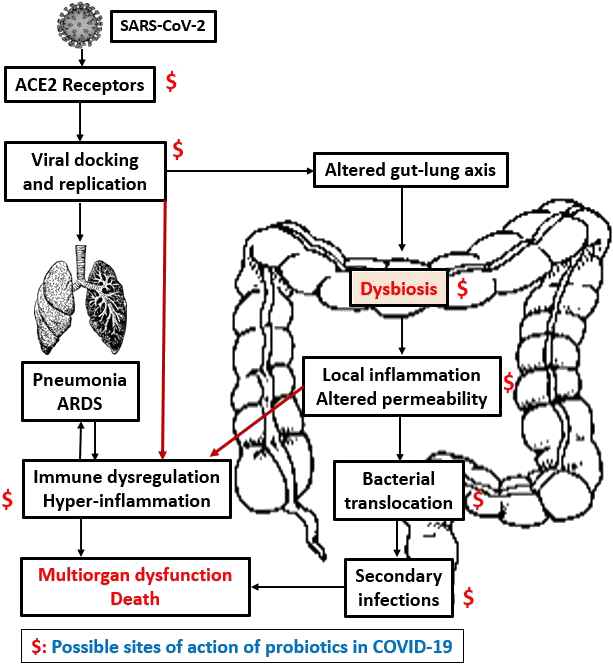
The pandemic of Coronavirus disease 2019 (COVID-19) is rapidly progressing, causing significant morbidity and mortality. Various antiviral drugs, anti-inflammatory drugs and immunomodulators have been tried without substantial clinical benefits. The severe and critical cases of COVID-19 disease are characterised by gut microbiome dysbiosis, immune dysregulation, hyper-inflammation and hypercytokinaemia (cytokine storm). Therefore, the strategies which target these pathophysiological processes may be beneficial. Probiotics are one such strategy that exerts beneficial effects by manipulation of the gut microbiota, suppression of opportunistic pathogens in the gut, decreasing translocation of opportunistic organisms, activation of mucosal immunity and modulation of the innate and adaptive immune response. Probiotics are the potential candidates to be tested in moderate and severe cases of COVID-19 due to several beneficial effects, including easy availability, easy to administer, safe and economical to use.
Although the African continent is, for the moment, less impacted than the rest of the world, it still faces the risk of a spread of COVID-19. In this study, we have conducted a systematic review of the information available in the literature in order to provide an overview of the epidemiological and clinical features of COVID-19 pandemic in West Africa and of the impact of risk factors such as comorbidities, climatic conditions and demography on the pandemic. Burkina Faso is used as a case study to better describe the situation in West Africa. The epidemiological situation of COVID-19 in West Africa is marked by a continuous increase in the numbers of confirmed cases. This geographic area had on 29 July 2020, 131 049 confirmed cases by polymerase chain reaction, 88 305 recoveries and 2102 deaths. Several factors may influence the SARS-CoV-2 circulation in Africa: (i) comorbidities: diabetes mellitus and high blood pressure could lead to an increase in the number of severe cases of SARS-CoV-2; (ii) climatic factors: the high temperatures could be a factor contributing to slow the spread of the virus and (iii) demography: the West Africa population is very young and this could be a factor limiting the occurrence of severe forms of SARS-CoV-2 infection. Although the spread of the SARS-CoV-2 epidemic in West Africa is relatively slow compared to European countries, vigilance must remain. Difficulties in access to diagnostic tests, lack of hospital equipment, but also the large number of people working in the informal sector (such as trading, businesses, transport and restoration) makes it difficult to apply preventive measures, namely physical distancing and containment.
The Covid-19 crisis that led to the loss of thousands of lives and initiated one of the most complex social and economic upheavals has also a created a window of reflection for health systems researchers to revisit our major concepts, frameworks, and underlying assumptions. This commentary reviews two literatures that remain rather separate: comparative health policy and global health. First, I examine whether convergence in circumstances brought about by the spread of Covid-19 creates opportunities for learning “about” as well as unpacking the motivations of policy actors and how they use the cross-national information. However, given the emphasis on national policy actors and processes, this literature may overlook the importance of global actors, institutions and ideas. Second, global health differentiates itself with an emphasis on multilateralism as a political positioning and its multidisciplinary and multi-sectoral approach. However, the global health field is also challenged to consider its mission, political standing on multilateralism, changing relationships between North and South and its commitment to multidisciplinary approach. I argue that health systems scholars should use the window of opportunity created by Covid-19 pandemic to reexamine their methodologies and rearticulate their positioning by acknowledging the voice and agency of the Global South.