Refine listing
Actions for selected content:
2727 results in Coronavirus Free Access Collection
Prevalence of SARS-CoV-2 antibodies among Swiss hospital workers: Results of a prospective cohort study
- Part of
-
- Journal:
- Infection Control & Hospital Epidemiology / Volume 42 / Issue 5 / May 2021
- Published online by Cambridge University Press:
- 08 October 2020, pp. 604-608
- Print publication:
- May 2021
-
- Article
-
- You have access
- Open access
- HTML
- Export citation
Implementation of COVID-19 Provider Resource Task Force: A provider support initiative during emergency preparedness in a quaternary-care center in western Michigan
- Part of
-
- Journal:
- Infection Control & Hospital Epidemiology / Volume 42 / Issue 10 / October 2021
- Published online by Cambridge University Press:
- 08 October 2020, pp. 1292-1294
- Print publication:
- October 2021
-
- Article
-
- You have access
- Open access
- HTML
- Export citation
COVID-19 induced social isolation; implications for understanding social cognition in mental health
-
- Journal:
- Psychological Medicine / Volume 52 / Issue 15 / November 2022
- Published online by Cambridge University Press:
- 08 October 2020, pp. 3748-3749
-
- Article
-
- You have access
- Open access
- HTML
- Export citation
Assessing severe acute respiratory coronavirus virus 2 (SARS-CoV-2) preparedness in US community hospitals: A forgotten entity
- Part of
-
- Journal:
- Infection Control & Hospital Epidemiology / Volume 42 / Issue 5 / May 2021
- Published online by Cambridge University Press:
- 07 October 2020, pp. 600-603
- Print publication:
- May 2021
-
- Article
-
- You have access
- Open access
- HTML
- Export citation
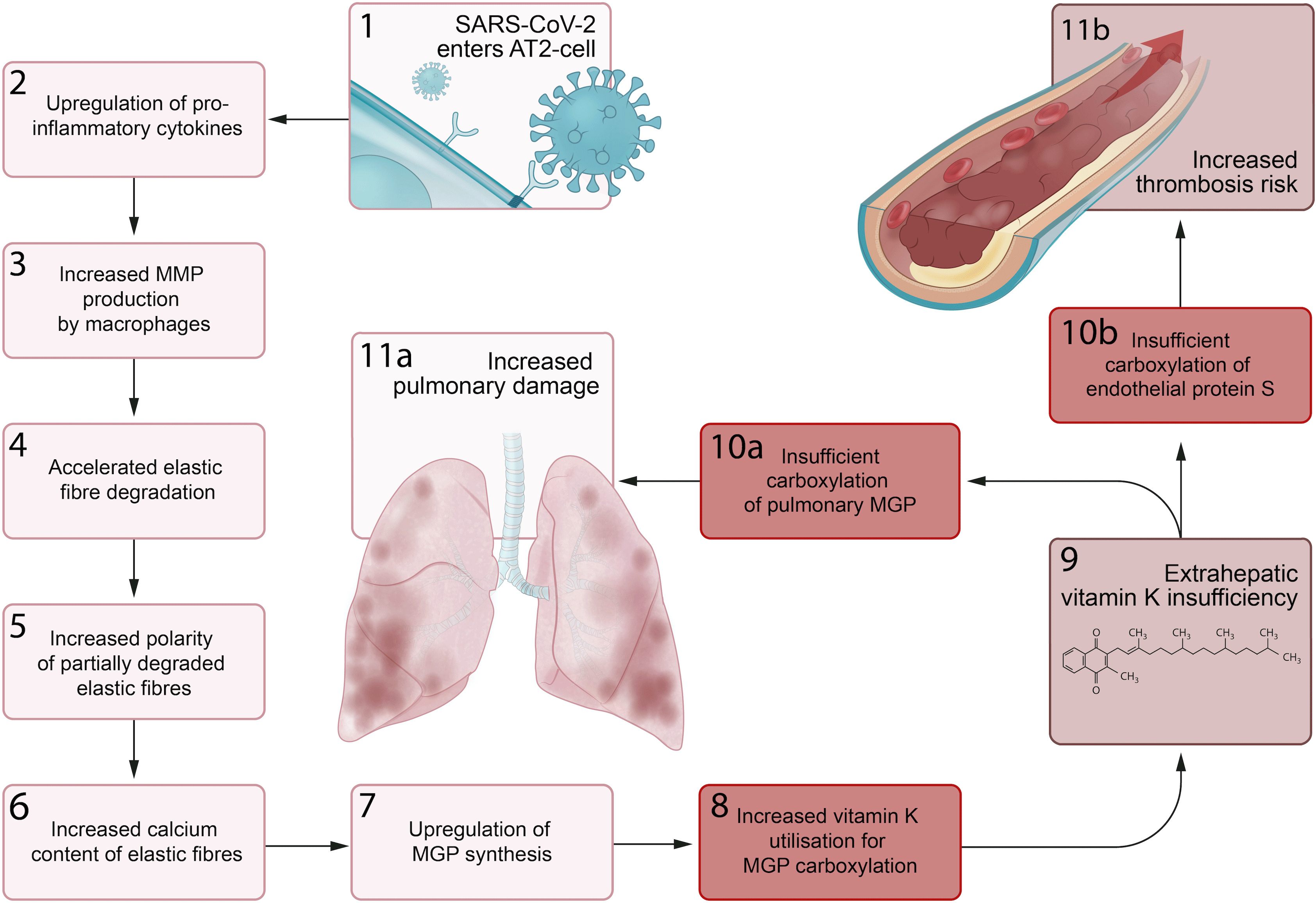
Vitamin K metabolism as the potential missing link between lung damage and thromboembolism in Coronavirus disease 2019
-
- Journal:
- British Journal of Nutrition / Volume 126 / Issue 2 / 28 July 2021
- Published online by Cambridge University Press:
- 07 October 2020, pp. 191-198
- Print publication:
- 28 July 2021
-
- Article
-
- You have access
- Open access
- HTML
- Export citation
Patients’ anxiety, fear, and panic related to coronavirus disease 2019 (COVID-19) and confidence in hospital infection control policy in outpatient departments: A survey from four Thai hospitals
- Part of
-
- Journal:
- Infection Control & Hospital Epidemiology / Volume 42 / Issue 10 / October 2021
- Published online by Cambridge University Press:
- 07 October 2020, pp. 1288-1290
- Print publication:
- October 2021
-
- Article
-
- You have access
- Open access
- HTML
- Export citation
Prolonged incubation of severe acute respiratory syndrome coronavirus 2 (SARS-CoV-2) in a patient on rituximab therapy
- Part of
-
- Journal:
- Infection Control & Hospital Epidemiology / Volume 42 / Issue 10 / October 2021
- Published online by Cambridge University Press:
- 07 October 2020, pp. 1286-1288
- Print publication:
- October 2021
-
- Article
-
- You have access
- Open access
- HTML
- Export citation
SARS-CoV-2 transmission: a sociological review
-
- Journal:
- Epidemiology & Infection / Volume 148 / 2020
- Published online by Cambridge University Press:
- 07 October 2020, e242
-
- Article
-
- You have access
- Open access
- HTML
- Export citation
Finding the “right” Canadian Neurology Residency Program During the COVID-19 Era
-
- Journal:
- Canadian Journal of Neurological Sciences / Volume 48 / Issue 1 / January 2021
- Published online by Cambridge University Press:
- 06 October 2020, pp. 47-49
-
- Article
-
- You have access
- Open access
- HTML
- Export citation
Response to Canadian Neurophysiology Laboratory COVID-19 Practice Guidelines
-
- Journal:
- Canadian Journal of Neurological Sciences / Volume 48 / Issue 1 / January 2021
- Published online by Cambridge University Press:
- 06 October 2020, pp. 133-134
-
- Article
-
- You have access
- Open access
- HTML
- Export citation
From COVID-19 to COVID-20: One Virus, Two Diseases
-
- Journal:
- Disaster Medicine and Public Health Preparedness / Volume 14 / Issue 6 / December 2020
- Published online by Cambridge University Press:
- 06 October 2020, pp. e18-e20
-
- Article
-
- You have access
- Open access
- HTML
- Export citation
Learning to Bury the Dead during COVID-19 – Barbarism or Indigeneity?
-
- Journal:
- Prehospital and Disaster Medicine / Volume 35 / Issue 6 / December 2020
- Published online by Cambridge University Press:
- 05 October 2020, pp. 702-703
-
- Article
-
- You have access
- Open access
- HTML
- Export citation
Forecasting the epidemiological trends of COVID-19 prevalence and mortality using the advanced α-Sutte Indicator
-
- Journal:
- Epidemiology & Infection / Volume 148 / 2020
- Published online by Cambridge University Press:
- 05 October 2020, e236
-
- Article
-
- You have access
- Open access
- HTML
- Export citation
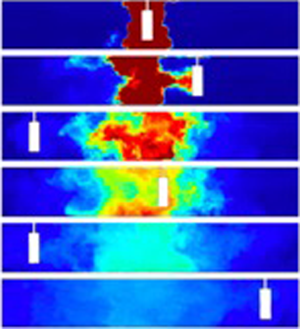
The mixing of airborne contaminants by the repeated passage of people along a corridor
-
- Journal:
- Journal of Fluid Mechanics / Volume 903 / 25 November 2020
- Published online by Cambridge University Press:
- 02 October 2020, A52
-
- Article
-
- You have access
- Open access
- HTML
- Export citation
-
We report a series of experiments in which a cylinder, with a vertical axis, is moved back and forth along a long narrow channel containing fresh water at Reynolds numbers
 $Re=3220\text {--}13\,102$. We examine the mixing of a cloud of dye along the channel by the oscillatory motion of the cylinder. Using light attenuation techniques to measure the time evolution of the concentration of dye along the channel, we find that at early times the concentration profile collapses to a Gaussian profile with dispersivity,
 $D=(2.4\pm 0.5) fdW$, where
 $f$ is the frequency of the cylinder oscillation,
 $d$ is the diameter of the cylinder and
 $W$ is the width of the channel, respectively. For times much longer than
 $L^2/D$, with
 $L$ being the length of the channel, the concentration becomes progressively more uniform over the whole length of the channel, and we show that the long-time non-uniform component decays with time dependence
 $\exp (- 4{\rm \pi} ^2 Dt / L^2)$. We consider the implications of these experiments for the dispersal of viral aerosols along poorly ventilated corridors, with implications for infection transmission in hospitals and public buildings.


COVID-19 and Global Health Security: Overview of the Global Health Security Alliance, COVID-19 Response, African Countries’ Approaches, and Ethics
-
- Journal:
- Disaster Medicine and Public Health Preparedness / Volume 16 / Issue 2 / April 2022
- Published online by Cambridge University Press:
- 02 October 2020, pp. 426-430
-
- Article
-
- You have access
- Open access
- HTML
- Export citation
Optimizing Pandemic Preparedness and Response Through Health Information Systems: Lessons Learned From Ebola to COVID-19
-
- Journal:
- Disaster Medicine and Public Health Preparedness / Volume 16 / Issue 1 / February 2022
- Published online by Cambridge University Press:
- 02 October 2020, pp. 333-340
-
- Article
-
- You have access
- Open access
- HTML
- Export citation
Arbaeen in the Context of the COVID-19 Pandemic
-
- Journal:
- Disaster Medicine and Public Health Preparedness / Volume 15 / Issue 4 / August 2021
- Published online by Cambridge University Press:
- 02 October 2020, p. e16
-
- Article
-
- You have access
- Open access
- HTML
- Export citation
The Cost of Coronavirus Obligations: Respecting the Letter and Spirit of Lockdown Regulations
-
- Journal:
- Cambridge Quarterly of Healthcare Ethics / Volume 30 / Issue 2 / April 2021
- Published online by Cambridge University Press:
- 02 October 2020, pp. 255-261
-
- Article
-
- You have access
- Open access
- HTML
- Export citation
A repeated cross-sectional survey assessing university students' stress, depression, anxiety, and suicidality in the early stages of the COVID-19 pandemic in Poland
-
- Journal:
- Psychological Medicine / Volume 52 / Issue 15 / November 2022
- Published online by Cambridge University Press:
- 02 October 2020, pp. 3744-3747
-
- Article
-
- You have access
- Open access
- HTML
- Export citation
Coronavirus disease 2019 and sudden sensorineural hearing loss
- Part of
-
- Journal:
- The Journal of Laryngology & Otology / Volume 134 / Issue 11 / November 2020
- Published online by Cambridge University Press:
- 01 October 2020, pp. 1026-1028
- Print publication:
- November 2020
-
- Article
-
- You have access
- Open access
- HTML
- Export citation
